AI video unicorn Higgsfield: Earned $200 million in 9 months by "serving" social media marketers
In 2025, AI is "producing" videos at an unprecedented speed.
At the end of last year, an AI spoof video titled "Epstein Island Vacation" went viral on the X platform. It placed celebrities like Michael Jackson and P. Diddy on a tropical island, with realistic visuals, and it received over a million retweets within 24 hours.
Few people noticed that the "tool" behind this storm came from an AI video startup called Higgsfield, which was only founded two years ago. At this moment, it is standing out in the fierce industry competition with a "creator-first" business strategy.
Higgsfield recently announced an additional issuance of $80 million, bringing the total Series A financing to $130 million, and its valuation soared to $1.3 billion, making it a new unicorn. It has witnessed rapid growth: within nine months of its launch, it had over 15 million users, generating 4.5 million videos per day, and its annual revenue doubled within two months, reaching $200 million.
Higgsfield's success largely stems from its precise targeting of users. According to Reuters, 85% of its users are social media marketers, mainly using it to create brand content, short - video ads, and marketing materials.
Its core path is clear: it precisely targets creators and brands with commercial monetization needs - a clear B - side payment demand; it meets their needs with full - stack tools that closely fit professional workflows and have advertising - level control, and then ensures continuous leading results through cross - model scheduling. This complete closed - loop of "creation entry + workflow + distribution incentives" builds long - term revenue potential.
Today, let's take a look at this new unicorn in the AI video field.
01 Build the Most User - Friendly "Cinematic" AI Video Production Line
In 2025, AI - generated videos are on the verge of a real explosion.
The film, advertising, and short - video industries have almost rigid demands for visual storytelling: content needs to be continuously produced, aesthetics need to be constantly upgraded, and budgets are generally sufficient in the long term. Investors realize that if videos are systematically reconstructed by AI like images, the value of entry - level products will be extremely high.
Higgsfield is at this inflection point.
Different from the common "video generation models" in the outside world, Higgsfield's core narrative has shifted from "can it generate videos" to "how to serve real AI video creators".
Simply put, it is more like a full - stack AI video workflow tool for creators and marketing teams.
In Higgsfield's official description, the frequently repeated keywords are: brand creativity, marketing workflow, and content collaboration. That is to say, they hope to bring brands and creators into the same workspace to collaborate around modular AI video tools.
The center of the entire platform is a workbench called Canvas, which is also the core space where users actually complete creation and collaboration.
Here, creators can design storyboards and camera movements, uniformly manage the visual structure and style, and integrate multiple creation steps into the same workflow.
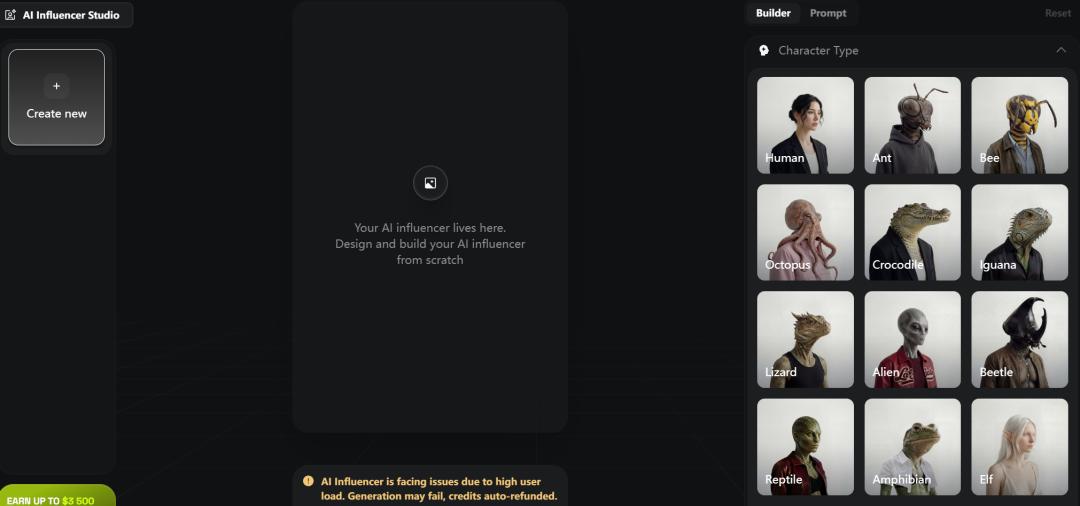
On top of this, Higgsfield has a built - in "multi - agent collaboration system", which is more like a virtual film crew:
The screenwriter agent is responsible for the narrative structure, the director agent controls the emotional rhythm, and the photographer agent decides on camera movements and shot selection.
In terms of actual use, Higgsfield does not require users to have complex prompt - word skills, and it provides multiple natural entry methods for users with different needs.
For those with creative ideas, they can use the "draw - to - video" function.
They only need to sketch the main outline on the canvas with simple drawings, mark the direction and speed with motion arrows, and indicate the camera intention with circular arrows to convert the sketch into a dynamic short video. After generation, they can also fine - tune the motion effect by adjusting the curvature of the arrows and the thickness of the lines to achieve an effect closer to professional tracking or circular shots.
For professionals who pursue efficiency, whether it is converting text, images, or sketches into videos, they all follow the same controllable workflow: ① Define the style and basic movements; ② AI automatically matches camera movements.
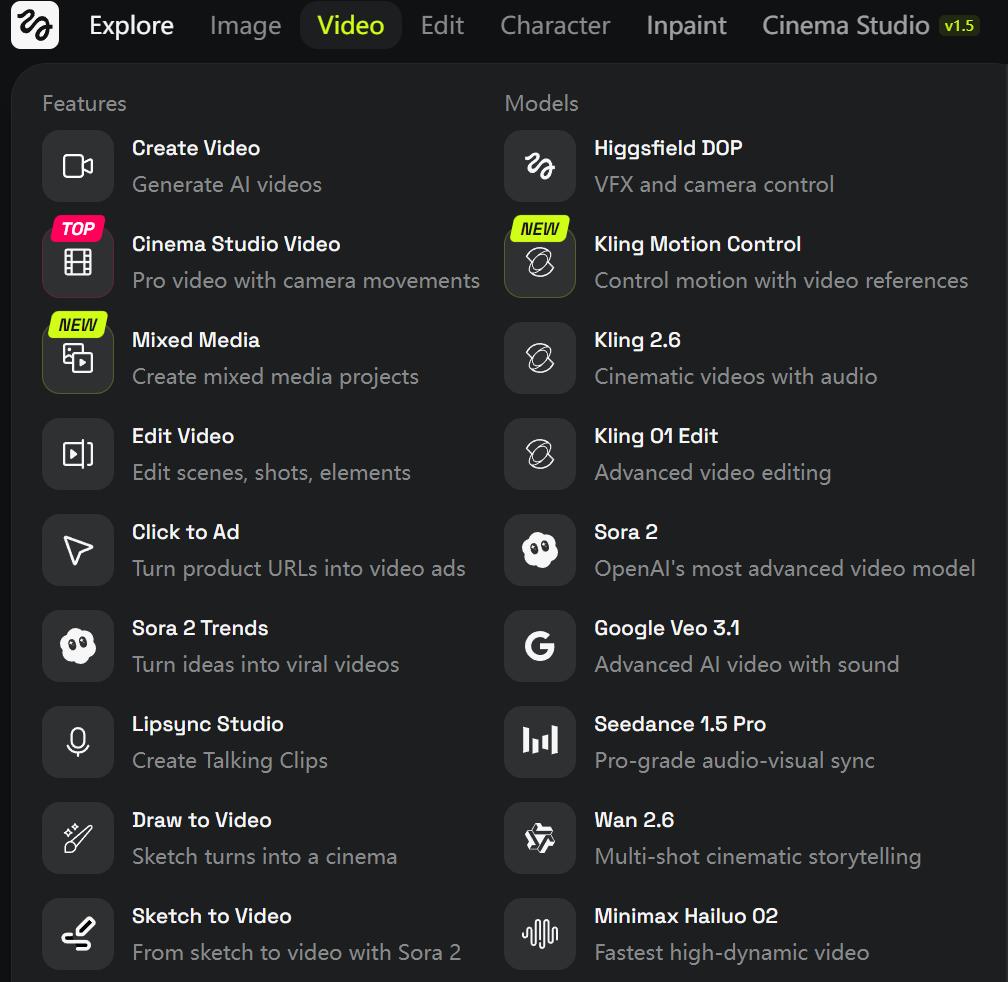
The platform provides a library of over 50 preset professional camera movement modes, from dolly pushes, FPV spirals to 360 - degree orbits and bullet time. Users can call them with a single click by description, achieving accurate and modular calls of "camera and lens combinations".
For creators who need fine - tuning: on the Canvas workbench, they can also use Effects Mix for color correction and post - production, or use other tools for in - depth editing.
Its tool design closely follows the creative rules of the film and advertising industries:
Professional camera movement library: It offers over 50 preset camera movement modes, such as real dolly pushes, orbital orbits, FPV flight perspectives, and bullet time. Users can call them by description.
Cinematic texture control: The unique "HCS module" has the color science of 6 top - tier movie cameras like ARRI and Red and 11 classic lenses built - in. With a single click, users can obtain cinematic colors and dynamics.
Fine - editing ability: It provides "SOUL Inpaint" for pixel - level image editing, supporting object replacement, background change, dynamic tracking optimization, etc., meeting advertising - level control requirements.
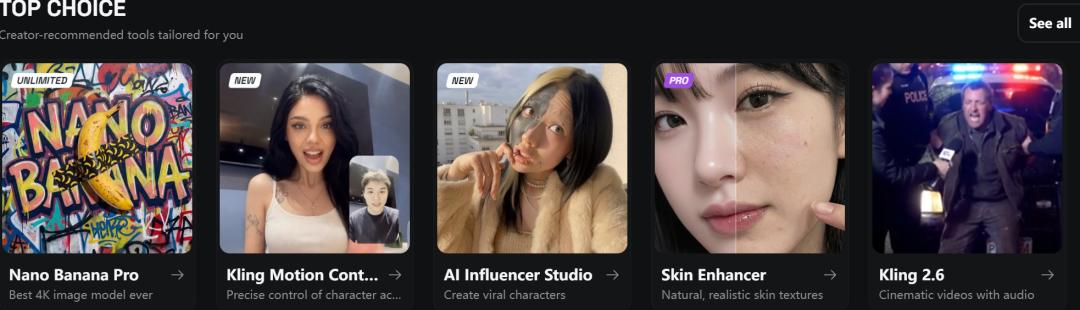
Value - added ecosystem and multi - platform coverage: It provides over 2000 small tools around the "Nano Banana" ecosystem, covering 4K image generation, video repair, style transfer, etc. In addition to the desktop version, Higgsfield also meets the "zero - threshold creation" needs through the mobile app Diffuse (such as uploading selfies to generate dynamic videos), and showcases its strength in virtual human technology by launching the AI virtual idol KION.
These functions together form a complete chain from creativity to the finished product, making it a "virtual production team" for professional creation rather than a toy for amateurs.
At the technical level, different from developing basic models, Higgsfield's model is to combine multiple existing AI models into "practical tools + workflows" to meet specific industry needs.
The platform has its self - developed "Soul" image model to ensure the authenticity and style consistency of the images. However, its core ability lies in aggregating and taming external mainstream models such as Sora 2, Keling, and Minimax. It can call different models in parallel during a single generation, providing users with multiple shot options in different styles.
This strategy cleverly avoids the pitfall of the technology competition in the AI video field, where "your model is good, but someone else's will be better next month". Higgsfield encapsulates the technical complexity in the background and provides stable, user - friendly, and scalable creative tools on the front - end.
In terms of user profiles, Higgsfield's real users are advertising creators, brand content teams, designers, editors, and social media creators. The core needs of these users are to improve efficiency and produce content that can be directly used commercially and bring conversions.
The platform's strategy is closely centered around this.
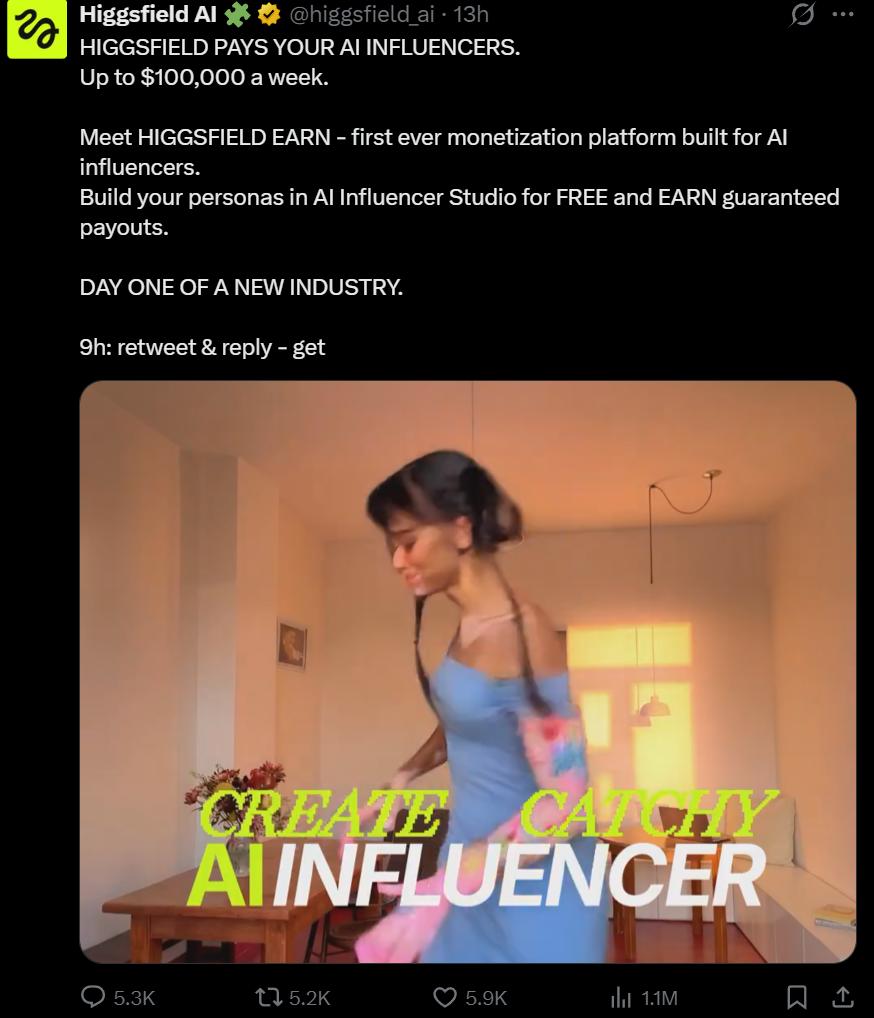
You'll find that Higgsfield attaches great importance to showcasing works on platforms like X, and it builds an ecosystem by setting up "creator bonuses" and officially reposting high - quality cases. It directly incentivizes creators to produce content with a "weekly bonus of up to $100,000", attracting users to participate through a high - value bonus pool.
An e - commerce professional commented: "I used Higgsfield AI to create 50 product videos in 2 hours without hiring a traditional cameraman." These videos were directly used to enhance the attractiveness and conversion rate of product pages. This precisely hits the pain points of commercial customers: cost reduction, efficiency improvement, and conversion increase.
Its commercial success also validates the feasibility of this approach. Five months after its launch, Higgsfield's annualized revenue reached $50 million. After nine months, its ARR exceeded $200 million, and it only took two months to grow from $100 million to $200 million.
02 The Highest Valuation Approaches $10 Billion, and 11 Companies Received Large - Scale Financing in One Year
Looking back at the end of 2025, this year was not only a year of technological breakthroughs for video - generation large models but also a year of intense market competition. The financing enthusiasm in the AI video track continued to rise, with many core enterprises disclosing large - scale financings. Capital paid far more attention to technology implementation capabilities and scenario adaptability than just concepts.
Higgsfield AI stood out with its creator incentive and social media operation strategies, while other enterprises also seized the market with their technological features or commercialization capabilities.
Aishi Technology secured two rounds of financing with its global product layout. It received $60 million in its Series B financing led by Alibaba and another 100 million RMB in its Series B+ financing, with a total financing of over $70 million. Its products focus on usability, covering scenarios such as short - video creation and commercial ad generation. It has over 100 million global users, with a MAU of 16 million and an ARR of $40 million.
Shengshu Technology, a benchmark for video and 3D multi - modal model technology in China, has a core team from the Institute of Artificial Intelligence at Tsinghua University. It completed a Series B financing of hundreds of millions of RMB in 2025.
Its core product, the Vidu video large model, uses the original U - ViT architecture, supporting the generation of 16 - second 1080P high - definition videos. It topped both the VBench - 1.0 and VBench - 2.0 rankings, surpassing Sora and Runway. Its video generation cost is only one - tenth of its peers. It achieved an ARR of $20 million within eight months, with over 400 million videos generated in total, and over 50% of them are commercial materials.
The lightweight tool Pollo AI set a new record for early - stage financing of domestic AI video tools, receiving $14 million in its seed - round financing in December 2025.
Its product integrates the entire process of script generation, video production, and post - editing, focusing on automated creation. Its MAU reached 6 million within only seven months of its launch, and it has achieved break - even.
The pure video large model SandAI completed a financing of no less than 100 million RMB.
The company focuses on the research and development of general video large models and performs outstandingly in indicators such as cross - frame consistency of subjects and complex scenario generation. It provides customized model training and generation capabilities for many film companies and content platforms.
The domestic multi - modal creation platform LiblibAI completed a $130 million Series B financing in October 2025, led jointly by Sequoia China and CMC Capital. The platform integrates image, video, and 3D generation capabilities, building a "tool + community" ecosystem and incubating 20 million AI creators.
The professional - level AI video company Video Rebirth completed a $50 million financing in November 2025. Its core team is led by a former outstanding scientist from Tencent, and it innovatively proposed the physical attention mechanism, solving the pain points of physical realism and controllability in video generation.
Globally, the concentration of leading companies in the overseas track has further increased.
Runway initiated a new round of financing in the later part of the fourth quarter of 2025, planning to raise $500 million - $1 billion, with a target valuation of $10 billion. As of January 2026, the process is still ongoing.
Previously, the company completed a $308 million Series D financing in April 2025, with follow - on investments from NVIDIA, SoftBank, etc. At that time, its valuation was about $3.55 billion.
Its technology has been highly recognized by Hollywood. The Gen - 3 Alpha model has been used by Netflix and Paramount for trailer production. The Gen - 4.5 model launched in December 2025 achieved further breakthroughs in physical realism and topped the independent Video Arena list.
Luma AI exceeded expectations in its financing process and officially announced the completion of a $900 million Series C financing in November 2025, with its valuation rising to $4 billion. This round was followed by investments from the AMD fund and a16z.
Its core Ray 2.0 model, with its excellent 3D content generation ability, doubled its user base within 30 days of its launch and became the core tool to replace traditional storyboards on Hollywood film sets, significantly shortening the pre - production cycle.
Pika Labs completed an $80 million Series A+ financing at the end of 2025, with continued investment from well - known capital a16z. Its core competitiveness lies in fine - editing, with a local redrawing function of "changing a video with one sentence", which can precisely modify local parts of the image without destroying the overall style. With this differentiated advantage, it was included in Adobe's list of candidate creative suites and is expected to enter the mainstream creative tool ecosystem.
Stability AI completed its first - round financing of $45 million in October 2025, with Disney participating in strategic investment and setting clear implementation requirements, demanding the establishment of a short - video generation pipeline for theme parks within one year to achieve commercial implementation of the technology in the cultural and tourism scenarios.
The Israeli company Lightricks completed a $60 million strategic financing in July 2025, with the funds specifically used to expand its AI film studio LTXV and research and develop generative video models. Its core breakthrough lies in diverting the advertising budgets of TikTok advertisers, replacing traditional on - site shooting with AI - generated videos.
Through the case of Higgsfield, we can foresee that single text - to - video models will gradually be integrated into a unified multi - modal "unified" model. The competition in the AI video field will also shift from single - point tools to building a platform - based ecosystem integrating generation, distribution, and monetization. In the future, specialized fine - tuned models for specific scenarios such as e - commerce, education, and healthcare will be more competitive.
This article is from the WeChat official account "Silicon - based Observation Pro", author: Silicon - based Jun. It is published by 36Kr with permission.