RF chips kick off a new competition for market positions
As the local 5G-A network races towards a 10-gigabit experience, the low-orbit satellite constellations in space are quietly reshaping the global communication landscape.
At the end of 2025, an application for frequency and orbit resources covering 203,000 low-orbit satellites was submitted to the International Telecommunication Union, instantly igniting the enthusiasm of the industry. It also brought the core cornerstone behind the satellite internet - RF chips - to the forefront of the industrial competition.
Meanwhile, in 2026, the aerospace and capital markets witnessed a historic moment: Elon Musk's SpaceX officially launched the preparation process for its initial public offering (IPO), with a target valuation of up to $1.5 trillion and a proposed fundraising scale of over $30 billion. For investors, this layout is not about paying for the current SpaceX, but rather betting on the long-term value of its space technology ecosystem built by Starlink, Starship, and space-based computing power.
The previous year, STMicroelectronics, a European chip manufacturing giant, had delivered more than 5 billion RF antenna chips to SpaceX for its "Starlink" satellite network. An executive of STMicroelectronics revealed that in the next two years (by 2027), the number of chips delivered through this cooperation may double. The accelerated implementation of the space technology ecosystem is deeply integrating with the RF chip industry.
In this strategic competition for space-air-ground integrated communication, RF chips are not only the key to technological breakthroughs but also the arena where domestic forces compete with global giants.
01 RF Chips: The "Throat" of Communication Systems
The RF communication system is composed of core components such as antennas, RF transceiver chips, baseband chips, and RF front-ends working in concert. Among them, the antenna is responsible for transmitting and receiving wireless electromagnetic waves, the RF transceiver chip undertakes the tasks of frequency conversion, channel selection, and signal amplification, and the baseband chip focuses on the synthesis and decoding of baseband signals.
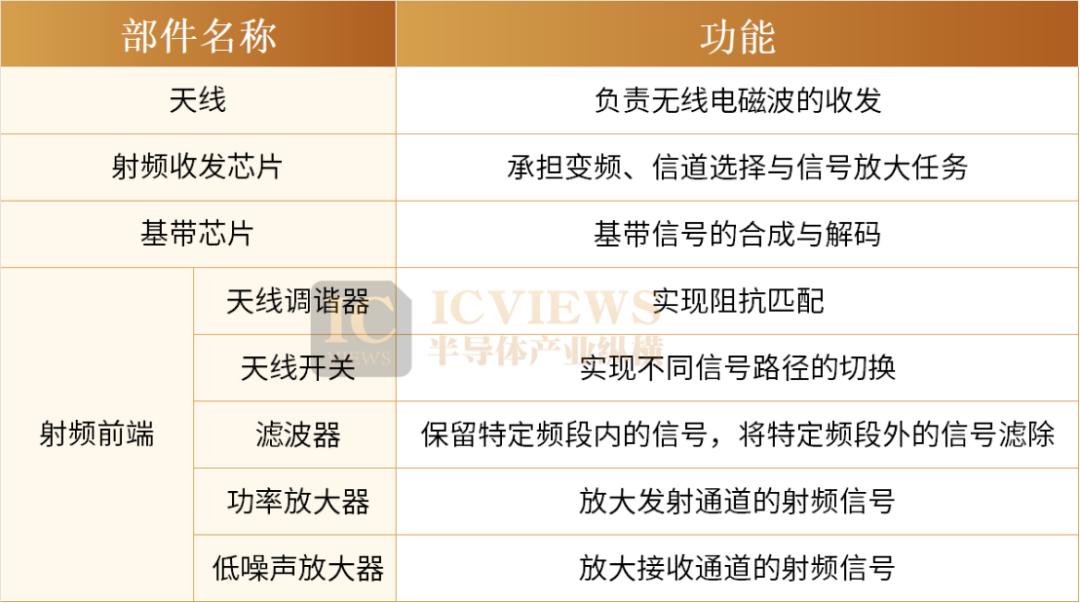
The RF front-end, as a key part, contains multiple sub-modules. It is usually composed of devices such as power amplifiers (PA), low-noise amplifiers (LNA), filters/duplexers, RF switches, and antenna tuners.
Antenna Tuner, abbreviated as ATU, is used between the transmitter and the antenna. During tuning, the microprocessor controls the analog-to-digital converter to quantify the sampling parameters provided by the detection circuit into digital signals, then reads them into the memory, and controls the state change of the matching network after processing to achieve impedance matching.
RF Switch is used to connect any one or several of the multiple RF signals through the control logic to achieve the switching of different signal paths, including transmit-receive switching, antenna switching, and frequency band switching, aiming to share the antenna and save the cost of terminal products.
Filter is a frequency selection device that allows specific frequency components in the signal to pass through while greatly attenuating other frequency components. It is a frequency-selective two-port network composed of inductors, capacitors, resistors, or ferrite devices. The duplexer is the main accessory of the heterodyne duplex radio and the relay station. Its function is to isolate the transmitting and receiving signals to ensure that both receiving and transmitting can work normally at the same time. It is composed of two sets of band-pass filters with different frequencies to prevent the local transmitting signal from being transmitted to the receiver.
Power Amplifier amplifies the RF signal in the transmitting channel, while the low-noise amplifier amplifies the RF signal in the receiving channel to ensure the receiving quality.
RF chips are hailed as the "pearl on the crown of analog chips." RF chips process high-frequency analog signals and need to be developed based on characteristic processes such as gallium arsenide, bulk silicon, silicon-on-insulator, and piezoelectric substrate materials. With high signal frequency, large bandwidth, and increasing power requirements, they belong to the high-threshold and high-technical-difficulty part of analog chips, requiring extremely high long-term experience accumulation and technical precipitation from RF front-end companies. For a long time, the global market has been monopolized by international leading manufacturers. The top five global RF front-end manufacturers, Skyworks, Qorvo, Broadcom, Qualcomm, and Murata, together account for 84% of the market share, with Skyworks leading the way with a 21% share.
02 Satellite Internet: In 2026, China Presses the "Launch Button"
While the ground 5G-A is sprinting towards 10-gigabit speeds, low-orbit satellites in space are also vying for a position. Whether 200,000 satellites can be launched depends on the rocket's carrying capacity. The good news is that the Long March 12B (CZ-12B) has successfully completed a static fire test, and China's "reusable" commercial rocket is approaching its launch.
As the third-generation revolution in Internet infrastructure after wired and wireless Internet, the satellite Internet is built on low-orbit satellite constellations, directly related to national security strategies, and has both industrial promotion and strategic defense values. With the advantages of wide coverage, large capacity, and low latency, low-orbit satellites complement high-orbit satellites in function and will dominate the evolution of the next-generation communication technology. Currently, the orbital resources for low-orbit satellites are scarce, and international competition is intensifying, forcing China to accelerate the construction of the satellite Internet. From the perspective of the industrial structure, the satellite Internet can be divided into two major stages: networking and application. Among them, the networking services such as satellite manufacturing, launch, networking, and maintenance, as the front-end market, will enter a high-speed growth channel first during the intensive hardware investment period. Data from the Satellite Industry Association (SIA) shows that in 2018, the total global satellite industry revenue reached $277.4 billion, among which the revenue of the satellite manufacturing sector was $19.5 billion, with the growth rate climbing to 28%, showing strong industrial vitality.
The iteration of communication technologies and the upgrading of information-based combat requirements have promoted the development of wireless communication systems towards multi-mode integration. The US military's Joint Tactical Radio System (JTRS) has achieved the integration of functions such as self-organizing network, tactical Internet, data link, and satellite communication in a single terminal and supports modular expansion, providing an example for multi-system communication interconnection. This trend confirms the inevitability of space-air-ground integration - no matter how dense the ground base stations are, they cannot cover the vast oceans, deserts, and polar regions, and space is becoming the strategic high ground for the next-generation communication.
03 Why are RF Chips the "Lifeblood" of the Satellite Internet?
The large-scale deployment of low-orbit commercial satellites is a key prerequisite for the construction of the 6G network. Compared with previous generations of communication technologies, the biggest feature of 6G is the integration of space, air, ground, and sea, which means that the 6G network and the satellite Internet are integrated and deeply connected. The satellite Internet will no longer be an independent system but an extension of the 6G ground network in space. In the satellite communication system, RF devices, as the core carriers for signal generation, processing, and transmission, directly determine the upper limit of network performance.
It is worth noting that the three-dimensional heterogeneous and heterogeneous integration technology of RF micro-front-end systems is undergoing profound changes and has become the key to breaking through the performance bottleneck of traditional RF front-ends.
This technology aims to break through the limitations of single-plane integration by achieving high-density stacking and interconnection of chips or dies with different materials, different process nodes, and different functions in the vertical direction (three-dimensional space) - covering "heterogeneous" and "heterogeneous" units such as high-performance III-V compound semiconductor devices, silicon-based complementary metal-oxide semiconductor (CMOS) control/digital circuits, high-quality passive components, micro-electromechanical systems (MEMS), and even photonic devices. Ultimately, it constructs a highly integrated and miniaturized RF system with more complete functions, smaller size, and better performance. Relying on advanced interconnection technologies such as through-silicon vias (TSV), micro bumps, redistribution layers (RDL), and hybrid bonding, this system can achieve ultra-short-distance, low-loss, and wide-bandwidth signal transmission between chips, effectively weakening the interconnection parasitic effect and significantly improving the overall system efficiency and integration density.
This technology aims to surpass single-plane integration by stacking and interconnecting chips or dies of different materials, different process nodes, and different functions in the vertical direction (three-dimensional space) to build a highly integrated and miniaturized RF system with more powerful functions, smaller size, and better performance. Through advanced interconnection technologies such as through-silicon vias (TSV), micro bumps, redistribution layers (RDL), and hybrid bonding, it realizes ultra-short-distance, low-loss, and broadband signal transmission between chips, significantly reducing the interconnection parasitic effect and improving the overall system efficiency and integration. The value of this technology is particularly prominent in the aerospace field.
In terms of miniaturization and lightweight of aerospace equipment, aerospace payloads are extremely sensitive to volume and mass. Traditional RF systems using discrete devices and two-dimensional planar integration methods can hardly meet the strict requirements of spacecraft for miniaturization and lightweight. Taking the large-scale phased array antenna of synthetic aperture radar (SAR) payloads or communication payloads as an example, the mass and size of traditional RF and antenna TR (TR) components are increasingly difficult to meet the strict requirements of the latest models. The RF microsystem can significantly reduce the system volume and mass by integrating RF, power supply, control, and other functional units at a microscale through three-dimensional heterogeneous and heterogeneous integration technology. For example, in satellite communication, SAR payloads, and other equipment, the RF microsystem can integrate complex RF front-ends and signal processing modules in a very small space, saving valuable payload space for spacecraft and reducing launch costs.
In terms of high performance and high reliability of aerospace equipment, the aerospace environment is complex and harsh, and satellite resources are limited, requiring the RF system to have excellent performance and extremely high reliability. The RF microsystem integrates a variety of advanced technologies, such as using compound semiconductor devices such as GaN and GaAs to improve RF performance, using silicon-based CMOS technology to achieve highly integrated digital logic design, and using processes such as TSV and wafer bonding (W2W) to achieve low-loss and high-reliability signal transmission. The application of these technologies enables the RF microsystem to achieve high-power, low-noise, and wide-bandwidth RF signal transmission and reception under limited mass and power consumption, meeting the high-performance requirements of aerospace radar, remote sensing, communication, and other equipment. At the same time, the three-dimensional integration technology reduces the solder joints and leads in traditional interconnection methods, reducing the risk of failure caused by environmental factors such as vibration and temperature changes and improving the system's reliability.
In terms of multi-function and intelligence of aerospace equipment, future aerospace missions tend to be diversified and intelligent, requiring the RF microsystem to have multi-function integration and adaptive capabilities. The RF microsystem can be flexibly configured according to different mission requirements through modular design and reconfigurable architecture. For example, in the communication, radar, and electronic warfare systems of spacecraft, the RF microsystem can achieve rapid switching between multiple modes and resource sharing, improving the system's multi-functionality and intelligence level. In addition, the RF microsystem can also be integrated with control, sensor, and energy units to form a miniaturized electronic information system with autonomous perception, decision-making, and execution capabilities, providing technical support for the development of intelligent spacecraft.
It can be seen that core devices such as RF chips are of utmost importance for the industrial implementation of the satellite Internet and directly determine the progress of the space-air-ground integration strategy.
04 Domestic Legion: The "Bullets" Already in the Chamber
Facing the historic opportunity brought by the satellite Internet, domestic RF chip companies have accelerated their layout, achieved breakthroughs in multiple sub - fields, and gradually broken the international monopoly.
ST Chenchang focuses on multi - channel, multi - beam amplitude and phase multi - functional chips. These chips feature high integration, low power consumption, and excellent noise figures, giving them strong competitiveness. They have been applied in the new generation of low - orbit satellites and ground supporting equipment. The latest news indicates that the company has prepared the inventory according to the delivery requirements of core customers and is advancing industry - wide deliveries as planned, with an accelerated project pace.
Feixiang Technology has achieved mass shipments of its satellite communication PAs, which have been adopted in Honor's next - generation flagship foldable smartphones. This marks that domestic RF devices have gained recognition from leading players in the consumer - terminal satellite communication field.
Leon Microelectronics's subsidiary, Leon Dongxin, has mastered the industry's first mass - producible integrated process technology. The pHEMT process can integrate power transistors with a gate length of 0.15 μm, low - noise transistors, PN diodes, E/D logic, and RF switches on a single chip and achieve commercial mass production. Currently, it is used in the low - orbit satellite communication field and has achieved large - scale shipments, realizing functions such as power amplifiers (PA), low - noise amplifiers (LNA), and RF switches (SW). In addition, Leon Dongxin aims to apply its gallium nitride RF chip process in the satellite field.
China Ceramics Electronics's subsidiary, Bowen Company, is actively promoting the breakthrough of key technologies and the development of products for RF chips and devices used in new - generation communication systems such as satellite communication. Currently, it has formed key technologies and products for relevant chips and devices in application fields such as direct - connection low - orbit satellite communication for mobile phones. According to user needs, it is steadily promoting industrial application work.
CETC Chip has listed satellite communication as a key business direction. The scientific and technological achievement of its subsidiary, Southwest Design, "Key breakthrough in satellite Internet RF chips," won the top ten scientific and technological advancements in Chongqing in 2024.
Verjain Technology's RF front - end chips supporting satellite communication have achieved large - scale application and in - depth expansion in fields such as smartphones and automobiles, helping to realize a seamless "space - ground integrated" communication experience. Currently, the company is continuously promoting the integration of satellite communication with emerging technologies such as the Internet of Things and 6G, actively laying out more terminal and vertical industry applications, and is committed to providing core support for the construction of the next - generation space - air - ground integrated communication network.
The competition in RF chips is no longer just a battle of technology but the "right to deal" for the communication landscape in the next decade. When the Long March 12B blasts off, domestic RF chips also reach the launch position simultaneously. There are no detours on the space track, only straight - line acceleration - whoever crosses the strategic line first will truly set the "pearl" on their own crown.
This article is from the WeChat official account "Semiconductor Industry Insights" (ID: ICViews), author: Peng Cheng. It is published by 36Kr with permission.