Talk about the testing strategy for data products
Before delving deep into the testing strategies for data products, let's briefly review the basic concept of data products to better understand the relevant background.
Review of Data Products
What is a Data Product?
A data product is " an integrated and independent combination of data, metadata, semantics, and models. It includes implementations that have undergone access and logical authentication, used to address specific data and analysis scenarios and enable reuse. A data product must meet the following conditions: be available for consumers (gain consumer trust), stay up - to - date (maintained by the engineering team), and obtain approval for use (regulated)." (Source: Gartner)
What are the Components of a Data Product Development Platform?
*From an implementation/execution perspective
In the context of data products on a data development platform or the infrastructure of a data product implementation platform (DDP), it represents an architectural quantum, which is the smallest deployable unit with a high degree of functional cohesion. It encapsulates all the necessary components required for independent operation, including code, infrastructure configuration, support for processing multilingual data, and the ability to generate product metrics.
(1) Code
The logic, algorithms, and data processing flows that drive the functions of the data product. It includes data transformation, analytical models, and any custom code required for processing and analyzing data. Developed using industry - standard programming languages and frameworks to ensure maintainability and scalability.
(2) Infrastructure
The underlying systems, hardware, and software configurations required to support the execution of the data product. It includes computing, storage, network connectivity, and other infrastructure resources required for data processing and delivery. Designed to be scalable, reliable, and resilient to enable the efficient execution of the data product.
(3) Multilingual Data (Input and Output)
The data product supports multilingual data, that is, various data formats, structures, and sources existing in the data environment. It supports the processing of structured, semi - structured, and unstructured data, enables seamless integration, and supports data ingestion, transformation, and enhancement, thereby achieving comprehensive data processing.
(4) Product Metrics
It is capable of generating product metrics, which are crucial for evaluating the performance, usage, and effectiveness of the data product. These metrics may include data processing time, throughput, error rate, usage statistics, and other relevant performance indicators (also known as data product metadata). This helps to gain in - depth insights into the behavior, efficiency, and impact of the data product, enabling data professionals to monitor its performance, optimize resource allocation, and identify areas for improvement.
What are the Stages of the Data Product Lifecycle?
To have a good understanding of the testing strategy, it is especially necessary to re - recognize the concept of the data product lifecycle, because testing permeates every stage and iteratively promotes the development of the next stage.
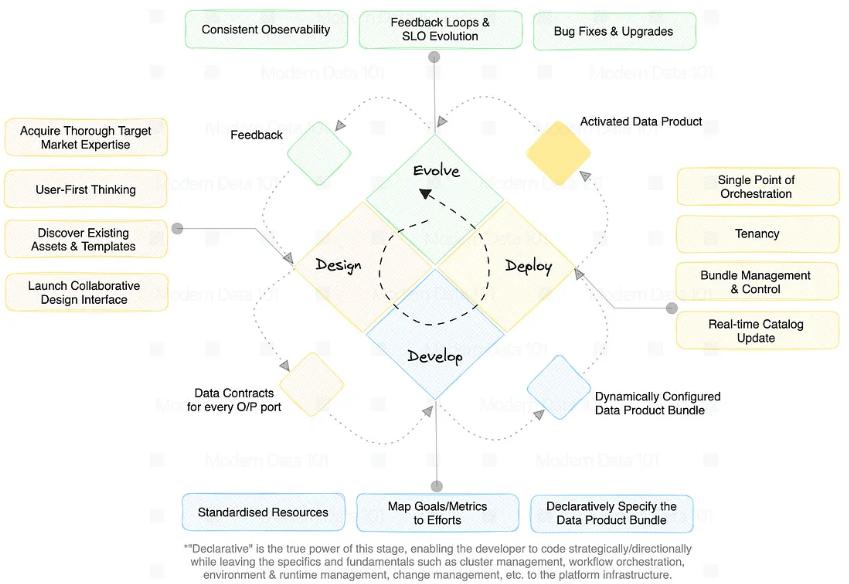
The data product lifecycle consists of four stages: Design, Development, Deployment, and Evolution.
Objectives of Data Product Testing
Ensure Data Quality and Consistency
For effective decision - making, data must be accurate, complete, and reliable.
Why set this objective? Poor data quality can lead to incorrect insights, low operational efficiency, and damage people's trust in analysis. Without automated checks, issues such as missing values, schema drift, and inconsistent formats and results will silently reduce the quality of decision - making and the efficiency of subsequent processes.
Then, there are three different answers to the same question. This will make stakeholders lose trust in the data because they don't understand why there are three different answers to the same question. They don't know which one to believe.
By embedding real - time validation and anomaly detection, organizations can prevent costly errors, ensure seamless data operations, and maintain confidence in their analysis and artificial intelligence initiatives .
Verify Business Logic, Transformation, and Semantics
Metrics, models, and transformations must be aligned with business goals to ensure meaningful insights.
Why does this happen? Defective business logic can lead to inaccurate KPIs, inconsistent reports, and strategic decision - making mistakes. Without continuous validation, transformation errors, semantic inconsistencies, and model configuration errors will distort the results and reduce people's trust in the data product.
Each data initiative should be closely linked to business value, focusing on how our work contributes to revenue generation or cost reduction. This approach ensures that our data work is aligned with organizational goals, thereby deepening our understanding and communication of our own value.
Results of achieving the goal: A reliable validation framework ensures that business logic remains consistent, transformations reflect real - world operations, and analysis provides actionable, high - confidence insights.
Monitor System Performance and Scalability
The data product must operate efficiently and scale seamlessly under increasing workloads. Continuous monitoring also boils down to providing features that better meet the actual needs of users.
Why set this objective? As the data volume grows, performance bottlenecks will gradually appear, leading to slower processing speeds, delayed insights, and ultimately affecting the user experience. Without proactive monitoring, enterprises will face the risks of system failures, inefficient queries, and unexpected outages.
The result of achieving continuous performance testing of the goal is that the data product can remain fast, responsive, and cost - effective on a large scale, thereby supporting the growing user needs and changing business requirements without interruption.
Governance, Security, and Compliance
Data must be secure, regulated, and compliant with industry regulations.
Why set this goal? Weak governance exposes organizations to the risks of security breaches, regulatory fines, and reputational damage. Without appropriate controls, unauthorized access, data leaks, and violations will become uncontrollable business risks.
The data governance framework must be tailored to the specific needs of the organization, because each company has its own unique systems and resources. Data governance is not just about restricting access rights; more importantly, it ensures that only the right people can access the data. The success of any governance framework ultimately depends on the human factor, and data governance ambassadors play a crucial role in its effectiveness.
Results of achieving the goal: A strong governance framework, automated security checks, and regulatory compliance verification can ensure data integrity, protect sensitive information, and maintain trust with customers and stakeholders.
Continuous Deployment
The data product should be deployed quickly without breaking its functions.
Why is this goal needed? Slow manual deployment processes bring risks, delay innovation, and increase operational friction. Without automated testing and continuous integration/continuous delivery (CI/CD), each update may become a failure point, thereby reducing agility and responsiveness.
The data product cannot be built in isolation - it requires continuous input to be useful. The value of an indicator depends on the context it provides. Therefore, ensuring its stability means closely monitoring its underlying dimensions and constantly optimizing.
Results of achieving the goal: Automated verification and deployment pipelines enable data teams to iterate quickly, minimize downtime, and accelerate the realization of value - ensuring that the data product stays ahead without sacrificing stability.
Components of a Data Product Testing Strategy
The seven key components of a data product testing strategy include:
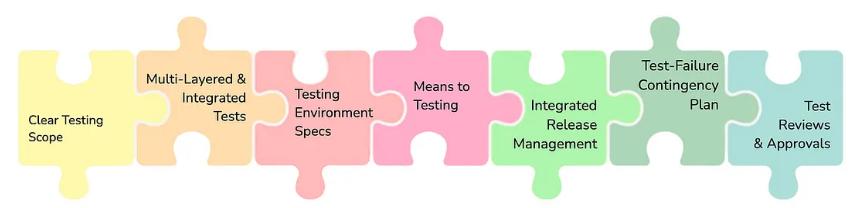
- Define the testing scope
- Multi - layer integration testing
- Specification of the testing environment
- Testing methods
- Integrated release management
- Emergency response plan for test failures
- Test review and approval
Define the Testing Scope
A clear ownership and decision - making structure is the cornerstone of an effective data product testing strategy. Without a clear scope definition, the team will be groping in the fog - unsure of who will verify key data transformations, who will confirm the accuracy of the model, and who will ensure compliance. This uncertainty will lead to inefficiency, delays, and missed risks.
Excellent data organizations view the approval workflow as a strategic lever, assigning domain experts to review the aspects they know best - data engineers are responsible for pipeline integrity, analysts for business logic, and compliance teams for security.
What are the results? Faster decision - making, fewer bottlenecks, and seamless integration between testing and deployment.
Multi - layer Integration Testing
Single - layer testing means a single point of failure.
A powerful data product testing strategy is like a well - architected system - resilient, redundant, and deeply integrated.
Unit testing ensures correctness at the transformation level.
Integration testing ensures seamless interaction between data flows.
Regression testing can prevent changes from breaking existing functions.
Automated testing integrates quality into the CI/CD pipeline, and
Data monitoring and observability transform static validation into dynamic real - time guarantees.
If these layers do not work together, the data system is still vulnerable - prone to silent failures, costly rollbacks, and loss of business trust.
Specification of the Testing Environment
Testing in an environment that does not match the production environment is like test - driving a car in a parking lot and assuming it will perform well on the highway.
Many failures - such as schema mismatches, unexpected delays, or scalability bottlenecks - only appear when the system is under actual pressure.
However, too many organizations test under unrealistic conditions, leading to a false sense of security. The best - in - class strategy is to regard the testing environment as a training ground for the production environment, ensuring that every extreme case, data volume, and integration are stress - tested before real users and system dependencies.
Detection Methods
Testing should not be an afterthought but must be integrated into every aspect of the data workflow. If the validation process exists outside the data platform, testing will become a bottleneck rather than a driving force.
The most mature data teams embed testing directly into their orchestration layers, transformation tools, and CI/CD pipelines, enabling real - time validation at every stage of the data product lifecycle.
This integration creates a system where errors can be detected early, problems can be diagnosed based on context, and testing can evolve in sync with development rather than slowing it down. This highly integrated testing environment and method are feasible on a unified platform, which provides a common interface for different entities in the data ecosystem, enabling them to communicate with each other easily.
Integrated Release Management
Incoordination between testing and release strategies can lead to two equally bad situations: either endless checks stifle innovation, or unvalidated changes are rushed into production.
The best solution is to adopt a testing framework that can adapt to the organization's release speed - where automated checks provide a fast feedback loop, business - critical validations proceed smoothly, and releases cannot be made without necessary approvals.
Organizations that master this balance can achieve continuous deployment without sacrificing data quality, enabling them to innovate fearlessly.
Emergency Response Plan for Test Failures
Test failures are not setbacks but warning signals. However, without a structured response, failures will turn into a frantic emergency drill - forcing the team into a reactive mode, causing system outages, and increasing operational risks.
Excellent data organizations not only prepare for failures but also design resilient systems. Establish a failure response plan to turn test failures into a learning cycle. Automated rollback mechanisms, intelligent alert systems, and structured root - cause analysis can turn test failures into a learning cycle, thereby strengthening the data system over time.
In product testing, if failures can be anticipated, prepared for, and systematically analyzed, they will become a competitive advantage rather than a disadvantage.
Test Review and Approval
Data integrity cannot be achieved by good intentions alone but requires strict verification and governance. Without a structured test review and approval process, organizations may deploy unreliable data products, thereby damaging trust and decision - making.
Efficient teams establish a multi - layer approval structure, allowing relevant personnel such as technology, business, and compliance to verify the data from their unique perspectives. This ensures that the data is not only technically correct but also meets business intentions, regulatory standards, and operational requirements.
Create an ecosystem where quality is guaranteed rather than left to chance.
What Aspects of a Data Product Should Be Considered for Testing?
A data product is not a monolithic architecture; it is more like a microservice system, where infrastructure, code, data, and performance continuously interact as smaller building blocks. Testing must reflect this complexity to ensure that no aspect is overlooked.
Excellent data teams not only verify the correctness of the data but also test the resilience of the entire system from multiple dimensions.
A. Infrastructure: Platform Stability and Policy Compliance
The foundation of any data product is its platform - storage, computing, access policies, and scaling policies determine its reliability. Testing must verify infrastructure configuration, security policies, and compliance requirements to prevent unexpected failures or vulnerabilities. Otherwise, even a well - tested data pipeline may be interrupted due to inconsistent environments.
B. Code: Unit Testing and Data Validation Testing to Verify the Accuracy of Transformations
Every data transformation may become a failure point. Through code - level testing - including unit testing for logical correctness and data validation testing for transformation outputs - it can be ensured that the data operates as expected. This can prevent latent errors, where incorrect transformations spread unnoticed, thereby destroying downstream analysis results.
C. Data: Model Integrity, Validation, and Governance
Raw data is meaningless without context, structure, and policy execution. Testing must verify:
Data models (schema integrity, business logic consistency)
Data validation (missing values, outliers, data drift)
Data services (API responses, access control)
Data policies (privacy, retention) and
Data quality (consistency, integrity, timeliness).
Organizations that fail to test these aspects may face the risks of unreliable insights, non - compliance, and poor user experience.
D. Performance: Query Speed, Uptime, and Refresh Rate
A data product is only valuable if it maintains high performance in large - scale applications. Testing must evaluate query response time (to ensure rapid analysis), uptime and availability (to minimize the risk of outages), and data refresh rate (to ensure that real - time or batch updates meet service - level agreements). Without performance testing, even a completely accurate data set may be useless due to slow response times or outdated information.
What to Test, When to Test, and How to Test: Testing in the Data Product Lifecycle
Let's see how the above components work at each stage of the data product lifecycle. What specific testing requirements apply and how to implement them.
