7 Predictions for Data and AI in 2026
The infrastructure supporting artificial intelligence is being completely rebuilt. Here's what will change and what won't.
Every year, we see predictions about the demise of SQL, the rise of the Lakehouse architecture, or some new paradigm that will disrupt everything. But most of these predictions ultimately fall short.
However, 2026 feels different. It's not because of the hype but because of the convergence. The forces that have been building up over the years have finally reached a tipping point: open table formats have matured, AI capabilities are ready for production, and the cost of a data stack integrating 50 tools has become unbearable.
Here are the trends I've observed based on conversations with hundreds of data leaders, our work model at Sifflet, and the massive changes taking place across the industry.
Prediction 0: The Basics Still Matter
Before we get into the exciting part, let's be a bit more down-to-earth.
Architectural changes can still break pipelines. NULL values can still corrupt reports. Traffic anomalies can still occur when no one is monitoring on weekends.
According to Gartner, poor data quality costs enterprises an average of $12.9 million per year. Many research reports have found that data teams spend up to 40% of their time on data quality issues, which could have been used for strategic work.
There is a huge gap between what is "possible" and what is "actually deployed". Most teams are still struggling with basic capacity and freshness checks.
By 2026, the key issue is not whether these problems exist; they definitely do. The key lies in whether you can detect them within minutes or days, and whether you fix them manually or automatically.
This is the common thread running through all the following content.
Prediction 1: Open Data Observability Wins, but Metadata Becomes the Battleground
The battle for the storage layer is over. Iceberg, Delta Lake, and Hudi have emerged victorious. Parquet has become the common language. The question "Where is my data stored?" has a clear answer.
But now, the situation is this: the war is shifting upstream. Whoever controls the metadata layer controls the intelligence layer.
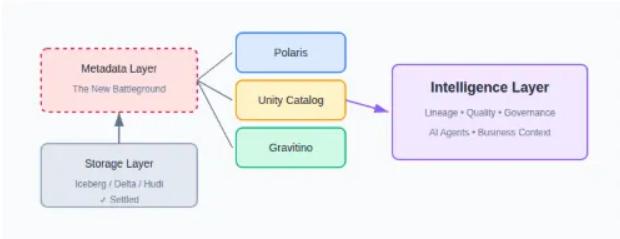
The metadata layer will be the battlefield for the next fight.
Let's see what's happening:
Snowflake has launched Polaris as an open catalog for Iceberg. Databricks is promoting Unity Catalog as a common governance layer. Apache Gravitino (in incubation) positions itself as a vendor-neutral alternative.
Why is this important? Because the catalog is no longer just a technical component; it's becoming the operating system for data. Data lineage, quality rules, access policies, business context, etc., all exist in the metadata layer.
If your observability tool can't natively understand Iceberg table evolution, time travel, and partition metadata, then it's already outdated.
This means that data observability built on open formats will outperform tools that treat Iceberg as an afterthought. Native integration is not a feature but a basic requirement.
Prediction 2: The 50-Tool Data Stack Will Simplify into 5 Platforms
We've reached the peak of tool fatigue.
On average, enterprise data teams manage 15 to 30 different tools. These tools cover various aspects such as data collection, transformation, orchestration, quality control, cataloging, governance, and visualization. Each tool has its own vendor, user interface, and set of thinking patterns.
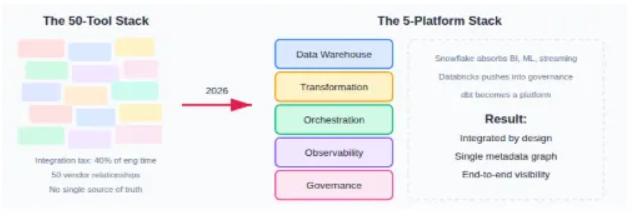
The integration of the data stack is accelerating.
The integration cost is killing productivity. A Fivetran study shows that data engineers spend 40% of their time on integration work rather than creating value. This situation is unsustainable.
In 2026, the integration process will accelerate:
Snowflake has integrated more functions - notebooks, streaming, and machine learning services. Databricks has delved deeper into governance and business intelligence. dbt Labs has evolved from a tool into a platform with a semantic layer and dbt Cloud. And those previously independent solutions are either being acquired or struggling to maintain their market positions.
If you're still building a single solution in 2026, you're building an acquisition target, not a company.
The ultimate winners will be platforms that can achieve the complete process from data ingestion to transformation, then to service, and finally to observability through a single metadata graph. It's not because bundled solutions are better, but because the integration process is just too painful.
Prediction 3: Data Quality Will Become a Business Function, Not an Engineering Task
I asked each data leader a question: "What impact does a failure in your data pipeline have on revenue?"
Most people couldn't answer. They could tell me which table had null values, which job failed, and how long the service level agreement (SLA) violation lasted. But they couldn't connect this information to the CFO's dashboard error or a machine learning model giving wrong advice.
This situation will change in 2026.
Data quality metrics are shifting from engineering metrics to business outcomes. Service level agreements (SLAs) are also defined in business terms: revenue risk, affected customers, decision delay.
Gartner predicts that by 2026, 80% of organizations will deploy data quality solutions that leverage AI/ML capabilities. But the bigger shift lies in the organizational structure: the Chief Data Officer (CDO) will be responsible not only for the data engineering team but also for the reliability related to business outcomes.
Data contracts; formal agreements between producers and consumers regarding data schemas, freshness, and quality are becoming standard practice. It's not because they're trendy but because without them, there's no accountability mechanism.
If your quality tool can't answer "What's the impact of this failure on revenue?", then it can't solve the real problem.
At Sifflet, this is at the core of how we think about observability. Connecting technical anomalies to business context is not a nice-to-have but a must-have.
Prediction 4: AI Agents Will Replace Dashboards for Data Operations
This is the prediction I'm most certain about.
For twenty years, data observability has meant dashboards. Once a failure occurs, you get an alert, open the user interface, and then manually investigate. It might take an hour to find the root cause, or it might take an entire night.
This model is no longer working.
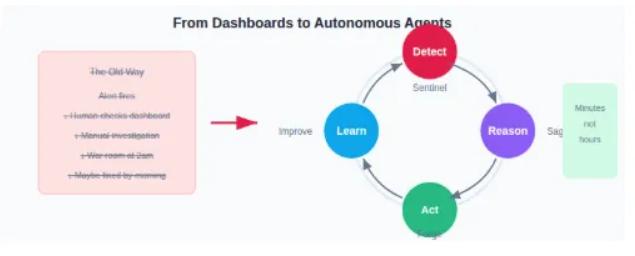
The shift from passive dashboards to autonomous agents.
In 2026, AI agents will take on the operational tasks:
Detection that can understand business context rather than just focusing on technical metrics; Investigation that can automatically trace the source and correlate cross-system signals; Resolution mechanism that can apply fixes, verify results, and learn from each incident.
The war room at 2 am becomes a Slack notification: "A problem has been detected in the revenue channel. Root cause: Upstream architectural change in CRM synchronization. Fix applied. Verification passed."
Detection capabilities have become commoditized. Any tool can tell you where the problem is. Reasoning and action are the new moats.
This is not about adding a chatbot to existing tools but about fundamentally rethinking what observability means when AI can take on the investigation work.
Prediction 5: AI Reshapes the Data Infrastructure Landscape
For some in the industry, this is an uncomfortable truth: the data stack was initially built to serve dashboards, not AI.
But now, AI has become the primary data consumer for many organizations. Feature stores, embedding pipelines, RAG architectures, and dataset fine-tuning all have different requirements from the business intelligence workloads we optimized for before.
AI models have a much lower tolerance for incorrect data than humans interpreting data dashboards. Humans can identify outliers and ignore them, but models will use these outliers for training.
By 2026, we expect to see two types of companies:
AI-native architecture: Infrastructure rebuilt from scratch, specifically designed to serve AI workloads. Quality verification is done at write time rather than read time. Metadata has rich semantic information built - in. Lineage tracks not only tables but also features and embeddings.
AI-additive: Traditional data stacks with AI capabilities added as an afterthought. Chatbots on dashboards. Auxiliary driving systems that can generate SQL statements but can't understand business context.
By 2026, all data tools will have an AI layer. But most will be just wrapper layers, not native layers. The difference is crucial.
The ultimate winners will be companies that rebuild their products from scratch to fit AI, rather than just adding AI to existing products.
Prediction 6: The Semantic Layer Finally Has Its Moment
For years, the semantic layer has been seen as a nice - to - have feature. Some technically proficient teams would implement it, but most teams would ignore it.
AI has changed the way we compute.
The problem is: when you ask an LLM to generate a query for "revenue by region", it needs to know what "revenue" specifically means in your organization. Is it gross or net? Does it include refunds? Which tables contain the canonical definition?
Without a semantic layer, text - to - SQL conversion is just a guess.
Solutions like dbt's semantic layer, Cube, and AtScale have solved the problem of "different dashboards showing different data" that has plagued analytics teams for decades. But for AI application scenarios, these solutions have become essential tools, not optional ones.
The semantic layer is where business logic exists in code form, not a carrier of experiential knowledge. AI agents need this context to function. Data quality tools also need it to verify what really matters, not just what exists.
The semantic layer becomes the bridge between technical data and business meaning. Without it, AI can't cross this bridge.
Common Ground
If there's a common theme among these seven predictions, it's this:
The data infrastructure is shifting from passive to active.
Passive: Store, transform, visualize, and wait for humans to discover problems.
Active: Understand, reason, act, and learn from every interaction.
The ultimate winning platforms will be those that integrate intelligent technologies into every layer of the architecture, rather than adding them as an afterthought. This means:
• Metadata that can understand business context, not just technical schemas
• Quality linked to revenue impact, not just the number of rows
• Observability that can investigate and solve problems, not just issue alerts
• Infrastructure built for AI workloads, not retrofitted
The basic principles still matter. Architectural changes can still cause problems. But how to detect, investigate, and solve these problems is the key to success.
This article is from the WeChat official account "Data - Driven Intelligence" (ID: Data_0101), author: Xiaoxiao. Republished by 36Kr with permission.