The product has been introduced into the leading 3C supply chain. Cellulose high-value application platform "GreenVena" has completed a Pre-A round of financing worth tens of millions of yuan | Exclusive report by 36Kr
Text | Azhi
36Kr learned that the high-value cellulose application platform "Green Micro-Nano" recently announced the completion of a Pre-A round of financing worth tens of millions of yuan. This round of financing was led by Jinqiao Fund, with industrial investors participating. Yibai Capital served as the financial advisor. The funds will be mainly used for production line expansion and market promotion.
Green Micro-Nano was established in October 2022. Its core technology was incubated from the Institute of Chemistry, Chinese Academy of Sciences. Zhang Jun, the technology leader, is the director, researcher, and doctoral supervisor of the Engineering Plastics Laboratory at the Institute of Chemistry, Chinese Academy of Sciences. He is a well-known scientist in the field of natural polymer and cellulose material research. The research team he leads has 20 years of basic research accumulation and more than 10 years of industrialization practice experience. The company's core team members come from the Institute of Chemistry, Chinese Academy of Sciences, Danaher, Zhongke Henglian, etc., and have comprehensive capabilities from R & D, production to commercial operation.
Green Micro-Nano's core technology is the preparation of micro-nano cellulose functional materials. Through a new green processing technology route using ionic liquids, it reshapes the physical form and chemical functions of cellulose, such as 3D cellulose gel (CMG), microspheres/microcapsules, etc., thus realizing the innovation of functional products and multi-field applications.
Currently, Green Micro-Nano is focusing on four major business areas: paper products, daily chemical and personal care, industrial additives, and life sciences. Relying on the unique forms and properties of the current core materials 3D cellulose gel and microspheres/microcapsules, it has planned 8 product pipelines, such as paper strength enhancers and multi-effect additives for natural skin care products.
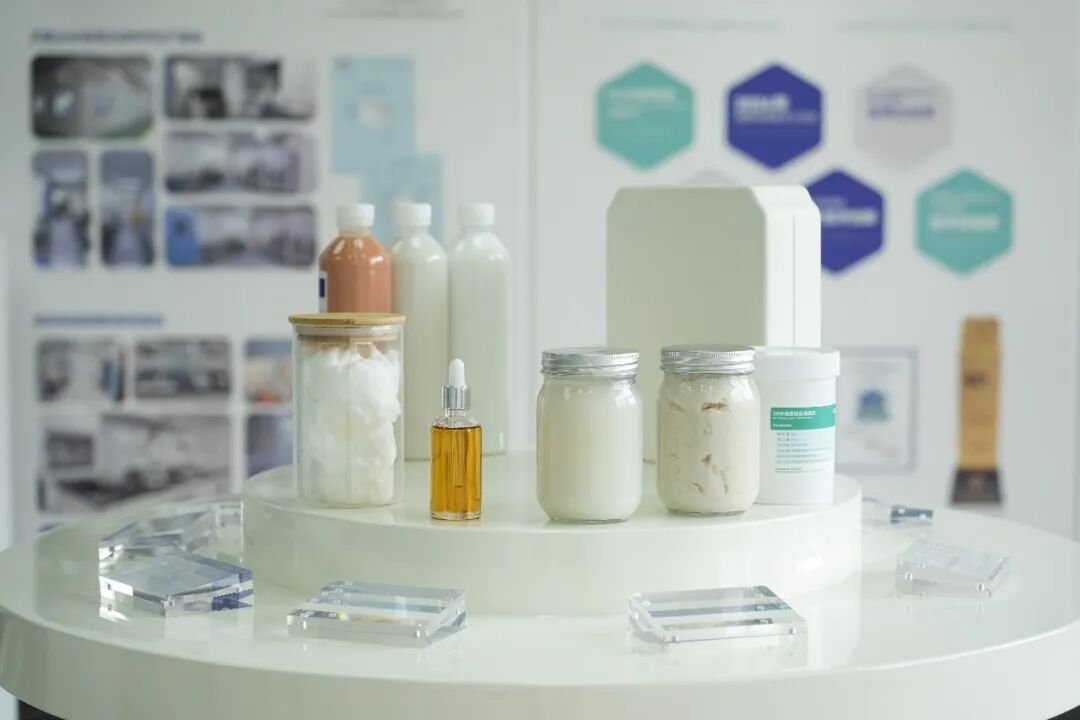
Photo provided by the enterprise
In the past year, in the paper and daily chemical fields, Green Micro-Nano has cooperated with many consumer electronics supply chain enterprises, ODM and OEM manufacturers of international skin care brands, completed the verification of leading customers and product introduction tests. After the factory's production capacity is increased, further volume growth can be achieved.
Conduct R & D according to market demand and promote the industrial application of natural cellulose
Different from traditional chemical materials products made from non-renewable chemical resources such as coal and petroleum, bio-based materials are expected to replace traditional petroleum-based materials in many application fields such as high-end manufacturing and green consumption due to the renewability of their raw materials (such as crops and trees) and the low-carbon and environmental-friendly nature of the production process, thus promoting the green transformation and sustainable development of the economy.
As the most ideal underlying raw material, cellulose is synthesized by plants through photosynthesis. It is the most abundant natural polymer material on earth at present and is almost inexhaustible. However, its industrial development has been restricted by traditional processing technologies and high production costs for a long time.
Around 2020, in the process of discussing the commercialization of raw materials in the synthetic biology track, especially the issue of carbon source production, with investment institutions, Teacher Zhang Jun's team found that there were problems in the application ideas of cellulose materials in the industry at that time.
"This existing natural polymer material with excellent properties, cellulose, is first degraded into sugar and then re-obtained through biosynthesis. This path may be a detour. Why can't we use it directly?" Tian Weiguo, the co-founder of Green Micro-Nano, mentioned. "Just at that time, based on the more than 20 years of research accumulation in the cellulose field at the Institute of Chemistry, Chinese Academy of Sciences, we proposed another possibility - to promote the direct use and industrialization of cellulose."
In fact, in the past many years of scientific research practice, the Institute of Chemistry, Chinese Academy of Sciences has achieved the implementation of some technological achievements in the fields of bulk materials such as cellulose membranes and cellulose fibers through technology transfer and enterprise cooperation.
But Tian Weiguo also mentioned, "The technology transfer model highly depends on whether the cooperating enterprises have high-level engineering and commercialization teams. We still have a large amount of technological reserves regarding cellulose micro-nano functional materials and are also thinking about new ways to implement the technology. So, why not do it ourselves? Combining with the call of investment institutions to invest in early-stage, small-scale, and hard technology at that time, the two sides hit it off."
In 2022, Green Micro-Nano was officially established.
In addition to technological reserves and industrialization experience, another key point that promoted the decision to start a business is: The new technology direction that Green Micro-Nano focuses on requires relatively small early fixed investment and can directly introduce products into the terminal market in a shorter path.
Japan, Europe, and the United States are the pioneers in the industrialization of nano-cellulose. In the past, the mainstream technology route was more of a "top-down" approach, which can be simply understood as "breaking" raw materials such as wood and bamboo through mechanical, chemical, or biological methods (destroying the weakest links in the natural structure of cellulose, such as the amorphous region) to finally make a very small material at the nano-scale. The whole process has high energy consumption, large consumption of chemical reagents, and low yield (for example, the yield of cellulose nanocrystals prepared by the sulfuric acid hydrolysis method does not exceed 30%), and a large number of by-products are produced during the processing, which is prone to cause waste and pollution.
The combination of multiple factors has led to high costs, which is the core problem. To promote the large-scale implementation of new materials, it is necessary to optimize the technology route from the perspective of market applications.
"We chose a completely different technology route from the mainstream at home and abroad, not simply a replacement." Tian Weiguo said. "Based on the past accumulation in the field of ionic liquid processing of cellulose, Green Micro-Nano takes a 'bottom-up' route, using ionic liquids to completely dissolve cellulose into a single-molecule state and then controllably reconstruct the micro-nano materials we need from the molecular level."
Specifically, regarding the advantages of the route, the yield of micro-nano cellulose based on the bottom-up technology route of ionic liquids is close to 100%, and almost no raw materials are wasted; the production process can achieve almost zero emissions, and in principle, only cellulose and energy are consumed, which meets the requirements of green and sustainable development; the high yield and low energy consumption can further drive a significant reduction in costs.
In addition, Tian Weiguo also emphasized, "Different from traditional nano-cellulose materials such as CNC or CNF, what Green Micro-Nano is actually making is a brand-new material category, which we call CMG (3D fiber gel). Its scale is in the micron range (20 - 40 microns) rather than the nano-scale, but it has most of the excellent properties of traditional nano-cellulose. CMG is also the basic material for the mainstream products we are selling at present."
"If the scale reaches more than a thousand tons, our production cost is expected to be reduced by an order of magnitude compared with the traditional route. This is the fundamental factor that can truly push the products to the market." Tian Weiguo added.
Help customers reduce costs and increase efficiency, and complete the test and introduction of multi-scenario brand supply chains
Based on its positioning as a high-value cellulose application platform enterprise, Green Micro-Nano has planned a product matrix covering four major fields: paper products, daily chemicals, industrial additives, and life sciences at this stage, mainly including bio-based paper strength enhancers, multi-effect additives for natural skin care products, powder anti-settling dispersants, and cell culture matrix gels.
Considering the technological maturity and commercialization cycle, in terms of market strategy, the company adopts a dual-track approach of focusing on cash flow income in the short term and cultivating high barriers in the long term.
Simply put, it first focuses on the daily chemical and paper product tracks, quickly enters the customer supply chain through low-cost and high-performance material solutions, and obtains large-scale orders and cash flow income; at the same time, it strategically plans high-value-added tracks such as life sciences, builds barriers through long-term investment and R & D, and occupies the future technological high ground.
In the paper product direction, Green Micro-Nano currently focuses on fields such as consumer electronics packaging and luxury packaging. Its cooperation with major 3C customers has increased from the level of hundreds of kilograms last year to orders in tons. In the daily chemical direction, it cooperates with ODM and OEM manufacturers of international skin care brands in the Pearl River Delta region, providing raw materials and solutions. Currently, it has achieved stable small-batch order income.
Tian Weiguo emphasized, "We are not just playing the 'environmental protection card'. We add environmental protection value on the basis of meeting the core needs of customers for value improvement or cost reduction and efficiency increase. Therefore, (the products) have stronger vitality."
Taking 3C packaging as an example, Green Micro-Nano's products can significantly enhance the performance of paper. Customers can use less material to achieve the same strength, realizing lightweight packaging, which means a overall reduction in raw material, transportation costs, and carbon emissions. Moreover, the raw materials are biodegradable and do not affect the recycling of paper.
Another example is cosmetics. Micro-nano cellulose materials can well meet the brand's needs for functions such as suspension, stability, emulsification, and thickening. The "natural" attribute is also a strong selling point, with high market acceptance, and it is easier to replace some petroleum-based components, creating value for customers. This also further shortens the commercialization path of Green Micro-Nano's products.
"Since the pre - customer verification and introduction cycle has basically been completed, the company's order volume in 2026 will increase by an order of magnitude compared with last year." Tian Weiguo added.
In terms of production capacity, Green Micro-Nano's 100-ton production line in Langfang, Hebei was put into operation in June last year. The production capacity is mainly used to meet the early testing and small and medium-batch introduction needs of customers. It is reported that with the further increase in the order scale, Green Micro-Nano has planned to build a 10,000-ton mass production line in Lianyungang, Jiangsu. After it is put into operation, the expected output value will exceed 300 million yuan.