Jensen Huang's Dialogue at Davos: Five-Layer Cake, Three Major Breakthroughs, and Trillion-Dollar Infrastructure Reshape the Future of AI
At the World Economic Forum held in Davos on January 21st, Jensen Huang, the founder and CEO of NVIDIA, had an in - depth dialogue with Laurence D. Fink, the CEO of BlackRock, about the future of AI, revealing the vision of how AI will reshape the global economic landscape.
Jensen Huang systematically elaborated on the "five - layer AI cake" theory, pointing out that the full - stack revolution from the underlying energy to the top - level applications is giving rise to "the largest infrastructure construction in human history."
He believes that the current investment of hundreds of billions of dollars is just the beginning, and trillions of dollars will be needed in the future. Notably, through the example of the increasing number of radiologists, he effectively demonstrated that AI will enhance rather than replace human work. The key lies in distinguishing between "work purposes" and "work tasks."
From chip factories to AI supercomputers, from open models to breakthroughs in physical intelligence, what Jensen Huang depicts is not only the technological evolution path but also a new world economic order that is being redefined.
His judgment on the "once - in - a - generation" opportunity for Europe and his outlook on developing countries narrowing the technological gap through AI show profound insights into the inclusive nature of technology from a global perspective.
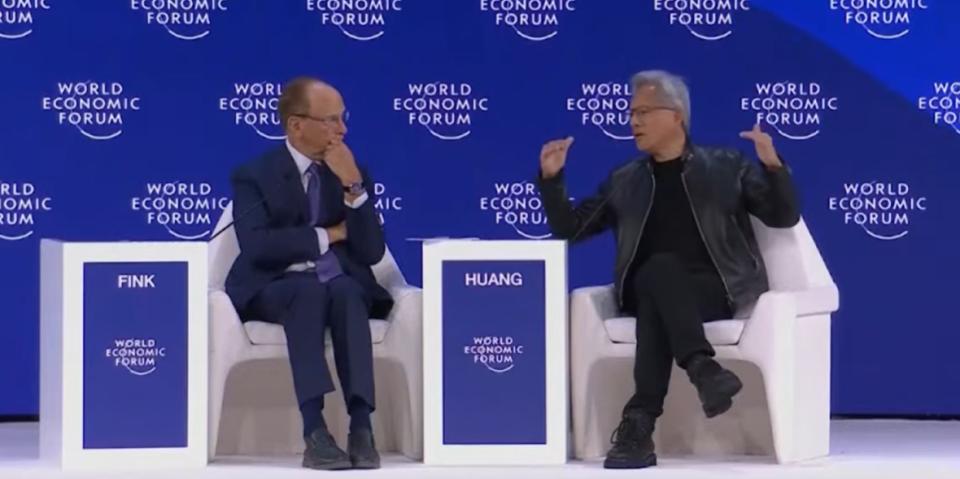
The following is the full transcript of Jensen Huang's dialogue:
I. The Essence of AI: From "Platform Transformation" to the "Five - Layer Cake"
Fink: It's a great honor to introduce Jensen Huang to you all. He is someone I've always followed and regarded as a mentor in my journey of learning and understanding technology and AI. The way he leads NVIDIA is truly remarkable. Since its listing, NVIDIA has delivered a total annual compound return of up to 37% for its shareholders. Imagine if every pension fund had invested in NVIDIA at its IPO, how great our collective success would have been. In contrast, BlackRock's total return is about 21%, which is excellent for a financial services company but pales in comparison to NVIDIA. This strongly confirms Jensen Huang's leadership, NVIDIA's market position, and the world's belief in its future. Jensen Huang, congratulations on your achievements. I believe the journey ahead will be even more wonderful.
Jensen Huang: My only regret was after the company's IPO. At that time, the company was valued at $300 million, and I sold some of my shares to buy my parents the most expensive Mercedes - Benz S - Class sedan at that time. Now they all regret it, but the car is still there.
Fink: Discussions about AI always revolve around how it will change the world and the global economy. Today, I want to explore how AI can add value to the global economy and become a fundamental technology that everyone can use to improve their lives. We need to think about how AI will reshape productivity, the labor force, and infrastructure in various fields. More importantly, how it will reshape the world and benefit more people, ensuring that the global economic cake gets bigger. I think no one understands AI and the infrastructure it requires more clearly than Jensen Huang. Many large cloud service providers are users of NVIDIA's products, and the participation in the entire AI infrastructure field is extremely high. So, why does AI have the potential to become such an important growth engine? What is the fundamental difference between this moment and past technological cycles?
Jensen Huang: To understand the importance of AI, we must first recognize that this is not just a new application but a profound "platform transformation." Just like personal computers, the Internet, mobile, and cloud computing, platform transformation means that the entire computing stack is reinvented, giving rise to a brand - new application ecosystem. The ChatGPT you use today is an application itself, but more importantly, countless new applications will be built on models like ChatGPT and Claude in the future. This is the meaning of platform transformation.
The key to understanding AI lies in seeing what it can do that couldn't be done before. In the past, software was essentially a "preset program." Humans wrote clear algorithms for computers to process structured information such as names and accounts. We call this SQL queries, and almost all systems in the past ran on SQL. Today's AI can understand completely unstructured information such as pictures, text, and sounds. It can perceive the environment and context in real - time, understand your intentions, and execute tasks. This is the first time we have a computer that is not a "preset program" but can understand and process the world in real - time.
Since we are reinventing the entire computing stack, we must understand AI from an industrial perspective. I think AI is essentially a "five - layer cake":
The bottom layer is energy: AI needs to process and generate intelligence in real - time, consuming a huge amount of energy. This is the physical foundation for everything.
The second layer is chips and computing infrastructure: This is where NVIDIA is located, providing core computing power.
The third layer is cloud infrastructure and services: It provides computing power as a service to enterprises and developers.
The fourth layer is AI models: Such as ChatGPT, Claude, and DeepSeek. This is the layer that the public is most familiar with.
The top layer is the application layer: The specific applications of AI in various industries such as finance, healthcare, manufacturing, and services. This is the layer where economic value is ultimately generated.
The key is that this brand - new computing platform requires strong support from all the underlying layers. Therefore, as you can see, we are witnessing the beginning of the largest infrastructure construction in human history. Currently, hundreds of billions of dollars have been invested globally, but this is "just the beginning." In many projects with Larry, I've seen that the scale of facilities to be built in the future will reach trillions of dollars. This is reasonable because all context information needs to be processed for AI models to generate intelligence and power the applications built on them.
This construction boom is surging globally: TSMC announced the construction of 20 new chip factories; we are collaborating with Foxconn, Wistron, and Quanta to plan the construction of 30 computer factories, and these computers will form AI factories; Micron has launched a $200 - billion memory investment in the United States, and SK Hynix and Samsung are also growing rapidly. At the same time, venture capital reached a record high in 2025, and a large amount of capital has flowed into "AI - native companies" in various industries because the model layer has matured enough to support the explosion of upper - layer applications.
II. From Digital to Physical: Three Major Breakthroughs in the AI Explosion
Fink: How will AI spread to the physical world? What transformative opportunities are there in fields such as healthcare, transportation, and science?
Jensen Huang: Looking back at last year, three milestone events took place in the AI model layer:
First, the models changed from being "novel and interesting" to "reliable and down - to - earth." Early models were prone to "hallucinations" (i.e., fabricating information). The major progress last year was that the models learned to perform step - by - step reasoning (i.e., Chain - of - Thought), being able to break down complex problems, formulate research or execution plans, and make reasonable inferences about situations not present in the training data. This marks that language models are evolving into "agent - style AI systems" that can take on important tasks.
Second, the rise of open models. Marked by the release of DeepSeek, the world saw the first powerful open - source inference model. Since then, a large number of open models have emerged. This is crucial because it allows global enterprises, industries, researchers, universities, and startups to start at a lower threshold and create domain - specific AI for their specific needs based on these open models.
Third, great progress has been made in "physical AI" or "physical intelligence." AI is no longer limited to understanding language and has started to learn to understand the laws of nature. This includes understanding protein structures, chemical reactions, fluid dynamics, particle physics, etc. These natural structures are like a kind of "language," and AI is learning to interpret them. A good example is our cooperation with Eli Lilly. They realized that AI has made rapid progress in understanding protein and chemical structures and can now "talk" to proteins just like we talk to ChatGPT, which will bring major breakthroughs in fields such as drug discovery.
These breakthroughs mean that AI is firmly moving from the digital world to the physical world, deeply integrating with the real economy such as manufacturing, pharmaceutical R & D, and materials science, opening a new era of "physical AI."
III. AI and Employment: Creating, Not Replacing
Fink: These breakthroughs have also raised people's concerns about employment. You've always held a different view, believing that AI construction itself will create a large number of jobs, and there may even be a labor shortage. So, how do you view AI and robotics changing the nature of work rather than eliminating jobs?
Jensen Huang: We can look at it from two levels.
First, this largest infrastructure construction in human history is creating a huge number of high - skill, high - paying jobs. Building chip factories, computer factories, and AI factories requires a large number of plumbers, electricians, construction workers, steelworkers, and network technicians. In the United States, the wages in these fields have almost doubled, reaching six - figure annual salaries, and there is a shortage of talent. This provides the society with a wide range of decent job opportunities that don't all require a doctorate in computer science.
Second, real - world examples are the most illustrative. About a decade ago, people predicted that radiologists would be one of the first professions to be replaced by AI because AI outperformed humans in image recognition. But today, a decade later, AI has fully penetrated radiology, and the number of radiologists has actually increased. Why? Because the purpose of radiologists' work is to diagnose diseases and help patients, and "looking at scan images" is just one of the tasks. AI automates this time - consuming task, enabling doctors to analyze images more quickly, so they have more time to communicate with patients, conduct complex diagnoses, and collaborate with other doctors. As a result, hospitals can serve more patients, their revenues increase, and they hire more radiologists.
The same thing is happening in the nursing industry. The United States is facing a shortage of 5 million nurses. By using AI tools like Abridge to automatically record and transcribe medical records (which originally took up nearly half of nurses' time), nurses can spend more time visiting and taking care of patients. The bottleneck in the hospital's service capacity is broken, the operational efficiency is improved, and naturally, more nurses will be hired.
Therefore, when thinking about the impact of AI on work, the key is to distinguish between "work purposes" and "work tasks." AI is good at automating specific and repetitive tasks, but it actually enhances humans' ability to achieve the core purposes of work (such as care, communication, creation, and complex decision - making). The improvement in productivity will create new demands and new service models, thus giving rise to more job opportunities.
IV. The Global Inclusiveness of AI: Opportunities for Developing Countries
Fink: How can we ensure that AI benefits not only developed countries and the educated class but becomes a global inclusive growth force?
Jensen Huang: First, AI should be regarded as part of a country's key infrastructure, just like electricity, roads, and communication networks. No country in the world doesn't need it. Although AI services can be imported, with the emergence of open models, it is no longer out of reach for countries to train AI that suits their own needs. Every country should invest in building its own AI infrastructure and use its most valuable resources - language, culture, and local knowledge - to develop and improve its own "national intelligence" ecosystem.
Second, AI is the most user - friendly and accessible technology ever. Its user base has approached 1 billion in just two or three years, making it the fastest - growing and most widely adopted technology. For individuals in developing countries, even without a programming background, they can communicate with AI in natural language to solve problems. For example, you can directly ask AI: "I want to build my own website. How should I do it?" AI will guide you through the whole process and even generate code for you. This extremely low threshold makes AI a powerful tool to narrow the global digital and technological gap rather than widen it. In the future, how to manage the AI digital workforce will become a crucial core skill.
V. The Truth about the AI "Bubble": NVIDIA GPUs Are in Short Supply
Fink: We are in Europe. You've mentioned many companies in the United States and Asia just now. How does AI intersect with Europe's future success? What role does NVIDIA play in Europe?
Jensen Huang: NVIDIA is fortunate to cooperate with almost all AI companies globally because we are at the infrastructure layer, powering the entire AI field. What really excites Europe is that you have a very strong industrial manufacturing foundation. This is an opportunity for Europe to leapfrog the traditional software era that requires a large amount of code writing. The United States did lead the software era, but AI is a different kind of "software" - you don't write it; you teach it. By entering this field early, Europe can integrate its strong industrial manufacturing capabilities with AI and take the lead in the field of physical AI or robotics. This is a "once - in - a - generation" opportunity for European countries.
In addition, Europe still has a very solid foundation in in - depth scientific research. Now, this research can be accelerated with the help of AI. I think Europe needs to seriously consider and increase its energy supply, which is a prerequisite for investing in the AI infrastructure layer and cultivating a rich AI ecosystem in Europe.
Fink: Are we still far from an AI bubble? The question is, are we investing enough? Can we meet the needs of expanding the global economy?
Jensen Huang: A good way to test whether there is an AI "bubble" is to look at the actual demand. Currently, millions of NVIDIA GPUs deployed in major global clouds are being widely used and are in short supply. If you want to rent a NVIDIA GPU, it will be very difficult. The spot rental prices of GPUs are rising, not only for the latest generation but also for the previous two generations. The reason is that the number of newly established AI companies is huge, and more and more companies are shifting their R & D budgets to AI. Eli Lilly is a typical example: Three years ago, its R & D budget may have been mainly allocated to traditional wet laboratories, but now they have invested in large - scale AI supercomputers. More and more R & D budgets are tilting towards AI.
Therefore, the large - scale investment in AI is because we must build the necessary infrastructure for AI's upper - layer applications. I think this opportunity is truly extraordinary, and everyone should get involved. We need more energy, more land, electricity, and facilities, as well as more technical workers. In Europe, the foundation of this kind of technical labor force is very solid, which is a great advantage.
We see huge investment opportunities, and the scale of investment is still growing. As I mentioned, the global venture capital reached a record high in 2025, exceeding $100 billion, and most of it flowed into "AI - native companies." These companies are building the top - level application layer, and they will need the underlying infrastructure and continuous investment to build the future.
Fink: In fact, I think this is an excellent investment opportunity for global pension funds to participate in and grow with the AI world. This is also one of the core messages I want to convey to many political leaders: We must ensure that ordinary pensioners and ordinary savers can share this growth. If they just watch from the sidelines, they will feel left out. We should invest in infrastructure - infrastructure is an excellent investment option. This is the largest infrastructure construction in human history. Yes, get involved!
This article is from "Tencent Technology", author: Jin Lu. Republished by 36Kr with authorization.