AI is accelerating its foray into the industry, and the global automotive aftermarket is on the eve of explosive growth.
When a 2014 Buick LaCrosse fails to start due to a circuit fault, and the car owner independently completes vehicle diagnosis and repair with only a $79 device guided by built-in AI, an industry transformation driven by AI technology is quietly unfolding in the global trillion-dollar automotive aftermarket.
The automotive aftermarket generally refers to all services and transactions generated around the full life cycle of a vehicle after it is sold. From maintenance and repair to part replacement, it forms a huge and complex ecosystem.
However, in this huge ecosystem, the digitalization process of automotive diagnosis, the core link for accurately locating faults, is extremely slow.
The AI wave is sweeping across the global consumer sector, but automotive diagnosis is still blocked by high costs, complex protocols and high walls built by professional knowledge. Why is it so hard for AI to break through the solid professional barriers in repair shops?
This industrial contradiction is becoming the breeding ground for a new generation of game-changers. TOPDON, a local Chinese smart hardware manufacturer, is one of the emerging players. With the core concept of "software-defined hardware + AI reconstructing processes", it acts as a "rule reconstructor" in the industry, bringing industrial-grade diagnostic capabilities down to the consumer market and reshaping them through technological innovation.
Market performance has proved its success. In the automotive repair tools category on Amazon, its products consistently rank at the top of the bestseller list; through in-depth educational content on platforms such as YouTube and TikTok, it has achieved efficient conversion from user awareness to purchase decisions.
Category Innovation:
Carving Out a "New Continent" from the Industrial Red Ocean
According to Statista, the global automotive aftermarket exceeded 1.9 trillion U.S. dollars in 2024. The market is expected to continue growing in the next few years, reaching approximately 3.3 trillion U.S. dollars by 2033.
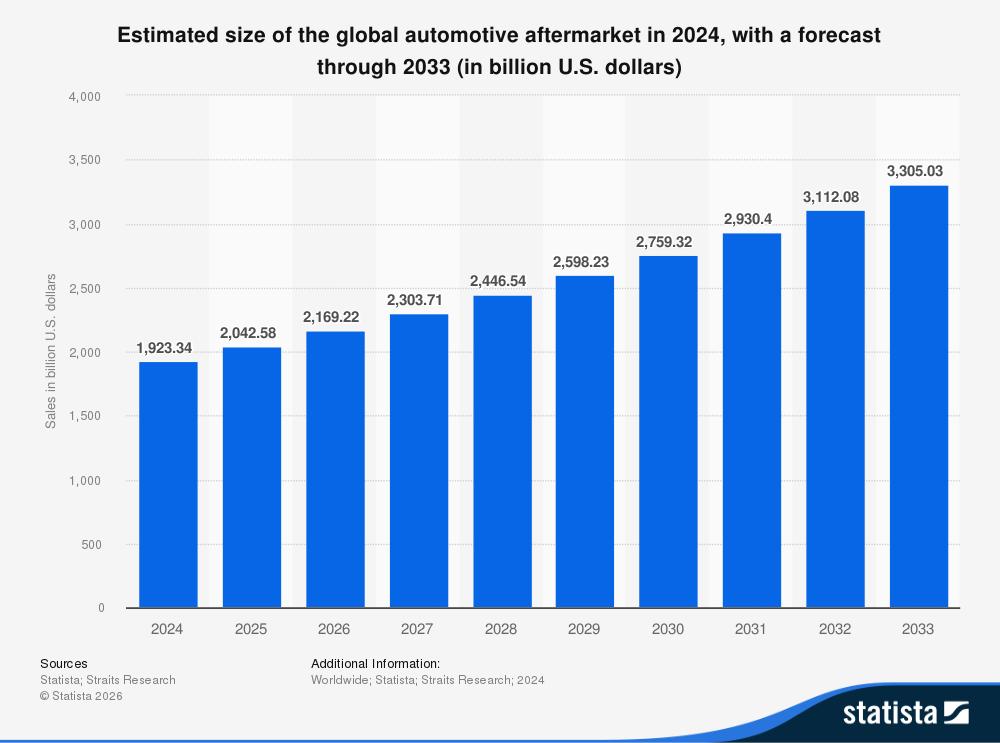
(Estimation of the global automotive aftermarket size in 2024, source: Statista official website)
At present, the global traditional automotive diagnostic market presents a pyramid structure: the top tier consists of original equipment (also known as OE equipment) used by 4S stores, the middle tier is industrial-grade comprehensive diagnostic equipment used by professional repair shops (such as TOPDON's Phoenix series), and the bottom tier is simple function-first consumer-grade tools used by DIYers and car owners.
What TOPDON targets is the "prosumer-grade" zone that has long been overlooked but boasts huge potential.
"This is a typical 'middle gap' market," Lou Ke, Chairman of Dingjiang Innovation Technology Co., Ltd., analyzed in an interview. "Professional equipment is too expensive and complicated, while simple tools have insufficient functions. But the demand is real — more than 30% of the 80 million car owners in the United States have tried DIY repair, and this proportion is 25% in Europe."
How big is this market? Lou Ke did the math: there are 80 million households owning cars in the United States, 120 million private cars in Europe, and 300 million car owners in China. If 10% of them are willing to buy diagnostic equipment, this will be a market worth hundreds of billions of yuan.
"More importantly," Lou Ke analyzed, "with the relaxation of mandatory scrapping rules and the increase in vehicle service life, as vehicles grow older, this demand will become increasingly strong. The older the car, the more faults it has, and the stronger the demand for diagnosis."
"Just as DJI turned drones into 'flying cameras', we want to turn automotive diagnosis from a professional tool into a consumer product," Lou Ke defined the company's mission.
In October 2023, TOPDON launched the TopScan device priced at $79 on Amazon. At that time, there were many players in this category, with monthly sales generally at 2,000 to 3,000 units. But TOPDON's product broke the balance as soon as it was launched: "We sold more than 10,000 units in a single campaign, and more than 100,000 units in a year." 36Kr learned that the total number of global users of TopScan and Carpal series has now exceeded 430,000.
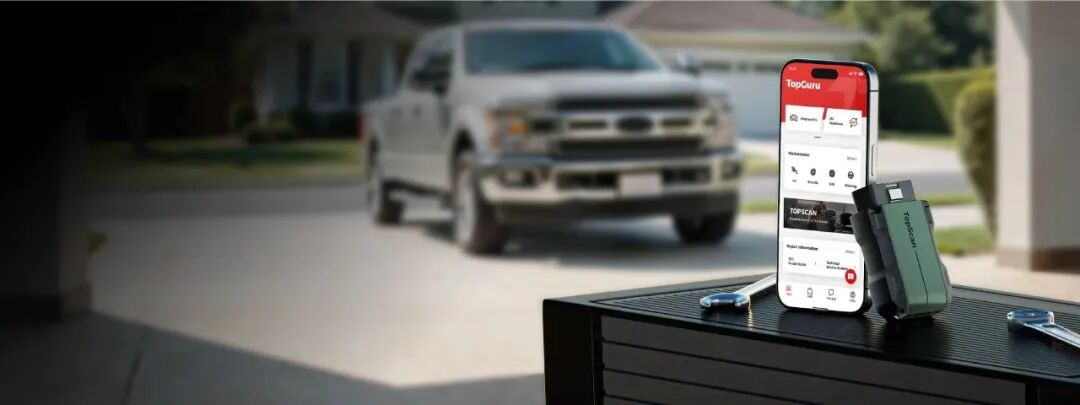
(TopScan — DIY automotive diagnostic scanner / Source: the enterprise)
How did this hit product come into being? Lou Ke briefly explained the reason: "The $79 product realizes 90% of the functions of original equipment, which costs three to five thousand U.S. dollars."
Building on the experience of this hit product, TOPDON has launched a three-layer product matrix: the Carpal series for entry-level novice car owners, the TopScan series for professional technicians, and the Phoenix series for repair shops.
Successful category creation cannot be separated from a differentiated implementation path. TOPDON has built an iron triangle of "localized product definition + global supply chain + regionalized content marketing".
The key to achieving "professional and easy-to-use" lies in TOPDON's original "Lego-style" architecture, which modularizes complex diagnostic functions, allowing users to combine and call them as needed, so that industrial-grade capabilities are presented with a consumer-grade experience. In contrast, traditional industrial equipment has fixed functions and is difficult to disassemble.
At the same time, building professional trust has become another core barrier. TOPDON adopts a "professional breakthrough" strategy: in addition to content platforms such as TikTok and YouTube, it also deeply cooperates with automotive media, industry associations, events and training schools, conveying brand temperature through certification endorsements and real user stories, rather than simply selling products.
By 2025, TOPDON has sold its automotive diagnostic scanners and other products to 140 countries around the world. In this year, the company's total annual revenue was close to 300 million U.S. dollars, with the North American market as its core pillar contributing as high as 65% of the revenue share.
"65% of our current revenue comes from diagnosis, 18% from thermal imaging, and 17% from battery solutions. In the U.S. battery testing category, our market share is close to 40%," Lou Ke revealed.
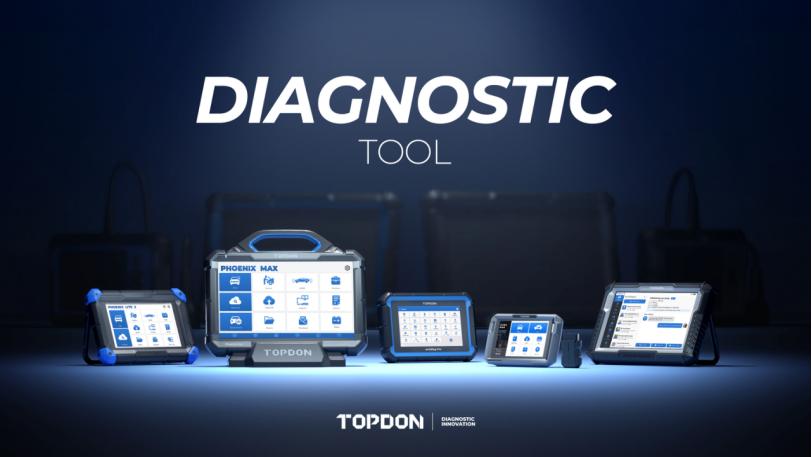
(TOPDON diagnostic product series / Source: the enterprise)
AI Upgrade:
Become the "Second Brain" for Automotive Diagnosis
The current competition in the automotive diagnostic market still mostly stays at three shallow dimensions: hardware parameter competition, vehicle model coverage race, and data update speed.
In Lou Ke's view, this is essentially the primary competition of "data porters". "Traditional tools stop at presenting information, while the real value lies in decision support."
After seeing through the essence of industry competition, TOPDON has built its own unique competitive moat — the key still lies in software, and hardware is only the carrier.
Lou Ke revealed that TOPDON has invested five years and hundreds of millions of funds to build a self-developed underlying technical architecture that is homologous with industrial giants. Its self-developed communication protocol can cover 151 passenger car brands and 105 motorcycle brands around the world, totaling more than 20,000 vehicle models, realizing true global vehicle model compatibility.
What is more noteworthy is its design concept that hardware serves software. 36Kr learned that TOPDON adopts a "Lego-style" modular hardware architecture, which allows devices of different models to share core modules and realize function differentiation through software configuration.
The direct advantage of this architecture is cost control and rapid iteration. "The same hardware platform can support new vehicle models and new functions through software upgrades," Lou Ke said. "This makes our R&D efficiency more than 3 times higher than that of traditional manufacturers."
In addition, in 2025, TOPDON officially launched its self-developed AI diagnostic platform (TopFix), which marks the company's strategic transition from a "smart hardware" company to an AI-driven "diagnostic solution" provider. Core businesses such as automotive diagnosis and infrared imaging have thus been empowered by AI, entering a large-scale, intelligent second growth curve.

(TopFix AI / Source: TOPDON official website)
"After AI arrives, the repair process will be interactive," Lou Ke described the future scenario. "Scan the vehicle, and AI will tell you whether there is a fault, whether the vehicle can be driven, whether it needs repair, how to repair it, what the spare parts are, where to buy them, how to replace them, and who to ask for help."
What TopFix AI aims to do is just like a general practitioner, who not only knows the symptoms, but also can diagnose the cause, write a prescription, give medical advice, and find a good doctor.
Compared with traditional automotive diagnosis, the first change is the reconstruction of the diagnostic path. Traditional diagnosis relies on the experience of technicians, which is the mode of "people looking for problems"; while AI diagnosis is the mode of "problems looking for people".
Through machine learning of massive repair cases, TopFix AI can establish an intelligent mapping from symptoms to root causes. TopFix not only identifies faults such as sensors, but also conducts cross-level causal inference through data stream analysis and circuit knowledge base, which is difficult for traditional tools to achieve.
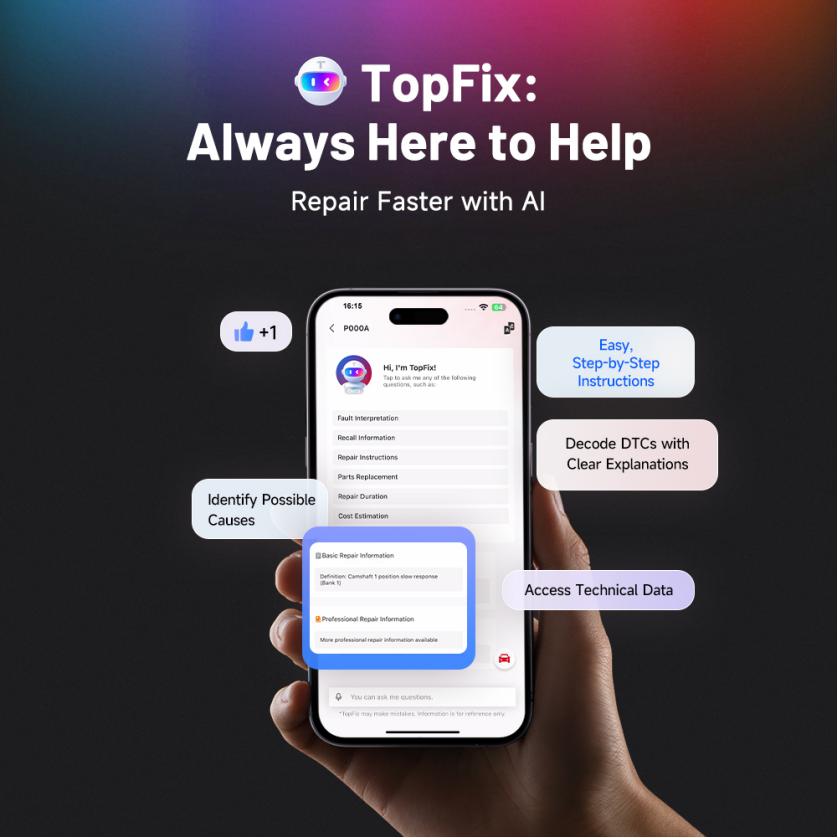
(TopFix interactive repair process / Source: the enterprise)
The second is the reconstruction of knowledge transmission method. The reason why professional-grade equipment has a high threshold is not only that the hardware is expensive, but also that the operation requires profound professional knowledge. Through interactive guidance, TopFix AI "packages" professional knowledge into a portable and communicative operation process. "In the future, even manual operation is not needed, and voice commands can complete the processing of vehicle fault diagnosis, inspection and repair," Lou Ke described. This allows industrial-grade capabilities to truly "sink" to consumer users.
The deeper reconstruction lies in the business model. TOPDON is shifting from "one-time hardware sales" to the SaaS model of "hardware for customer acquisition + continuous profit from software services". Its software revenue is expected to grow from tens of millions of yuan in 2025 to 200 million yuan in 2027.
The underlying logic of this growth stems from a continuously strengthening flywheel effect.
With the increase in equipment sales, massive diagnostic data continuously nourishes the AI model, making it more and more accurate; and more intelligent AI can attract more users. At the same time, the platform systematizes and productizes the professional knowledge traditionally scattered in the experience of technicians, and realizes monetization through subscription services; basic diagnosis serves as an entry, from which value-added services such as remote expert support and accurate spare parts recommendation are extended, continuously opening up new revenue curves.
High-quality diagnostic data will be the scarcest asset in the future automotive aftermarket. "The massive real repair cases we have accumulated will be the best 'nutrient' for AI," Lou Ke emphasized.
In the AI era, the data assets in automotive diagnosis directly determine the accuracy and commercial potential of future products.
Ecological Blueprint:
Advance from "Smart Tool" to "Diagnostic Ecosystem"
During the interview, Lou Ke confessed to 36Kr that the company is not only facing technical challenges, but also the opportunity to reshape the industrial value chain.
Traditional diagnosis is only the first step, and the real value lies in building a digital ecosystem that connects car owners, technicians, spare parts dealers and insurance companies.
This is also the reason why TOPDON decided to "go all in AI". The ambition of TopFix AI is not limited to being an intelligent function, it is positioned as a strategic platform that redefines the industry's value distribution.
At present, TopFix AI has achieved a qualitative change in diagnostic efficiency. A typical case vividly demonstrates this transformation:
An American Buick owner was at a loss when facing the "P0113" fault code, and the traditional method failed to solve the problem after several days. Guided by TopFix AI, he finally found the wire bitten off by a mouse in the engine compartment wiring harness — the entire diagnostic process changed from blind trial and error to precise positioning.
"Traditional diagnosis relies on the accumulated experience of technicians, and a top technician needs ten years to master the ability to judge complex faults," Lou Ke analyzed. "Our AI has realized the standardization and intelligence of diagnostic paths by learning millions of repair cases through machine learning."
The efficiency improvement brought by this transformation is amazing. Data shows that after using TopFix AI, the average diagnostic time is shortened from 2 hours in the traditional mode to 20 minutes, and the first-time repair rate is increased from 65% to 92%.
In addition, TOPDON is building a more imaginative industrial collaboration network.
The spare parts ecosystem extending to the upstream has become the first breakthrough. When AI diagnoses a generator fault, the system can not only accurately locate the problem, but also intelligently recommend the most matching spare parts solution based on data such as vehicle model, service life and repair history.
What is more promising is the construction of a remote expert network. "Imagine that a repair shop in a small American town can connect to a BMW expert in Munich at any time," Lou Ke described this scenario. "Through AR technology, experts can 'see' the on-site situation and guide complex repairs in real time. We plan to pilot this service in the United States in the third quarter of this year."
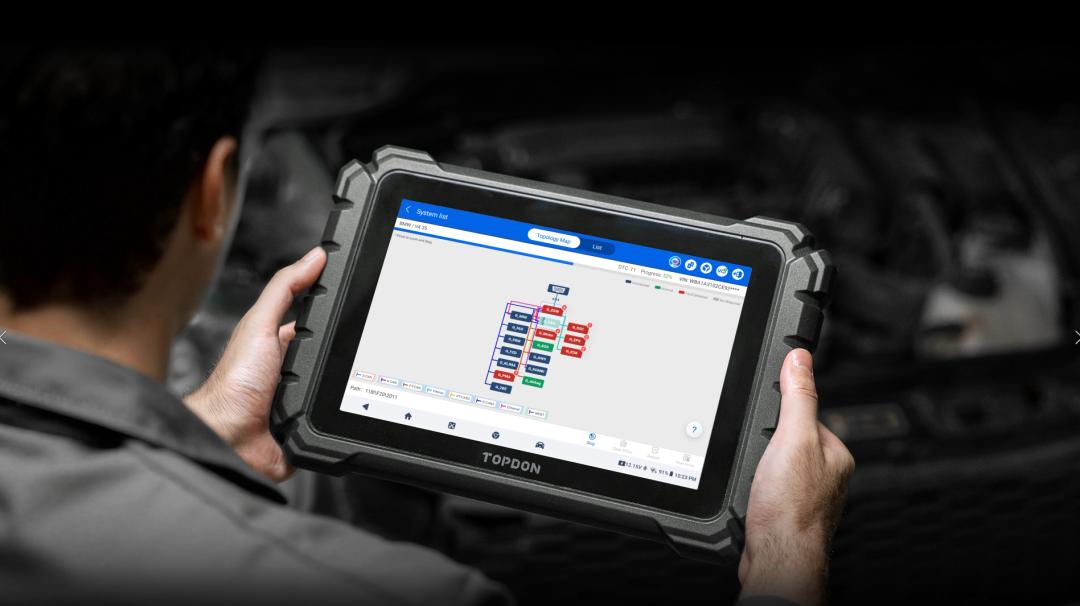
(ONE — TOPDON's new 2026 professional-grade diagnostic product)
The release of data value has also opened up the third growth curve. On the premise of strict compliance, anonymized diagnostic data is becoming industry infrastructure. Vehicle health data is of extremely high value for manufacturers to improve design and for insurance companies to make precise pricing.
A subversive idea comes from the third layer of layout — vehicle health management. "The current mode is to repair the vehicle after it breaks down, and the future mode is predictive maintenance," Lou Ke depicted a brand new scenario. "Through long-term connection between the equipment and the vehicle, AI can warn of battery degradation 30 days in advance, detect abnormal tire wear 60 days in advance, and predict gearbox risks 90 days in advance."
This means a fundamental change in business logic.