In the middle of the night in Silicon Valley, without writing a single line of code, the shepherd uncle Ralph triggered a singularity. After a good sleep, all the AI systems ran smoothly.
The Ralph Loop by the Shepherd Uncle has made it unnecessary for Silicon Valley developers to code late into the night! Without writing a single line of code, you can have all software development done by AI while you sleep.
Without writing a single line of code, you can have the entire project up and running after a good sleep.
The "magic spell" of the Shepherd Uncle's Ralph Loop is sweeping across the internet, set to trigger a revolutionary explosion in exponential productivity.
Today, Damian Player, the founder of an AI startup, shared his heartfelt thoughts -
Those who master this skill from now on will be unparalleled in three months.

Here's what happened.
The previous night, Damian was halfway through his workflow and was too exhausted to continue. So, he launched Ralph, closed his laptop, and went straight to sleep.
When he woke up this morning, he found that there had been six updates, all tasks were completed, and the system was running perfectly.
He particularly emphasized, "I didn't write a single line of code."
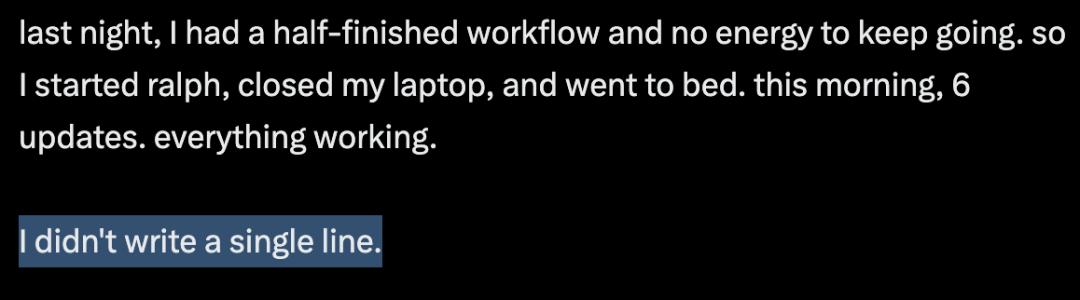
It's as if overnight, everyone can effortlessly finish their work while sleeping.
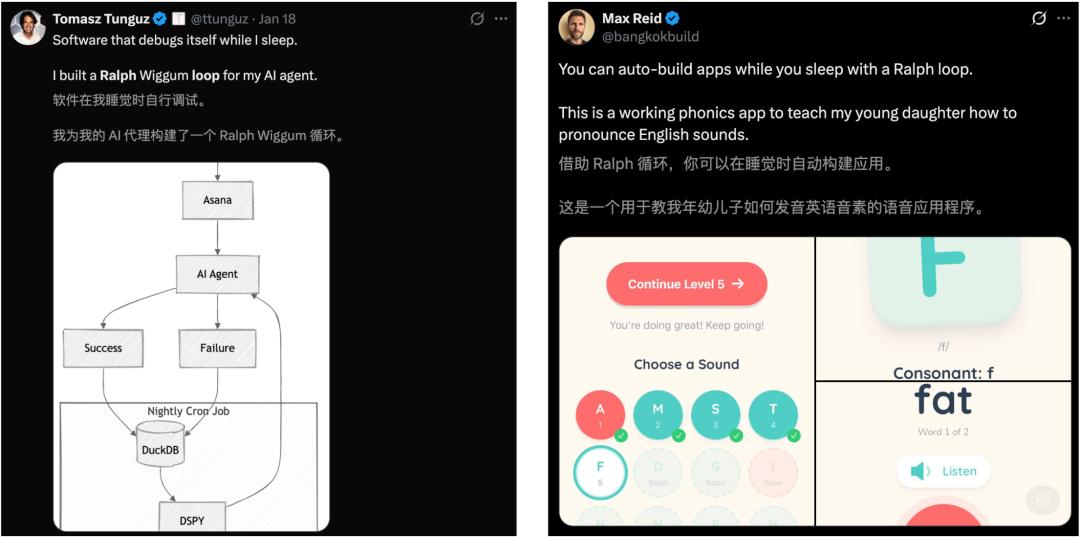
One can't help but sigh that once you learn to use certain tools, they can truly bring about a significant leap in productivity.

This "Infinite Loop" Enables AI to Code 24/7
In the following long article, Damian specifically shared some tips and experiences of using Ralph.
The name Ralph is derived from Ralph Wiggum, a character in "The Simpsons" who is always innocent yet extremely persistent.
In programming, Ralph is essentially an AI agent - an AI that continues to build software infinitely even after humans leave the computer.

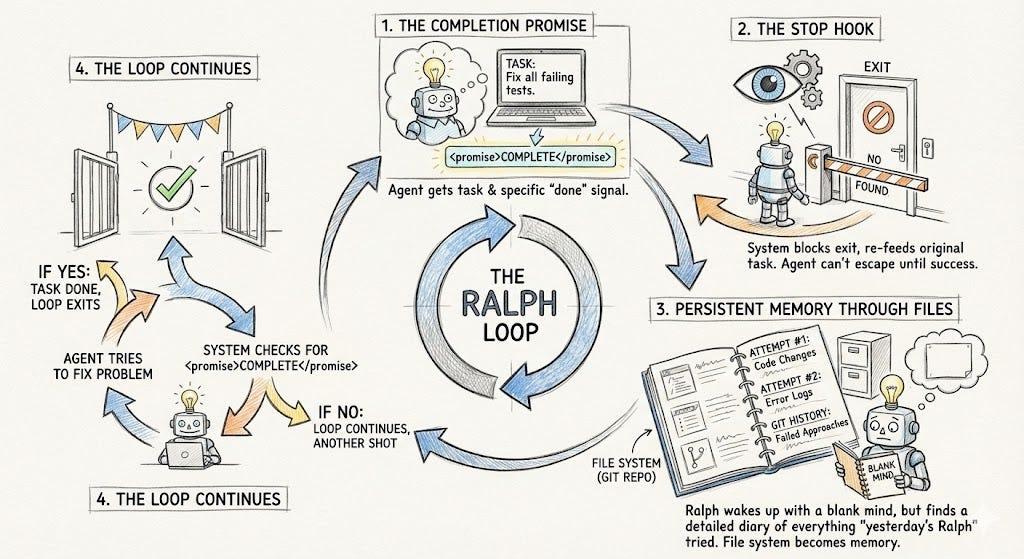
Its working method is very straightforward:
Give it a list of small tasks → Select one → Write code, test, and run → Save progress if it passes → Redo if it fails → Run again → Exit until the conditions are met.
During this process, Ralph is locked in a "while-true" iterative closed loop.
Keep looping like this until completion.
All of this can progress silently while a person is sleeping, having dinner, or doing anything else.
The most crucial thing is that Ralph Loop can solve the pain points where many ordinary AI tools crash.
When most people use AI programming tools, they only have an idea but no plan. After 45 minutes, they are still fixing the same bug for the third time.
The AI has long forgotten the original requirements, the developer's mindset collapses, and the project makes no progress.
The root cause is - the tasks are too large.
A single function may consist of 20 small parts. The AI tries to remember all the details at once, but it can't.
Ralph solves this problem by breaking down all tasks into the smallest granularity that the AI can complete and judge the correctness in one go.
There will be no confusion, and it won't stop every five minutes to ask you what to do.
This is exactly the most reliable method that excellent engineering teams have been using for decades: Just like sticky notes on a kanban, tear one off, finish it, stick it back, and then take the next one.
Ralph is the AI version of this workflow.
Developers don't need to tell the AI step by step how to build each part. They only need to describe what the final product should be like.
As a result, humans become product designers, and the AI becomes the engineering team.
Give Instructions Before Bed, and the Project is Online When You Wake Up
How to integrate Ralph into your workflow and free your hands?
Step 1: Describe What You Want
Open the AI programming tool and start entering instructions -
I want users to filter tasks by priority: high, medium, and low. A dropdown menu with all options. Select one to filter the list.
Describe everything you want, and then let the AI transform your messy requirements into a formal list of requirements.
Step 2: Break Down the Tasks
Each task needs a clear way to check whether it is successful. Pass or fail, Yes or No.
Good examples: "Add a priority column, default to medium." "The dropdown menu shows options: All, High, Medium, Low."
Bad examples: "Make it look better." "Make it more beautiful."
The AI needs to know exactly when it has finished its work without asking humans.
Step 3: Run Ralph
Launch Ralph on your computer, and it will automatically execute tasks in a loop.
Pick a task -> Build -> Test -> Save if successful -> Pick the next one. Repeat until completion.
The main advantages of this workflow are as follows:
Each round starts afresh: Each task starts in a clean environment. There is no accumulated chaos.
Clear success criteria: The AI knows whether it has succeeded or not without asking humans. It's a binary result.
Compound knowledge: Each round records what it has learned. The next round reads these logs. The same mistake won't be made twice.
However, you must spend most of your time on describing the requirements.
Vague descriptions = poor output. Large tasks = failure. Unclear success criteria = the AI doesn't know when to stop.
Spending an hour on requirements can save you ten hours of fixing and patching.

It can be said that the description is the "contract" between the developer and Ralph. As long as the contract is written correctly, the rest is fully automated.
There are two ways to run Ralph, and you need to choose according to the specific tasks -
AFK Ralph: Set it to run overnight, and the function will be ready when you wake up. Suitable for straightforward tasks with clear requirements.
Hands-on Ralph: Run one round at a time, review each update, and provide guidance when needed. Suitable for complex functions where you want more control.
Even in the hands-on mode, it is faster than the ordinary AI prompt interaction. This structure allows developers to focus on "what needs to happen" rather than "how to make it happen."
As for the cost, a typical Ralph run with 10 rounds of loops costs about $30.
A developer used Ralph to deliver, review, and test an entire application, spending less than $300. If hiring someone, it would cost $50,000.
During a startup hackathon, a team used it to launch six different projects overnight.
Someone even used Ralph entirely to build an entire programming language from scratch in less than three months.
Damian Player said that we also need to manage our expectations. It doesn't mean that humans can just sit back and do nothing when the AI is working.
Developers still need to review what the AI has built, still need to test it themselves, and still need to fix edge cases.
A typical result is that Ralph completes 90% of the work, and humans spend an hour finishing the remaining 10%.
The real victory lies in that humans can turn a whole day of focused work into an hour of cleanup work. Moreover, all of this runs while you are sleeping.
It's Really Too Late if You Don't Learn Ralph Now
Most developers spend 6 - 8 hours writing code for each function.
Now, by learning the skill of Ralph, you only need to spend one hour writing requirements, and the work will be done when you wake up.
This is not a slight advantage. It's a five-fold increase in output within the same time frame.
If you compound this advantage over three months, while others are still debugging manually, you will have launched ten projects, built a portfolio, won clients, and accumulated skills that they haven't even started learning.
The gap between "those who can use Ralph" and "those who can't" will be huge. Moreover, if you don't seize this opportunity, you won't have any advantage left.
I Killed Software Development with My Own Hands
Recently, the Shepherd Uncle, Geoffrey Huntley, sighed in his latest article "It's All About Ralph Loop" that his personal programming method has completely changed.
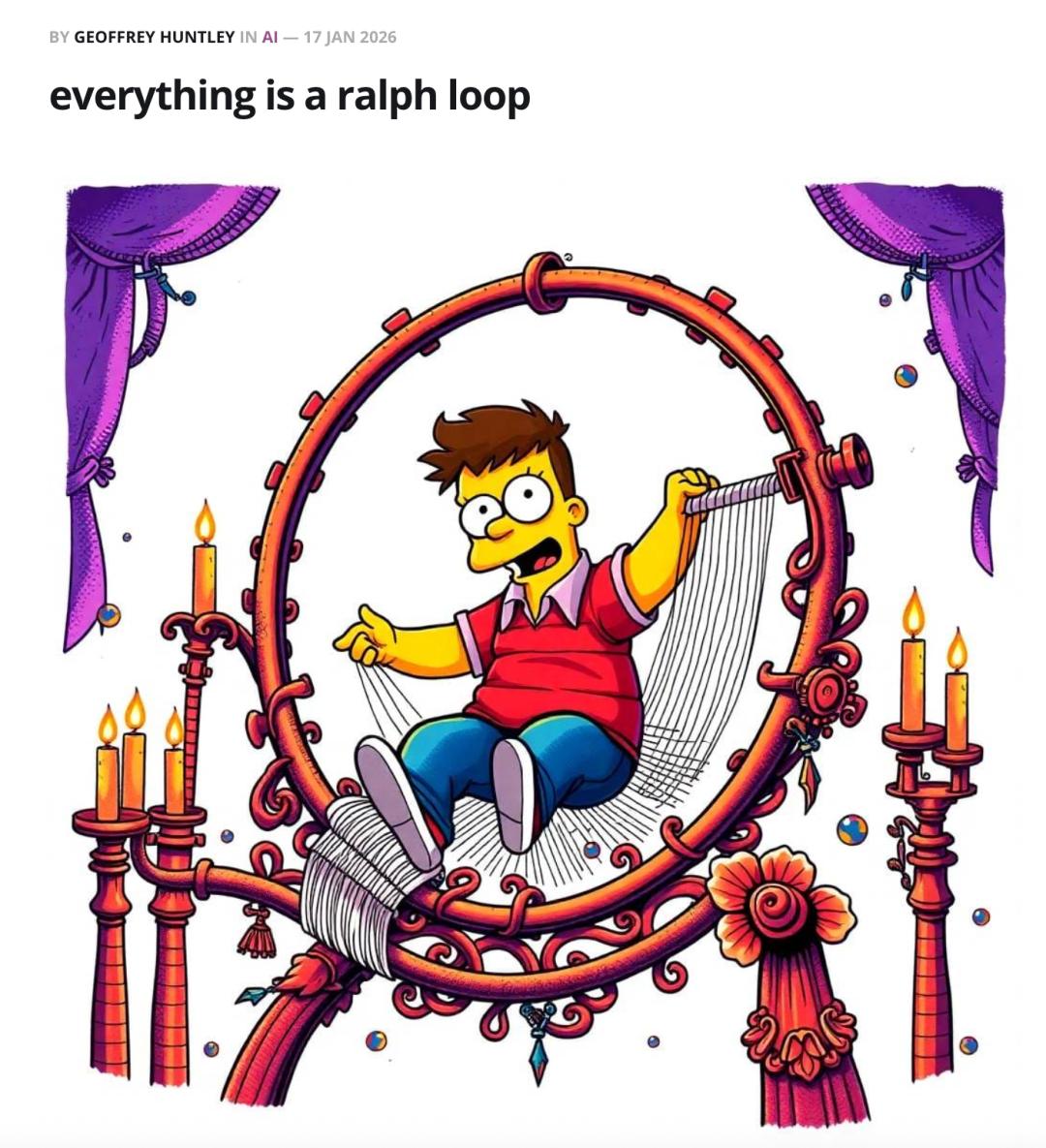
In the past, standard software development was like playing "Jenga," where you had to build brick by brick.
Now, Geoffrey sees everything as a "loop," which is also the core of Ralph: These computers (LLMs) can be programmed.
Ralph is an orchestration model where developers assign the required background specifications, give it a goal, and then keep looping around this goal.
Observing this loop is crucial because it is the source of personal development and learning.
When developers encounter a failure domain, they "put on their engineer hats" to solve the problem and ensure it doesn't happen again.
The Shepherd Uncle said bluntly that there is now a dividing line in the circle -
Some software engineers openly reject AI or only use tools like Claude Code/Cursor to speed up the "building block" process.
But I have to say... Software development is dead - I killed it with my own hands.
Now, the cost of software development is even lower than the salary of a McDonald's burger flipper. Moreover, it can build itself while you are AFK.

Geoffrey revealed his latest project: The Weaving Loom, which is the result of his conception over the past three years and is the infrastructure for evolving software.
Let AI Work While You Sleep
Unknowingly, AI has evolved to such a terrifying level that now Silicon Valley developers all go to sleep and let AI do the development at night.

The venture capitalist Tomasz Tunguz exclaimed, "The software is debugging itself while I'm sleeping."
An accidental exploration led Tomasz to start his Ralph journey.