Car companies are offering "seven-year low-interest loans". Is it a real benefit or a hidden trap?
In 2025, in terms of the car - manufacturing business alone, Tesla's performance was undoubtedly disappointing.
336,000, 384,000, 497,000, and 418,000 were its specific global delivery figures for the four quarters respectively. After a sluggish first quarter, there was a slight improvement in the second quarter. After reaching a high point in the third quarter, there was a very unexpected sharp decline in the fourth quarter.
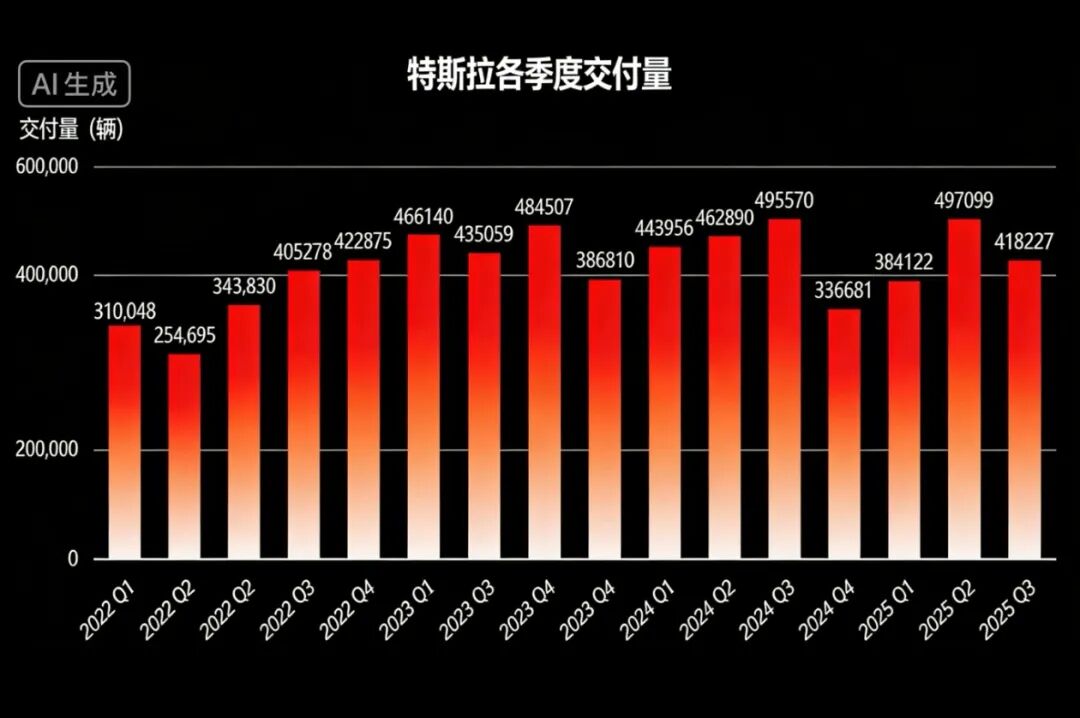
Ultimately, this American new - energy vehicle manufacturer ended its past 365 days with 1.636 million vehicles, which was a somewhat embarrassing conclusion. Compared with 1.789 million vehicles in 2024, the year - on - year decline exceeded 8%. It was even further away from the 1.808 million vehicles in 2023.
Two consecutive years of "negative growth" have completely sounded the alarm for this American new - energy vehicle manufacturer.
At this moment, 2026 has already begun. The urgent task in front of Tesla is to boost orders as soon as possible, especially in those major markets, such as the Chinese market.
In 2025, according to the statistics of the Passenger Car Association, its retail sales volume in China was 625,000 vehicles, a year - on - year decrease of 4.78%. The wholesale sales volume including exports was 851,000 vehicles, a year - on - year decrease of 7.08%.
The overall situation is not optimistic.
However, there is also good news. That is, it basically maintained its pricing system without large - scale official price cuts. Instead, it continuously stimulated and leveraged potential end - customers through financial policies.
In 2026, Tesla seized the opportunity to continue to increase its efforts. On the one hand, it launched a "five - year interest - free" plan for the six - seat Model Y L. On the other hand, it also launched a "seven - year ultra - low - interest" plan for the rear - wheel drive version, long - range rear - wheel drive version, long - range all - wheel drive version of Model 3 and Model Y, as well as the six - seat Model Y L for the first time.
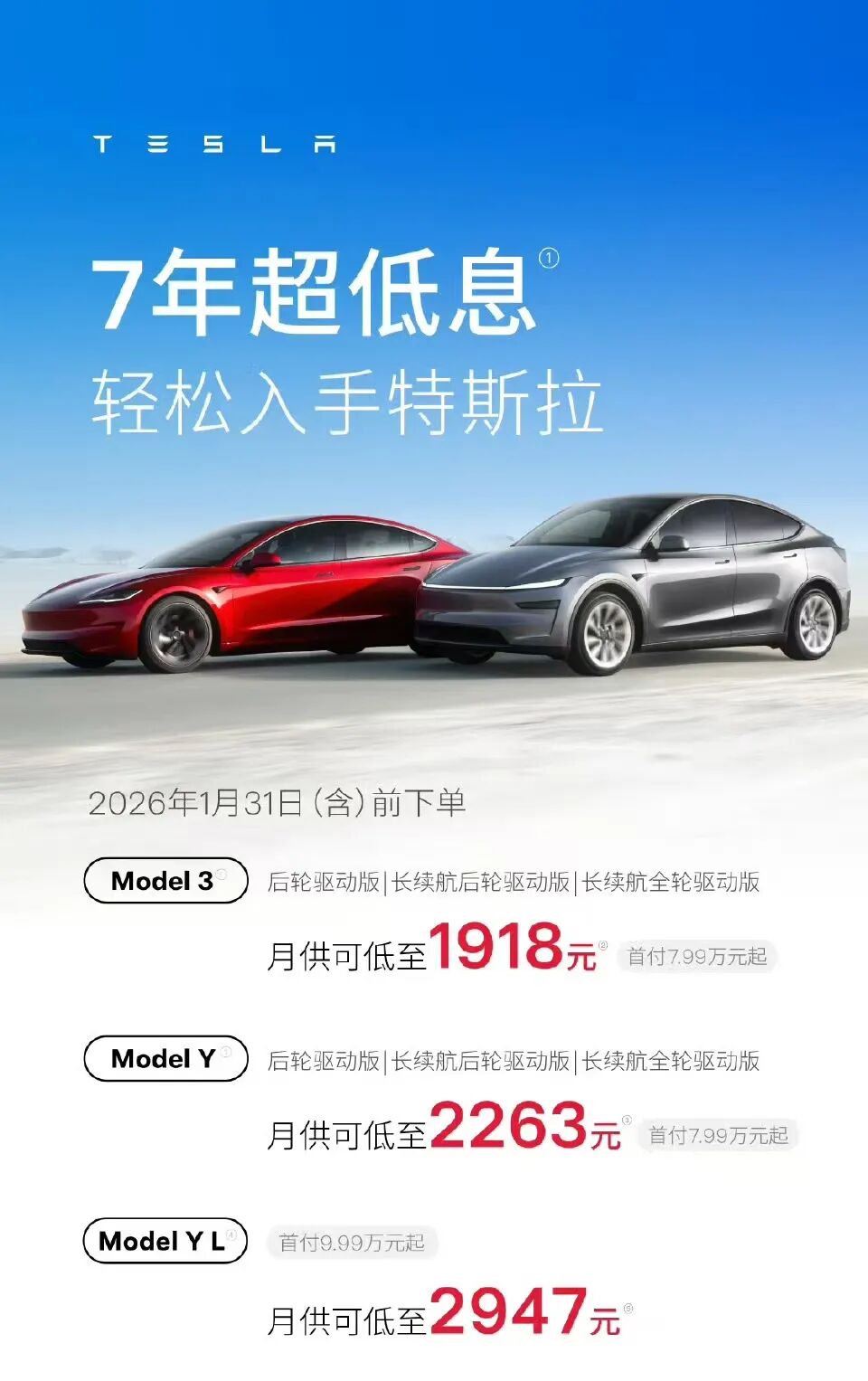
Especially the latter quickly sparked enthusiastic discussions among people.
Taking the rear - wheel drive version of Model 3 as an example, the current official website price is 235,500 yuan. Without any optional extras, the down payment is 79,900 yuan, the loan amount is 155,600 yuan, the monthly payment is 1,918 yuan, divided into 84 installments in total. The annualized rate is 0.5%, equivalent to an annualized rate of 0.98%. The annual principal and interest are only about 800 yuan, and the total interest for seven years is only more than 5,000 yuan.
Undoubtedly, Tesla's "seven - year ultra - low - interest" plan has once again greatly lowered the so - called car - buying threshold. It is very suitable for consumers who have a tight budget in the early stage, pursue low monthly payments, and plan to hold the car for a long time. Or, for users who have better investment uses for their funds, after all, the annualized rate of 0.98% is far lower than the 4% - 8% stipulated by the general auto loans in the market.
"With a down payment of less than 80,000 yuan, you can buy a Model 3 and drive it for about seven years. The monthly repayment is less than 2,000 yuan, just like renting a car. After seven years, if you don't want to drive it anymore, you can resell the car. It is estimated that the residual value will still be about 50,000 yuan. To be honest, it's quite cost - effective. It's very suitable for me, a Buddhist office worker with basically no major changes in my life."
It's not a fabrication. As soon as Tesla launched the "seven - year ultra - low - interest" plan, a childhood friend of mine quickly sent me a message. You could feel his high interest from his words.
Taking this as an example, this wave of intensified financial policies in China is undoubtedly showing its due effect.
Looking further, right before the Spring Festival, in the so - called off - season, this American new - energy vehicle manufacturer has clearly stated its purpose - to start a good year in China in 2026 with sincerity while trying not to damage the pricing system.
Interestingly, as Tesla's biggest competitor, Xiaomi Auto, which put great pressure on Tesla in 2025, quickly followed suit.
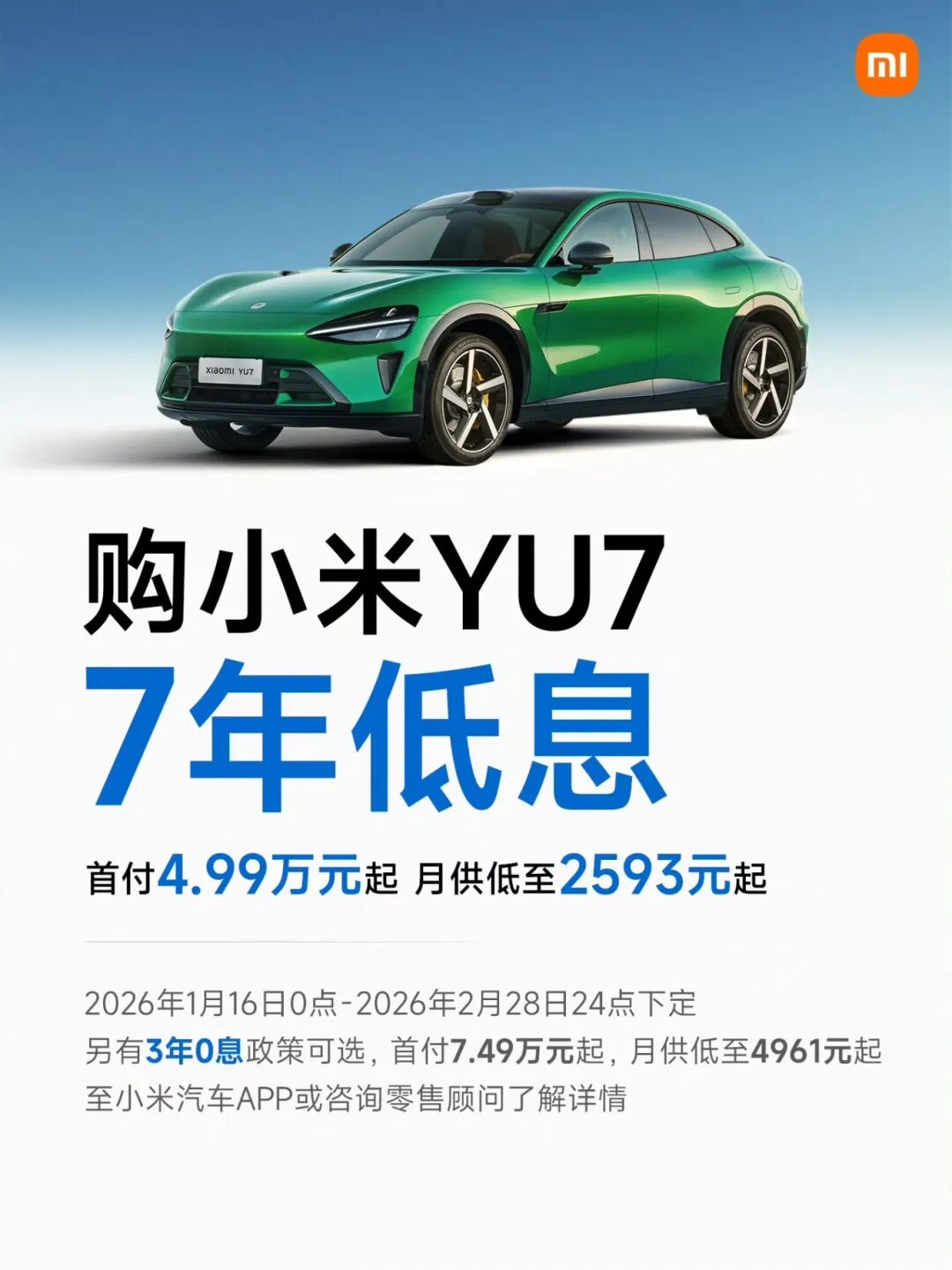
Not long ago, during a live - broadcast, Lei Jun personally announced that in response to users' expectations for flexible car - buying, starting from 0:00 on January 16th, a "seven - year ultra - low - interest" plan for the YU7 would be officially launched, applicable to users who place orders before February 28th, 2026 (inclusive).
According to the new policy, consumers who buy the YU7 can enjoy a minimum down payment of 49,900 yuan, with monthly payments as low as 2,593 yuan. The loan term can be up to seven years.
Undoubtedly, Xiaomi's "move" clearly referred to Tesla. During the live - broadcast, Lei Jun even said bluntly, "Many Mi fans left messages hoping that we could also provide similar support. We listened carefully to everyone's voices."
In my eyes, such a quick follow - up shows, on the one hand, the strong execution ability and efficiency of this rising Chinese new - energy vehicle manufacturer. On the other hand, it also reflects that the competition at the end - customer level is still intensifying, and Xiaomi also has considerable anxiety in terms of new orders.
In essence, the "seven - year ultra - low - interest" plan can be completely understood as a disguised price war launched by car manufacturers through sacrificing profits. It is foreseeable that more and more brands will follow suit.
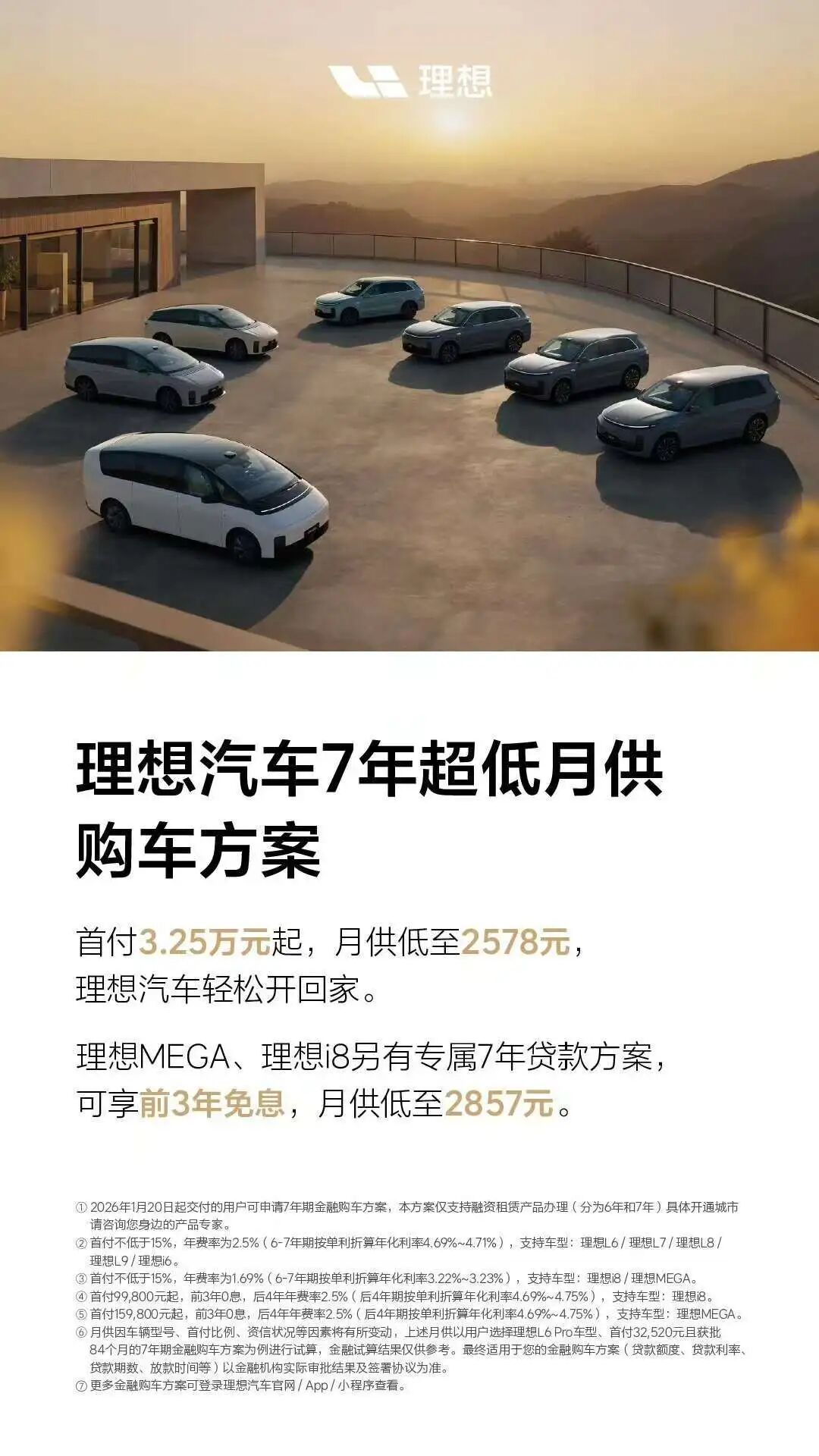
Sure enough, just this week, Li Auto, which is under pressure in terms of sales in 2026, decided to join the game. According to the official poster, "With a down payment starting from 32,500 yuan and monthly payments as low as 2,578 yuan, you can easily drive a new car home." There are also exclusive seven - year loan plans for the MEGA and i8, with interest - free for the first three years and monthly payments as low as 2,857 yuan.
In addition, according to netizens' revelations, even earlier, all models of Dongfeng Yipai also followed the "seven - year low - interest" plan. Against this background, I can't help but recall an interesting view I learned during a discussion with a senior industry expert.
From his perspective, in the era of electrification where the game rules and the overall pattern are being completely innovated and reshaped, the financial policy plays of major car manufacturers should be bolder and more diverse.
"Seven - year ultra - low - interest" is nothing. "Ten - year ultra - low - interest and zero - down - payment" is more interesting. In fact, a real on - demand subscription long - term rental service should be launched to completely break the traditional car - buying model. It not only lowers the selection threshold, but also increases user stickiness and ensures profit returns.
Perhaps, in the eyes of some skeptics, such a way may seem a bit extreme. But I believe that in the highly competitive Chinese auto market, there is still huge innovation space and flexibility in the sales process.
Of course, past experience tells us that every coin has two sides.
Regarding the fact that many new - energy brands have successively followed Tesla's "seven - year ultra - low - interest" plan in 2026, there is another analysis that says, "Most people only see the reduction of the monthly payment pressure, but ignore the uncertainties brought by the extended time."
In other words, according to the current iteration speed of smart electric vehicles, there will definitely be earth - shattering changes in the technical dimension after seven years. The popularization of solid - state batteries and the implementation of autonomous driving are not impossible.
And you are still repaying the loan for an "old car".

In contrast, the more embarrassing problem is depreciation. Once the entire industry really experiences the next stage of technological explosion, the residual value of the "old car" will decline even more rapidly. Maybe after only three to four years, its market price will be lower than the loan balance.
It's not an exaggeration to say that "in this crazy and competitive era, you need to be extremely cautious when locking in a current product with long - term debt."
Of course, the purpose of elaborating on the above content is not to bad - mouth the "seven - year ultra - low - interest" plan. It's just to remind everyone that any financial promotion definitely has its "pros and cons".
Don't just get excited and blindly place an order because you think it's a great deal. Ignore the uncertainties brought by the extended time. It's never too late to make a decision after considering the consequences and costs clearly.
In short, as the saying goes: "Weigh your own situation and act within your means."
This article is from the WeChat public account "Automobile Commune" (ID: iAUTO2010), author: Cui Liwen, published by 36Kr with permission.