a16z finally clarified the investment logic of AI. There are only three truly valuable paths left.
In the past few years, the AI field has witnessed a dizzying growth story. The capabilities of models have increased exponentially, software companies have achieved astonishing growth from zero to billions, and the narrative of "software eating the world" has convinced people that AI will reshape almost all industries.
Has the application of AI created real and sustainable business value? When the technological dividend slows down, what is the real moat for enterprises? In an era when software can be quickly replicated, what barriers cannot be easily crossed?
Today, we focus on the in - depth sharing of Alex Rampell, a partner at a16z. As a senior investor in the fintech and software investment fields, he doesn't just stay at describing trends. Instead, he systematically disassembles the core of driving growth - the product life - cycle theory, and points out that the current explosion of AI value essentially hits the eternal human need to be "lazier and richer".
He has distilled three types of investment directions with the greatest potential at present:
① AI - native transformation of traditional software
② Software's substitution of labor
③ Value reconstruction based on "walled - garden" exclusive data
This article will in - depth interpret this framework, reveal how competitive advantages will shift to the application layer and data layer against the backdrop of increasingly homogeneous infrastructure, and provide readers with an AI roadmap that goes beyond the technological appearance and points directly to the business essence.
How AI Meets the Human Need to be "Lazier and Richer"
Since 1977, the Nasdaq index has shown an upward trend in the long run, but it has experienced several sharp drops in between. This corresponds to four main product cycles. The pattern they show is: First, companies at the infrastructure layer pave the way, and then teams at the application layer develop actual products.
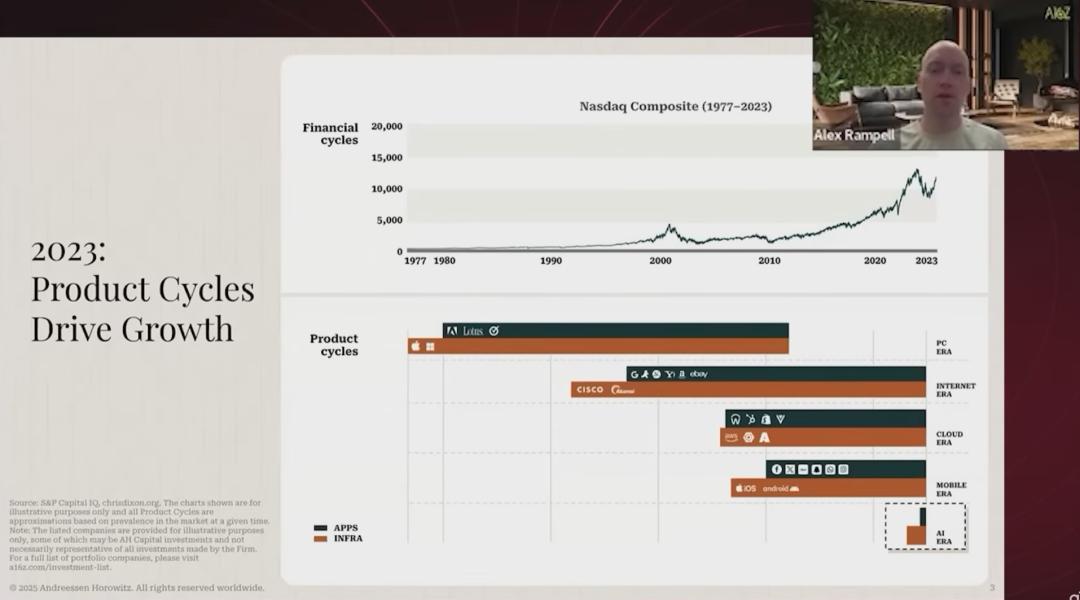
It started with the PC era, followed by the Internet era, and then the mobile era. The AI era has arrived. Currently, the vast majority of new revenues in the software field actually come from AI, both at the application level and the infrastructure level.
Whenever a bull market in technology stocks arrives, there are always people saying "it's just a bubble" or "it won't work at all". Take the credit - card expense management company RAMP as an example. Data from January 2025 shows that many enterprises adopting the technology - upgrade path are not traditional giants like General Electric, but more forward - looking technology companies in the San Francisco Bay Area or New York with thousands of employees. They suddenly realize: "Wow, this thing is really amazing!"
I always hold a general view of human behavior. Everyone desires two things: to become richer and to be lazier. This is exactly the core value targeted by generative AI, and this trend is truly emerging now.
Although the growth curve was once flat, its impact has been very significant, from cost expenditure to corporate growth, whether at the infrastructure or application level. Currently, about 15% of adults worldwide use ChatGPT every week, and it has become a daily habit: for making bets with friends, asking for directions, or when they don't understand something.
Everything is developing rapidly. In 2017, the paper on the Transformer model was published, attracting wide attention. Our long - term partner Frank Chen once demonstrated an early GPT model, and the effect was not ideal.
This reminds me of the Eliza system in the 1960s, an AI therapist that just turned your words into questions. Until you ask: "Hey, I want to complain to the school about the school - bus driver." It would just ask back: "Why do you want to complain to the school about the school - bus driver?" Obviously, it didn't provide an answer.
It's hard to imagine that this happened just a few years ago. But from 2023 to now, we have truly entered the golden age of application.
We are witnessing software companies achieving a leap from zero to 100 million US dollars in revenue within one or two years. This is not blind consumption during an active economic period, but these technologies can create huge value for enterprises. They want to be lazier and richer, and this technology is opening the door for them.
AI - Native Transformation: Greenfield Transition and Labor Substitution
Next, I will discuss three broader themes in the field of AI applications, which are the types of companies we invest in.
First, traditional software is transforming into AI - native, and the current opportunity lies in AI - native.
As an investor, I deeply understand a key experience: Mercury is an excellent example of "the tortoise beating the hare". They have created a new bank for startups, which can not only help you pay bills but also provide accounting services. This is a typical greenfield investment opportunity.
On this "bingo game board", whether it's payroll, ERP, or customer - service software, existing enterprises are actively adopting AI. Companies like Workday are about to start charging for AI functions. For example, the system might ask: "Do you want us to conduct a background check on each new employee?" Each check costs 500 US dollars. Why not 499 dollars?
The most successful enterprises have established deep ties with customers, resulting in extremely high switching costs.
In the RPA (Robotic Process Automation) field, traditional "pay - per - seat - per - month" models, like those of UiPath or Zendesk, are facing challenges. Customers will think: "If 99% of inquiries can be automatically solved by AI, why should I pay for idle human - staff seats? I'd rather pay for the actual results achieved."
Therefore, the truly worthy companies to invest in are those that can build and maintain such an advantageous situation, rather than those simply pursuing customer growth. When the underlying AI models become increasingly homogeneous, the real competitive barriers often lie in 'data that others can't access' .
Second, software is replacing labor, which is a much larger market.
If the transformation of traditional software by AI is "optimization", then its replacement of labor means "reconstruction". This is the emerging field I'm most looking forward to personally.
Previously, few software companies could truly enter this field because the mainstream choice in society has always been to hire professional talents. But now, the situation is different: software can complete 90% of the core workload of a position, it masters 21 languages, and it never stops.
This is a landmark event in software history. Take the Plaza Lane Optometry Center as an example. Their job description for a front - desk receptionist has eight requirements. If you can provide a software that meets five of the core responsibilities, they will "hire" this software.
Enterprises won't pay a software the same 47,000 - dollar annual salary as a human employee, but they also won't pay only 500 dollars. A reasonable price might be 20,000 dollars per year.
Our investment logic is to hope that such software can further evolve into an irreplaceable "core business record system". In this way, when the software performs five job duties, no one can easily replace it with an annual fee of 19,999 dollars. We hope to ensure that this solution can bring highly sticky long - term value.
It can be predicted that when existing software products launch better alternative solutions and target the greenfield market, their market value will increase significantly. In this case, choosing the brownfield market may even provide higher pricing space. This path can bring far - exceeding - expected revenue growth.
Take the legal industry as an example. Its high requirements for document processing are naturally compatible with the capabilities of AI. This market has a unique feature: especially plaintiff lawyers usually adopt the contingency - fee model, which means they only get paid if they win the case. This model aligns the interests of lawyers and clients highly. They don't charge by the hour but share the final results.
Therefore, for every 10 potential cases a plaintiff lawyer gets, they usually only take on 1 because screening and evaluating cases require a lot of time. This is where AI can play a huge value.
On the contrary, for corporate lawyers who charge by the hour, if AI increases the efficiency of junior lawyers by 50 times, it may erode their revenue model. But for plaintiff lawyers, a 5 - fold increase in efficiency means potential revenue may increase by 5 times or more.
The Eve company we invested in is a good example. Their product concept is very clear: they are committed to controlling the end - to - end workflow from screening potential clients to the final conclusion of the case.
Eve recently launched a voice assistant specifically for collecting potential client information. It can screen information from a large number of medical records and employment documents to help lawyers judge the value of a case, such as "this case may be worth 50,000 dollars, that one is worth 5 million dollars, and you should spend your time here".

Furthermore, the system can assist lawyers in sorting out the entire litigation process: automatically organizing medical records, generating legal claim letters, and preparing formal prosecution documents.
The most interesting part of this business is the data closed - loop. When Eve starts generating result data, this data is not public, and large laboratories cannot use it. Eve can use this proprietary data for back - analysis to find out the key variables that determine the value of a case, thus forming a better model.
As we analyzed, this method significantly lowers the threshold for lawyers to accept cases. In the past, considering the cost, lawyers might only take cases with a claim value of over 50,000 dollars. Now, with the help of AI, they can economically handle cases with a claim value of 5,000 dollars.
The total market volume of legal services has thus expanded. On the plaintiff side, there has long been an obvious imbalance between supply and demand, and Eve is precisely releasing this suppressed demand. As a result, the market's eagerness for such products far exceeds expectations. Because it perfectly fits the principle of "being lazier and richer", it can help law firms increase revenue and provide affordable legal services for more people.
What Eve represents is the business model we advocate. Its revenue has increased from 0 to 20% - 30% in a short period, which seems amazing. But as long as you can act quickly and truly fulfill the promise of "making me more efficient and more profitable", this kind of growth is a replicable norm.
Of course, many consumer - level AI applications have difficulty accessing core business processes, and as tool components, the user switching cost is very low. The key here is to distinguish between 'functional differences' and 'business moats'.
AI can create strong functional differences. For example, a voice assistant that can speak 50 languages and collect information intelligently can bring significant value by itself. But relying solely on functional advantages is not enough to build a solid moat. Eve's moat lies in the fact that it is not a single tool but replaces and integrates the entire workflow of lawyers, becoming the "central system" of business operations.
In addition, that crucial "X - factor" is still the exclusive data generated in the business closed - loop. The privacy of data creates a strong competitive advantage: the more cases Eve handles, the smarter the product becomes; the smarter the product is, the more cases it can attract. It's like bringing an automatic rifle to a cold - weapon battle. It will soon become a must - have for plaintiff lawyers and is difficult to replace once deeply adopted.
Therefore, the key to competition is not the accuracy of voice recognition or the elegance of document summarization, but whether the system has the ability to be the recorder and generator of the final work results.
We often say that "software is eating the world", and now, we are developing and deploying these "softwares" at an astonishing speed. But this is also increasing the risks for all high - profit software companies. High profit itself is a signal attracting competition. If I can easily write code to replicate your core functions, then your product must have extremely strong user stickiness and unique competitive advantages, and data is often one of the strongest barriers.
In an industry like trucking with 3.5 million practitioners, there will surely be better AI scheduling and driving - assistance solutions in the future. But in most cases, it's a dynamic balance between cost and value. Enterprises won't hire labor with a cost higher than the value it creates. Introducing AI is to find this balance again on the premise of increasing value or keeping it unchanged.
You will widely adopt AI as an enhancement tool, but you won't immediately lay off a large number of human employees on a large scale. What's more worth thinking about is that we can't predict what new occupations will emerge in the future. 75 years ago, there were no positions like "product manager" or "user - experience designer", and they made no sense in the context of the 19th century.
Therefore, we shouldn't arbitrarily think that AI will only replace human labor. In fact, what we observe more is that AI enhances human efficiency rather than simply replacing it.
When I'm on the phone with a friend, the system can automatically judge and prompt applicable traffic regulations based on his geographical location, such as traveling from California to Kansas. This is the power of the data model. Because it has processed millions of calls, it can accurately master the response content and achieve extremely low latency.
They handle complex scenarios so smoothly that it becomes extremely difficult for latecomers to compete. In today's era when software development has become unprecedentedly convenient, the importance of this "model" formed by the deep integration of data and scenarios has exceeded any previous time.
Data Barriers: How to Turn "Public Resources" into "Exclusive Assets"?
Vertical software companies have long been able to grow into industry giants. For example, Toast locks in customers with its catering - specific system and payment/loan services. The same applies in the AI era.
This is not just a matter of "a penny difference in labor cost". The key is to establish an exclusive record system and vertical operation system so that customers can't easily switch to cheaper suppliers.
This leads to the third theme, which I call the "walled garden", and this concept is particularly important at present.
Take OpenAI as an example. They were originally like a "vegetable farm", selling large - scale foundation models to developers. Later, they wanted to open a "restaurant" in the farm and directly develop applications for end - users themselves. This made the developers who originally purchased "vegetables" unhappy: the supplier suddenly became a competitor. This example is very instructive as it reveals a future trend: when basic technologies become increasingly popular, the real scarcity will shift upstream in the industrial chain - that is, high - quality, exclusive "raw materials" (data).
Just as value was created by demarcating boundaries and setting up toll - booths in history, in the data field, such "walls" can also be built.
Take Flight Aware as an example. Their data itself doesn't involve business secrets, but it has extremely exclusive value. After the Malaysia Airlines Flight MH370 incident, the civil - aviation field widely adopted the ADS - B (Automatic Dependent Surveillance - Broadcast) system. Planes broadcast signals such as real - time position, altitude, and speed. Theoretically, anyone can buy a receiver on Amazon to capture these signals.
But Flight Aware's barrier lies in the fact that they have carefully deployed about 100 receiving antennas globally. Through long - term and systematic collection and cleaning, they have built a coherent, complete, and highly available global flight - tracking database.
This kind of deeply processed data has a very high signal - to - noise ratio, which cannot be directly accessed by general AI like ChatGPT. Similar examples include Pitchbook's private - financing data, Bloomberg's real - time financial data, and Co Star's real - estate data.
Another example is Ancestry.com. They built a unique family - history database by purchasing the genealogy records collected by the Mormon Church and continuously investing in digitization. This data forms their "walled garden". This data cannot be accessed on ChatGPT or Anthropic. Even if they open API authorization, the core value lies in the exclusivity and integrity of the data.
This exclusivity is directly translated into pricing power. For example, using Pitchbook's data: if an analyst needs to write an in - depth report on a company or compare the historical performance of all legal - technology companies, Pitchbook can provide a complete data panel of the Series B financing of every legal - technology company since 1992.