Big Tech Companies Compete in the Voice Recorder Market: A Stealthy Battle for the AI and Data Entry Ecosystem
Who could have thought that the competition among tech giants in the audio recording market is intensifying!
From DingTalk's launch of its smart hardware product line last year to Feishu's joint release of the "Recording Bean" with Anker Innovations at the beginning of this year, a clear and accelerating trend is emerging: the two major domestic collaborative office giants are extending the battle from the cloud to the offline world, targeting the once "traditional" and somewhat marginal hardware category - the voice recorder.
However, this is no longer the voice recorder we used to know. Empowered by AI, it is evolving into a "smart office assistant" with multiple functions. What's more interesting is that this hardware competition led by DingTalk and Feishu is attracting more and more players of different types. For example, Insta360, a new hardware force that has established itself in the market with panoramic cameras and action cameras, has also joined the fray. Suddenly, this seemingly niche market is presenting a complex situation of "old vs. new, hardware vs. software, and ecosystem confrontation."
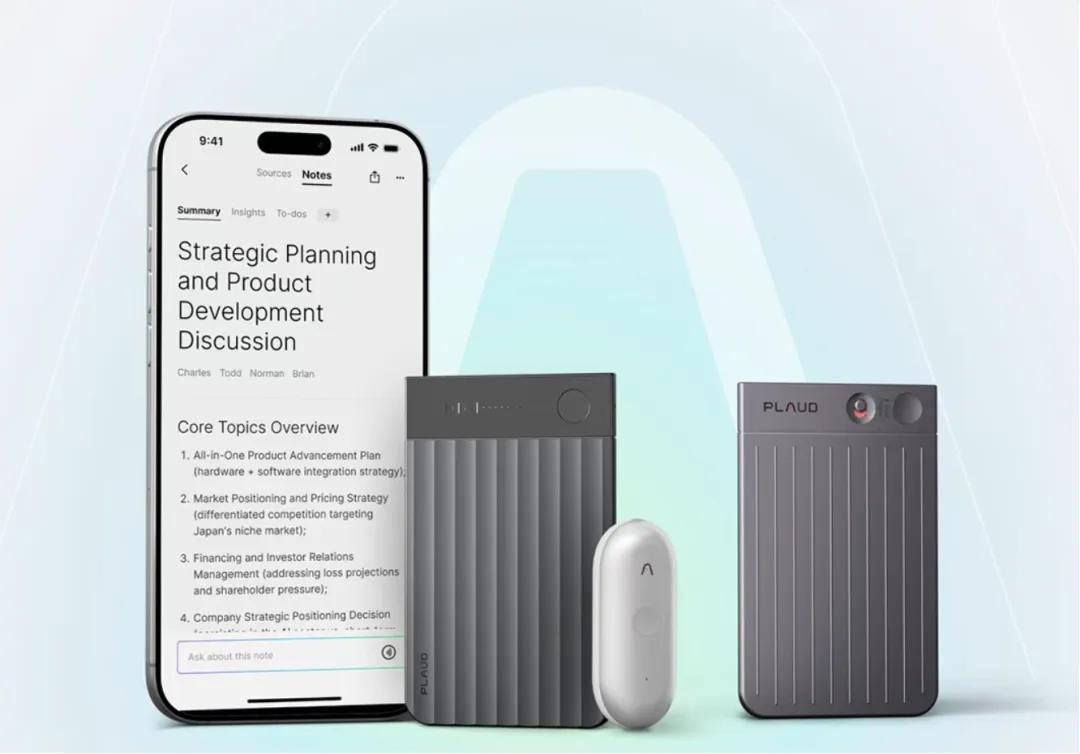
Of course, there is an undeniable "model" behind all this enthusiasm: Plaud. This AI voice recorder brand, which became an instant hit on overseas crowdfunding platforms, has proven to the market with real sales and user reviews that in an era where remote work and hybrid meetings have become the norm, people have a strong and willing-to-pay demand for efficient, seamless, and intelligent meeting information recording and organization. Plaud's success is like a stone thrown into a lake, stirring up ripples in the hearts of domestic tech giants.
However, is the collective investment of tech giants in AI audio recording hardware just to replicate Plaud and compete for profits in the hardware market? The answer is far from that simple.
In the deeper logic of To B (enterprise services), this is more like an attempt to "complete the ecosystem" and "seize the entry point." For a long time, Internet giants represented by DingTalk and Feishu have concentrated their core advantages and revenue on software and services: instant messaging, online documents, process approval, project management, etc. They have built a vast digital office kingdom, but in the physical world, on employees' desks, there has always been a lack of a highly sticky hardware entry point under their control.
However, the explosion of generative AI and multi-modal large models is redefining the form of human-computer interaction and the starting point of data flow. Whoever controls the closest and most natural data collection entry point to users may gain an advantage in the next generation of AI applications.
Even immature AI glasses and AI headphones have attracted the frequent exploration and layout of tech giants. Then, the AI voice recorder, with relatively mature technology, proven demand, and the ability to perfectly support voice interaction and multi-modal understanding, naturally becomes a "gold mine" not to be missed. It is not just a "pen," but an excellent carrier to materialize and productize their AI capabilities and directly reach a large number of enterprise users. A "dimensionality reduction attack" and "ecosystem encirclement" from software to hardware have already begun.
01 Why has AI audio recording become a "gold mine" for tech giants?

Plaud's story is a perfect market enlightenment. This hardware, with a simple design and the main features of "one-click recording and AI automatic summary and to-do list generation," raised over one million dollars on Kickstarter and has been selling well in the global consumer market ever since. It clearly sends a signal that the long-standing "pain point" of meeting recording and organization for office workers is being elegantly solved by AI hardware. Users are willing to pay for the saved time and improved efficiency. Data shows that this is not just a toy for niche geeks, but a broad-based office productivity market. What's more interesting is that even big names like investor Zhu Xiaohu have sighed that Plaud has an almost perfect monetization path, which has brought quite a shock to the money-burning AI industry.
It has to be said that this successful case is like a spotlight shining into the strategic meeting rooms of domestic tech giants. It answers a key question: the demand is real, and the market is willing to pay. But this is just the beginning. For DingTalk and Feishu, entering the AI audio recording hardware market is based on a deeper set of combined logic that aligns with their strategic concerns and the opportunities of the era.
First, there is a general anxiety and inevitable layout regarding the "hardware entry point" in the AI era. As the competition in large models enters the deep waters of application, everyone is looking for the next explosive hardware carrier. From the Rabbit R1 and Humane Ai Pin to the AI wearable devices secretly developed by various tech companies, the exploration has never stopped. The consensus behind this is that the ceiling of pure software interaction is visible, and hardware that is more closely integrated with the physical world will be the key to unleashing AI capabilities in the next stage. For Internet giants with powerful AI labs (such as Alibaba's Tongyi and ByteDance's Doubao), injecting large model capabilities into hardware is the inevitable way to monetize technological value and a defensive measure to avoid falling behind in the competition for entry points.

At the same time, to some extent, this push into AI audio recording devices is a crucial step to complete the "imbalance between hardware and software" in the To B ecosystem of tech giants and engage in differential competition. DingTalk and Feishu are essentially "software-defined" office platforms. They are good at processing structured digital information, but they have always relied on third-party devices or the built-in microphones of mobile phones for collecting unstructured physical world information (especially high-fidelity and continuous voice information), resulting in uneven results. The AI voice recorder is the perfect piece to fill this gap. It gives the software ecosystems of tech giants an independently controllable and high-quality "ear."
More importantly, this creates a clever form of "differential competition." Traditional voice recorder manufacturers (such as Sony and Sogou) are strong in hardware design and sound recording, but weak in AI capabilities and office ecosystems. Traditional office hardware manufacturers (such as conference tablets) have fixed scenarios and are not portable. The AI voice recorders of DingTalk and Feishu fill the gap in the middle. With their top-notch AI large models (Tongyi Qianwen and Doubao), they offer industry-leading transcription accuracy, semantic understanding, and summarization capabilities. Through deep integration, the recorded content can be instantly converted into directly usable "content." This seamless flow from "recording" to "knowledge assets" is a complete experience that no single hardware manufacturer or independent software can provide, forming a strong ecological barrier.
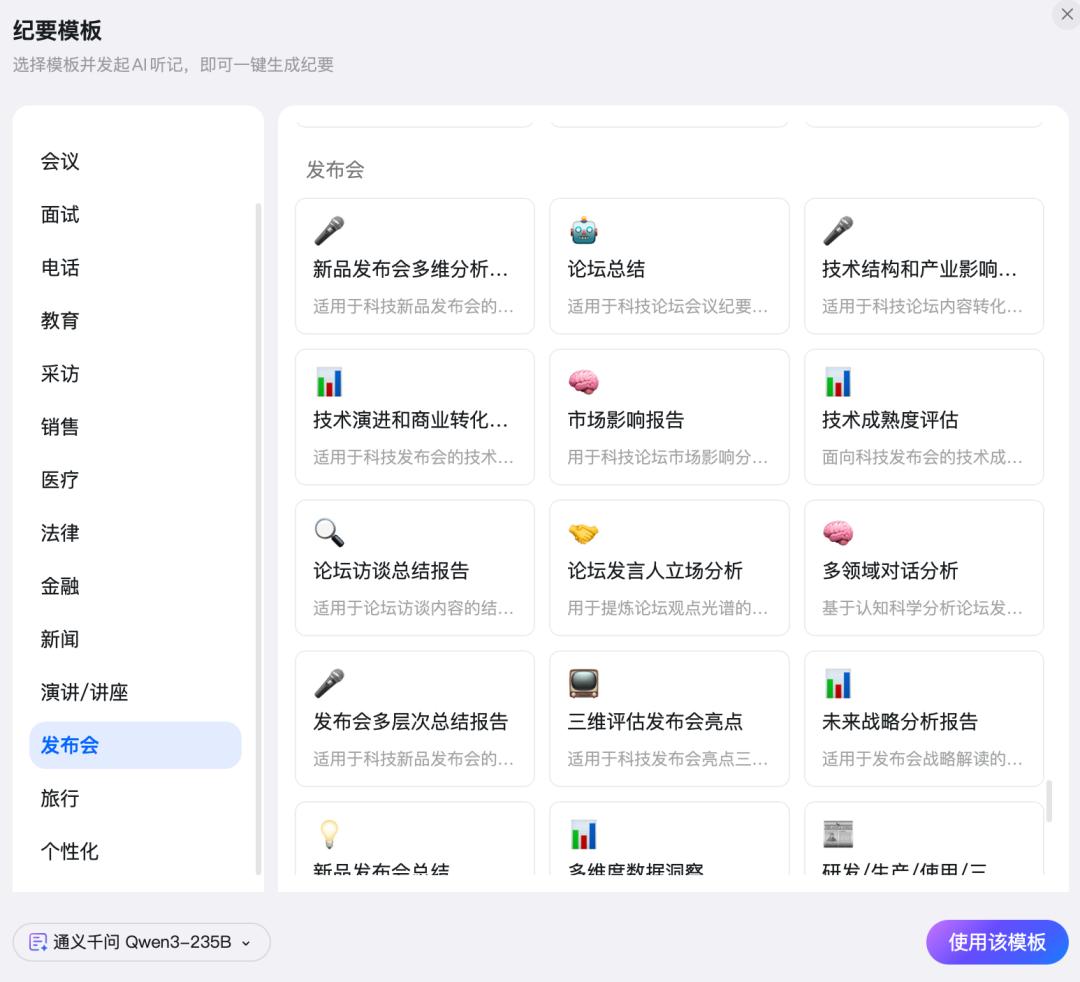
Finally, and most importantly, this is a "showcase" for large model capabilities, especially multi-modal capabilities. In the current AI competition, the homogeneity of pure text large models is becoming more and more serious. In the field of multi-modal understanding and generation, there is still an opportunity for each player to differentiate. The audio stream generated by the voice recorder is a typical representative of multi-modal data (voice). Whoever can more accurately understand the complex semantics of different accents, multi-person discussions, and cross-lingual conversations, and extract the real key points, action items, and the views of different roles, will demonstrate stronger underlying model capabilities.
Feishu's "Doubao" and DingTalk's "Tongyi Qianwen" are both continuously investing in the multi-modal field. The AI voice recorder has become a "touchstone" and "billboard" to test and showcase these capabilities. When enterprise users find that the meeting minutes organized by a certain brand's voice recorder are of significantly higher quality, their trust in the brand's entire AI capabilities and even its office suite will also increase. This is no longer just a simple hardware sales battle, but a "mental battle" for AI core capabilities through hardware.
02 The multi-dimensional battle: the "surprise attack" of new hardware players and the "encirclement" of ecosystem giants
The entry of DingTalk and Feishu has not made this market clearer. Instead, it's like throwing a boulder into a calm lake, creating more complex ripples. The battlefield of AI audio recording hardware is far from a simple two-horse race. It is evolving into a multi-dimensional melee between the "hardware innovation school" and the "ecosystem integration school." While Internet giants try to launch a "dimensionality reduction attack" with their model and ecosystem advantages, a group of "newcomer" players emerging from the consumer electronics field are launching a "flank surprise attack" with a completely different product philosophy.
To some extent, the entry of Insta360 is the most disruptive variable in this changing situation. In Luo Yonghao's podcast, its founder introduced the Insta360 Wave, which completely breaks away from the traditional framework of a "voice recorder." It is essentially a desktop intelligent center integrating a high-quality microphone array and an AI tracking camera. Its core logic is no longer "recording sound," but "recording the scene and the relationship between conversations."
This provides irreplaceable value for reviewing the meeting atmosphere, body language, whiteboard content, and even product demonstration details. Insta360 represents the core idea of a group of players: using top-notch hardware innovation capabilities to create a new dimension of experience and meet the in-depth scenario needs that pure audio cannot cover (such as creative brainstorming, design reviews, online training, and important interviews). Their advantage lies in the ultimate pursuit of hardware experience and the keen insight into user pain points. However, the challenges are also obvious: this complex multi-modal (audio and video) data processing places higher requirements on the AI capabilities of the device side and the cloud. In the deeper knowledge processing aspects such as "intelligent summarization" and "semantic understanding," they may not be able to fully compete with ecosystem giants with self-developed large models for the time being.
In contrast, DingTalk and Feishu face a different strategic logic. Looking at their products, DingTalk's early hardware was criticized for being highly similar to Plaud, while Feishu chose to cooperate with consumer electronics manufacturing expert Anker Innovations to launch the "Recording Bean." This actually exposes the reality of ecosystem giants: they are strong in ecosystem and AI, but still in the "apprenticeship period" of rapid learning in the "basic skills" of industrial design and basic acoustic experience of hardware products.
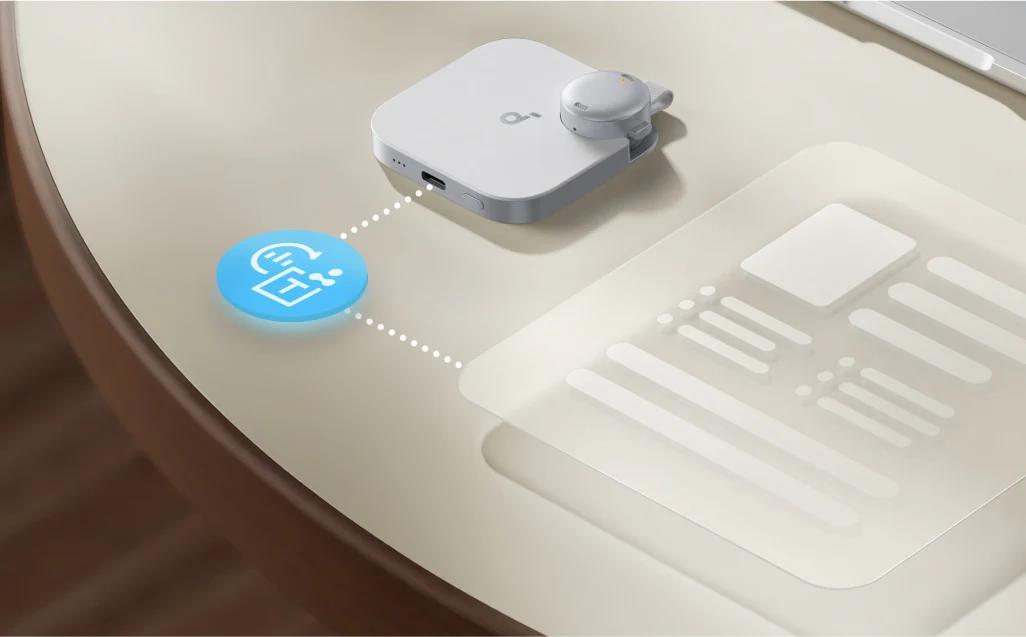
Their core strategy is not to create a single-champion audio recording device, but to create a "data conduit" that understands their own ecosystem best. Their biggest selling point lies in the seamless experience of the "last mile": after the meeting ends, the automatically transcribed manuscript is already synchronized to generate to-do items and inserted into Feishu tasks, or stored as knowledge cards in DingTalk. This deep integration creates a smooth experience that other players can hardly build in the short term.
However, this model also brings challenges. In the early stage of hardware homogenization competition, if the product has obvious shortcomings in portability, sound recording quality, or design aesthetics, it may damage its brand image as a "high-end intelligent office tool," and further affect users' perception of the professionalism of its entire ecosystem. The cooperation with Anker is a smart move for Feishu to quickly make up for its hardware shortcomings. For them, this competition is a race against time to use the advantages of the software ecosystem to make up for the deficiencies in hardware experience and exchange capital and traffic for development time.
At present, the two paths are running parallel without intersection. The innovation school captures scenarios with richer sensory data (video + audio) but needs to climb the peak of AI processing. The integration school creates efficiency with smoother data flow but needs to improve its hardware experience. The endgame of this multi-dimensional melee may not be one side swallowing the other. Instead, according to the different workflows and scenario preferences of enterprise users (such as "creative generation meetings" vs. "decision-making and execution meetings"), a differentiated market pattern of "professional scenario tools" and "general efficiency components" will be formed. Undoubtedly, all players are involved in a comprehensive competition for capacity expansion - regardless of whether they start from hardware or software, they must ultimately approach the dual goals of "excellent hardware experience" and "deep ecological intelligence."
03 The endgame speculation: the evolution from "voice recorder" to "core node of intelligent office"

The battle has begun, and the paths have diverged. However, for both the ecosystem giants and the innovation players, the current hardware products are far from the endgame.
The competition in AI audio recording devices is essentially an early battle for "reconstructing the enterprise knowledge production and management process." Its evolution direction clearly points to a core goal: to transform the device from a "recorder" beside the conference table to a "core node" driving the flow of organizational wisdom.
In the future, the competition will go beyond the hardware form itself and deepen in two dimensions: "depth" and "breadth." In terms of depth, AI capabilities will evolve from "recording what happened" to "understanding why it happened and predicting what to do." This means that the device will not only generate summaries but also analyze the logical structure of the discussion, identify unresolved disputes, and even provide auxiliary insights into the risks and feasibility of meeting decisions based on past project data.
This tests the deep understanding of complex business contexts and organizational behaviors by large models. It is a deep battlefield for ecosystem giants to train models based on full-scenario data and build barriers. To some extent, similar to the concept of traffic entry points, in-depth insights and diversified functions are the keys to connecting the ecosystems of tech giants through products in the next stage. This means that the product is just the beginning, and the ecosystem is the future picture.
In terms of breadth, the independent hardware form will gradually dissolve. AI audio recording and multi-modal perception capabilities will be embedded as a basic service into intelligent desks, conference rooms, and even wearable devices, becoming the default customization of the office environment. At the same time, the structured knowledge generated from meetings must be able to flow bidirectionally with the enterprise's core business systems such as CRM, ERP, and code libraries, so that the meeting conclusions can directly drive the update of customer strategies or product iterations. The key to winning the competition lies in who can build the smoothest and most intelligent "data