The most mysterious robotics company has emerged.
Text by | Fu Chong
Edited by | Su Jianxun
If you were to discuss "Who is the hot and mysterious player in the embodied intelligence venture capital circle in 2025?", many industry insiders would vote for the Singaporean startup Sharpa.
At the industry conference ICRA in May 2025, Sharpa's dexterous hand attracted attention in the industry. This hand can perform delicate operations such as peeling eggshells and using scissors with a proficiency close to that of a human hand. It has the same size as a human hand, and each fingertip is equipped with 1000 tactile sensors.
At that time, an investor at the forefront of embodied intelligence expressed his views on this company to Intelligence Emergence: "The product effect is amazing. I started contacting them in August, but they avoided meeting me. I still don't know who the top - leader is until now."
Another investor also confirmed this situation: "I heard that I could get in touch with Sharpa through the investment and financing director of Hesai Technology, a lidar company. I proposed to have a chat about investment - related matters regarding Sharpa with the person, but I was rejected."
The experience of "difficulty in cooperation" is not limited to investors. Many practitioners in the field of embodied intelligence mentioned that they are interested in the Sharpa Wave, which is priced at about $50,000, but it's not easy to buy one.
The founder of an embodied intelligence model company interviewed by Intelligence Emergence also mentioned that their algorithm research and development must be linked with hardware, and Sharpa is currently the best dexterous hand hardware in their mind. However, when they contacted the company at the end of 2025, they were told that there was no available inventory at present, and they could only go to Sharpa's office in Shanghai to conduct experiments with the dexterous hands there.
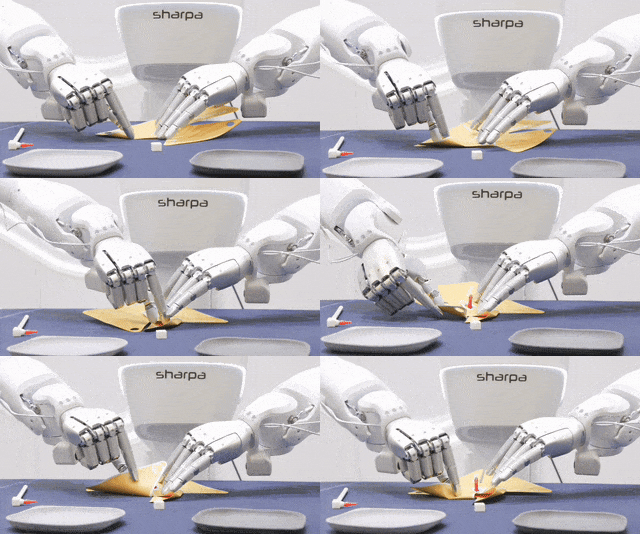
△ Sharpa robot stacking windmills at CES 2026, Video: Provided by the company
At the just - concluded CES 2026, Sharpa, which was founded about a year ago, publicly unveiled its robot Sharpa North for the first time.
This robot is equipped with Sharpa's self - developed dexterous hand. It can not only perform flexible hand movements but also has the ability of independent decision - making. It can play table tennis with people on the spot, stack windmills, and can also accurately press the shutter and pull the lever when taking a photo with a Polaroid. It was evaluated by well - known AI investor Fu Sheng as "a robot that has accomplished the most difficult tasks".
Speculations about Sharpa's background in the industry have never stopped, but the mystery has only been solved recently: According to a report by LatePost, Sharpa's co - founders are Li Yifan, the CEO of Hesai Technology, Xiang Shaoqing, the CTO, and Sun Kai, the Chief Scientist.
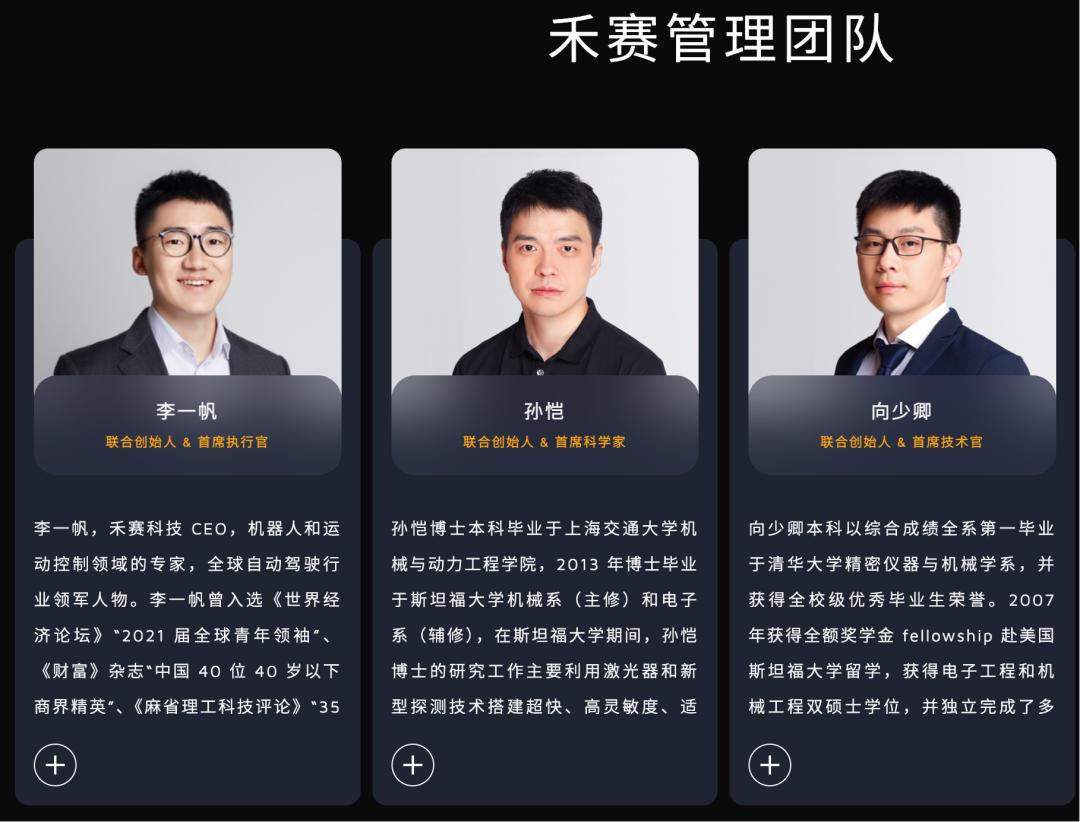
△ The three co - founders of Hesai Technology are also the co - founders of Sharpa, Picture: Screenshot from the official website
The official website shows that Hesai Technology is currently the world's leading automotive lidar company in terms of market share. It is said that the company's name is derived from "San Jose" in Silicon Valley, as this is where the three founders started their academic and entrepreneurial journey in the United States.
Both the intelligent driving circle and the robotics circle are no strangers to Hesai Technology.
Xiaomi's first car model chose Hesai as its lidar supplier. In its prospectus for listing on the STAR Market at the end of 2020, Hesai Technology mentioned that the company was shipping products for the broader robotics business, including self - driving cars, unmanned cleaning vehicles, and unmanned delivery vehicles.
Today, products of many embodied intelligence companies such as Unitree Robotics and Vitarobotics are equipped with Hesai lidars. The company continues to play the role of a supplier in the new wave of robotics.
More interestingly, the robotics business has also supported Hesai's secondary - market narrative recently.
Hesai Technology listed on the Hong Kong Stock Exchange in September 2025, becoming a company dual - listed on the US and Hong Kong stock markets.
However, after its listing in Hong Kong, the company faced a decline in its stock price. In November 2025, the company released a nearly "perfect" third - quarter report. It not only announced that it had achieved its annual profit target ahead of schedule but also disclosed that the delivery volume of lidars in the robotics field reached 60,639 units, a year - on - year increase of 1311.9%.
Fan Peng, the CFO of Hesai, also attributed the company's performance growth to the increasing penetration rate and strong shipment volume in the ADAS and robotics fields.
Shortly after the release of the performance report, the stock price of Hesai Technology on the Hong Kong Stock Exchange started to rise continuously.
In the third - quarter report, CEO Li Yifan also linked a greater goal with the robotics business: Looking forward to the next decade, the company will actively transform... to create a new era of perception and interaction methods for automobiles and robots.
The establishment of Sharpa shows that Li Yifan and his co - founders are obviously not satisfied with just being a robotics supplier. Looking at the resumes of the three founders of Hesai Technology, we can understand why they decided to start a business in embodied intelligence themselves:
CEO Li Yifan was recommended to study at the Department of Precision Instruments and Mechanology at Tsinghua University for his undergraduate studies. His research topics included robotics. During his Ph.D. at the University of Illinois at Urbana - Champaign, he focused on robot motion control.
Chief Scientist Sun Kai graduated from the School of Mechanical Engineering at Shanghai Jiao Tong University for his undergraduate studies, majoring in Thermal Energy and Power Engineering, and obtained his Ph.D. from the Department of Mechanical Engineering at Stanford University.
CTO Xiang Shaoqing also graduated from the Department of Precision Instruments and Mechanology at Tsinghua University for his undergraduate studies. He holds a dual master's degree in Electrical Engineering and Mechanical Engineering from Stanford University. He once served as an iPhone system integration engineer and has long been responsible for project implementation.
The three of them have accumulated many years of experience from academic research in the fields of robotics, power engineering, and machinery to industrial implementation.
In fact, it has become a trend in recent years for autonomous driving teams to enter the field of embodied intelligence, and many companies have attracted the attention of the venture capital circle.
Tashi Intelligence Navigation, reported by Intelligence Emergence, was founded by Chen Yilun, the former chief scientist of Huawei's autonomous driving department, and it raised 1.7 billion yuan in its angel - round financing.
"From automotive lidars to embodied intelligence, the underlying logic of both is spatial perception." An FA (financial advisor) in the field of embodied intelligence told Intelligence Emergence. There has long been a saying in the primary market that Sharpa has a close relationship with Hesai Technology. This intersection of "spatial perception" is one of the clues that make the industry associate the two.
From the fragmented information obtained so far, we know that Sharpa is headquartered in Singapore and also has an office in Shanghai, which is the "base" of Hesai Technology. This arrangement is easy to understand - Shanghai is closer to the domestic supply chain and talent pool, while Singapore is more convenient for overseas business cooperation and communication.
But the most curious question remains: Why did the three founders register Sharpa in Singapore? And why do they keep a low - key profile? Perhaps we can piece together the answers from the important turning points in Hesai Technology's overseas market.
Before and after Hesai Technology's listing in the United States in 2023, Li Yifan mentioned in an interview that Hesai is a global business, and its US business accounts for a large proportion. Overseas investors are willing to see a company with a global business.
However, in January 2024, Hesai was included in the "Chinese military - related companies" list by the US Department of Defense, and its stock price immediately plunged. Although the situation fluctuated later, the problem was not resolved. Hesai Technology filed a lawsuit, but in July 2025, it was ruled to have lost the case by the US District Court for the District of Columbia.