Smart glasses are shortlisted, while six categories of kitchen appliances are excluded. Here are 10 questions you want to know about the new national subsidy in 2026.
Entering 2026, the national subsidies for the new year in various provinces across the country have officially kicked off.
Compared with 2025, the national subsidies for the new year have been adjusted, optimized, and improved in many aspects, aiming to ensure that this "consumption stimulus" initiative, which benefits both the country and the people, can reach a wider and larger group of actual consumers with real needs.
Below, Xiaolei will provide the most comprehensive Q&A on the 2026 national subsidies in the form of ten hot questions.

Image source: Doubao
1. Are there any new product categories added to the national subsidies this year?
Yes, and they are popular new technology hardware categories that many people have been looking forward to.
The previous "subsidy for purchasing new digital products" has been expanded to the "subsidy for purchasing new digital and smart products" this year, covering mobile phones, tablets, smart watches (bands), and smart glasses. Smart glasses are included in the national subsidy list for the first time this year.
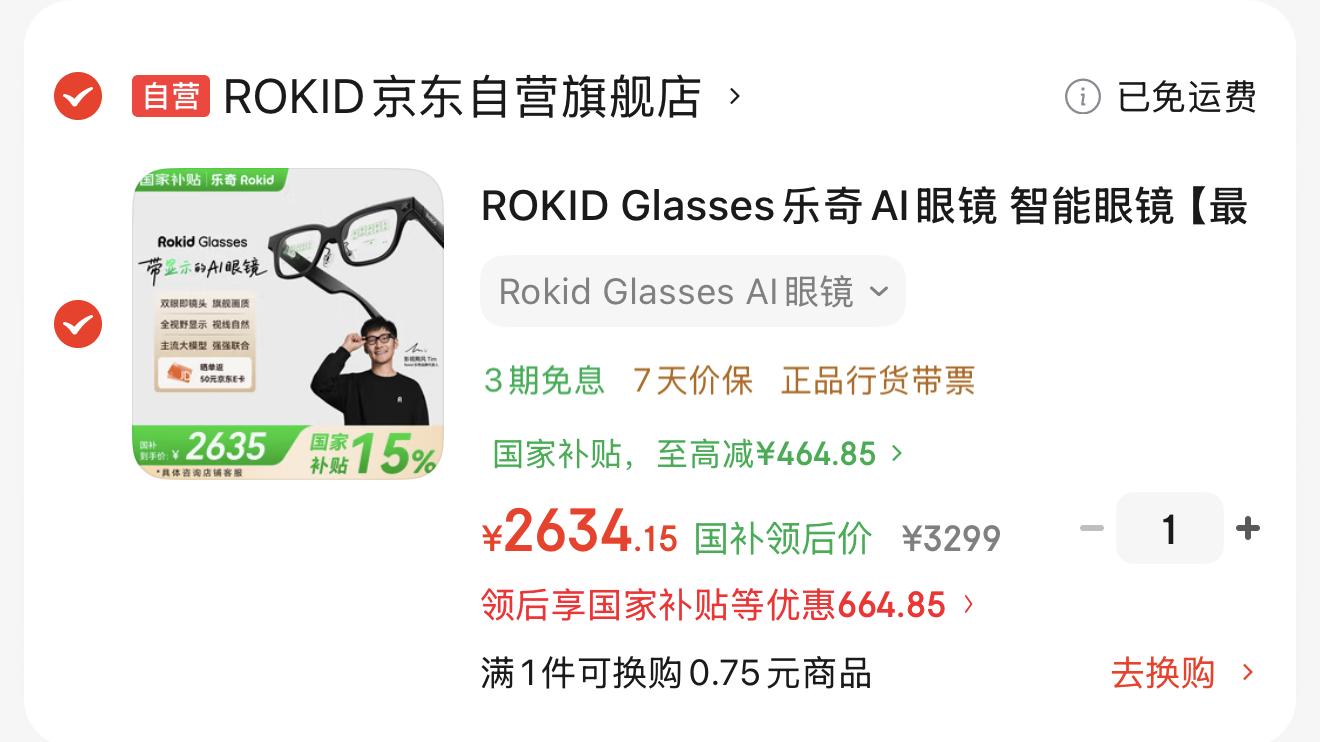
Take the Rokid Glasses AI glasses launched by Rokid as an example. Currently priced at 3,099 yuan on JD.com's self - operated platform, after claiming the national subsidy, consumers can get a discount of 464.85 yuan, bringing the price down to 2,634.15 yuan.
Screenshot from Lei Technology
In addition, the state supports the subsidy for purchasing new smart home products (including products suitable for the elderly). The specific subsidy categories and standards will be formulated independently and reasonably by local governments based on actual conditions.
2. Are there any old product categories removed from the national subsidies this year?
Yes, and there are quite a few removed categories.
The previous 12 categories of home appliances eligible for the trade - in subsidy have been reduced to 6 major categories this year, including refrigerators, washing machines, TVs, air conditioners, computers, and water heaters. Six categories of kitchen appliances, such as household stoves, range hoods, water purifiers, dishwashers, rice cookers, and microwave ovens, have been removed from the national subsidy list this year.
It should be added that the home furnishings and home improvement categories, which were previously subsidized, are also not included in the national subsidy list this year.
3. Has there been any change in the subsidy standards this year?
There have been changes in the subsidy standards for home appliances and automobiles.
This year, the trade - in subsidy for 6 categories of home appliances is limited to products that meet the Grade 1 energy or water - efficiency standards. At the same time, a 15% subsidy will be given based on the product's sales price. Each consumer can receive a subsidy for one item of each product category, with a maximum subsidy of 1,500 yuan per item. In comparison, previously, home appliances meeting the Grade 1 energy or water - efficiency standards had a 20% subsidy rate and a maximum subsidy of 2,000 yuan. Additionally, the previous limit of a maximum of 3 air - conditioners per person for subsidy has been unified to 1 air - conditioner per person this year.
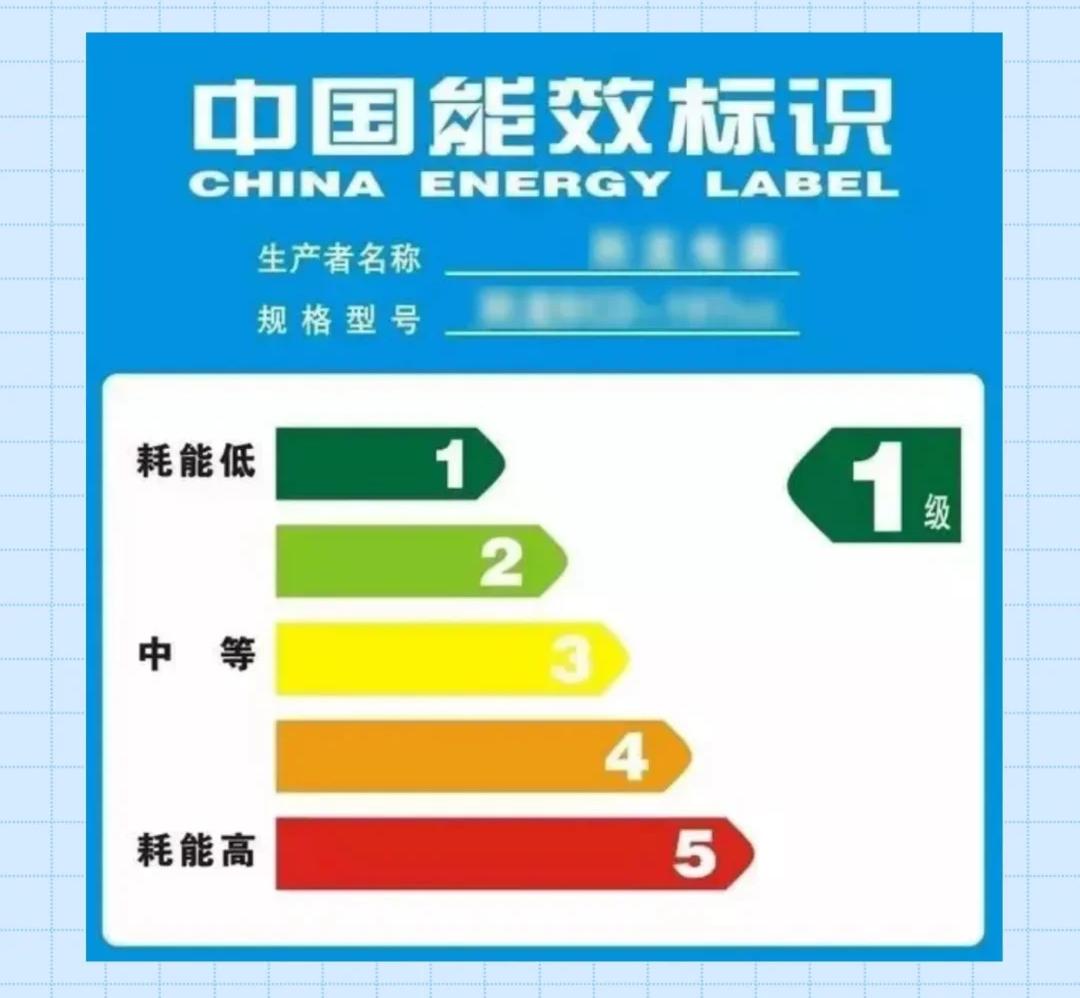
Image source: CCTV News
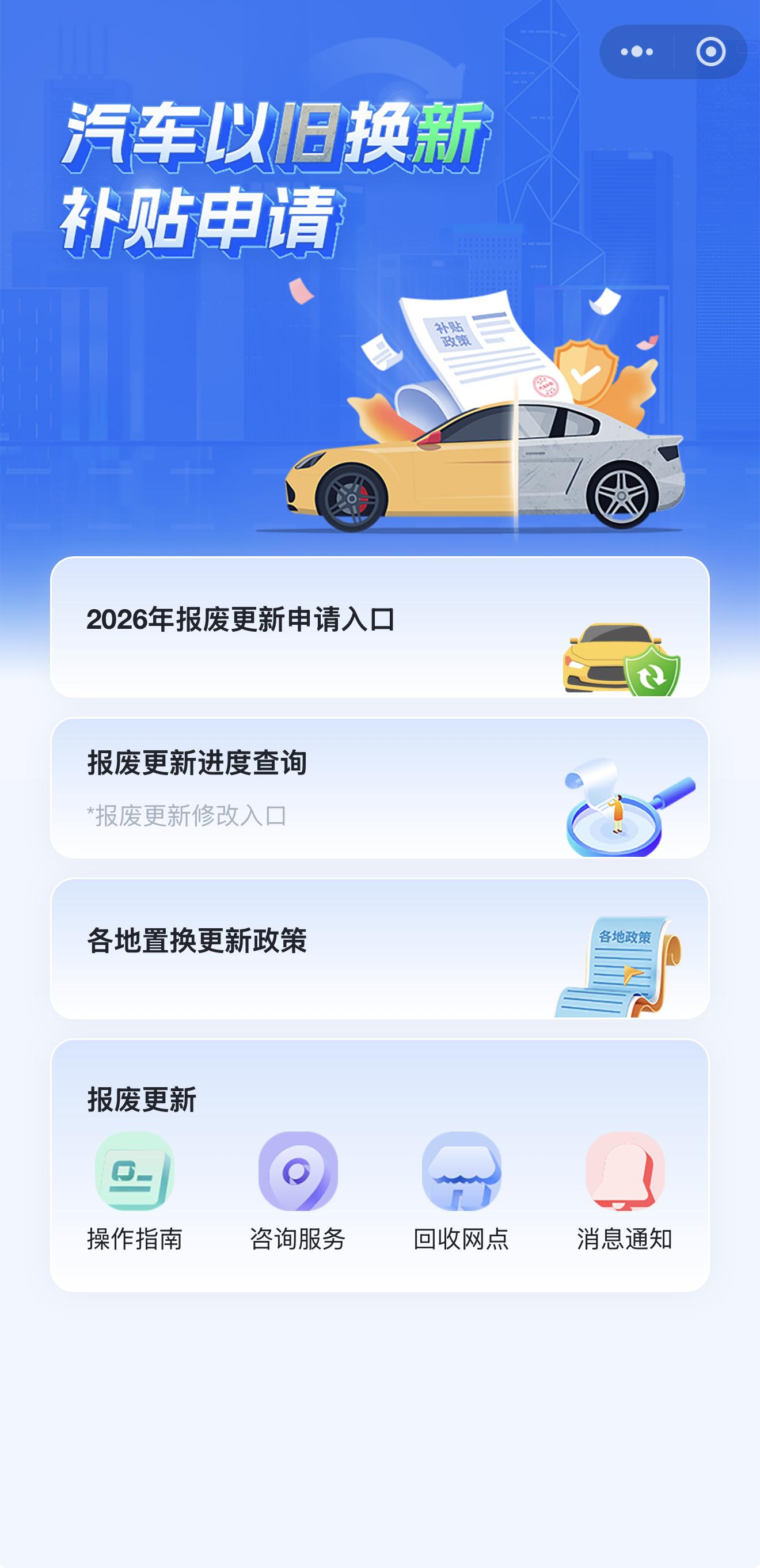
There have also been changes in the national subsidies for automobiles this year. While keeping the subsidy cap unchanged, for automobile scrapping and replacement this year, the previous "fixed - amount subsidy" has been adjusted to the current "subsidy based on the vehicle price ratio".
Specifically, for those who scrap eligible old vehicles and purchase eligible new new - energy passenger cars, a 12% subsidy will be given based on the new car's sales price, with a maximum subsidy of 20,000 yuan; for those who scrap eligible fuel - powered passenger cars and purchase eligible new fuel - powered passenger cars, a 10% subsidy will be given based on the new car's sales price, with a maximum subsidy of 15,000 yuan. No subsidy will be given for those who scrap new - energy passenger cars and purchase fuel - powered passenger cars.
Screenshot of the "Automobile Trade - in" WeChat mini - program (from Lei Technology)
For those who trade in eligible new new - energy passenger cars, an 8% subsidy will be given based on the new car's sales price, with a maximum subsidy of 15,000 yuan; for those who trade in eligible new fuel - powered passenger cars, a 6% subsidy will be given based on the new car's sales price, with a maximum subsidy of 13,000 yuan.
4. If I used the national subsidy last year, can I still claim and use it this year?
Yes, it has no impact. If you used the national subsidy for any product category last year, you can still claim and use the national subsidy for any category this year. Your record of claiming and using the national subsidy in 2025 has no impact on your ability to claim and use the "new national subsidy" in 2026.
5. What is meant by "maliciously claiming eligibility"?
In the implementation rules of the national subsidy in Liaoning Province, a clause regarding "maliciously claiming eligibility" has attracted external attention.
After Liaoning consumers claim the entitlement vouchers, if they fail to redeem them within the validity period or do not redeem them at all, they can click the cancellation button in the entitlement list on UnionPay QuickPass. After cancellation, they can claim the entitlement vouchers again.
Meanwhile, to ensure that more consumers can benefit from the policy, in Liaoning, consumers who obtain eligibility for various product categories twice but do not make a purchase are considered to have maliciously claimed eligibility, and their eligibility to claim the subsidy in 2026 will be revoked.

Relevant clauses from the Liaoning national subsidy implementation rules (screenshot from Lei Technology)
Beyond Liaoning, more provinces are also restricting the phenomenon of "secondary" or even "multiple" claims caused by the invalidation of vouchers due to non - use after claiming the national subsidy. Many provinces even use a lottery system to select eligible users for this round of national subsidies, which is fundamentally to promote the national subsidy more efficiently and accurately.
6. How difficult is it to claim the national subsidy this year? Can we return to the state of being able to claim and purchase at any time as in the first half of last year?
Objectively speaking, in the provinces that have launched the 2026 national subsidy, the difficulty of claiming the subsidy has been continuously increasing.
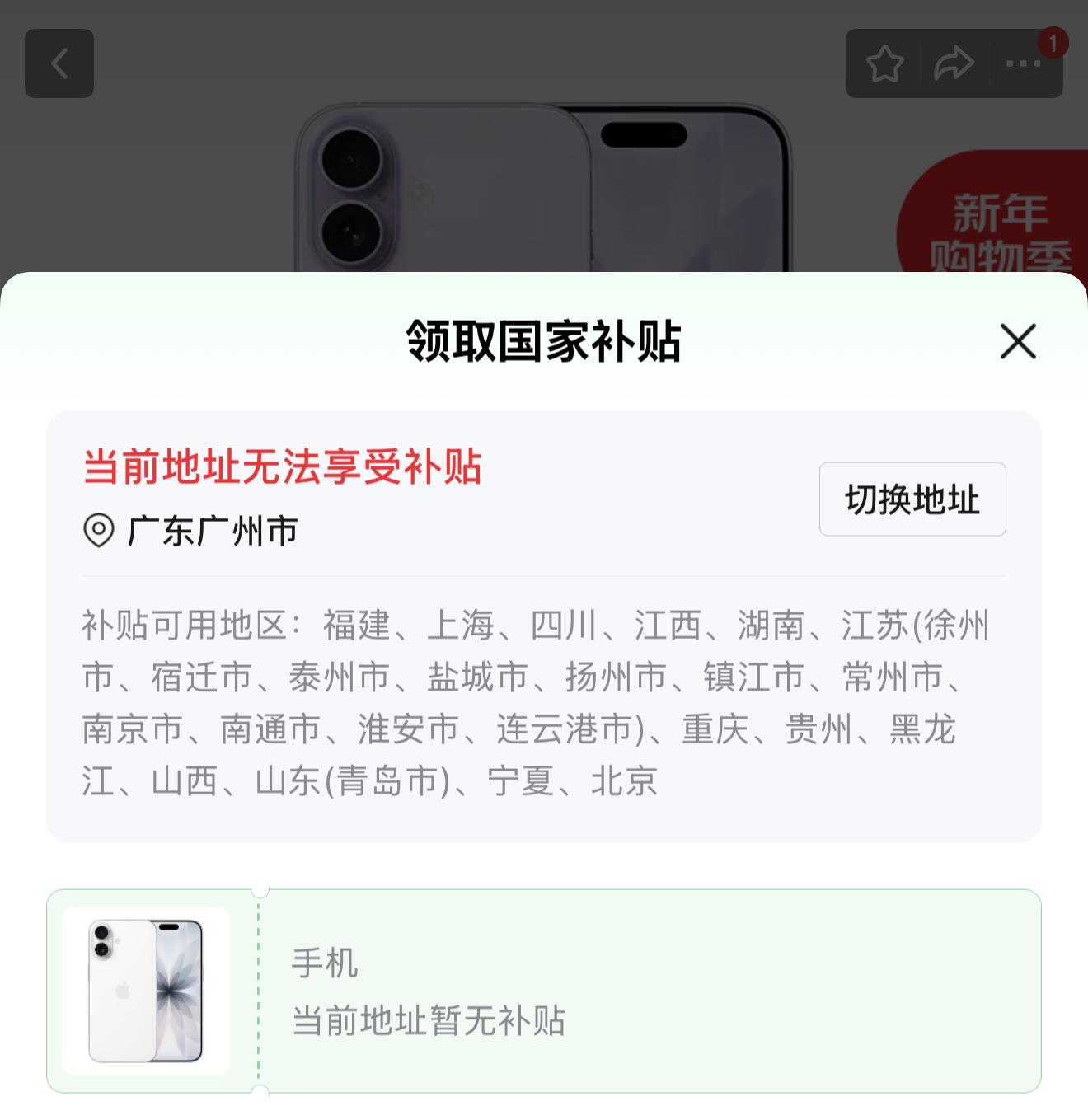
Take Guangdong as an example. The subsidy for purchasing new digital and smart products was launched on New Year's Day this year, and it was relatively easy to claim in the following days. However, within less than two weeks, "unable to grab the Guangdong national subsidy" became a hot topic among netizens. Currently, platforms such as JD.com are temporarily unable to provide the subsidy for purchasing new digital and smart products in Guangdong, and the subsidy for computers among the 6 categories of home appliances is also temporarily unavailable.
Screenshot from Lei Technology
7. Are there any local subsidies for "digital and smart products" priced over 6,000 yuan?
Yes, some provinces and cities offer local subsidies or consumption vouchers for "digital and smart products" priced over 6,000 yuan.
For example, Guangdong users can open the UnionPay QuickPass app, click on "Enjoy a Warm Winter in Guangdong" on the home page, then enter the "Guangdong High - quality Product Purchase Consumption Voucher" page, select the provincial subsidy discount for "Guangdong High - quality Product Purchase", and then enter the "Subsidy for Purchasing New Electronic Products". They can then see the page for claiming the Guangdong provincial subsidy eligibility for mobile phones, tablets (including learning machines), smart watches (bands), and smart headphones priced over 6,000 yuan.
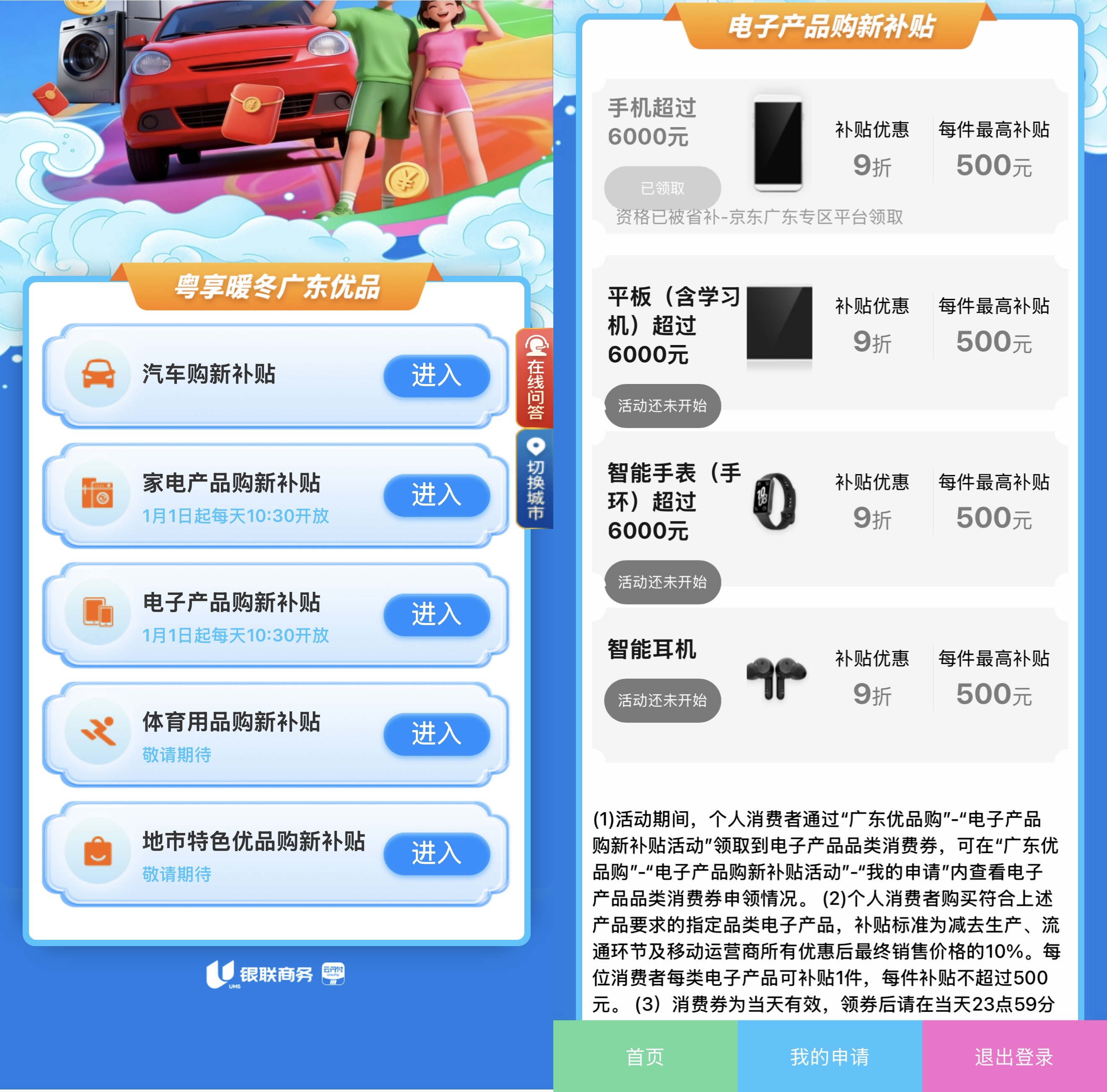
Screenshot from Lei Technology
It is worth noting that Xiaolei had previously claimed the Guangdong provincial subsidy eligibility for a mobile phone priced over 6,000 yuan on the product page of the iPhone 17 Pro Max on JD.com's self - operated platform.
8. If the local national subsidy has been launched but the online subsidy eligibility is temporarily unavailable, can I try to claim it offline?
Yes, you can give it a try. However, you still need to claim the national subsidy eligibility applicable to offline merchants first.
Xiaolei is currently unable to claim the national subsidy eligibility for mobile phones in Guangdong on e - commerce platforms such as JD.com. However, on the national subsidy eligibility claim page in the UnionPay QuickPass app, Xiaolei successfully claimed the national subsidy eligibility for mobile phones.

Screenshot from Lei Technology
It seems that the national subsidy eligibility for mobile phones in Guangdong claimed through the UnionPay QuickPass app cannot be redeemed through the UnionPay QuickPass payment interface on the JD.com app. Therefore, it should be a redemption channel for the national subsidy eligibility applicable to local offline merchants in Guangdong.
9. Do I need to redeem the national subsidy early in the first half of this year to avoid the situation where many provinces had no national subsidies available in the second half of last year?
This is a very realistic and poignant question.
Currently, the 62.5 billion - yuan ultra - long - term special treasury bonds for supporting the trade - in of consumer goods in the first batch allocated to local areas in 2026 have only been used to launch the national subsidy in some provinces this year. In provinces like Guangdong, where the new - year national subsidy has been launched, it is obvious that the consumption rate of the national subsidy funds for the digital and smart product categories, especially the computer category, targeted at online merchants is still "beyond expectations".

Screenshot from Lei Technology
The peak Spring Festival consumption season has not yet arrived. Can the first - batch 62.5 billion - yuan central funds in some provinces that were the first to launch the new - year national subsidy last until the end of the Spring Festival? Currently, this is still a question. Looking at the whole year of 2026, the same situation exists, even though the annual national subsidy funds at the central level are allocated in batches at different stages.
Therefore, rather than rushing to consume early in the first half of this year, for example, during the 618 promotion at the latest, to use up this year's national subsidy eligibility; it is better to say that if you have a need to replace consumer electronics, home appliances, or automobiles this year, you can claim the eligibility for the relevant product categories shortly after each batch of central funds is allocated, for example, in the first few days after the local government launches a new round of national subsidies this year (in Guangdong, it was the days after New Year's Day this year), and then make your purchases and redeem the subsidy.
If you are unable to claim the national subsidy eligibility on e - commerce platforms for the time being, you can try to claim the national subsidy eligibility for local offline merchants on platforms such as UnionPay QuickPass. Of course, it would be best if you can catch the major promotion seasons such as the Spring Festival, 618, and Double 11, whether it is for online or offline national subsidies.
10. In which aspects have there been systematic improvements and refinements in this year's national subsidy compared to last year?
First of all, at the national level, factors such as the permanent population of each region, the regional GDP, the ownership of automobiles and home appliances, the implementation of the consumer goods trade - in policy and the use of funds, and the problems found in audits have been comprehensively considered, and the fund allocation scale for each province has been re - optimized.
For example, in provinces like Guangdong, there is a large number of migrant workers, and the permanent population is much larger than the household -