Only 5 years left? Nobel laureate Hassabis reveals the AGI timeline: One or two technological breakthroughs are still needed.
The five - year countdown to AGI has begun! Hassabis predicts that perhaps with just one or two breakthroughs on the level of AlphaGo, we can expect to witness the arrival of AGI within 5 years, and its speed and influence will be 10 times that of the Industrial Revolution.
Humanity is only 1 - 2 key technological breakthroughs away from AGI!

Just now, Nobel laureate and Google DeepMind CEO Demis Hassabis has given the ultimate timeline for AGI!
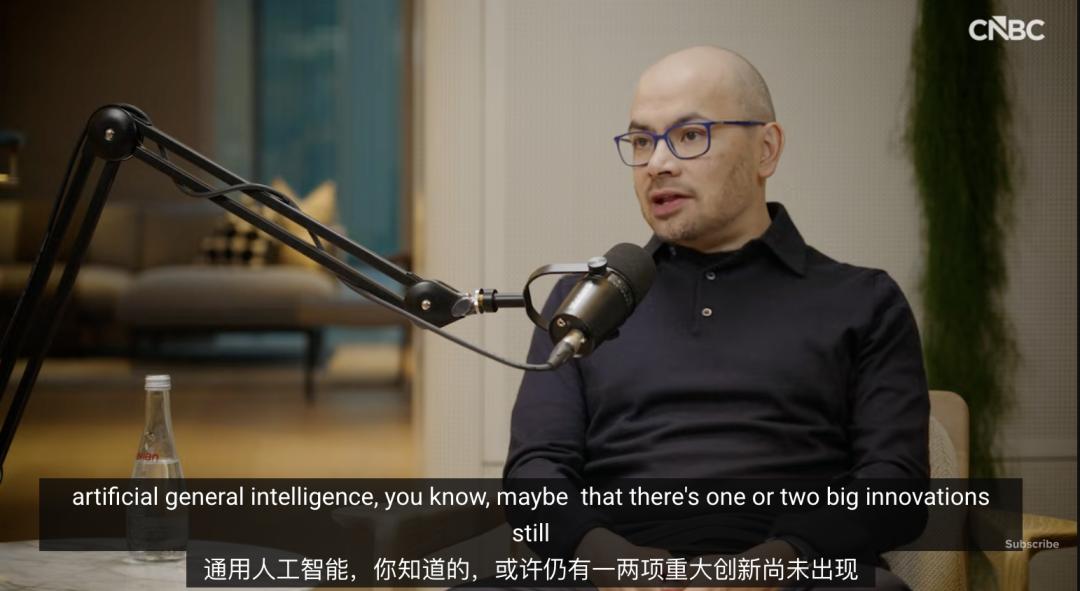
He believes that within 5 years, perhaps with 1 - 2 major technological breakthroughs, we may overcome the obstacles on the path to AGI.
While making an optimistic prediction, Hassabis also doesn't forget to pour some cold water on us:
He believes that simply expanding data and computing power may not be enough to achieve AGI.
For example, Hassabis believes that although large models are powerful, they lack a true understanding of the physical world, logical reasoning, and long - term planning.
Therefore, to achieve AGI, the missing piece for large models is the "world model".
In addition, Hassabis also believes that AI will be the ultimate tool for scientific discovery.
AlphaFold is just the beginning. AI will usher in a golden age of scientific discovery in the next 10 years, especially in fields such as drug research and development, disease cure, discovery of new materials, and clean energy (fusion).
And this will undoubtedly accelerate the arrival of AGI.
If Hassabis' prediction comes true, this will be a moment of great change, and its speed and influence will be 10 times that of the Industrial Revolution.
And each of us will be under the impact of this epic - scale change.
Why aren't large models AGI yet?
Take well - known large models like ChatGPT and Gemini as examples.
You may think that although they sometimes perform outstandingly on some difficult tasks, they often make mistakes on simple questions.
Hassabis used a very precise and vivid term to describe this state: "Jagged Intelligence".

This is like students in a class who have extremely severe subject biases.
They may be geniuses in liberal arts and programming, but in terms of physical common sense, logical reasoning, and long - term planning, they may be even worse than ordinary students.
Why is this the case?
Hassabis pointed out the essential limitation of large language models (LLM) sharply: They are just top - notch "probability predictors".
They don't really "understand" the world. They are just predicting the probability of the next word appearing. Therefore, they lack knowledge of the physical laws of the real world and don't have a coherent, self - correcting thinking model like humans.
So, they are extremely good at some things but completely useless in others.
This is like asking someone who can only recite chess manuals but doesn't understand the rules of Go to play chess. The first few moves may seem okay, but once the situation becomes complex and requires thinking about strategies dozens of moves ahead, he will immediately collapse.
Therefore, to evolve from the current "biased students" to the all - knowing and all - powerful AGI, simply making the models larger (Scaling) is no longer enough.
We need a qualitative leap to fill in the key pieces on the path to AGI.
The key pieces on the path to AGI
Hassabis specifically pointed out the directions of one or two key technological breakthroughs.
Key breakthrough 1: "World Models"
If large models are like "reading ten thousand books", then "World Models" are like "traveling ten thousand miles".
The so - called world model refers to a model that can predict and simulate how the state of the environment changes with actions. Its core logic is to truly "understand" the operating rules of the physical world.
For current large models, if you ask them "What will happen if a cup falls off the table?", they will tell you "It may break" based on text probabilities.
But an AI with a world model truly simulates gravity, friction, and the fragility of glass in its "mind" and "sees" the process of the cup falling.
Currently, DeepMind is developing video/interaction models like Genie and Veo as the prototypes for building world models.
This is also a prerequisite for AI to move from the "digital world" to the "physical world".
Only by understanding the physical laws can AI drive robots to serve tea, tighten screws, and handle complex causal relationships in the real world, rather than just chatting with people.
Key breakthrough 2: "Agentic Systems"
Having the ability to understand the world is not enough. AI also needs to have the ability to "act" in the world.
This is the second breakthrough: Agentic Systems.
Current AI is passive: You ask a question, and it gives an answer.
Future Agentic AI will be proactive.
You give it a vague goal, such as "Help me plan and book a trip to a certain place".
It can break it down into dozens of steps: check air tickets, compare prices, book hotels, plan routes, adjust the itinerary according to the weather...
More importantly, it has the ability of "cognitive error correction".
If it finds that air ticket prices have increased or there are no rooms in the hotel during the execution process, it can stop like a human, rethink, and adjust the plan, rather than directly reporting an error or getting into an infinite loop.
Hassabis also specifically mentioned DeepMind's "secret weapon": AlphaGo.
The reason why AlphaGo was able to defeat human champions back then was that it had this "planning" ability and could deduce the changes in the Go game dozens of steps into the future.
The current goal is to generalize this "planning" ability on the chessboard to specific scenarios in the real world.
When the extensive knowledge of large models meets the physical cognition of world models and the action ability of agentic systems, the key pieces on the path to AGI may be filled in, and the moment of AGI's arrival will come.
A future 10 times faster than the Industrial Revolution
Hassabis' obsession with AGI is not to create a Siri that is better at chatting or to make advertising recommendations more accurate.
His ambition is written in DeepMind's core mission, which has never changed:
AI for Science (Using AI to drive science).

In an official blog written by Hassabis and others, it was stated that DeepMind will establish its first automated laboratory in the UK in 2026, focusing on materials science research.
This laboratory will be built from scratch, fully integrating the Gemini system, and by commanding world - class robots to synthesize and characterize hundreds of materials every day, it will significantly shorten the time required to discover transformative new materials.
Imagine such a scenario:
AI is responsible for reading a vast number of papers and proposing new scientific hypotheses;
The agentic system is responsible for designing experimental plans;
The robot connected to the world model is responsible for operating sophisticated experimental instruments;
Finally, AI analyzes the experimental results, iterates itself, and starts the next round of experiments.
The involvement of AI in scientific research is expected to reduce costs and give rise to brand - new technologies, and the efficiency of scientific research will be increased by a hundred or even a thousand times.
Maybe in the near future, superconductors that can work at room temperature and pressure can enable low - cost medical imaging and reduce power losses in the power grid.
Other new materials can help us address key energy challenges by promoting the development of advanced batteries, next - generation solar cells, and more efficient computer chips.


Therefore, Hassabis said that the scale of this change will be "10 times that of the Industrial Revolution", and the speed will be "10 times that of the Industrial Revolution".
The Industrial Revolution took more than 100 years to reshape human civilization, while AGI may only take 10 years.
This will be an era of great abundance and also an extremely turbulent era.
Old jobs will disappear, and old economic structures will collapse, but the boundaries of human cognition will be extended infinitely.
Chinese AI models are only "months" behind the US
In this extreme race towards the future, where will China stand?
Hassabis said in an interview with CNBC that the gap in capabilities between Chinese artificial intelligence models and those in the US and the West may have shrunk to "only a few months":
Chinese AI models may be much closer than we thought one or two years ago. Maybe so far, they are only a few months behind.
The emergence of DeepSeek and the strong performance of Alibaba's Qwen model have both proven the amazing engineering capabilities of Chinese technology companies.
Chinese AI companies have still trained powerful models at a lower cost while using relatively backward chips.
Nevertheless, Hassabis believes that although China has proven its ability to catch up, it remains to be seen whether it can achieve a real AI breakthrough.
He also raised a deeper question, which may be an objective review and a "wake - up call":
Hassabis compares DeepMind to the "modern - day Bell Labs", a holy land where source innovations such as transistors and information theory were born.
He believes that China has currently proven itself to be a world - class "engineer" capable of quickly replicating and optimizing cutting - edge technologies (Copy and Improve).
However, the real test lies in whether it can be the "inventor":
The key question is whether they can achieve original innovation beyond the cutting - edge. Can they really create something brand - new, such as a new Transformer, to surpass the cutting - edge?
This is DeepMind's moat and will also be the next competition point in the Sino - US AI competition.
In any case, the judgment of this global AI leader is very clear:
The countdown to AGI has begun, and there are only one or two key technological breakthroughs left.
And within five years, we will hopefully witness the historic moment of AGI's arrival.
References:
https://x.com/Ric_RTP/status/2012523232998334577?s=20%20
https://www.cnbc.com/amp/2026/01/16/google-deepmind-china-ai-demis-hassabis.html
This article is from the WeChat official account "New Intelligence Yuan", author: New Intelligence Yuan, published by 36Kr with authorization.