Tsinghua University's research in Nature reveals a striking finding: AI can write papers three times faster, but the boundaries of science are locked down.
A recent study published by Tsinghua University in Nature found that AI makes scientists focus more on fields with abundant data and well - defined problems, leading to a single - type of innovation and a decrease in cross - border cooperation. The research team proposed the "Full - process Scientific Research Agent System" to promote the evolution of AI from a tool to a partner and expand the boundaries of science.
When it becomes normal for AlphaFold to predict protein structures, ChatGPT to assist in scientific writing, and AI laboratories to independently design experiments, we can't help but ask: Is AI really accelerating scientific progress? Or is it quietly changing the "rules of the game" of scientific exploration?
In January 2026, Professors Xu Fengli and Li Yong from the Department of Electronic Engineering at Tsinghua University, in collaboration with a team from the University of Chicago, published a significant study in Nature. Through a 45 - year analysis of over 41 million scientific research papers, they first revealed a thought - provoking contradictory phenomenon: AI is significantly improving the individual productivity of scientists, but invisibly shrinking the collective territory of scientific exploration.
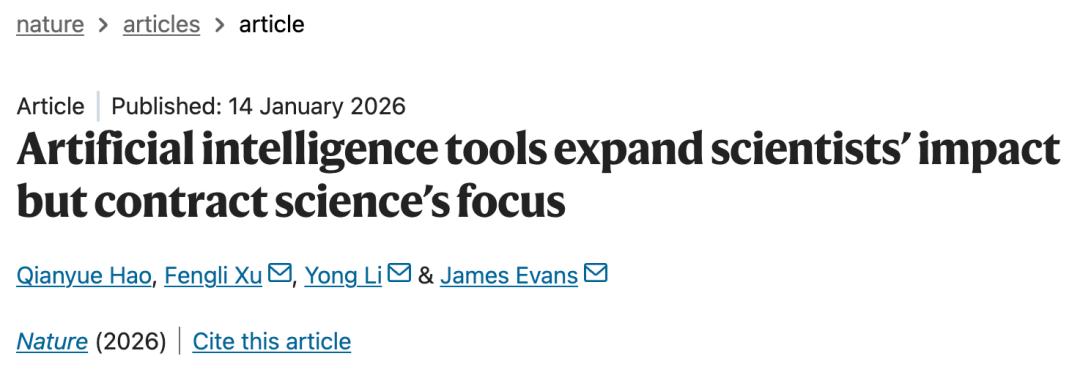
Paper link: https://www.nature.com/articles/s41586-025-09922-yScience
The research team constructed the world's first AI - empowered panoramic knowledge graph for scientific research. Through high - quality expert annotation and large - scale language model training, they accurately identified AI - enhanced scientific research papers spanning three eras of "machine learning, deep learning, and generative AI".
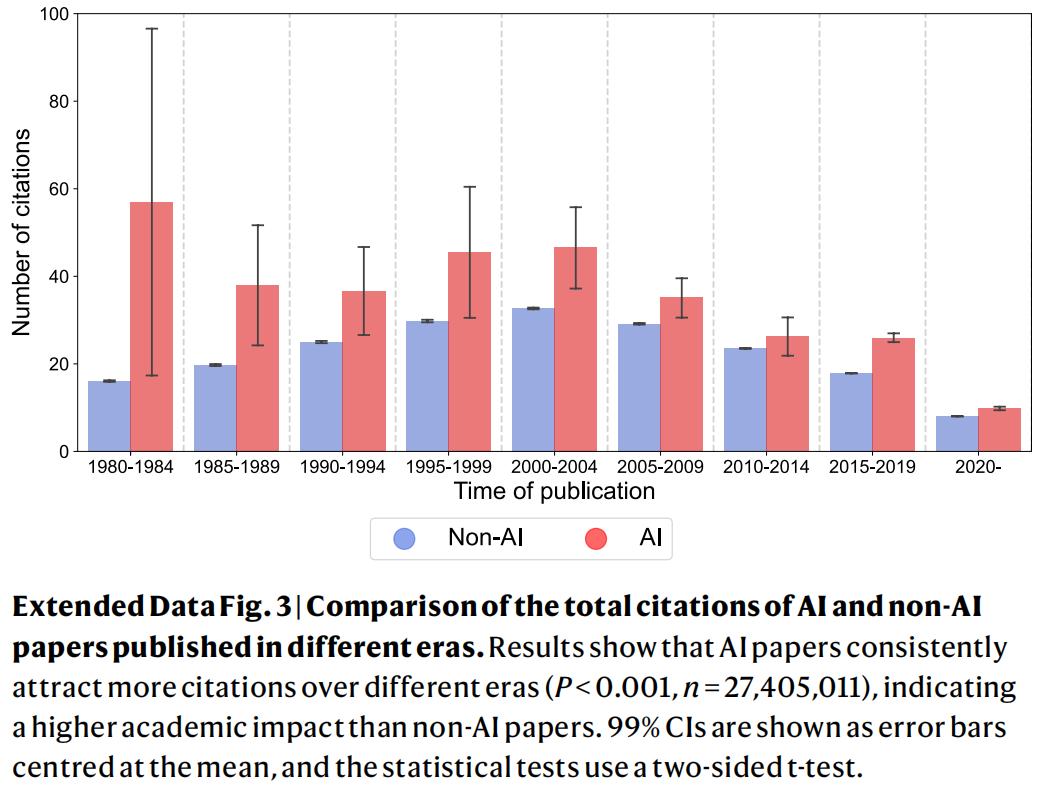
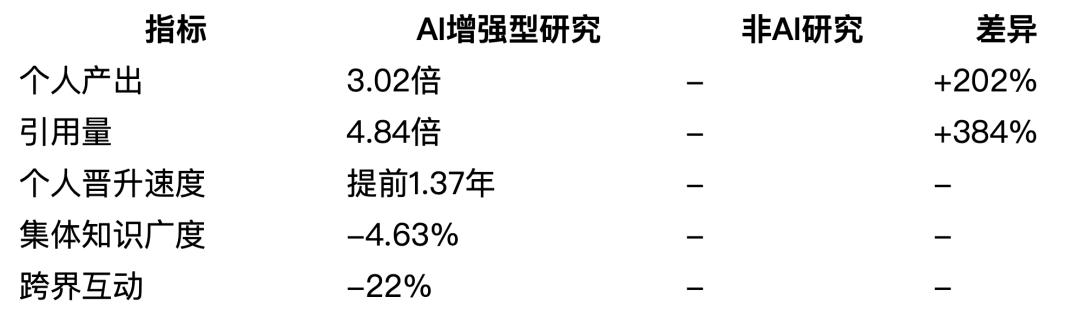
The analysis shows that scientists using AI have significant advantages at the individual level: the average annual number of published papers is 3.02 times higher; the number of citations is 4.84 times higher; the average time from junior to senior promotion is advanced by 1.37 years; the average annual number of citations of AI papers is 98.7% higher.
"This indicates that AI tools have effectively improved the output efficiency and influence of scientists," said Assistant Professor Xu Fengli from the Department of Electronic Engineering at Tsinghua University.
However, when shifting the perspective from the individual to the collective, the research found a worrying phenomenon:
The collective knowledge breadth of AI - driven research has decreased by 4.63%.
Cross - border interactions among scientists have decreased by 22%.
The citations of AI papers present a "star - shaped structure", and the innovation vitality tends to be concentrated and single - type.

Professor Li Yong explained, "We found that the high efficiency of AI has led researchers to collectively flock to a few popular areas suitable for AI research. Although this group - climbing model accelerates the solution of known problems, it invisibly solidifies the path of scientific exploration and systematically weakens the breadth of scientists' exploration of unknown areas."
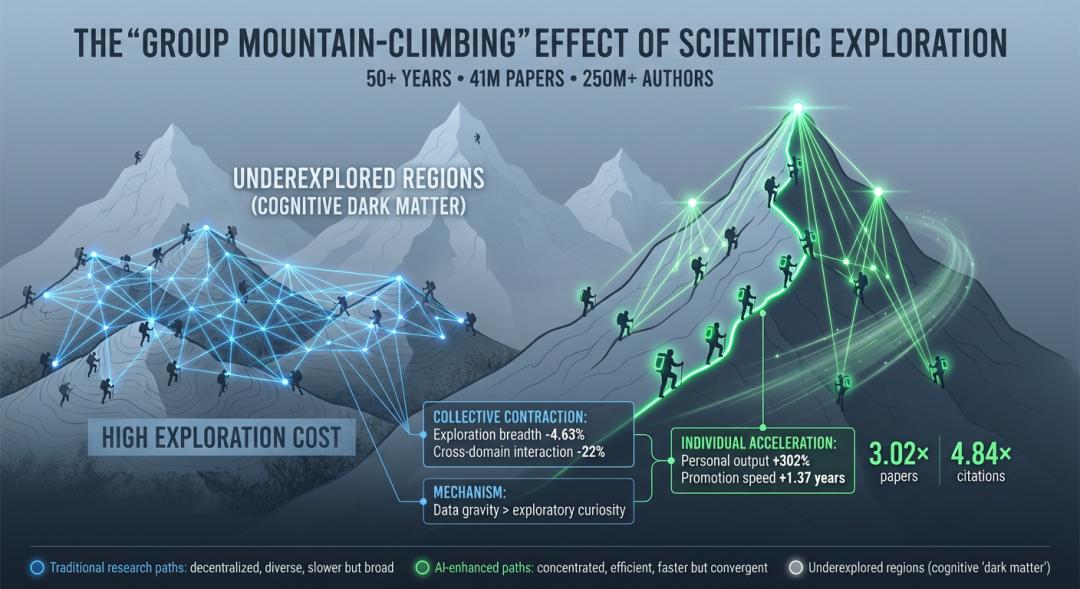
Example diagram of the mountain - climbing effect
Why does AI "shrink" the scientific territory?
The research team's in - depth analysis found that the "preference" of AI stems from data accessibility: AI tends to focus on fields with "abundant data and well - defined problems", while cutting - edge fields with scarce data and vague problems are marginalized.
The research team pointed out, "AI is not bad at innovation, but it is easier to focus on fields with sufficient data and clear problems. When AI is widely used in scientific research, it guides scientists to collectively flock to those popular areas with abundant data and well - defined problems, resulting in a convergent optimization of scientific exploration."
This is in sharp contrast to our expectations for scientific progress: the real value of science lies not only in solving problems but also in raising questions.
From "auxiliary tool" to "partner", the paradigm upgrade of AI - based scientific research
Facing this "involution paradox", the teams of Xu Fengli and Li Yong proposed a new solution: the "Full - process Scientific Research Agent System" (OmniScientist.ai).

Access link: OmniScientist.ai
This system realizes cross - disciplinary, full - process, and multi - modal broad - spectrum scientific research empowerment by deeply exploring the general reasoning ability of large - model agents, promoting the evolution of AI from an "auxiliary tool" to an "AI scientist" capable of "actively proposing hypotheses, independently designing experiments, analyzing results, and forming theories".
"What we are building is a scientific world that accelerates approaching the existing boundaries of knowledge, rather than a future world that can continuously reveal new knowledge boundaries," emphasized Professor Xu Fengli. "In the future, AI needs to expand not only cognitive abilities but also perception and experimental abilities."
Future implications: be vigilant against "scientific involution" and expand the boundaries of cognition
The findings of the paper have sounded the alarm for scientific policy - makers and AI researchers: while AI is accelerating individual scientific research output, it may be systematically weakening the diversity of scientific exploration.
"We need to rethink the positioning of AI in science," said Professor Li Yong. "AI should not only be an amplifier of cognitive abilities but also an expander of perception and experimental abilities."
The application of AI in scientific research is moving from a "tool" to a "partner", but this paradigm upgrade is by no means smooth.
When AI enables scientists to "run faster", we need to be more vigilant: Are we accelerating towards a future of "scientific involution"?
As the research points out, "The real value of science lies not only in solving problems but also in raising questions."
In this AI - driven era, we need to maintain our enthusiasm for the unknown and let AI become a pioneer in exploring boundaries rather than a guard of the comfort zone.
Author introduction
This research was jointly led by Xu Fengli (Assistant Professor) and Li Yong (Professor) from the Department of Electronic Engineering at Tsinghua University and Professor James Evans from the Department of Sociology at the University of Chicago. Hao Qianyue, a doctoral student in the Department of Electronic Engineering at Tsinghua University, is the first author.
Xu Fengli: Assistant Professor in the Department of Electronic Engineering at Tsinghua University, focusing on interdisciplinary research between artificial intelligence and scientific discovery.
Li Yong: Professor in the Department of Electronic Engineering at Tsinghua University, a Changjiang Scholar, and has long been committed to research in intelligent science and engineering.
James Evans: Director of the Knowledge Lab at the University of Chicago, Professor of Sociology, and an authority in scientometrics.
The research was supported by the National Natural Science Foundation of China. The completion units are the Department of Electronic Engineering at Tsinghua University and the Department of Sociology at the University of Chicago.
Reference materials:
https://www.nature.com/articles/s41586-025-09922-y
This article is from the WeChat public account "New Intelligence Yuan". The author is New Intelligence Yuan. 36Kr published it with permission.