The former president of Fourth Paradigm starts a business, using marketing AI Agent to deconstruct the "marketing mystery" of content social platforms, and has received tens of millions of yuan in financing.
Text by | Wang Xin
Edited by | Su Jianxun
It's not a common practice in the startup circle to move a company directly into the client's office area. However, the Noumena team led by Pei Misi, the former president of Fourth Paradigm, insists on doing so. Even now, they are still stationed in the office area of a beauty brand, deeply co - creating with the client team.
Pei Misi's original intention is very clear: to let the scientists in the team who know large models best get close to the front - line of business.
Among the three co - founders of Noumena, Jett once served as the general manager of the KA industry group at Xiaohongshu. The other two co - founders are both scientists who have experienced the business and industrialization training at Fourth Paradigm. The chief scientist, Zhao Huan, previously focused on large - model training and AutoGraph (automated graph learning) at Fourth Paradigm. The CTO, Li Jiajun, is a gold - medalist of ACM (Association for Computing Machinery).
But from the first day of starting the business, they reached a consensus: this startup should focus on specific business domains. They need to roll up their sleeves and get involved in the business to have a deeper understanding before they can fully utilize the leverage effect of AI.
After settling in Shanghai for a few days, without even renting an office, they directly entered a 4A company and served brand clients through AI tools. In this process, he also had new thoughts about the business. As a "veteran" who has been deeply involved in the ToB field for many years, from SAP to Fourth Paradigm, Pei Misi's career has always revolved around the CEO group.
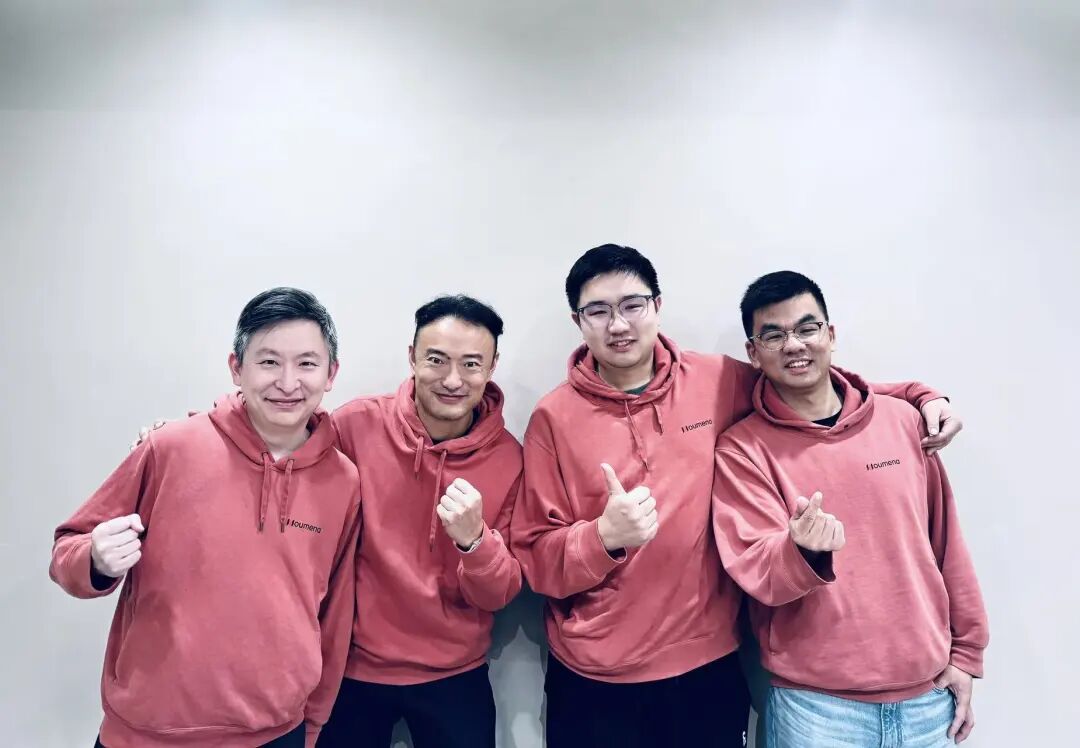
△ Pei Misi (second from left), founder and CEO of Noumena, and co - founders Jiang Xianghui (first from left), Zhao Huan (first from right), and Li Jiajun (second from right)
During the months of co - creating with the brand, Pei Misi noticed that the old era of brand marketing has been deconstructed. The marketing battlefield has gradually shifted from e - commerce platforms to content social platforms, and the certainty of brand online marketing has been declining, with a higher proportion of gambling involved.
Even the strongest human teams can hardly resist the fluctuating influence of the recommendation of distribution platforms on the demands of potential consumers.
In his opinion, content social platforms are the biggest external variable for ToC enterprises. Over 85% of Generation Z's consumption decisions are made here. The user habit of "being influenced by content on content platforms and making purchases on e - commerce platforms" has made this the core battlefield for brand competition. The pain point for brand owners is that their online profits are greatly squeezed by the platforms, and the cost - effectiveness ratio (output benefit / input cost) is getting higher and higher.
He observed that "everyone says they don't understand social platforms and think that content marketing is a mystery." This is because the communication ability between brands and the segmented groups they want to reach is disappearing at the mental level.
Therefore, Pei Misi chose to start from this perspective and use AI to turn marketing from a "mystery" into a "science". To this end, Noumena has created an AI - native marketing agent - the "Growth Intelligence" system, which helps brands achieve sustainable growth on content social platforms.
Content marketing starts with consumer insights. Traditional methods rely on small - sample surveys and are highly dependent on the subjective judgment of researchers, which has limitations. The explosive growth of user - generated content (UGC) on social media has provided unprecedented data resources for consumer research, but it has also brought two new problems:
First, the massive amount of unstructured data far exceeds the processing ability of human experts.
Second, it is difficult for decision - makers to judge the credibility of the insights extracted from it. The emergence of large - language models provides a possibility to solve this problem, but current AI research tools (such as Deep Research - type products) mainly focus on information retrieval and integration and have not solved the problem of the confidence level of insights.
The Noumena AI Agent system includes an AI - native consumer insight infrastructure named the "Manhattan Project". In June 1942, the U.S. Army Department launched the "Manhattan Project", which released atomic energy through breakthroughs in basic physics. Noumena's vision echoes this, that is, to achieve the industrialization of marketing through AI Agents and release the large - scale potential of consumer science.
Noumena's "Manhattan Project" includes two key modules: public - domain compression and evidence - grading verification mechanism.
First, the Agent (intelligent agent) conducts large - scale throughput and refinement of massive public - domain UGC based on public - domain UGC. For example, by browsing the content and comment sections on content social platforms, it learns knowledge information such as content tonality and user preferences.
Then, through the L1 - L4 evidence - grading verification, it discovers the causal relationships in the graph, which is equivalent to redrawing the chaotic and noisy content platforms, enabling brands to find more reliable causal relationships and effective information.
For example, under the "refreshing" topic on social platforms, keywords such as "colleagues", "embarrassment", and "decency" frequently appear, like "want to drink coffee to refresh but afraid colleagues think I'm anxious". After L1 - L4 verification, it can be found that this actually reflects the anxiety of office workers. In this scenario, emphasizing keywords such as "odorless", "not embarrassing", and "decent" in the content can lead to higher conversion rates.
Brands can use the verified L3/L4 insights to replace subjective guesses, accurately define the target group and communication strategies; guide content production and KOL selection based on high - conversion causal keywords to improve the certainty of material supply; and finally, predict and optimize ROI at the advertising placement end with verifiable business causality. Ultimately, it transforms discrete expert experience into standardized industrial - level scientific assets and truly releases the large - scale potential of consumer science.
Every startup is a process of overcoming past thinking inertia. Pei Misi found that this AI ToB startup has a completely different logic from previous SaaS startups. SaaS startups are like "tutoring poor students", and the core is to seek standardization - that is, the largest market common denominator, aiming to make it usable for everyone.
The core competitive barrier for vertical AI Agent startups is the upper limit of intelligence level. In Noumena's Growth Intelligence system, a new architecture Noumena Thinkflow (inspired by anthropic's skills and developed from it) is defined, which can, in the real business context, through long - term co - judgment with human experts, precipitate "how experts make judgments" into system capabilities.
At the current stage, the key is who can absorb the implicit knowledge of more excellent human experts, and these experts are concentrated in leading industry clients. Therefore, Noumena has chosen the strategy of "letting good students strive for the first place". By serving leading industry brands and high - growth DTC new brands, it gives AI the possibility to break through the bottleneck of human intelligence. For example, Noumena is actively promoting cooperation with L'Oréal Group, the leader in the global beauty industry.
In addition to serving leading clients, in this process of precipitating brand experience and intelligence capabilities, they have also found another ToC business path: serving prosumers (professional consumers). For example, currently, there are a total of 200,000 categories and about 40 million content creators on the Xiaohongshu platform, all of which are their potential target groups.
Currently, Noumena's prosumer services mainly focus on the beauty industry. However, Pei Misi believes that the core defining dimension of this service is not the industry but the content social platform. There are a large number of reusable capabilities across different industries, which is also significantly different from the industry - vertical logic in the SaaS era.
The following is the original text of the interview, edited by "Intelligent Emergence":
"Intelligent Emergence": You have long interacted with CEOs and intensively collected enterprises' demands for service providers. Why did you finally choose the AI marketing track? What was the core understanding in this process?
Pei Misi: The core understanding comes from two aspects. First, my career has always focused on the CEO group. From SAP to Fourth Paradigm, I have deeply realized that the key to AI - decision - making transformation lies with the CEO, not the CTO. Enterprises need to overcome many internal resistances, and the implicit cost of transformation is extremely high. Second, my business experience at Fourth Paradigm has made me see the inevitability of track migration. In the early days, it focused on closed scenarios such as bank risk control. Although the demand was clear, the imagination was limited. The marketing side is the core area where intelligent enterprise scenarios emerge.
More importantly, we found that the large number of enterprise sales forecast demands essentially use AI to replace traditional statistical methods, relying on internal data to predict the future, with a very low success rate and less than 50% customer satisfaction. Especially in the retail and FMCG sectors, the speed of external environmental change far exceeds the ability to summarize historical data, and the traditional model has completely failed. Coincidentally, with the rise of large models, their labeling ability and external data interpretation ability have been greatly improved, which made us see the possibility of optimizing enterprise decisions by capturing the external environment, and finally we locked in the AI marketing track.
"Intelligent Emergence": You mentioned that the change in the external environment is the core reason for the failure of enterprise forecasting. Which specific external environmental dimensions have the greatest impact?
Pei Misi: For ToC enterprises, the biggest externality comes from content social platforms. Data shows that over 85% of Generation Z's consumption decisions are made here, far exceeding the influence of traditional factors such as weather and current politics. The migration of the media field has made content social platforms the core battlefield for brand competition, while the traffic growth of e - commerce platforms has gradually slowed down. Users' habits have changed to "being influenced by content on content social platforms and making purchases on e - commerce platforms".
Take a leading footwear and clothing brand as an example. It has thousands of shoe SKUs, and the supply - chain cycle is long. It needs to predict sales and prepare inventory in advance. However, past sales data cannot fit unexpected situations. For example, a certain style of shoes suddenly became popular because of being worn by celebrities and KOLs. This accidental external variable made traditional forecasting completely ineffective. For brands, this kind of uncertainty is unacceptable. What they need is the ability to predict, influence, and even dominate consumption trends.
"Intelligent Emergence": Compared with traditional external factors such as weather and current politics, how is the influence of content social platforms on brands different?
Pei Misi: The difference lies in that the depth and breadth of the influence are not on the same level. Traditional factors such as weather and current politics mostly have short - term and local impacts on brands. For example, rainy days affect the sales of outdoor products, but they will not change users' core consumption decision - making logic.
Content social platforms have become the core scenario for Generation Z's consumption decisions. Over 85% of their choices are made here. It has directly reshaped users' consumption habits, changing from "buying products after seeing advertisements" to "placing orders after being influenced by content". This influence is long - term and systematic, directly determining a brand's market competitiveness.
"Intelligent Emergence": Against the background of drastic changes in the external environment, where do you think the startup opportunities lie? What is the core solution?
Pei Misi: The opportunity lies in "aligning the speed". Enterprises' understanding, capture, decision - making, and execution links regarding content social platforms are too slow. The core idea is to improve the efficiency of the entire link through technology and achieve a fast closed - loop of "understanding - decision - making - execution - iteration". Specifically, the essence of brand performance advertising is "content quality × content distribution and communication structure". The value of technology lies not only in content generation but also in optimizing the distribution structure.
There is a cognitive misunderstanding in the current industry, which overly focuses on AIGC - generated content. However, the dominance of high - quality content has shifted to tens of millions of influencers, and it is difficult for brands to control. The real core is: on the basis of capturing the SOP of high - quality content, calculate the matching logic of content, target groups, and scenarios through technology to achieve precise reach. Simply put, it is to turn the operation of brands on content social platforms from a "mystery" into a "science".
"Intelligent Emergence": Why do you say that the dominance of high - quality content has shifted to influencers? How can brands break the deadlock in this context?
Pei Misi: Now, influencers with tens of millions of followers have formed their own creative styles and fan circles. The content they produce is closer to users' preferences and is more likely to get platform traffic support. It is difficult for brands to achieve the same effect by producing their own content, so the dominance has shifted.
The key for brands to break the deadlock is not to regain the content dominance but to do a good job in "matching". First, find influencers who match the brand's tonality and can precisely reach the target group. Then, capture the SOP of their high - quality content through technical means, co - create content with the brand's core information, and finally optimize the distribution structure to let the content precisely reach more potential users.
"Intelligent Emergence": Please use a specific case to illustrate how you empower the entire brand - marketing link?
Pei Misi: Take a leading footwear and clothing brand as an example. The entire - link empowerment is divided into three core steps.
The first step is to position the target group and the product. Clearly define that the core target audience of the product is men aged 35 - 45 who are office workers in first - tier cities and have a monthly running volume of over 100 kilometers. Based on this, screen suitable niche influencers. These influencers need to precisely cover the target group, and the cooperation cost should be controllable, avoiding the high cost and low precision of top - tier celebrities.
The second step is content co - creation. Combine the influencers' original creative styles and SOPs and implant the brand's core information. For example, fitness influencers can start from the "post - workout recovery" scenario, and workplace influencers can implant the information from the "morning workout routine" scenario to ensure that the content is natural and not forced.
The third step is advertising optimization. If the initial attention of the content is insufficient, analyze the tags of potential users and conduct targeted advertising to amplify the communication effect.
This entire - link combination is the implementation of "content quality × communication structure". The core is to use technology to support every decision - making step with data and improve certainty.
"Intelligent Emergence": In the influencer screening process, besides precisely covering the target group, what other core indicators will you pay attention to?
Pei Misi: Besides the target - group matching degree, we also focus on the stability of the influencers' content quality and the authenticity of their fan interactions.
The stability of content quality means checking whether the content produced by influencers in the past has consistently met the high - quality SOP and whether there has been a large amount of low - quality content. The authenticity of fan interactions means judging whether the influencers' fans are real and active, whether there are a large number of fake followers, and whether the interactive comments are strongly related to the content. These two indicators directly affect the subsequent content communication effect and are more important than simply looking at the number of fans.
"Intelligent Emergence": Where do your business and products specifically manifest? What is the cooperation boundary with brands?
Pei Misi: We mainly empower three core roles: brand planners, content planners, and advertising operators. The business boundary is to "deconstruct and transform the existing physical product definitions of brands into digital definitions suitable for content social platforms". For example, if the brand's product manager has clearly defined the product's functional parameters, our job is to translate them into the language of the target group and scenarios on platforms such as Xiaohongshu and Douyin.
"Intelligent Emergence": Can you give an example to illustrate the specific method of this "definition transformation"?
Pei Misi: Take a high - end shampoo brand as an example. Its original positioning was a "salon - grade professional product", but on the Xiaohongshu platform, the salon - goer group is extremely small. Through data analysis, we found that "high - end fluffy feeling" is the core demand. We re - positioned it as a "fluffy hair - care product for scenarios such as after taking a makeup - look photo or working out", successfully entering the "self - indulgence" main track on Xiaohongshu.