The key to breaking the bottleneck of AI computing power: the advanced packaging sector has skyrocketed. Is the windfall here?
The competition in AI computing power has reached a white - hot stage, but the chips are almost "overheating"!
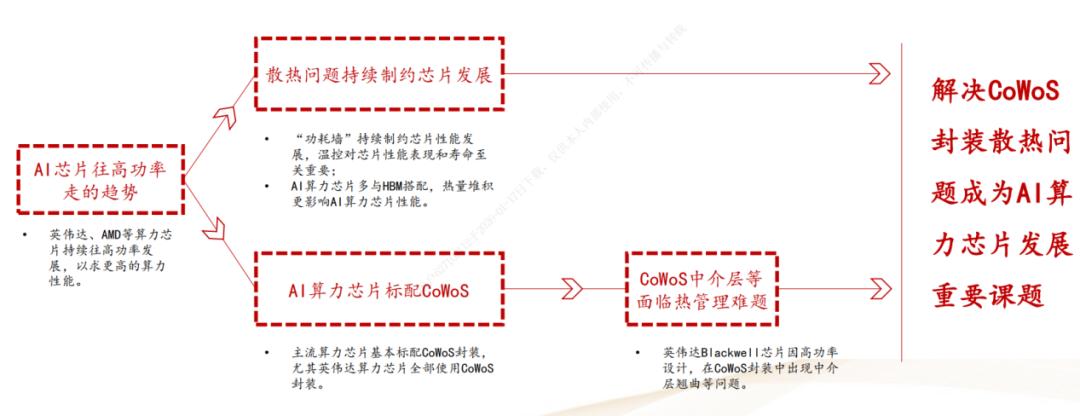
The peak power consumption of NVIDIA's H100 exceeds 700W. The next - generation Rubin processor is heading straight for 1800W, and it may even reach 6000W in 2029. Behind the soaring computing power is the "collapse" of traditional packaging - the heat dissipation of the silicon interposer can't keep up, and it is prone to cracking. The "power consumption wall" of CoWoS packaging has become a fatal bottleneck for AI computing power.
The key to breaking the deadlock lies in the combination of "advanced packaging + SiC". TSMC has issued a call for cooperation to promote SiC interposers. NVIDIA plans to introduce 12 - inch SiC substrates in 2027. Industry giants are collectively betting on it.
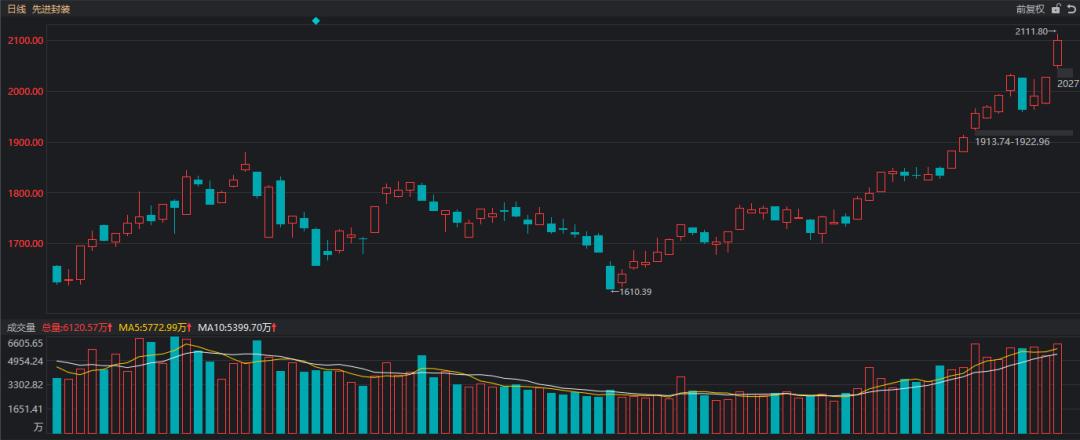
The A - share market has already reacted: the advanced packaging index has risen by more than 14% since the beginning of the year. The single - day trading volume of Changjiang Electronics Technology exceeded 5 billion yuan. SiC - related stocks such as Jingsheng M&E and Tianyue Advanced Materials have shown abnormal movements. A feast driven by "rigid demand for AI computing power + breakthroughs in SiC technology + domestic substitution" has begun!
(Source: Flush)
Soaring demand for computing power, advanced packaging becomes the key to breaking the deadlock
The demand for computing power in AI large - model training and data centers has skyrocketed exponentially, directly pushing chips to the "power consumption limit". In 2025, China's intelligent computing power scale will reach 1037.3 EFLOPS, and it will increase by another 40% in 2026. However, traditional packaging can no longer bear the load.
For every doubling of chip performance, the power consumption triples. The thermal conductivity of the silicon interposer is only 148 W/m·K, which is simply unable to dissipate the heat generated by ultra - high power. What's more troublesome is that as the size of the CoWoS interposer increases, the silicon material is prone to delamination and cracking, and the yield rate drops significantly.
(Source: Huaxi Securities Research Institute)
At this time, advanced packaging steps forward. Through technologies such as 2.5D/3D stacking, hybrid bonding, and replacement of the SiC interposer, it can not only solve the heat dissipation problem but also increase the chip interconnection density by more than 10 times, becoming the core means to surpass Moore's Law. Yole predicts that the global advanced packaging market scale will exceed $79 billion in 2030, among which the growth rate of 2.5D/3D packaging is as high as 37%, making it a high - growth track.
From 2.5D to SiC, continuous technological iteration
The core upgrade logic of advanced packaging is the dual breakthrough of "materials + processes". Especially with the addition of SiC, the industry has undergone a qualitative change.
First, look at the process iteration: traditional 2.5D packaging connects chips through a silicon interposer, but its performance has reached the ceiling; 3D packaging uses hybrid bonding technology to achieve direct copper - to - copper connection. The interconnection pitch is reduced from 20μm to < 10μm, and the signal delay is reduced by 30%. Technologies such as TSMC's SoIC and Intel's Foveros have been implemented, and hybrid bonding will enter large - scale application in 2026.
Then, look at the material revolution: SiC has become the "optimal solution" for the interposer, but its economic efficiency is still lacking. Its thermal conductivity reaches 490 W/m·K, more than three times that of silicon. Its Mohs hardness is 9.5, and its anti - cracking ability far exceeds that of silicon and glass. More importantly, SiC can achieve a high - aspect - ratio through - hole design, optimize the wiring density, and increase the chip transmission speed by another 20%.
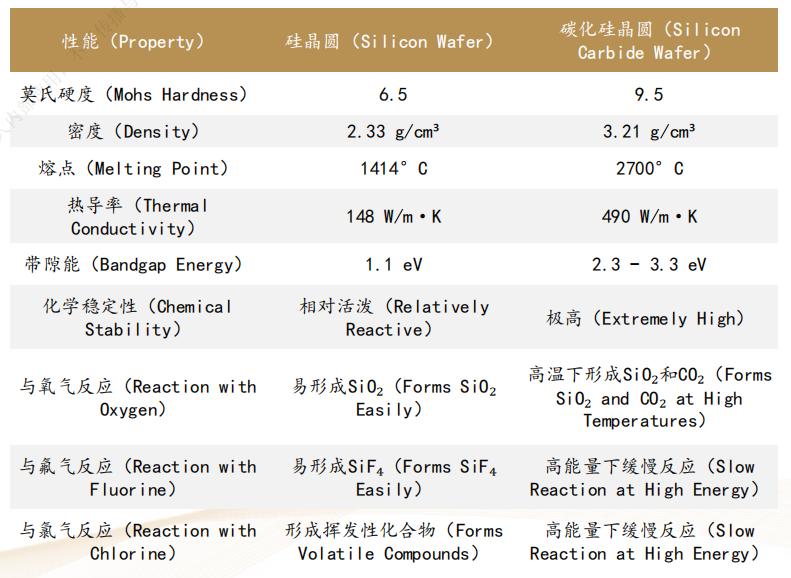
(SiC is superior to Si in key indicators such as thermal performance and hardness. Source: Huaxi Securities Research Institute)
From an industry perspective, 2027 is expected to be the first year of mass production of SiC interposers. Based on the 35% compound growth rate of CoWoS and a 70% replacement rate of SiC, more than 2.3 million 12 - inch SiC substrates will be needed in 2030, equivalent to 9.2 million 6 - inch substrates, far exceeding the current global production capacity, resulting in a huge gap.
Equipment + materials + OSAT, leading companies are taking the lead
The explosion of advanced packaging is not a single - point opportunity but a resonance of the entire industrial chain. The three major tracks of equipment, materials, and OSAT (outsourced semiconductor assembly and test) are all making efforts.
OSAT is the direct beneficiary. Changjiang Electronics Technology's XDFOI solution covers 2.5D/3D packaging. Tongfu Microelectronics' large - size FCBGA has entered mass production. Shenghe Jingwei's silicon interposer technology has been mass - produced, and it has a deep - seated partnership with customers such as Huawei Ascend. In the global packaging and testing pattern, Changjiang Electronics Technology and Tongfu Microelectronics rank among the top ten globally, and the share of domestic substitution continues to increase.
The materials track is the key to breaking through the core bottleneck. The localization rate of key materials such as packaging substrates (Shennan Circuits, Xing Sen Technology), PSPI (Dinglong Co., Ltd., Feikai New Materials), and CMP polishing fluid (Anji Technology) is increasing rapidly. Especially for SiC substrates, Tianyue Advanced Materials ranks second globally with a market share of 16.7%. Jingsheng M&E's 12 - inch pilot line has been connected. Sanan Optoelectronics and STMicroelectronics have jointly established a factory, and the production capacity is continuously being released.
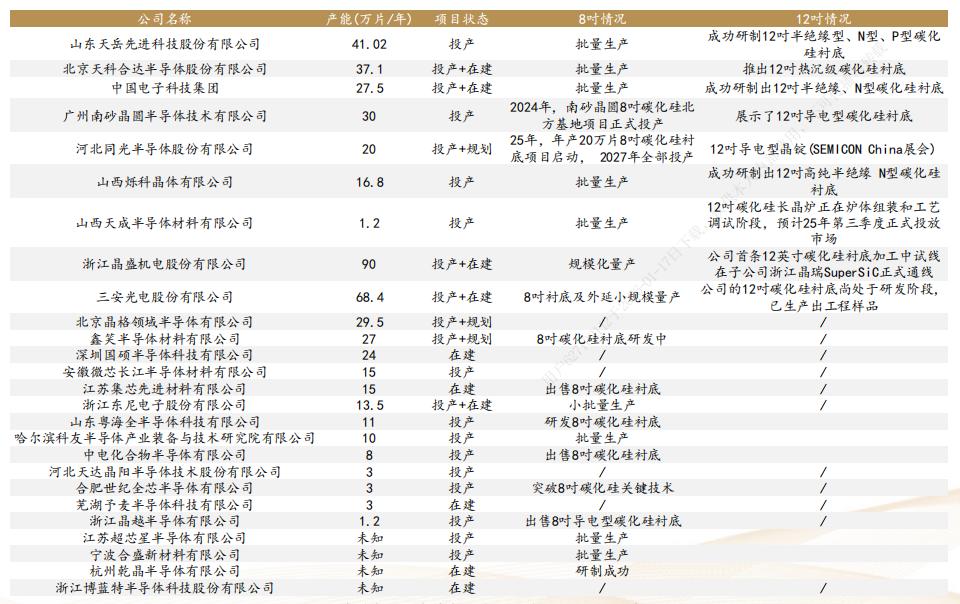
(Progress of domestic SiC manufacturers. Source: Huaxi Securities Research Institute)
The equipment track is the key to mass production. Equipment manufacturers such as hybrid bonding machines (Tuojing Technology, Xinyuan Micro), CMP equipment (Huahai Qingke), and laser dicing machines (Xinqi Micro - Equipment) have broken through overseas monopolies. In 2024, the market scale of China's semiconductor packaging equipment reached 28.27 billion yuan, a year - on - year increase of 18.9%. With the mass production of SiC interposers, the demand for equipment will further explode.
Gold - mining guide: Focus on 4 directions to capture tens of billions of dividends
The growth logic of advanced packaging + SiC is clear. By focusing on 4 directions, one can both grasp certainty and enjoy flexibility.
1. SiC materials and equipment
Bet on the eve of mass production Give priority to 12 - inch SiC substrate and equipment enterprises. For substrates, look at Tianyue Advanced Materials (ranked second globally, 12 - inch substrates are in mass production) and Sanan Optoelectronics (cooperating with STMicroelectronics, ramping up 8 - inch production capacity); for equipment, keep an eye on Jingsheng M&E (dual - layout of crystal growth furnaces and substrate processing) and Jingsheng Co., Ltd. (SiC crystal growth furnaces) to share the dividends of the 2027 mass - production wave.
2. Advanced packaging OSAT: The core of domestic substitution
Lock in leading companies with technological breakthroughs and customer partnerships. Changjiang Electronics Technology (XDFOI solution implemented, ranked third globally), Tongfu Microelectronics (core supplier of AMD, breakthrough in CoWoS - like solutions), and Shenghe Jingwei (mass - production of silicon interposers, core of Huawei's supply chain) will benefit from the overseas production capacity gap and domestic substitution.
3. Key materials: Overcome bottleneck links
Invest in leading companies in segments such as packaging substrates, PSPI, and CMP materials. Shennan Circuits (mass - production of FCBGA substrates), Dinglong Co., Ltd. (dual breakthroughs in PSPI and polishing pads), and Anji Technology (full coverage of CMP polishing fluid and electroplating fluid). As the penetration rate of advanced packaging increases, the demand for materials will continue to grow.
4. Hybrid bonding and 3D packaging: Pioneers of technological iteration
Pay attention to enterprises implementing cutting - edge technologies. Tuojing Technology (receiving repeat orders for hybrid bonding equipment), Xinyuan Micro (increasing sales of temporary bonding/de - bonding equipment), and Huahai Qingke (mass - supplying 12 - inch thinning machines) to seize the commercialization opportunities from "0 to 1".
Conclusion
From the rigid demand generated by AI computing power, to the breakthroughs in SiC technology, and then to the window period of domestic substitution, the advanced packaging industry has been upgraded from a "semiconductor back - end process" to a "core carrier of computing power", becoming a key track supporting AI, data centers, and intelligent driving.
The industry is currently on the verge of explosion: the mass production of SiC interposers in 2027 will open up new growth space. Domestic enterprises have achieved breakthroughs in areas such as SiC substrates, packaging equipment, and OSAT, with significant advantages in the industrial chain.
Note: The companies mentioned in this article are only for case analysis and do not constitute any investment recommendations. The market is risky, and investment should be made with caution. Please make independent judgments before making decisions.
This article is from the WeChat official account "Gelonghui Financial Hotspots" (ID: glh_finance), author: Editor of Gelonghui. It is published by 36Kr with authorization.