The upper payload limit of robots has been broken by Galaxy Universal.
Today's manufacturing industry is facing a new challenge.
From factories to warehouses, from energy to advanced manufacturing, unprecedented changes are taking place on the demand side: on the one hand, there are high-intensity, heavy-load, long-cycle rigid tasks; on the other hand, there are realistic scenarios with variable operating environments and labor shortages.
This is why embodied intelligence is so highly anticipated. Compared with robots that remain in the demonstration and experience stages of making coffee, folding clothes and playing boxing, what is more urgently needed at this stage is a hardcore productivity tool that can enter the real manufacturing system and solve operational pain points.
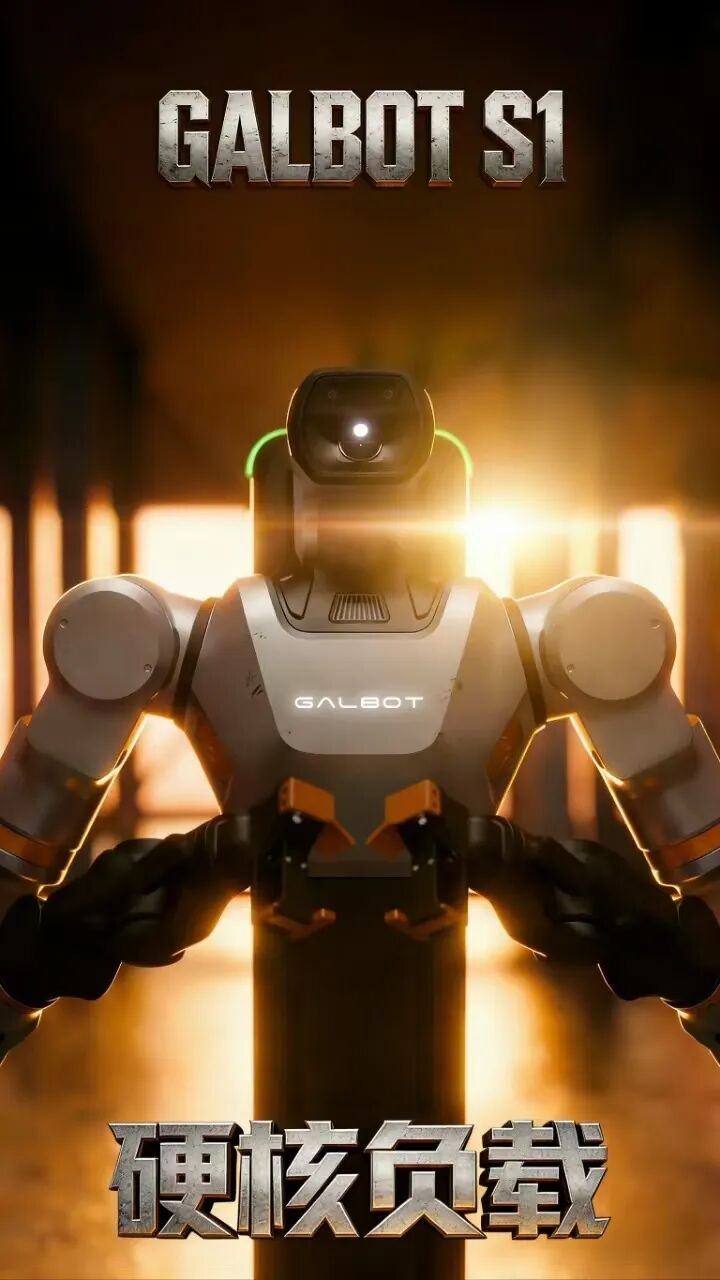
Nowadays, some enterprises have taken the first step. On January 5, Galaxy Universal officially released the Galbot S1 embodied intelligent heavy-duty robot, which has now been applied in the production lines of leading manufacturing giants such as CATL with zero teleoperation and full autonomy.
It is worth mentioning that the core embodied handling model of the Galbot S1 product has been presented as an important achievement of Beijing's artificial intelligence industry by Dr. Wang He, Assistant Professor of Peking University and Founder of Galaxy Universal, at the Beijing Artificial Intelligence + Innovation Demonstration Highland Conference to the participating leaders.
This also means that Galbot S1 is not only a technological breakthrough of one single company, but also has obtained authoritative certification at the strategic level. As the "No.1 Artificial Intelligence City" with concentrated national innovation resources and active innovation entities, excellent embodied intelligence innovation cases will be exported to the whole country and even the world as a "Beijing Solution".
When Galbot S1 enters the real factory environment, a long-standing unresolved question begins to get an answer: is embodied intelligence just an expensive tech show, or a practical new digital infrastructure that can deliver real value?
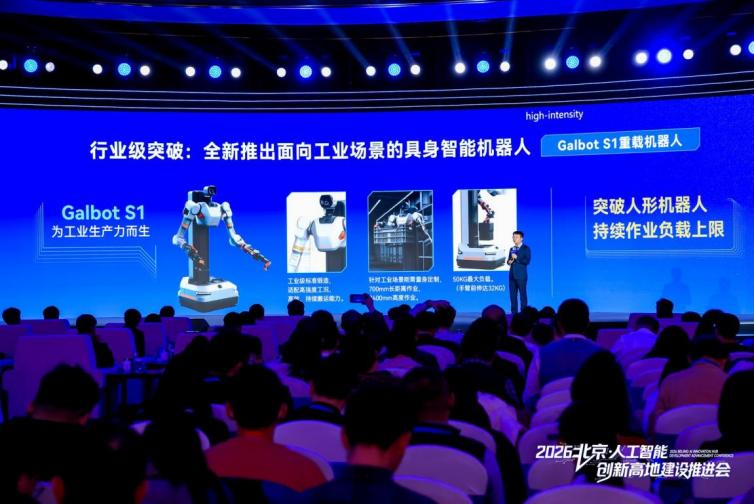

Load Capacity Breaking the Industry Ceiling
From the very beginning of its design, Galbot S1 is an embodied intelligent robot targeted at industrial productivity scenarios.
The current industrial robots, in essence, are still superimposing simple industrial functions on general bodies, such as QR code positioning, fixed-point grabbing, or preset-track simple movement. Galbot S1, by contrast, is tailor-made for industrial scenarios. It directly faces the industrial environment of high intensity, long cycle and continuous operation, can adapt to non-ideal working conditions such as dust, vibration, occlusion and light change, and can also operate stably in the complex process of human-robot coexistence in factories.
More critically, it has made a major breakthrough in load capacity: the maximum load of its dual arms reaches 50kg, and it can stably carry 32kg when its arms are fully extended forward, breaking the load ceiling of the robot industry and truly entering the key handling links of production processes.

Of course, strength is not the only evaluation criterion. What determines whether a robot can really play a role is its continuous ability to cope with changes.
The requirements of manufacturing production lines for embodied intelligence are often more stringent: different from highly automated production lines, robots need to flexibly handle materials, move autonomously, and continuously conduct human-robot collaboration.
Focusing on real industrial demands, Galaxy Universal takes Galbot S1 as the cornerstone to build an embodied intelligent handling model for production scenarios. Based on the existing intelligent interaction and perception capabilities, this model pays more attention to determinism and reliability, ensuring that the robot can complete key handling tasks stably for a long time.
Empowered by the model, Galbot S1 can achieve pure visual perception, no longer relying on QR codes or tags for positioning, and can still achieve accurate positioning and operation in complex factory environments; it also has strong anti-interference ability, and can stably complete tasks even in the face of light changes, occlusions or dynamic interference; at the same time, with the help of hard real-time response and 360° omnidirectional obstacle avoidance perception, Galbot S1 can flexibly cope with dynamic environments and carry out human-robot collaboration safely and efficiently.

Moreover, relying on the highly reliable mechatronics architecture and dual-battery design, Galbot S1 has the capability of long-distance continuous operation — with an 8-hour ultra-long battery life, it can also realize autonomous battery swapping to achieve 7×24 hours of continuous operation, enabling the robot to adapt to the continuous operation requirements in real factories.

This is also Galbot S1's response to industrial pain points: while taking into account intelligence and safety, it can also operate autonomously and stably day after day on the production line with tight rhythm.

Not Just a New Product, But a Ready-to-deploy Combat Force
The ultimate goal of embodied intelligence is to liberate productivity. But all discussions about productivity must eventually return to reality.
36Kr exclusively learned that Galbot S1 has now been successfully deployed in CATL's factories, serving real production operation processes with zero teleoperation and full autonomy.
The application in CATL shows that the demand for heavy-load handling in the advanced manufacturing sector remains urgent, and embodied intelligence has been able to match the real demand in terms of capability. More importantly, this marks that for the first time, embodied intelligent robots have truly undertaken heavy-load tasks in key links of manufacturing, and have withstood the complex test of real factory environments. The productivity represented by embodied intelligence has been officially integrated into the main track of industrial upgrading.
When leading enterprises entrust their core production links to embodied intelligence systems, it is not only a recognition of the technical reliability and long-term value of the manufacturer behind it, but also can gradually form a replicable and scalable productivity solution through round-the-clock practical experience, which has great reference significance for many industrial fields such as automobile manufacturing, semiconductors, energy and power in the future.
For current robot manufacturers, getting factory orders does not seem to be a new thing, but there is still a long distance between mass delivery and entering real production links. The successful entry of Galbot S1 into CATL's production process also provides a sample to some extent: in factories, what role should embodied intelligence play exactly?
Galaxy Universal has given a standard answer: embodied intelligence productivity should not be a gimmick that only performs, but an intelligent labor unit that can be continuously deployed, run stably, and generate scale effects.
From the perspective of the industry, this productivity form has also brought innovation to production methods. In the past, there was an awkward gap in the manufacturing industry — "those with strength have no intelligence, and those with intelligence have no strength". To move heavy objects of dozens of kilograms, people could only rely on fixed mechanical arms that were rigidly welded, lacking flexibility. While the so-called industrial robots can recognize obstacles, they cannot carry heavy loads. The emergence of S1 means that factories no longer need to modify production lines to accommodate machines, but let robots adapt to variable production tasks just like real human workers.
The most direct value of this breakthrough is to provide certainty for factories. In an era of labor shortage, the mobility of workers has become the biggest variable for factories. Galbot S1 not only fills the labor gap, but also connects the previously disconnected logistics and production links, truly bringing a qualitative improvement to production efficiency.
This also explains Galaxy Universal's restraint in path selection. When the embodied intelligence track is crowded with delicate, fun, and even socially viral smart toys, it has chosen a heavier and slower path: polishing the capability of "getting real work done" to the extreme.
This is a kind of sobriety based on industrial practice — in the context of factories, any intelligence that cannot be converted into productivity is an expensive redundancy. Rather than demonstrating dexterity, conquering the practical proposition of carrying 50kg heavy objects in dusty and high-temperature environments truly touches the underlying pulse of China's manufacturing transformation and upgrading.

Firmly Stick to the Right Path
From the perspective of the macro industry, the development path of embodied intelligence is diverging.
Most products emphasize light weight, portability and interactive experience, which are more suitable for display and promotion; a small number of products focus on high-intensity and long-cycle tasks, continuously polishing engineering reliability and system stability.
Galaxy Universal is a very representative enterprise of the latter.
This choice may not quickly attract attention, but it is closer to the long-term needs of industrial customers. Under this path, embodied intelligence is no longer a display product for casual viewing, but gradually evolves into a production factor that can be evaluated, replicated and deployed on a large scale.
This is also in line with the strategic rhythm of the country promoting the high-quality development of the manufacturing industry. As the 15th Five-Year Plan kicks off, the intelligent transformation of China's manufacturing industry is no longer satisfied with patchwork local automation, but pursues a system-level reconstruction. The "new quality productivity" advocated by the country has never been based on vague concepts, but on strong support for the real economy.
In December 2025, Galaxy Universal announced the completion of a new round of financing of over 3 billion US dollars (about 21 billion RMB). This round of financing is currently the largest single round of financing in the embodied intelligence field, making Galaxy Universal the highest-valued embodied intelligence startup in China. This also shows that capital is recalibrating the valuation logic of embodied intelligence: from focusing on whose shape is more human-like, to focusing on whose machine can create more practical value.
In this context, the value standard of embodied intelligence has become increasingly clear: whether it can enter real scenarios, undertake real tasks, and deliver stable output for a long time. Galaxy Universal's practice path is exactly developed around this standard.
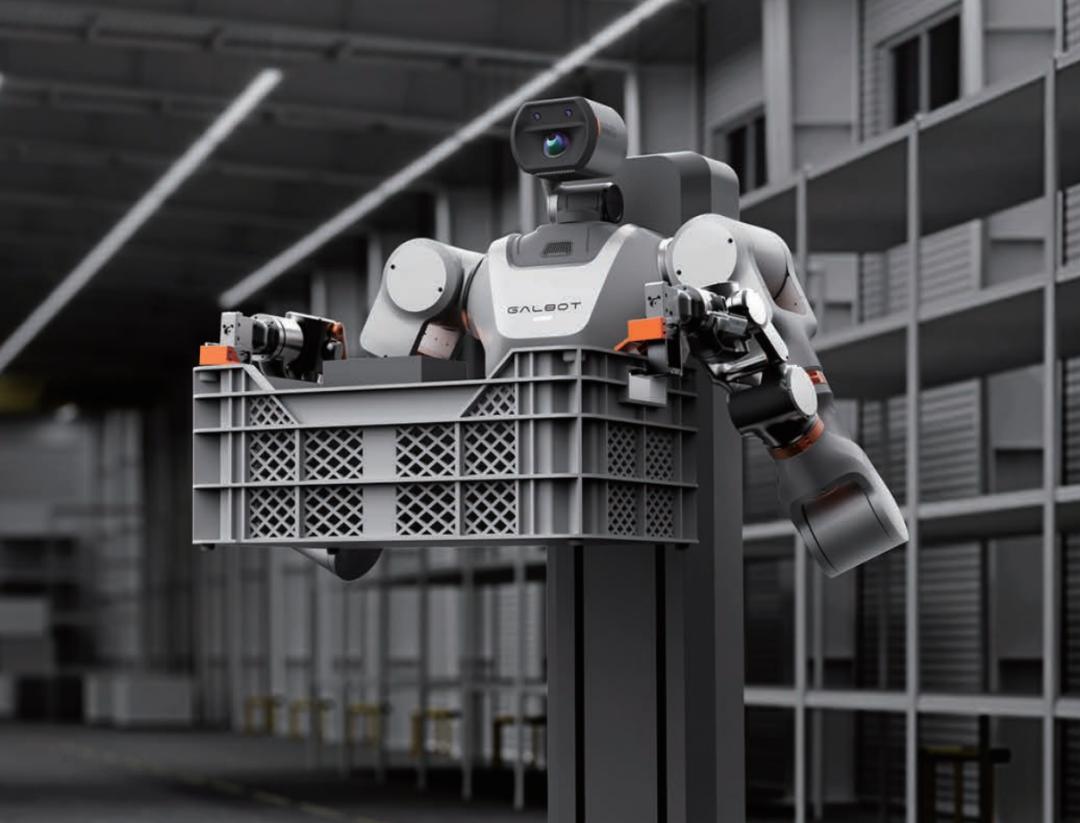
In the history of industrial development, every leap of human civilization, in essence, redefines the boundary of productivity. In the 18th century, Watt improved the steam engine and solved the power source for the operation of industrial society, while the popularization of assembly lines in the 20th century created the cooperation order of mass production. Nowadays, Galbot S1 entering CATL's production lines is also answering the major proposition of this era: when aging and labor shortage come irreversibly, who will take over the heavy and boring front-line production work.
From this perspective, the value of Galbot S1 does not lie in how much weight it can carry, but in marking that embodied intelligence has begun to truly enter the core links of China's manufacturing industry. Its arrival fills the industry gap that embodied intelligence is difficult to undertake heavy industrial tasks, and opens a new chapter of industrial application with dual breakthroughs in heavy load and intelligence.
At this moment, embodied intelligence has finally taken off its gorgeous coat and put on work overalls. This step is the beginning for Chinese technology to truly take root in the real economy and deepen the industrial soil.