Anthropic has just released a report titled "AI Job Displacement Report": The higher the educational level, the more likely one is to "lose their job to AI".
[Introduction] The "gold content" of your job is being siphoned away by AI. A recent report from Anthropic reveals a counterintuitive truth: the more complex a task is as measured by the number of years of education required, the greater the acceleration AI brings. What's more terrifying than being directly replaced is "deskilling" – AI takes away the joy of thinking, leaving you with only menial tasks. However, the data also points out the only way out: those who understand human - AI collaboration can increase their chances of success tenfold. In this era of excess computing power, this is a survival guide you must understand.
Anthropic just released the "Economic Index Report" on its official website yesterday.
The report not only focuses on what people are using AI for but also on the extent to which AI truly replaces human thinking.
This time, they introduced a new dimension called "Economic Primitives" in an attempt to quantify the complexity of tasks, the required education level, and the autonomy of AI.
The future of the workplace reflected by the data is much more complex than the simple "unemployment theory" or "utopia theory."
The harder the job, the faster AI can do it
In our traditional perception, machines are usually good at repetitive and simple labor but appear clumsy in fields involving advanced knowledge.
However, Anthropic's data gives a completely opposite conclusion: the more complex the task, the more amazing the "acceleration" brought by AI.
The report shows that for tasks that only require a high - school education to understand, Claude can increase the work speed by 9 times;
Once the task difficulty increases to the level requiring a university degree, this acceleration rate soars directly to 12 times.
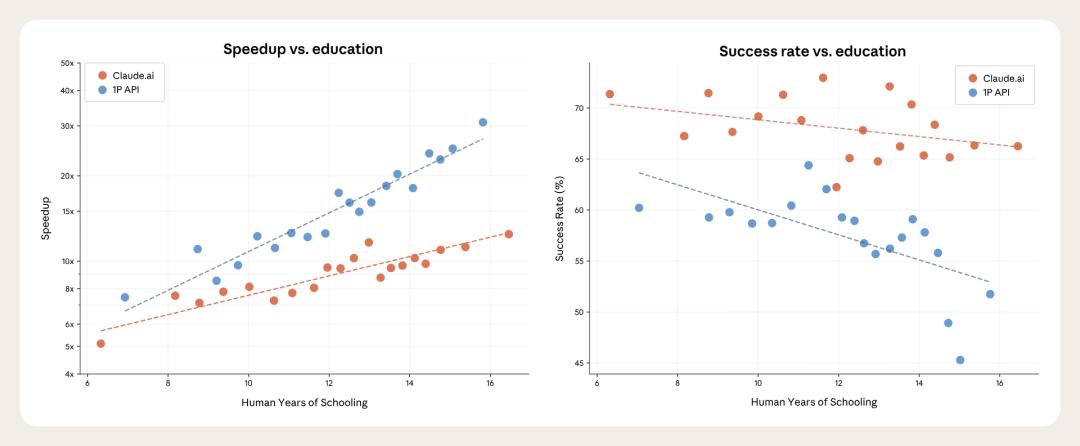
This means that the white - collar elite jobs that originally required humans to think hard for hours are currently the areas where AI has the highest "harvesting" efficiency.
Even if we take into account the failure rate of AI's occasional hallucinations, the conclusion remains the same: the huge increase in efficiency that AI brings to complex tasks is enough to offset the repair costs caused by its mistakes.
This explains why current programmers and financial analysts rely more on Claude than data entry clerks – because in these high - intelligence - density fields, the leverage effect shown by AI is the strongest.
The "New Moore's Law" of 19 - hour human - AI collaboration
The most shocking data in this report is the test of AI's "endurance" (task duration, Task horizons, measured by a 50% success rate).
Common benchmark tests such as METR (Model Evaluation & Threat Research) believe that for the current top - tier models (such as Claude Sonnet 4.5), when dealing with tasks that take humans 2 hours, the success rate will drop below 50%.
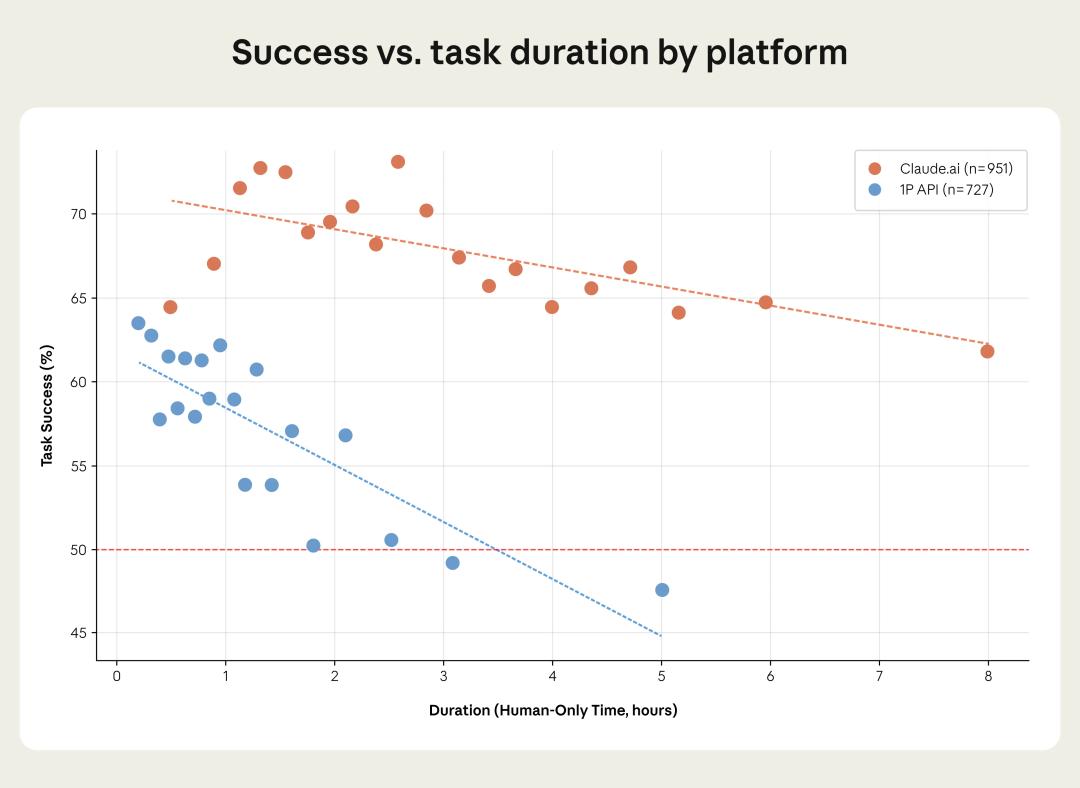
However, in Anthropic's actual user data, this time limit has been significantly extended.
In the business scenario of API calls, Claude can maintain a winning rate of more than half in tasks involving 3.5 hours of work.
In the Claude.ai dialogue interface, this number has been astonishingly pushed up to 19 hours.
Why is there such a huge gap? The secret lies in the intervention of "humans."
In benchmark tests, AI faces the test paper alone, while in reality, users break down a large and complex project into countless small steps and correct AI's direction through continuous feedback loops.
This human - AI collaboration workflow pushes the upper limit of task duration (measured by a 50% success rate) from 2 hours to about 19 hours, nearly 10 times.
This may be what the future of work looks like: it's not that AI completes everything independently, but that humans learn how to harness it to run a marathon.
Folding on the world map: the poor learn knowledge, the rich engage in production
If we broaden our view to the global scale, we will see a clear and somewhat ironic "adoption curve."
In developed countries with a high per - capita GDP, AI has been deeply embedded in productivity and personal life.
People use it to write code, create reports, and even plan travel itineraries.
But in countries with a low per - capita GDP, the main role of Claude is as a "teacher," and a large number of its uses are concentrated in coursework and educational tutoring.
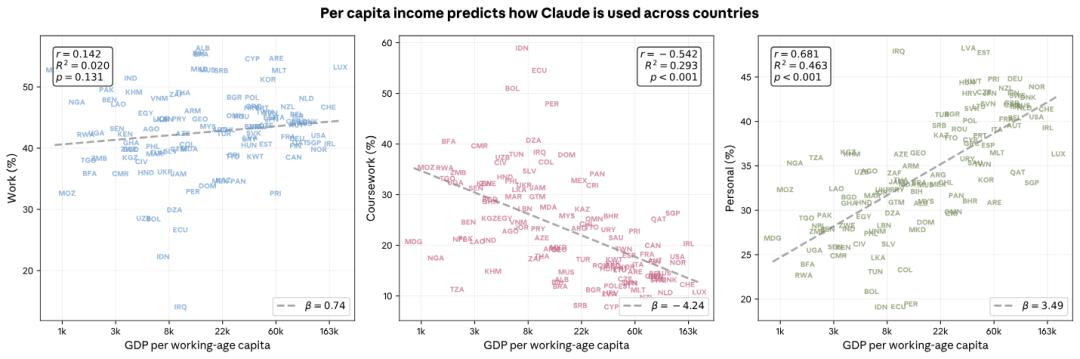
In addition to the difference in wealth, this is also a manifestation of a technological gap.
Anthropic mentioned that they are cooperating with the Rwandan government, trying to enable the people there to cross the simple "learning" stage and enter a more extensive application layer.
Because without intervention, AI is likely to become a new barrier: people in wealthy areas use it to exponentially amplify their output, while people in underdeveloped areas are still using it to supplement basic knowledge.
Hidden concerns in the workplace: the ghost of "deskilling"
The most controversial and worthy - of - attention part of the report is the discussion about "deskilling."
The data shows that the tasks currently covered by Claude require an average of 14.4 years of education (equivalent to an associate degree), far higher than the 13.2 years required for the overall economic activities on average.
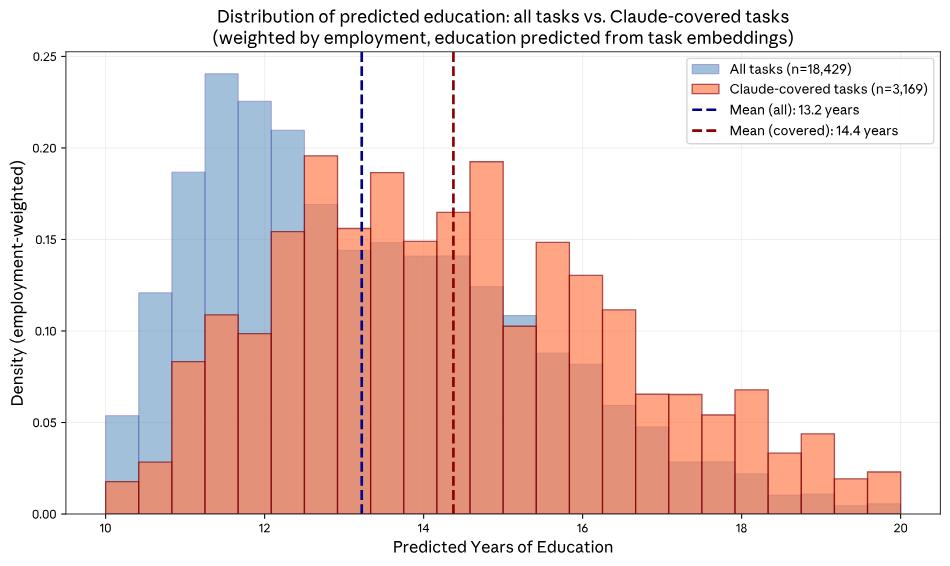
AI is systematically removing the "high - intelligence" part from work.
For technical writers or travel agents, this may be catastrophic.
AI takes over the "brain - intensive" tasks such as analyzing industry trends and planning complex itineraries, leaving humans with only trivial tasks such as sketching and collecting invoices.
Your job still exists, but the "gold content" of the job has been siphoned away.
Of course, there are also beneficiaries.
For example, real - estate managers. After AI takes care of the boring administrative tasks such as bookkeeping and contract comparison, they can focus their energy on customer negotiation and stakeholder management that require high emotional intelligence – this is actually a kind of "upskilling."
Anthropic cautiously stated that this is only a deduction based on the current situation, not an inevitable prediction.
But the alarm it rings is real.
If your core competitiveness is only to process complex information, then you are at the center of the storm.
Will productivity return to the "golden age"?
Finally, let's return to the macro perspective.
Anthropic has revised their prediction of the US labor productivity.
After excluding the possible errors and failures of AI, they expect AI to drive productivity growth by 1.0% to 1.2% annually in the next decade.
This may seem to be one - third less than the previous optimistic estimate of 1.8%, but don't underestimate this 1 percentage point.
This is enough to bring the US productivity growth rate back to the level of the late 1990s during the Internet boom.
Moreover, this is only based on the model's capabilities in November 2025. With the entry of Claude Opus 4.5 and the "enhanced mode" (that is, people no longer try to leave all the work to AI but collaborate with AI more intelligently) gradually dominating user behavior, there is still huge room for this number to rise.
Conclusion
Reading the entire report, what is most thought - provoking is not so much how powerful AI has become, but how quickly humans have adapted.
We are experiencing a migration from "passive automation" to "active enhancement."
In this transformation, AI is like a mirror. It takes over the tasks that require a high - level education but can be completed through logical deduction, forcing us to find the values that cannot be quantified by algorithms.
In this era of excess computing power, the scarcest ability of humans is no longer to find answers, but to define questions.
References:
https://www.anthropic.com/research/economic-index-primitives
https://www.anthropic.com/research/anthropic-economic-index-january-2026-report
This article is from the WeChat official account "New Intelligence Yuan". Editor: Allen. Republished by 36Kr with permission.