After laying off 50% of the staff, he achieved a remarkable comeback through AI programming. His Annual Recurring Revenue (ARR) exceeded 100 million, and the company's valuation soared to 60 billion.
According to a report by ZDONGXI on January 16th, today, Bloomberg reported that Replit, a unicorn in the field of Vibe Coding in the United States, is on the verge of finalizing a new financing deal. It plans to raise approximately $400 million (equivalent to about 2.787 billion yuan), and its post - investment valuation may reach around $9 billion (equivalent to about 62.715 billion yuan), roughly three times its valuation in the previous round of financing.
In September last year, Replit completed a round of financing worth $250 million (equivalent to about 1.742 billion yuan), with a valuation of $3 billion (equivalent to about 20.905 billion yuan). Since its establishment in 2016, Replit has completed 10 rounds of financing, and the cumulative total financing amount is $472 million (equivalent to about 3.289 billion yuan).
Replit also entered the "$100 million ARR (Annual Recurring Revenue) Club" in 2025. In the AI application track, only a handful of enterprises can cross this threshold, and they are all leading players, such as Perplexity and Character.AI. Specifically in the Vibe Coding track, currently only Cursor, Lovable, and Replit have achieved this goal.
Different from traditional programming, which relies on developers writing code line by line, Vibe Coding emphasizes expressing intentions. Users only need to describe what they want to do, and AI will automatically complete the entire process, including requirement decomposition, code generation, debugging, deployment, and even database configuration.
However, Replit didn't start off on the "Vibe Coding" bandwagon. Its initial positioning was as a developer tool for "writing code in the browser". Although it had a good product reputation, it always failed to cross the threshold of commercialization. Its ARR hovered in the range of $2 million - $3 million for a long time, with sluggish growth.
In 2024, after experiencing commercial setbacks and laying off 50% of its staff, Replit decided to take a bold gamble: completely abandon the core market of "professional developers", launch Replit Agent, and shift the target users from programmers to "ordinary people who can't write code", attempting to enable anyone to turn their ideas into real - world applications and get them up and running.
This approach was the prototype of what was later officially named "Vibe Coding" by AI expert Andrej Karpathy in February 2025.
This bold bet ultimately changed Replit's fate. In just half a year, Replit's ARR jumped from the $10 million level to $100 million, a growth rate of over 900%. By September 2025, it further increased to $144 million, and the company's valuation soared accordingly. Replit has transformed into one of the most representative enterprises in the AI programming track.
Behind the hustle and bustle of sky - rocketing financing and valuation, Replit's starting point was actually a very simple idea.
01. Inspired by Google Docs, Rejected a $1 billion Acquisition Offer from Github
Around 2010, local development was still the mainstream in the programming world. However, the complex local environment setup and difficult code sharing discouraged many students and beginners.
Approximately during the same period, browsers and web technologies made great leaps forward. Inspired by Google Docs, Amjad Masad, the founder and CEO of Replit, had an idea: Why not write and run code directly in the browser? This would make code sharing extremely simple, and the environment could be easily replicated. Another source of his inspiration was cloud virtual machines, where developers could write code and share the entire machine, and others could clone it.
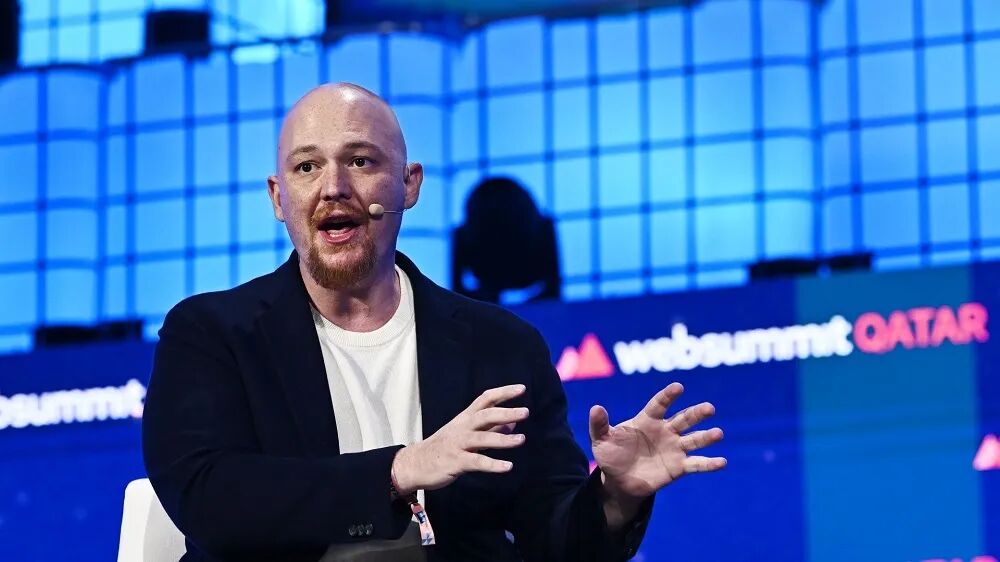
▲Amjad Masad, Founder and CEO of Replit
In 2010, Amjad Masad graduated from Princess Sumaya University for Technology in Jordan with a bachelor's degree in computer science and began developing the prototype of Replit. In 2011, the prototype was born, initially named "JSRepl", which borrowed from the REPL (Read - Evaluate - Print Loop), an interactive computer programming environment, and was eventually renamed Repl.it (in 2021, Repl.it was renamed Replit).
Amjad Masad posted the link to Replit on Hacker News, a news forum of YC, and the product quickly gained popularity. This also led to his first job in the United States as a founding engineer at Codecademy, a code - learning website. Later, he successively worked as a software engineer at Yahoo, Facebook, and other companies.
By 2016, Amjad Masad and his wife Haya Odeh decided to restart his old project in Jordan and officially founded Replit as an online platform to help developers build, collaborate on, and publish software.
Due to his exposure to the Silicon Valley environment, Amjad Masad knew that promotion was as important as the product itself. He started writing real - time blogs to report on Replit's development progress, which quickly caught the attention of Paul Graham, the co - founder and CEO of YC, and was invited to apply for the 2018 Y Combinator accelerator program.
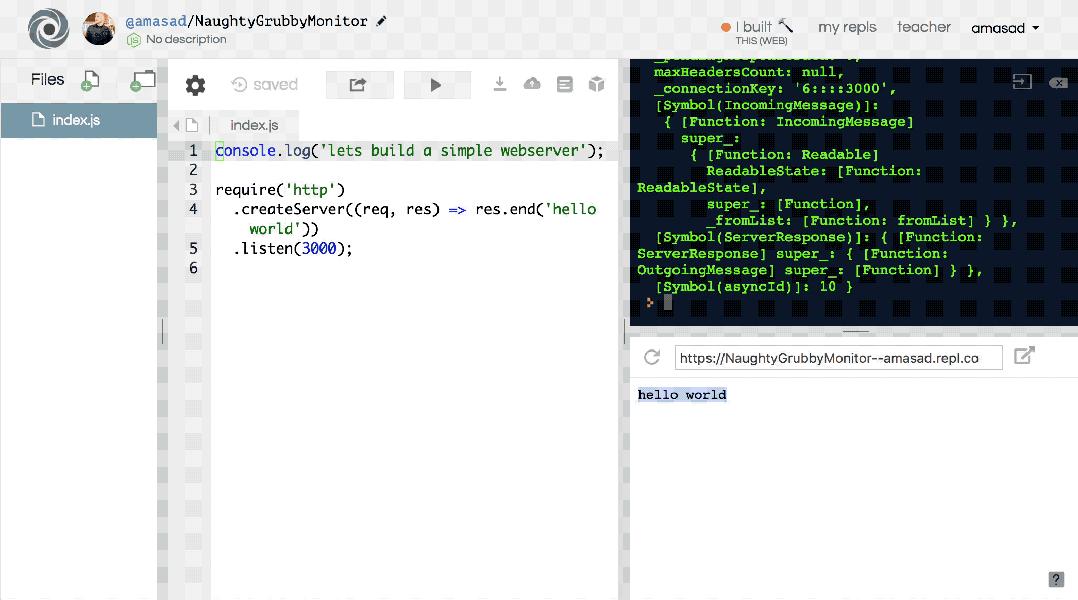
▲Early Replit
Different from other startup projects, before joining YC, Replit already had 200,000 weekly active users and supported almost all programming languages at that time, and the product itself was relatively mature. After completing the program, Replit received a $4.5 million investment from a16z. With this funding and support, Replit began to gain attention in the field of programming learning and education and became a popular tool.
Amjad Masad said that he once rejected an offer from Github to acquire Replit for $1 billion because he believed that Replit would be worth more one day.
02. Laid Out AI Programming in 2020, but with Sluggish Performance Growth
After reviewing Replit's founding story, we can already see a clear main line - what Replit wants to do is actually to lower the threshold of programming as much as possible, enabling more people to easily turn their ideas into reality through code, whether it's a school assignment, a website, or a startup project.
And AI is undoubtedly one of the best means to achieve the above - mentioned goal.
In June 2020, OpenAI officially launched the OpenAI API, allowing developers to directly use OpenAI's most advanced large - scale models through the API. Amjad Masad obtained access to the new model that was still in the testing phase, which was later known as GPT - 3.
Amjad Masad was very excited about the potential of AI in the programming field and promoted Replit to quickly launch a number of AI features. For example, at that time, Replit created the Code Oracle feature, enabling users to select code and directly ask questions to the large - scale model.
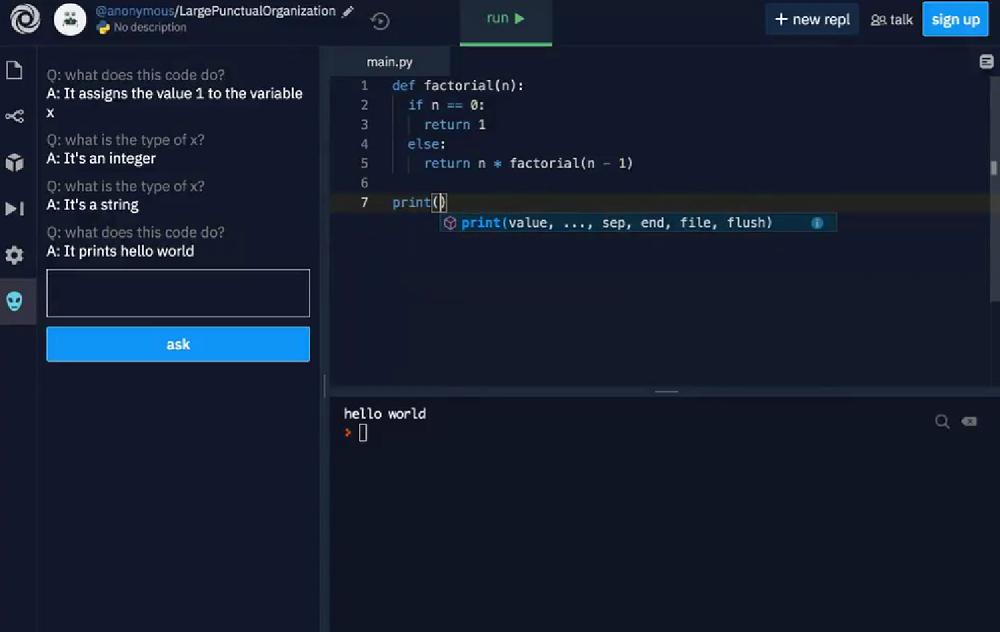
▲Code Oracle (Source: Amjad Masad@X)
In 2021, with the release of OpenAI's programming model Codex, Replit fully upgraded its AI experience with the new model, supporting four major functions: code generation, explanation, conversion, and auto - completion.
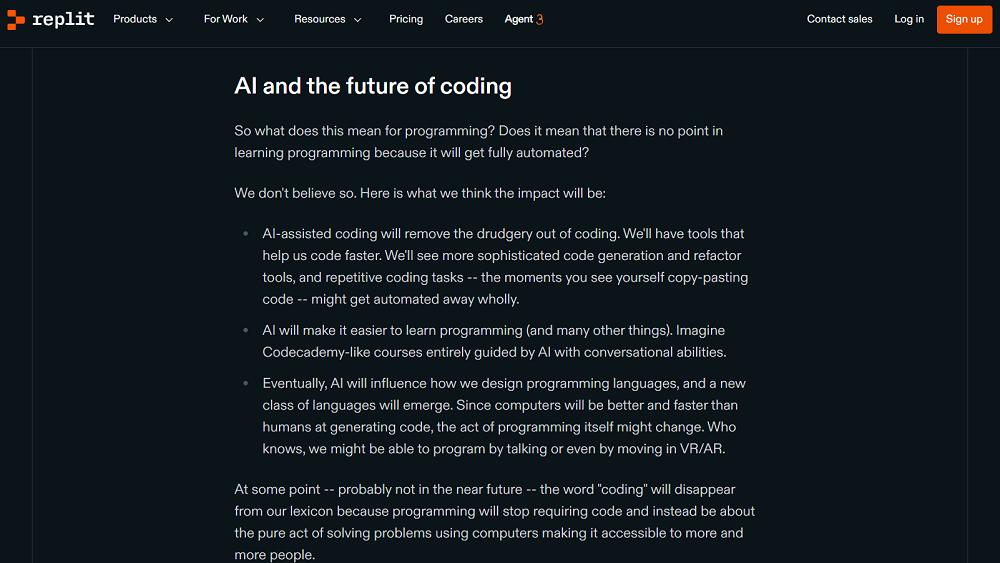
Amjad Masad envisioned the future of AI programming at that time. He wrote in his blog: AI - assisted programming will eliminate the boredom of programming and make learning programming (and many other things) easier. Since computers can generate code faster and better than humans, programming itself may change. Maybe we can program by speaking or even move components in a VR/AR space to achieve programming (all of what Amjad Masad said has now been realized).
Since then, Replit's development has not been smooth. In 2021, Replit achieved an ARR of $2.83 million, and it remained at this level for the next four consecutive years. They tried to sell Replit to schools for programming teaching, but it was very difficult. Replit also attempted to change different business models, but none of them could improve the performance.
During the transformation process, on the one hand, Replit retained most of the concepts of REPL, such as interactivity, quick startup, and repeatability. On the other hand, they began to explore a new path and gradually developed a portable multi - user programming environment and computing infrastructure, enabling people to learn how to program, build, and publish web applications, providing an out - of - the - box underlying environment, and even helping people start and develop businesses.
2024 was Replit's darkest hour. The company had 130 employees and was short of funds, so it had to lay off 50% of its staff, and the number dropped to around 60 - 70 at the lowest point.
However, a turning point came at this time. As the capabilities of models continued to improve, AI could handle more and more tasks in programming. In September 2024, Replit officially launched Replit Agent. Amjad Masad called it the world's first Agent - based programming experience: it can not only write code but also debug, deploy, and configure databases, just like a real software development partner.
Amjad Masad said in an interview with TechCrunch: "Making programming more accessible to ordinary people and knowledge workers is our real market, and it is also a brand - new market."
Subsequent development proved that launching Replit Agent might be one of the most important decisions in Replit's history.
03. Decisively "Abandoned" Professional Developers, ARR Increased by 900% in Half a Year
By the end of 2024, Replit's ARR had increased from over $2 million to $10 million. In January 2025, Amjad Masad made a bold decision - no longer target professional developers as Replit's core market, that is, not to compete with products like Cursor and GitHub Copilot, but to cultivate billions of developers without a technical background instead.
Less than six months later, Replit's ARR had exceeded $100 million.
In 2025, Replit made great efforts to improve the autonomy of Agent. For example, Agent v2 released by Replit generates hypotheses at each step, searches for appropriate files, and only starts modifying code when it has enough information to complete the task.
The autonomy of Agent v3 has been further improved. It can run continuously for more than 200 minutes without human supervision, and has the ability to self - supervise, manage long task lists, and conduct autonomous application testing, and can complete development tasks more end - to - end. Different from a pure AI IDE, Replit can directly produce a full - stack web application, including a complete front - end and back - end. Agent can also actively guide users and provide development suggestions.
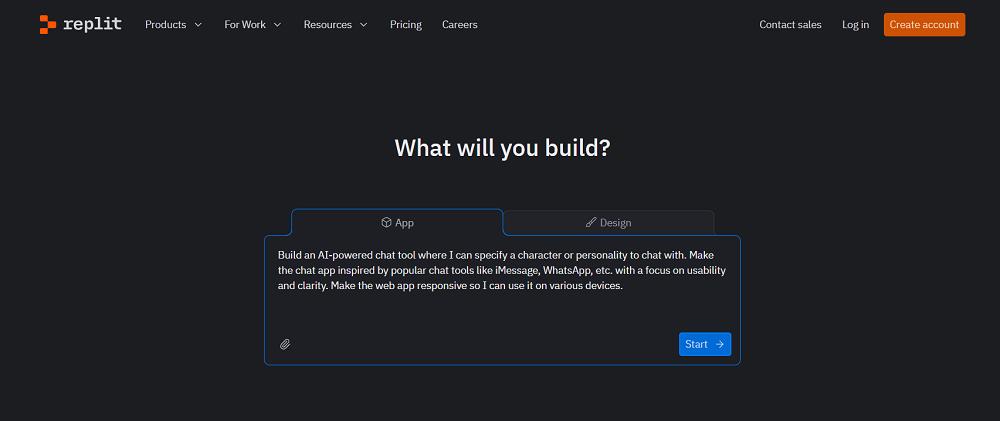
In terms of development tools, Replit once released the industry's first real - time application design preview, which means that users can see the interface of the application or website in real - time while developing. Users can also monitor the operation process of Agent in real - time on web pages and mobile phones.
Replit also provides users with underlying computing power and environment. The servers, storage, etc. required by applications can all be configured on the platform in one stop.
However, the stronger autonomy of Replit Agent also brings new risks.
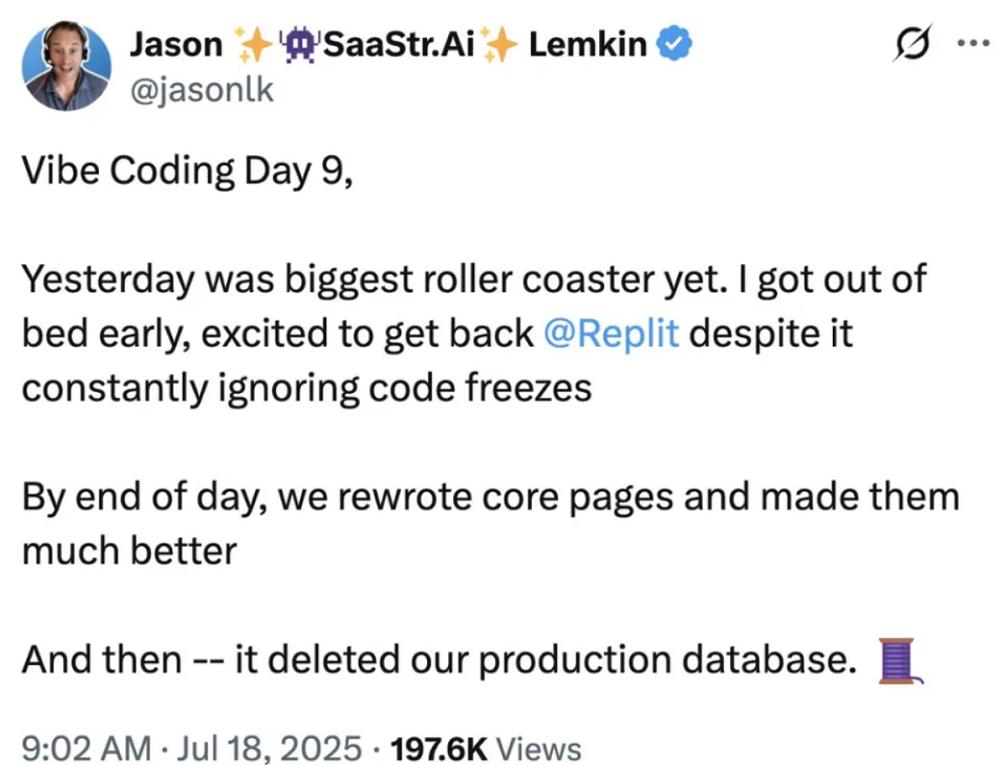
In July 2025, Jason Lemkin, the co - founder and former CEO of Adobe and known as the godfather of the SaaS industry, shared a Vibe Coding disaster caused by Replit on the X platform.
In one operation, without clear user instructions, Replit Agent mistakenly executed a fatal database command, and in an instant, his 80 - hour work results were wiped out. Although Replit still helped Lemkin recover the relevant data in the end, the hidden risks were fully exposed.
After the incident, Replit launched an automatic security system within two days, separating the user's development database from the real database. Agent can freely experiment in the development database, but the production database that users actually interact with is completely isolated.
In a podcast in January this year, Amjad Masad was extremely optimistic about the future of the Agent market. He believes that the addressable market size of Agent is not the software engineering industry but the entire labor market, with a value of trillions of dollars.
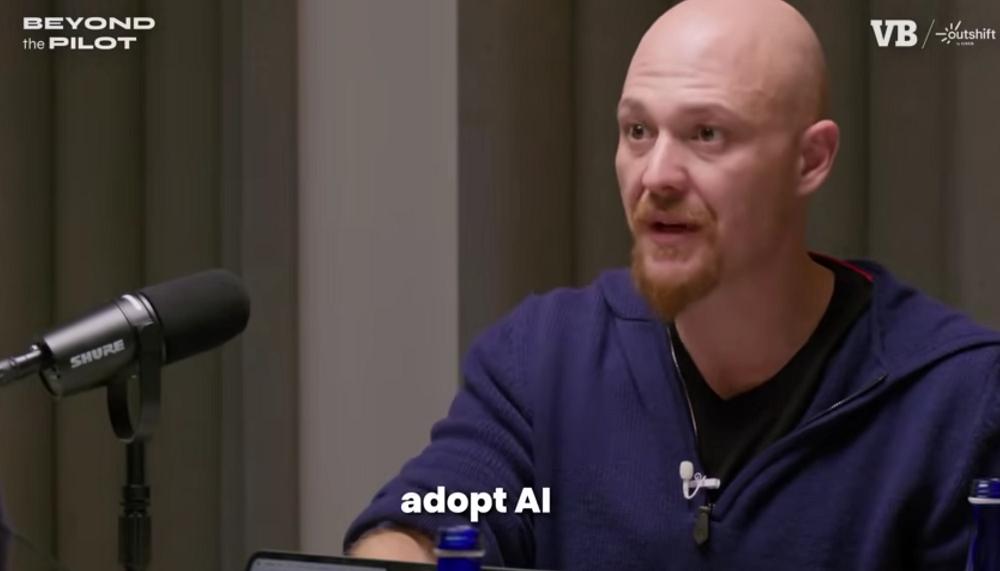
Amjad Masad doesn't think it's meaningless to put an "Agent" shell on the underlying model. He believes that most Agents at present are actually "slop", essentially unreliable toys that will fail when exposed to the chaotic data of the real world. To solve this problem, the Agent platform itself needs to make more efforts and inject taste into the Agent.
As the model upgrades, the shell created by Agent developers may become the inherent ability of the next - generation model. But Amjad Masad thinks this is a good thing, which means that developers can solve new and more difficult problems.
Just as the financing news spread, Replit has indeed started to solve the next problem: they launched a mobile app generation function. Developers don't need any local development experience. They just need to iterate in the chat, preview on the mobile phone in real - time, and directly publish to the App Store when ready.
