Across-the-board corrections: The hottest sector at the beginning of the year suddenly hit the brakes.
On January 16th, almost all stocks in the AI application sector tumbled.
Visual China Group Co., Ltd. hit the daily limit down, and a group of AI application concept stocks, including Tianlong Group Co., Ltd., declined collectively.
Before this, AI application was almost one of the hottest sectors at the beginning of the year.
Leo Group Co., Ltd. had six daily limit ups in ten days and will be suspended for verification starting today. Yidian Tianxia Network Technology Co., Ltd.'s stock price doubled within nine trading days and was suspended for verification starting on the 15th.
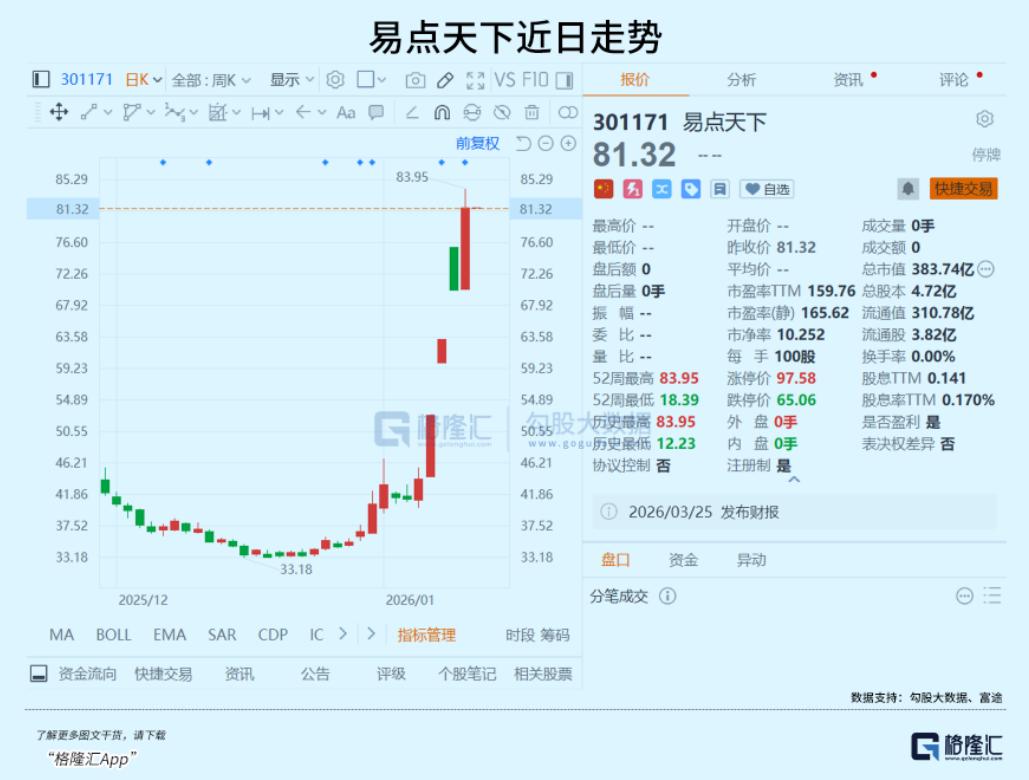
Why has the AI application sector witnessed a collective explosion recently?
On the one hand, recently, large - model companies such as MiniMax and Zhipu Intelligence have successively listed on the Hong Kong Stock Exchange, and their market performance has been remarkable, driving up the overall market enthusiasm.
The listing of large - model companies also means that the business closed - loop of large - model enterprises is gradually being perfected, bringing expectations for the development and growth of AI application implementation.
In addition, at the end of last year, Meta's acquisition of the company developing the AI application Manus for billions of dollars had a "butterfly effect", boosting the recognition of Chinese AI applications.
On the other hand, with the large - scale implementation of domestic self - developed inference chips, since the end of last year, the cost of AI calls has dropped sharply, and large - model companies have successively cut prices.
When the competition in computing power has reached its peak and the valuation of AI hardware has skyrocketed, AI application enterprises with an existing user base and traffic pool have become new market hotspots.
However, with the collective tumble of AI applications today, can the upsurge of AI applications continue?
01
At the beginning of the year, the upsurge of AI applications was concentrated in the marketing and media sector.
This is because Elon Musk recently posted that he would officially open - source the latest content recommendation algorithm of the X platform, and the code would be updated every four weeks thereafter, along with developer instructions indicating the changes in the algorithm and logic.
This move has led many to speculate that Musk is also going to get involved in GEO.
As a result, GEO has become one of the hotspots in the AI application field and the market.
So - called GEO refers to Generative Engine Optimization, which is the optimization of generative engines.
In June 2024, a team from Princeton University first systematically defined GEO in an academic paper. The research shows that the visibility of optimized content in AI - generated answers can be increased by 40%.
Put simply, it means improving the "citation rate" and "recommendation weight" of brand content in AI - generated answers by producing or adjusting content, so that when AI extracts information after being questioned, it can preferentially cite brand content and achieve brand promotion in the answers.
With the migration of traffic entrances caused by the popularization of AI, currently, AI search is continuously replacing traditional search.
Gartner predicts that by 2028, AI search will account for 50% of search engine traffic.
With the change in search logic, the current marketing market has also undergone earth - shaking changes.
Traditional SEO, that is, search engine optimization, is based on keyword matching and page ranking rules, and its logic is relatively linear and certain.
When more decisions are made by directly asking AI, the citation of generative AI has become the focus of marketing.
Since different large AI models have different parameters, training data, and output style preferences, GEO needs to help customers optimize content specifically for different AI platforms.
According to the measurement of Miaozhen Marketing Science Academy, in 2025, the global and Chinese GEO market sizes will be $11.2 billion and 2.9 billion yuan respectively, and are expected to reach $100.7 billion and 24 billion yuan respectively by 2030, with a CAGR of 55% and 53% respectively.
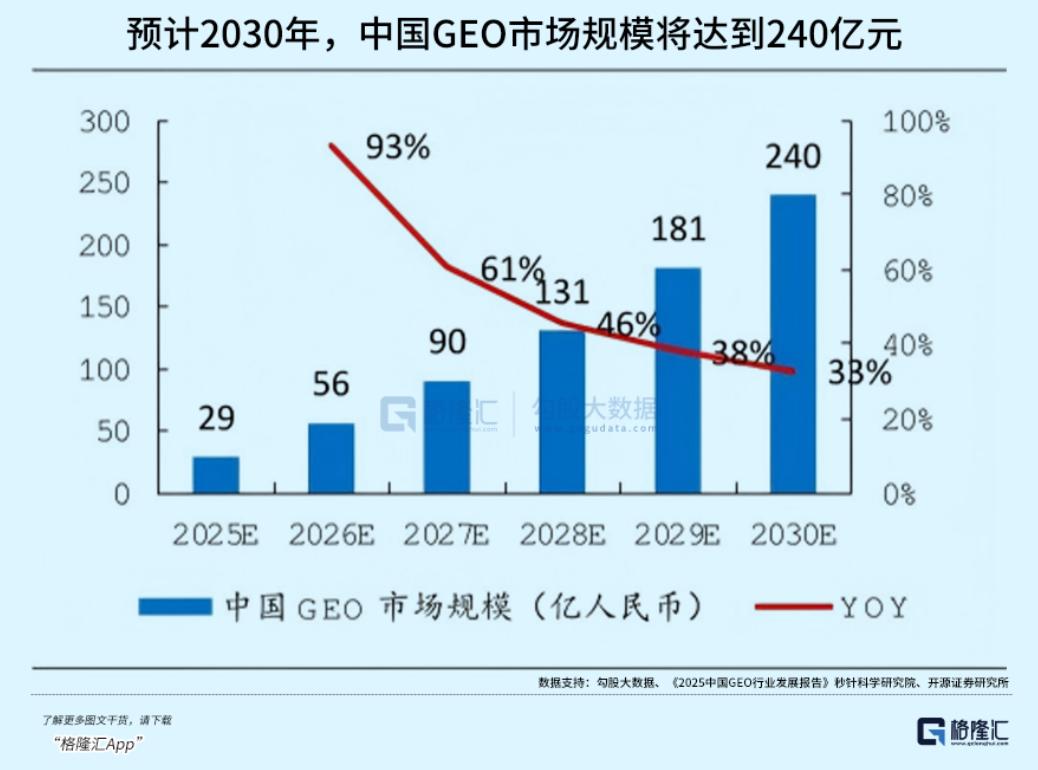
In the future, GEO may reshape the distribution of the marketing industry chain. Marketing agency companies in the middle of the industry may be able to increase their value through their user accumulation and planning experience in GEO.
However, it may be too early to say that GEO will boost the performance of marketing companies in the short term.
In this AI application upsurge, BlueFocus Intelligent Communications Group Co., Ltd. has performed quite prominently, and its corporate performance is also outstanding.
In the first three quarters of 2025, BlueFocus's revenue was 51.098 billion yuan, a slight year - on - year increase of 12.50%. The non - recurring profit after deduction was 227 million yuan, a significant year - on - year increase of 85.53%. Both revenue and net profit increased by double - digits.
Among them, the revenue from AI - driven business soared by 310%.
However, it is not difficult to find that such amazing growth is based on a relatively low base.
In the first half of this year, BlueFocus's AI - driven revenue reached 1.57 billion yuan, exceeding the whole of last year. However, in its total revenue of 32.36 billion yuan in the first half of the year, the proportion of AI - driven revenue was still less than 5%.
In the announcement of stock price fluctuations, BlueFocus also said that at present, the relevant revenue driven by AI accounts for a small proportion of the company's overall operating revenue and has no significant impact on the company's overall operation.
Although this AI upsurge originated from GEO, BlueFocus's in - house marketing model, BlueAI, has still been focused on improving marketing efficiency with AI.
If BlueAI and Xinying can really form their own marketing closed - loop, creating a marketing placement and creation system, and then combine it with BlueFocus's existing large customer base, BlueFocus's profitability may reach a new level, and its business model will also change completely.
However, this also faces the problems of customers' acceptance of AI marketing and BlueFocus's investment in AI models.
Moreover, currently, the underlying technology of BlueFocus's BlueAI is still based on the large models of big technology companies such as ByteDance and Alibaba. ByteDance has launched a series of marketing tools such as Jimeng and Coze, and Alibaba has Tongyi Lingma.
This means that BlueFocus needs to prove the unique strength of self - developed AI in marketing in competition with big technology companies.
Although the GEO model will change the focus of enterprise marketing, it is still difficult to change the essence of the marketing industry.
For the entire marketing industry, including BlueFocus, the current competition model in the industry is still essentially a "scale game".
However, changes are gradually taking place.
02
2026 may be a big year for the main line of AI applications.
Currently, with the continuous improvement of model capabilities and the maturity of agent technology, many large models now have the ability to independently understand tasks, call tools, and execute complex processes, providing a good foundation for AI applications.
On the other hand, policies are also promoting the implementation of AI applications.
Recently, eight departments including the Ministry of Industry and Information Technology issued a notice on printing and distributing the Implementation Opinions on the Special Action of "Artificial Intelligence + Manufacturing".
The Opinions point out that 2 - 3 globally influential ecological leading enterprises and a number of specialized and innovative small and medium - sized enterprises should be cultivated, a number of enabling application service providers who "understand intelligence and are familiar with the industry" should be created, and 1000 benchmark enterprises should be selected.
On the same day, the Ministry of Industry and Information Technology issued the Action Plan for the Integration and Empowerment of Industrial Internet and Artificial Intelligence, requiring that by 2028, no less than 50,000 enterprises should implement the transformation and upgrading of new industrial networks.
On this basis, the demand for AI applications is also constantly increasing.
From cost reduction and efficiency improvement in enterprises to the popularization of personal applications, the agent era of AI is gradually approaching, and AI applications are also entering the stage of commercial implementation.
In the marketing industry, one of the fields where AI empowerment is the most thorough and the monetization path is the clearest, AI can automatically generate a large number of personalized advertising materials, optimize placement strategies in real - time, and accurately predict user preferences, greatly improving the return on investment of advertisers.
In the US stock market, AppLovin, a company that uses AI to empower its marketing business, saw its advertising revenue increase by 71% year - on - year in the first quarter of 2025, reaching $1.159 billion, and its net profit increased by 92% year - on - year to $943 million, with a profit margin as high as 81%.
Since its listing in 2021, AppLovin's stock price has increased nearly tenfold, which undoubtedly verifies the empowerment of AI in the marketing industry.
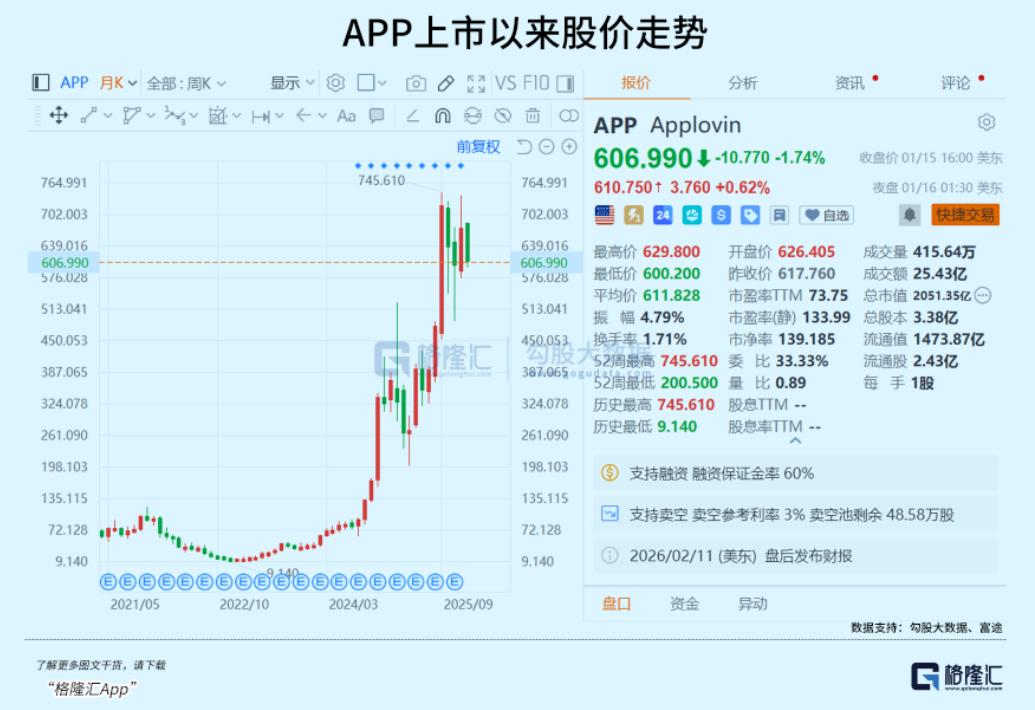
AI is reshaping the entire content production chain from text, pictures to videos, greatly lowering the creation threshold, increasing production capacity, and giving rise to new content forms.
Recently, AI - generated comic dramas are becoming the next big thing after short dramas.
By using AI to generate animation images and storylines, short - drama content that meets online hotspots can be produced at extremely low cost and high efficiency. According to statistics, in September 2025, more than 6,500 AI - generated comic dramas were newly launched on the Douyin platform alone.
Data from ByteDance's marketing service platform shows that in December 2025, the daily consumption of comic - drama advertising reached over 20 million yuan.
According to a conservative estimate by Sina Finance, the application fees for AI image generation behind AI - generated comic dramas may be close to 100 million yuan per month.
This market is undoubtedly huge. In fact, if a Chinese - version AI video - generation tool similar to Sora can be launched in the domestic market, AI - generated comic dramas may trigger a national - level upsurge in video creation and consumption.
This can also be seen from the development of visual - generation AI. Currently, Keling has topped the free iOS app charts in many countries.
According to the measurement of China Merchants Securities, the global market size of AI visual - generation applications is expected to reach $16.6 billion in 2027.
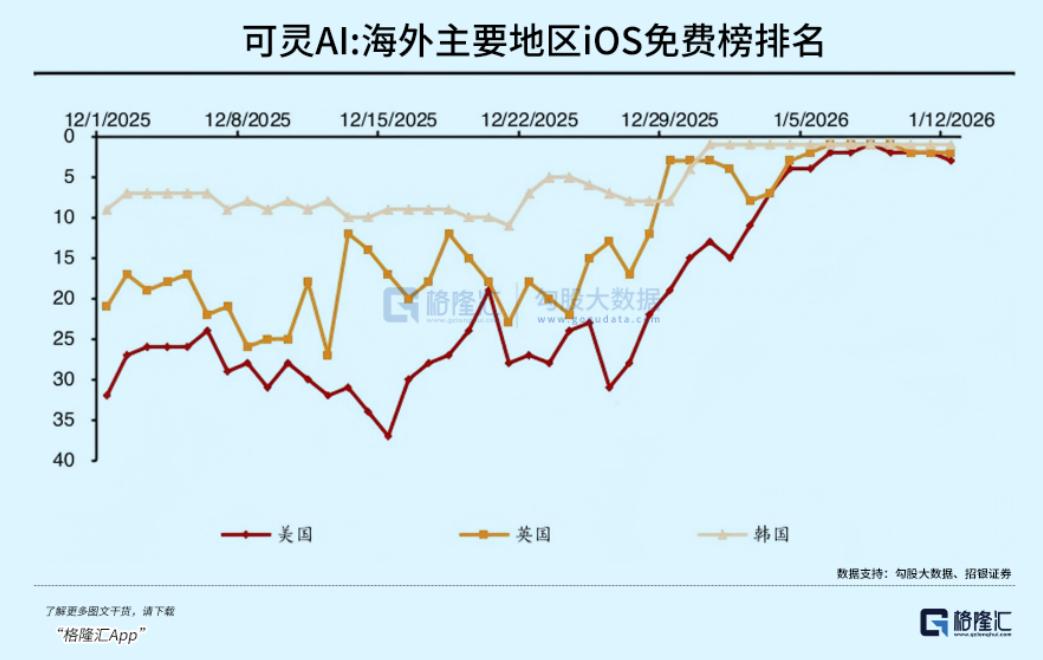
With the continuous improvement of AI's creative ability, the consumer Internet sectors such as gaming and virtual digital humans may also be boosted.
In addition, the combination of AI with traditional industries such as industry, finance, and taxation will also witness an explosion of AI applications.
Based on the existing industry accumulation in these traditional industries, the application of AI in vertical industries can more significantly reduce costs and improve efficiency for companies. Companies also have a stronger willingness to pay for AI applications, and their performance growth is more certain.
Recall that when generative AI was first born, there was a general concern that large - model giants would dominate everything.
However, in reality, in the specific scenarios of various industries, vertical application companies that focus on a certain field and can solve practical pain points are showing their irreplaceable value.
This may be an important topic for investment in the next few years.
03 Conclusion
As Alibaba's Qianwen open - source large model has witnessed explosive growth and the new DeepSeek model is about to be released, the popularity of AI is bound to remain high in the next period.
However, just like the market of AI hardware in 2025, in 2026, the core of the investment logic for AI applications will also be the rapid realization of performance.
Only companies with a continuously increasing proportion of AI business revenue and that can effectively drive overall performance growth can continue to be the focus of the market.
In the future, the pattern of the AI industry may be a combination of super - traffic entrances and diverse vertical applications. While paying attention to giant platforms, companies that master technology, exclusive industry data, and operating logic in niche fields will also achieve unexpected growth.
Of course, risks exist, but there is no doubt that the era of AI applications is about to begin.
However, it is bound to go through some setbacks before that.
Glonhui's statement: The views in this article are all from the original author and do not represent the views and positions of Glonhui. It is especially reminded that investment decisions should be based on independent thinking. The content of this article is for reference only and is not intended as any actual operation advice. The trading risks shall be borne by the investors themselves.
This article is from the WeChat official account “Glonhui APP” (ID: hkguruclub), written by Yuan He. It is published by 36Kr with authorization.