Ford changes its strategy, embraces BYD from China, and abandons LG from South Korea
Can't sell pure electric vehicles in the United States? Ford Motor is coming to China to embrace BYD.
A month ago, Ford just cancelled a cooperation worth tens of billions of yuan with the South Korean battery giant LG Energy Solution, and then it was reported that it was in talks with BYD.
In many previous public statements by Ford's CEO, this American automaker regarded BYD as the strongest competitor.
However, despite the concerns, it still has to learn from others.
The new energy wave is already irresistible. Overseas players embracing Chinese technology may gradually become the mainstream.
Ford Reported to Embrace BYD
According to people familiar with the matter who revealed to The Wall Street Journal, Ford is in talks with BYD about cooperation and plans to purchase batteries from BYD for some hybrid models.
The specific details of the transaction are still unclear. People familiar with the matter said that discussions are still ongoing.
One possibility is that Ford will import batteries from BYD and transport them to Ford's overseas factories, which may be located in Germany, Spain, Thailand, Turkey and other places.
However, people familiar with the matter also said that the transaction is not a done deal, and there is a possibility that it may fall through in the end. So far, neither Ford nor BYD has responded to this cooperation.
Ford's intention to purchase BYD's batteries is actually not abrupt.
The two sides had contact as early as 2020. At that time, the domestic electric models jointly produced by Ford and Changan used batteries supplied by BYD.
Later, BYD also took the initiative to contact Ford, hoping to supply batteries for Ford's models sold in other markets.
However, at that time, Ford had multiple battery suppliers to choose from, and the cooperation did not go further.
Moreover, in Ford's view, BYD has a special status - the latter is not only a power battery supplier but also an automaker.
Ford even regards BYD as its strongest competitor, and attaches more importance to BYD than to Tesla, Toyota and General Motors.
In recent years, Ford CEO Jim Farley has publicly expressed this view many times.
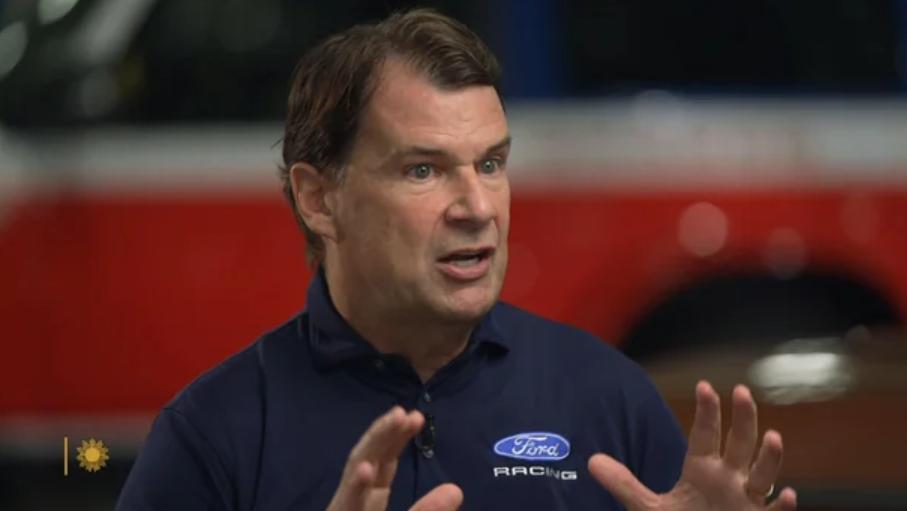
He has repeatedly admitted BYD's leading edge, praised its amazing vertical integration ability, and even had a BYD Seal airlifted for disassembly. The conclusion he reached was that the car was "very, very good".
So, why has Ford changed its mind and is ready to buy batteries from BYD, its "strongest competitor"?
Slow Transition to Pure Electric? Supported by Chinese Players
The news that Ford is reported to embrace BYD comes at a critical juncture in Ford's strategic transformation.
Compared with the average progress of the global new energy industry, Ford's progress in pure electric models seems a bit difficult, especially in Ford's home market - the US market.
In 2025, Ford's sales volume in the US market reached 2.2 million vehicles, the best performance since 2019.
Among them, the sales volume of fuel models increased by 5.5% year-on-year, the sales volume of hybrid models soared by 21.7% year-on-year, but the sales volume of pure electric models decreased by 14.1% year-on-year.
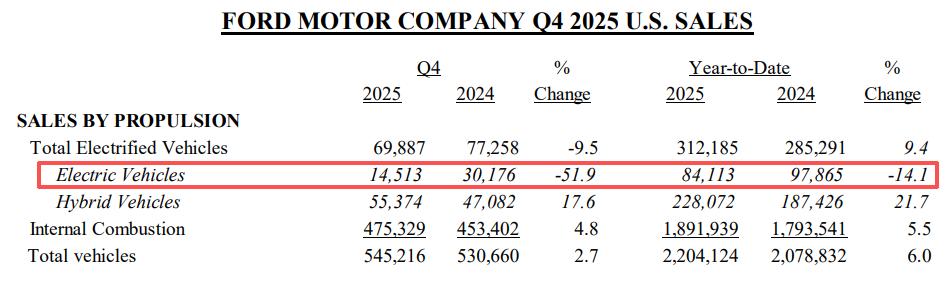
In the fourth quarter of last year, the sales volume of Ford's pure electric vehicles declined particularly severely, dropping from 30,000 vehicles in Q4 of 2024 to 14,500 vehicles, a direct halving.
This is actually not only a dilemma for Ford. The sales volumes of electric vehicles of other automakers in the US have basically been affected to varying degrees, including Tesla.
The main reason for the collective decline in sales points to the withdrawal of subsidy policies. The $7,500 purchase tax credit was cancelled in September last year, and the enthusiasm of American consumers for electric vehicles has since faded.
Therefore, Ford recently announced a strategic transformation and began to focus on hybrid vehicles:
The production of its star pure electric pickup truck model was stopped, the subsequent large-scale pure electric vehicle projects were suspended, and the electric vehicle factory in Tennessee, USA was converted into a fuel vehicle factory.
Due to these series of changes, Ford is expected to incur a loss of $19.5 billion (about 137.4 billion yuan), most of which will be included in the financial report of Q4 last year.
Originally, the company planned to have the penetration rate of pure electric vehicles exceed 40% by 2030; now the new goal is that by 2030, the sales volume of hybrid + pure electric models will exceed 50%.
However, it should be noted that this strategic adjustment will bring a large amount of excess battery production capacity to Ford. The company plans to open up a new business line for battery energy storage.
That is to say, Ford is not short of batteries.
And just a month ago, Ford notified the South Korean battery giant - LG Energy Solution that due to strategic adjustment, it cancelled an electric vehicle battery contract worth $6.5 billion (about 45.3 billion yuan), which is roughly equivalent to 11% of LG's revenue in 2024.
Then why does Ford still need to purchase externally and choose BYD?
Perhaps a few months ago, in an interview with Ford CEO Farley, we can find some clues to Ford's decision.
He revealed in the program that Ford has conducted a detailed investigation on BYD and found many opportunities from it.
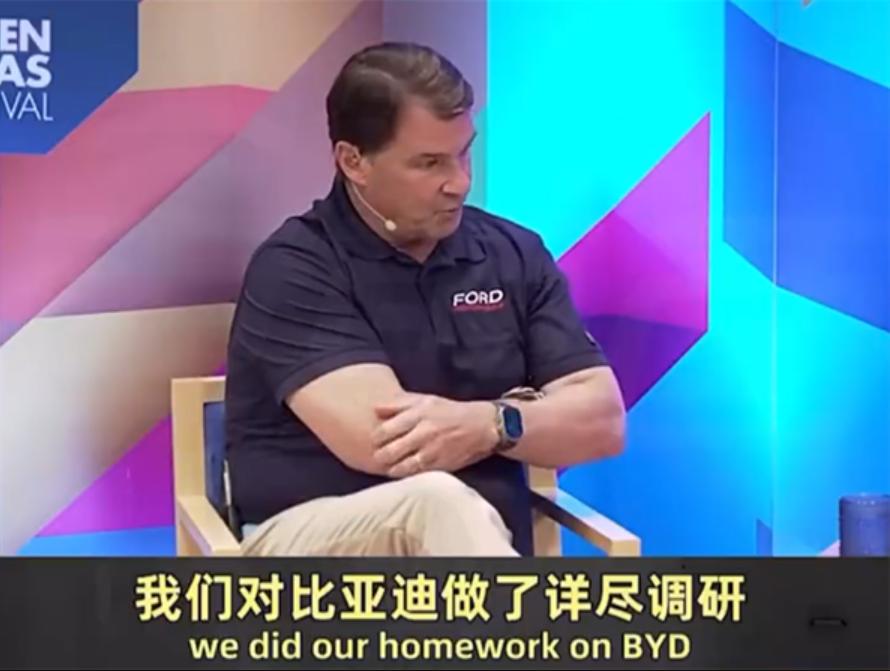
He said that China chose to bet on LFP (lithium iron phosphate) battery technology, while the West gambled on traditional lithium battery technology.
For example, almost no electric vehicles in the United States use LFP batteries - these batteries not only have a 30% lower cost, but also do not experience performance degradation after repeated charging and discharging, and have almost no risk of fire and spontaneous combustion.
So Ford's future strategy is to shift the focus to LFP electric vehicles, but the relevant intellectual property rights are in the hands of China.
So this may initially explain why Ford wants to embrace BYD. In addition to BYD, Ford has also established contact with another major Chinese battery giant - CATL.
Ford will use the technology licensed by CATL to develop and produce LFP batteries by itself, hoping that it can supply both internally and customers in the public utility or data center industries in the future.
Such cases may no longer be unfamiliar to you in today's new energy era.
Chinese players have risen rapidly. Whether it is electrification or intelligence, they have accumulated an absolute leading edge in the new energy vehicle industry and have begun to gradually export it back to the world.
Whether it is the BBA or the three major Japanese automakers, they are all trying to cooperate with Chinese technology companies (such as Momenta, Huawei, etc.) to improve their intelligence level as soon as possible.
Needless to say in terms of electrification. Take the power battery, one of the three core components, as an example:
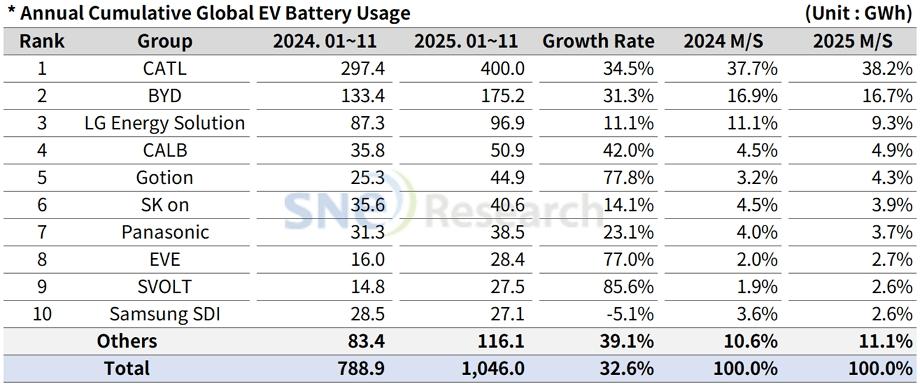
According to SNE Research data, from January to November 2025, the global electric vehicle battery usage reached 1046GWh.
△
CATL and BYD topped the list. CATL's usage reached 400GWh, with a market share of 38.2%; BYD's usage reached 175.2GWh, with a market share of 16.7%.
That is to say, more than half (54.9%) of the "cake" in the global automotive power battery market has been taken by two Chinese companies.
This article is from the WeChat official account "Intelligent Vehicle Reference" (ID: AI4Auto), author: Jessica. It is published by 36Kr with authorization.