The "shovel sellers" in the brain-computer interface field are on the rise. Domestic substitution and mass production capabilities will determine who can reach the top.
In just a dozen trading days, the entire sector soared by over 30%. Stocks like Xiangyu Medical and Mailande doubled in value within just a few days. Looking at the longer term, the entire brain-computer interface (BCI) sector has skyrocketed by over 100% since the beginning of 2025. BCI, once confined to the realm of science fiction, is now exploding at an unprecedented pace.
A series of recent clinical breakthroughs signal the arrival of its industrialization inflection point: Invasive BCI has enabled multiple paralyzed patients to drink water, control smart wheelchairs, and even command robotic dogs to retrieve and deliver items through their thoughts. The signal transmission delay has been compressed to less than 100 milliseconds, offering an experience approaching that of natural limb control. Non-invasive technologies are also gradually seeping into daily life. For example, consumer-grade sleep monitors capable of real-time EEG regulation have been launched, propelling health management from “monitoring” to “guidance.”
On the policy front, China officially implemented its first industry standard for BCI medical devices on January 1, 2026, paving the way for technological transformation and clinical application.
This race centered around “human-machine integration” has broken through the boundaries of the laboratory and is reshaping the fields of medical rehabilitation, human-machine interaction, and even human ability enhancement. It has also opened up a new trillion-dollar market opportunity.
Strategic High Ground with Vast Prospects
It's no exaggeration to say that BCI has become a new arena for competition between China and the United States. It not only integrates the disruptive fields of neuroscience, artificial intelligence, and microelectronics but is also regarded as the ultimate gateway to “human-machine integration,” carrying strategic significance in reshaping healthcare, the military, and even the way humans perceive the world. As a hotly contested territory, a battle for technological dominance in the next decade has already begun.
At the end of 2025, Elon Musk announced that Neuralink would initiate “mass production” of BCI devices in 2026. The core breakthrough lies in a fundamental innovation in the surgical approach. The delicate electrode wires in the device can directly penetrate the dura mater for implantation, potentially significantly reducing the trauma risk associated with traditional invasive surgeries. This is combined with a highly streamlined and almost fully automated surgical process.
Meanwhile, MergeLabs, co-founded by Sam Altman, the CEO of OpenAI, is being spun off into an independent company, focusing on non-invasive ultrasonic BCI technology that doesn't require craniotomy. The aim is to achieve non-invasive interpretation of a wide range of brain signals through ultrasound. In China, both invasive and non-invasive startups are also thriving.
In July 2025, seven government departments, including the Ministry of Industry and Information Technology and the National Development and Reform Commission, jointly issued the “Implementation Opinions on Promoting the Innovative Development of the BCI Industry,” providing top-level support for the industry's growth.
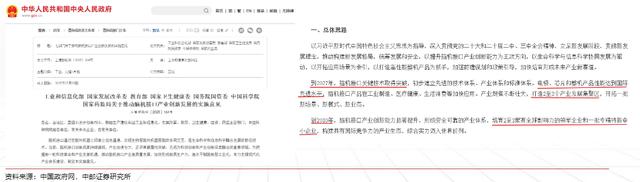
The industry standard “Medical Device Terminology for Brain-Computer Interface Technology” issued by the National Medical Products Administration officially came into effect on January 1, 2026, comprehensively establishing a closed-loop system for registration, pricing, payment, and market access. The 15th Five-Year Plan explicitly proposes forward-looking layout of future industries such as BCI, aiming to turn it into a new economic growth point.
Driven by policy support and technological breakthroughs, the BCI industry is entering a period of rapid development. According to statistics from the international market research firm IMRC Groupe, the global BCI market size reached $1.5 billion in 2021 and grew to $1.74 billion in 2022, showing a steady upward trend. It is projected to expand to $3.3 billion by 2027, with a significant compound annual growth rate.
Data from the Zhongshang Industry Research Institute shows that the Chinese BCI market size reached 3.2 billion yuan in 2024, a year-on-year increase of 18.81%.
As application scenarios extend from medical rehabilitation to consumer, artificial intelligence, and other fields, and with the continuous optimization of the policy environment, the domestic market size is expected to climb to 3.8 billion yuan in 2025 and further increase to 4.6 billion yuan in 2026. The industry has strong development momentum and broad prospects.
The technological landscape presents a diversified competitive pattern. In the United States, besides Neuralink, companies like MergeLabs focus on non-invasive ultrasonic technology. In China, there is also a vibrant ecosystem. Peng Lei, the former CEO of Qiannaohu Technology, and Chen Tianqiao, the founder of Shanda Group, jointly established Gestalt, the first domestic company dedicated to ultrasonic BCI technology.
This indicates that China and the United States are racing neck and neck in both invasive and non-invasive BCI technologies. This will accelerate the continuous expansion of the global BCI market. In the long run, the global BCI market size is expected to reach $12.4 billion by 2034, with a compound annual growth rate of approximately 17.35%. The medical and health sector is the core application area, with a potential market size of $150 billion - $850 billion.
A new trillion-dollar market opportunity is quietly emerging!
The Accelerated Rise of the BCI Industry
When the technological singularity truly arrives, the key lies in how to translate “neural signals in the laboratory” into an industrial revolution.
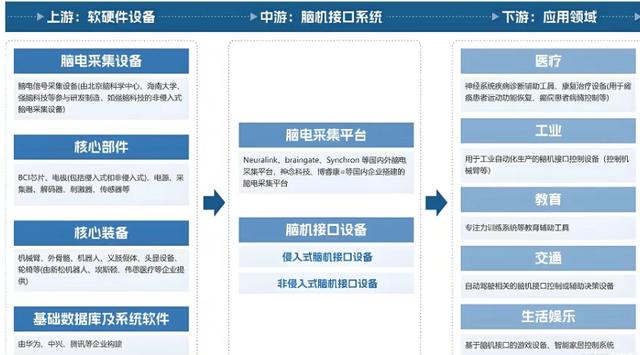
The core of this transformation is the comprehensive reconstruction of the industrial chain. The upstream controls the “materials and devices,” the midstream dominates the “system integration” capabilities, and the downstream determines the breadth of “application scenarios.”
First, the upstream of the BCI industry, as the cornerstone of the entire industry, focuses on core components such as high-precision electrodes, dedicated neural chips, biocompatible materials, and signal amplifiers. It is the segment with the highest technological barriers and the greatest potential for domestic substitution.
Although traditional EEG electrodes are already mature, the future will be determined by the development of next-generation flexible microelectrodes, high-density arrays, and wireless transmission modules.
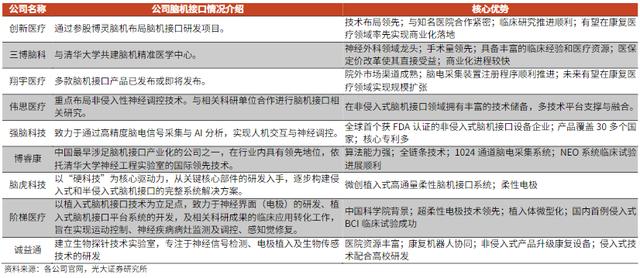
In the past, high-end implantable electrodes relied on imports, resulting in high costs. Now, companies such as Qiangnao Technology and Borui Kang have driven the cost of key hardware down by over 60% in three years. However, this has also led to a brutal reshuffle, and only companies with expertise in microfabrication technology, materials science, and long-term biocompatibility verification have survived.
Currently, upstream companies account for about 8% of the global total. Although the number is small, they control the “chokepoint” segments. Among invasive electrodes, flexible electrodes have become the mainstream due to their good biocompatibility and low immune response. Neuralink and the “Beinao II” system have achieved high-density data acquisition with 65,536 channels, reaching the international leading level. Non-invasive electrodes mainly include dry electrodes and gel electrodes. There are many suppliers, but high-end products are still dominated by overseas companies.
In terms of chips, BCI chips are evolving towards integration, miniaturization, and low power consumption. They can be divided into general-purpose solutions and dedicated ASIC custom chips, with the latter having an advantage in terms of performance and energy efficiency. Neuralink has launched a highly integrated chip, and China is also accelerating breakthroughs. Hainan University, Ningju Technology, Xinzhida, and other institutions and companies have successively released high-performance dedicated implantable chips.
The current biggest opportunity in the upstream lies in: Whoever can integrate the entire value chain from materials, design, manufacturing, to packaging and has the mass production capacity of high-density, low-damage, and long-life devices will become the core support for the rise of domestic BCI and the most stable “shovel seller” in the industrial chain.
The midstream, as the core integration segment of the BCI industrial chain, is the key battlefield for the technology to move from the laboratory to large-scale application. Approximately 37% of global companies are concentrated here, undertaking the core task of deeply integrating upstream hardware with AI algorithms to create a complete, registrable, mass-producible, and implementable system. Opportunities in this segment are emerging as technology matures and commercialization accelerates.
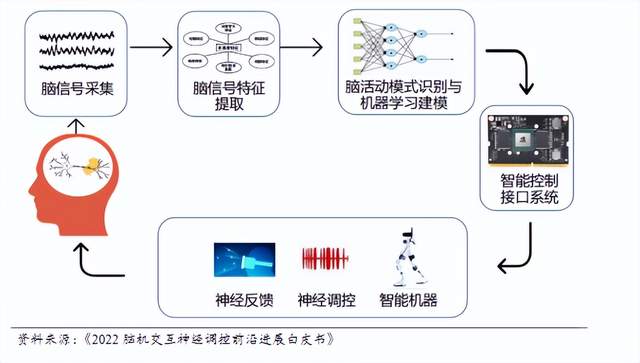
Currently, midstream companies are deploying around three major modules: EEG signal acquisition platforms, signal processing systems, and analysis software. The acquisition platform is responsible for obtaining raw data from electrodes and performing preprocessing such as noise reduction and amplification. The main technological approach is electrical, and products such as electroencephalographs and ERP instruments have widely obtained Class II or Class III medical device certifications and entered the clinical use stage.
Magnetic methods such as fMRI and MEG, although highly accurate, are limited by large equipment size and high cost, and are mainly used in scientific research scenarios. Optical fNIRS technology is maturing and is gradually being promoted in portable monitoring. Ultrasonic sensing is in the forefront of exploration, with the potential for non-invasive, deep imaging, and is becoming an important future direction.
At the signal processing level, deep learning algorithms have become the mainstream. Through models such as CNN, LSTM, and Transformer, efficient feature extraction and instruction classification of typical EEG paradigms such as motor imagery, P300, and SSVEP are achieved, driving the decoding accuracy to continuously exceed 90%, providing underlying support for thought-controlled external devices.
More importantly, the non-invasive path has taken the lead in opening up the commercialization channel. Qiangnao Technology's concentration training headbands and Ningju Technology's emotion feedback devices have been launched as Class II medical devices or consumer-grade products, with annual sales exceeding tens of thousands of units, covering diverse scenarios such as education, healthcare, and mental health, forming a preliminary ecosystem of “self-developed closed-loop + scenario implementation.”
Meanwhile, invasive midstream companies are sprinting towards the high-end medical market. Companies such as Pinchi Medical and Jieti Medical are focusing on ECoG cortical electroencephalography and DBS deep brain stimulation systems, advancing the registration and application for Class III certificates, aiming for functional reconstruction of patients with high paraplegia, amyotrophic lateral sclerosis, and aphasia. It is expected that the first domestic implantable BCI device will be approved in 2026, marking China's official entry into a new era of “thought-controlled external devices.”
However, the real opportunity lies not only in the realization of a single function but also in the “hardware-software integration” full-stack capabilities. Companies that master the entire process from hardware adaptation, signal processing to personalized algorithm modeling, such as rehabilitation leaders like Xiangyu Medical and Weisi Medical, rely on their self-developed BCI platforms to build “hospital + home” dual-scenario solutions, significantly improving product iteration speed and clinical applicability.
In addition, with the introduction of large models and personalized AI, it is expected that a prototype of a “brain-computer operating system” will emerge in the midstream in the future, supporting multi-modal access and third-party application expansion, further opening up the consumer and industrial market spaces.
Therefore, the most core investment logic in the midstream lies in: Whoever can build barriers in signal stability, registration progress, algorithm autonomy, and mass production capacity will become the key driver for BCI to evolve from a “medical necessity” to “human-machine integration.”
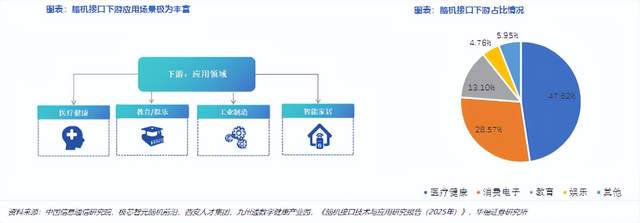
The downstream, as the ultimate value realization end of the BCI industry, is the core trigger for the explosion of the trillion-dollar market. Approximately 55% of global companies are concentrated here, focusing on diverse application scenarios such as healthcare, consumer electronics, education, entertainment, and industrial control.
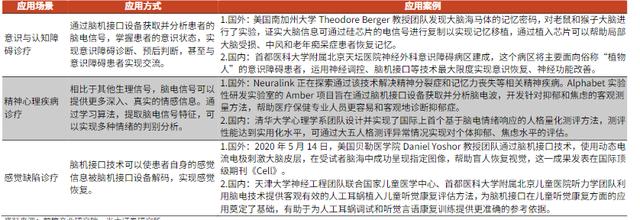
Currently, healthcare remains the largest segment, accounting for approximately 47.62% of applications. It is widely used in the rehabilitation treatment and neuromodulation of diseases such as movement disorders, epilepsy, and depression. Some products have entered the registration channels for Class II or even Class III medical devices, with clear clinical paths and leading commercialization processes.
What's more disruptive is the “substitution effect.” BCI is expected to gradually replace some neuropsychiatric drug treatments, impacting the global traditional drug market worth hundreds of billions of dollars and promoting “digital therapy” as a new paradigm.
Non-medical fields are expanding rapidly, accounting for over 50% in total. Among them, consumer electronics accounts for 28.57%. Through non-invasive headbands, functions such as concentration training and sleep monitoring have been implemented in adolescent education and workplace health management. The entertainment and gaming sectors account for 13.10%. Users can control virtual characters through their thoughts, enhancing immersion. Smart home and transportation driving scenarios are also taking shape.
As signal decoding accuracy improves and costs decrease, BCI will penetrate from high-end medical applications to the mass consumer market, forming a three-tier ecosystem of “hospital + home + individual.”
The current biggest opportunity lies in: Whoever can be the first to build a closed-loop solution covering diagnosis, intervention, and feedback and bind real clinical scenarios or high-frequency usage entry points will establish barriers in areas such as medical rehabilitation, cognitive enhancement, and human-machine interaction and become the terminal entry point and service provider for users in the BCI era.
McKinsey predicts that the global BCI healthcare market size will reach $145 billion by