After using hundreds of AI products, I can no longer remember how I lived without AI.
A friend asked me at the beginning of 2025 what significant changes would occur in the AI industry that year. My reply was: I'm more curious about how it will change my life.
The reason for this answer at that time was that the variety of available AI products was too limited, and apart from ChatGPT, there weren't many standout ones.
Unexpectedly, just one year later, AI has truly "stepped into" my life.
I'm no longer just pondering prompts in the dialog box. Instead, I've gotten used to throwing profound or trivial questions at AI assistants. When encountering topics that require in - depth research, I first use Agent or DeepResearch to search for information and read reports. When I come up with an idea, I'll express it impromptu through the AI voice input method and let it polish the content. Even at night, I'll look at that furry AI pet, hoping to find a sense of companionship in its eyes.
If I were to actually count the AI products I used in 2025, there would probably be over a hundred.
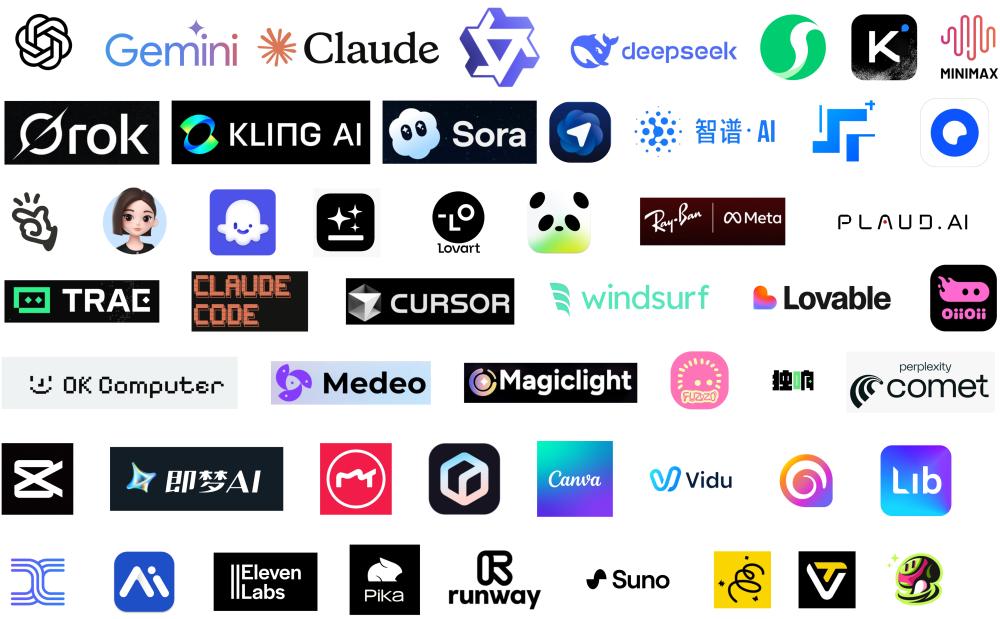
*Some of the products I used this year
Of course, I've also realized that today's AI is far from perfect.
For example, whether an AI pet is online depends on the network configuration; the copywriting provided by AI assistants is rather mechanical; the videos generated by AI still often have glitches and require "lucky draws"; the functions of AI glasses are restricted by the ecosystems of super - giants; and even many AI Agents still can't complete tasks.
However, in just one year, my life has indeed changed a lot because of this not - yet - perfect AI.
1. 365 Days Changed by AI
The reason I was able to try out so many products this year is that AI applications have entered a period of qualitative change. This change lies not only in the explosion of product numbers but also in the improvement of effectiveness and the refinement of interaction granularity.
What I felt most strongly was, first of all, the transformation of life by general AI assistants.
In 2025, almost all general AI assistants further enriched their vertical functions. Especially ChatGPT, Gemini, Doubao, Yuanbao, and Qianwen. They cover all modalities including images, videos, text, and voice, and handle daily needs such as inquiries, translations, copywriting revisions, image editing, and learning perfectly.
Moreover, each of these products has its own unique features. Thanks to its continuously optimized memory function, ChatGPT has become the AI assistant I open the most often. I often have conversations with it and ask it to help me analyze my own and others' thoughts.
After integrating Google's most powerful image - processing model, NanoBanana, Gemini has become the product that helps me process the most images.
As for Doubao, Yuanbao, and Qianwen, their advantages lie in their proficiency in Chinese, comprehensive functions, and fast response. In 2025, the multi - modal capabilities of these products have been significantly enhanced. So it has become my habit to give them direct instructions.
During the just - passed Christmas, I invited some friends in the AI industry for a small gathering. I directly used Doubao to handle the visual design, and it completed the invitation poster in just ten minutes.
This picture is AI - generated.

*Generated by Doubao. I asked it to put my image on the poster, and the result was very smooth.
Near the end of the year, AI input methods completely took over my way of expression.
The amazing thing about it is that when the voice input method is connected to the large - scale model, it not only improves the recognition accuracy but also adds the ability to understand and organize. Even for a vague statement, it can sort it out in minutes. This is extremely friendly to those who are not good at typing, and I've started to get used to expressing everything verbally with my phone.
This picture is presumably AI - generated.
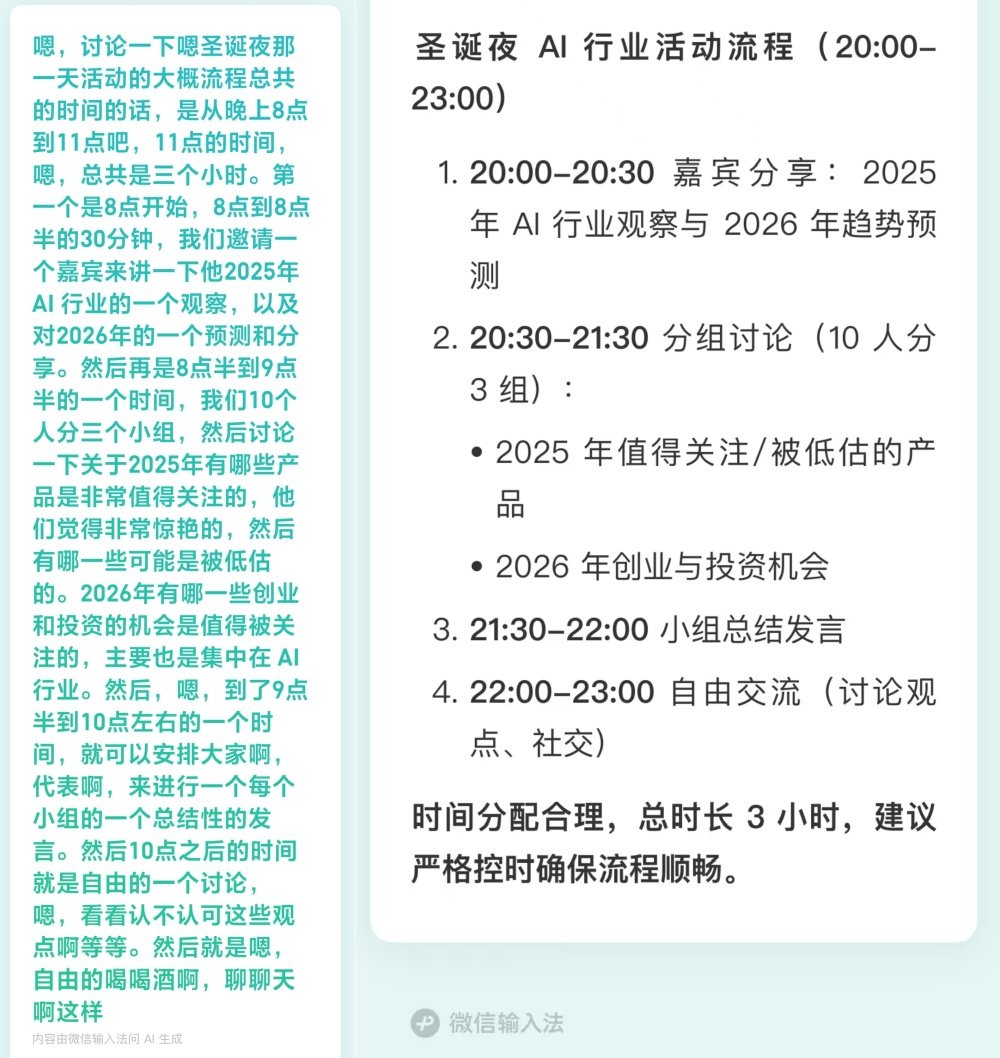
*Left picture: The content transcribed from voice by WeChat input method; Right picture: The content organized by one - click "Ask AI".
Beyond my life, my work has also been mostly reshaped by AI.
In 2025, DeepResearch and the evolved Coding products became essential tools.
First, DeepResearch. After the overseas products were released, many AI assistants built - in this function . Now when facing unfamiliar topics, using DeepResearch to collect and organize online information first can help me quickly understand the information.
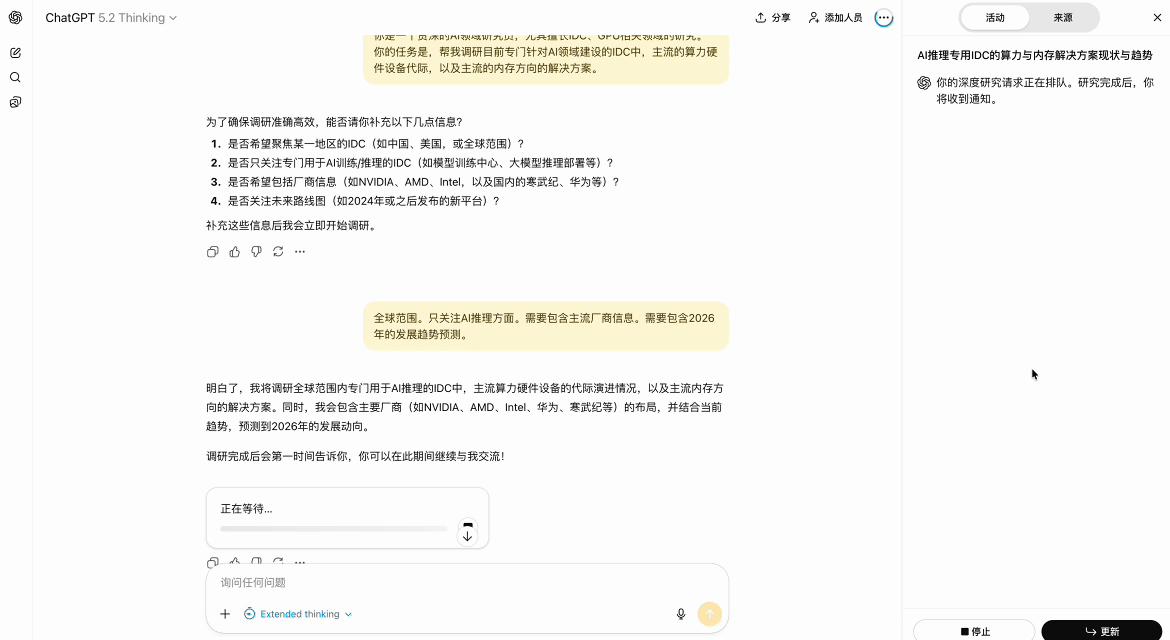

*Conduct research using DeepResearch in ChatGPT and Gemini, and manage and query personal knowledge bases using IMA.
The results from DeepResearch can be exported as PDFs with one click and stored, along with some key web pages, in IMA. When needed, I don't have to search manually. I can directly @ my personal knowledge base in IMA, enter the keywords I want to query, and then find relevant content and summarize it.
IMA is also connected to the Tencent ecosystem, so high - quality official account articles can be stored there, which is quite convenient overall.
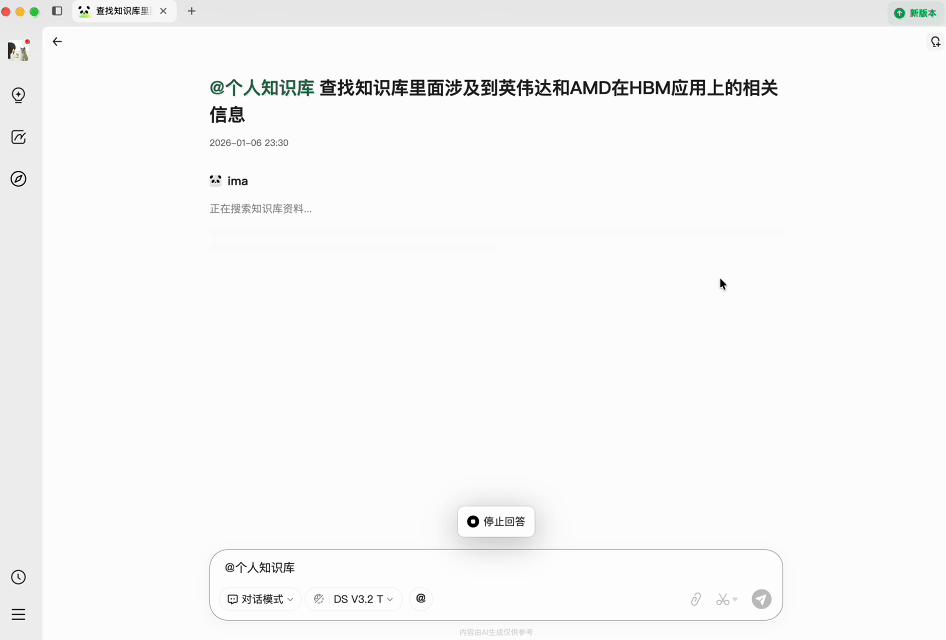
*Manage and query personal knowledge bases using IMA.
To improve work efficiency, I also developed some small tools with Vibe Coding this year.
As someone often overwhelmed by AI information, one of my urgent needs is to quickly filter out the most useful news. So I tried to make a browser plugin that can quickly summarize information (of course, before the release of Atlas).
Actually, I tried to make this plugin with Cursor in 2024. But at that time, Cursor's ability to plan the overall task was weak. It often forgot the previous requirements when making later changes, getting stuck in the cycle of "fixing bugs - creating new bugs".
Moreover, to develop a browser plugin, one needs to execute commands in the terminal to install development components in advance. But Cursor lacked the function to directly run commands in the terminal, so I had to manually execute the installation commands repeatedly to successfully code. Although it was called Vibe Coding, it was hard to really enjoy it, and I gave up after just a few tries.
It wasn't until 2025 that Anthropic launched Claude Code (CC), which is truly a god - like tool.
Its first amazing feature is that it reduces the difficulty of fixing bugs through task decomposition and planning. After I describe my requirements, it will first give a detailed plan, avoiding the situation of forgetting the requirements during the following changes and having to repeatedly fix bugs. At the same time, CC natively has CLI Agent capabilities and can directly execute terminal commands, automating everything from creating files, installing dependencies to running tests.
With the help of CC, I finally developed a plugin that can quickly translate and summarize.
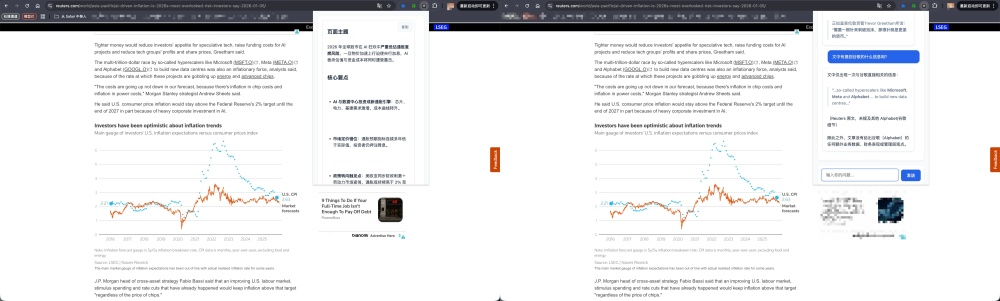
*Left picture: The browser plugin I made can make a structured summary of the content on the current web page; Right picture: The plugin also allows users to have further discussions and Q&A with AI about the web - page content.
AI hardware is also part of my daily work process.
The AI recording device, Plaud, officially launched for domestic users, has really become a constant companion. It has an extremely long standby time and simple operation (with only one button). It can upload the recorded content to the App with one click for AI transcription, summarization, and export. For me, who needs to communicate frequently, this product eliminates the hassle of cross - device operations.
Moreover, it also supports AI Q&A. I can query the questions I just discussed in specific recordings. This is equivalent to defining a precise context, which can quickly provide answers with few errors.
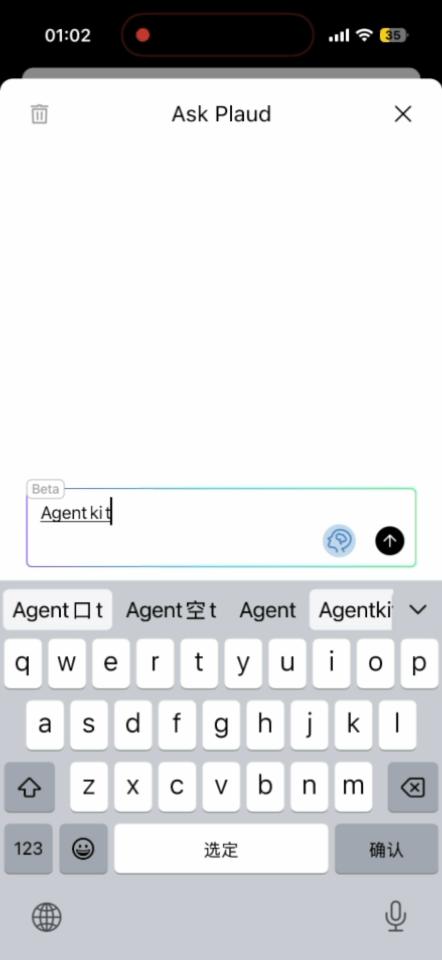
Some other small functions are also very practical, such as using Yuanbao to organize WeChat articles and using Feishu knowledge base to query internal information.
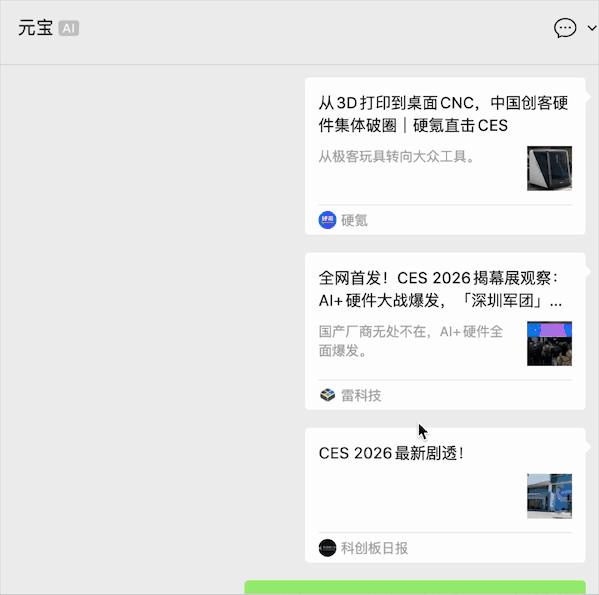
*Yuanbao was launched on WeChat in April this year. Just recently, I was interested in CES, so I sent the link to Yuanbao, and it quickly sorted out a "list" of featured products.
In short, various AI tools have completely penetrated into my daily life in 2025. I even can't really remember how I lived without AI before.
2. AI Products in 2025: More Realistic and User - Friendly
It's not hard to see from my changes that in 2025, both the quantity and quality of AI applications have made great leaps.
On second thought, user - friendliness and realism are probably the most important changes in AI products in 2025, and they are also the reasons why people are willing to use them.
First is user - friendliness. The improvement of the experience in this dimension is inseparable from the optimization of technology and engineering.
Many people remember that when ChatGPT first appeared, people were shocked by its smooth conversation ability. However, the interaction at that time was limited to text, and the information responses were neither accurate nor timely.
By 2024, almost all AI assistants could search the Internet, have voice conversations, and understand images, and the interaction methods were no longer limited to text. But at that time, these functions were still in their infancy, and the output accuracy and intention - understanding ability needed to be improved.
In 2025, two very important technological changes improved the user experience.
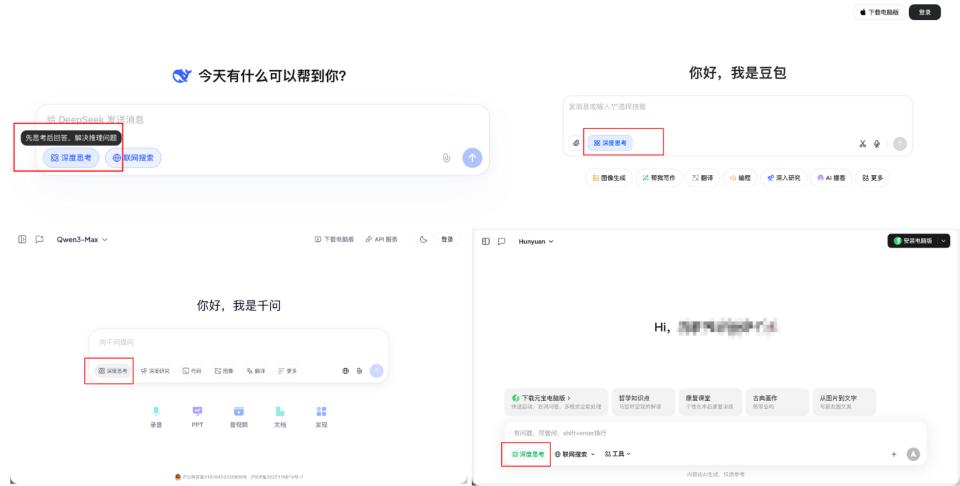
First, deep thinking, starting from DeepSeek, has become a standard feature of various products. It reduces the hallucinations of AI products, making the content more reliable and easier to adopt.
This picture is presumably AI - generated.
Next is the multi - modal ability.
From the popularity of ChatGPT's Ghibli - style in spring to the release of Sora 2 and NanoBanana, AI products have quickly integrated various modalities, significantly enhancing their playability and making the interaction more convenient and diverse.
These more visually stimulating changes quickly attracted users' attention.
For example, the relatively late - released general AI assistant, Grok, rushed into the top 5 of the "Entertainment" list on the App Store in the United States, Japan, South Korea, etc. after launching the Imagination function and Companion characters represented by Ani. Previously, it only ranked around 20th in the "Efficiency" and "Tools" lists.

*Ani, the most popular virtual companion character in Grok
There is also video conversation.
In the past 2025, the AI video - calling function was fully launched in many AI assistants.
Now, by opening the video - calling function of Doubao, Yuanbao, or Qianwen, you can use AI to accompany you shopping, play games, interpret subtitles, or complete any task that requires real - time image understanding.
This function requires strong multi - modal understanding, low latency, and sufficient computing power. Behind the full - scale launch, we can see that manufacturers attach great importance to multi - modality.
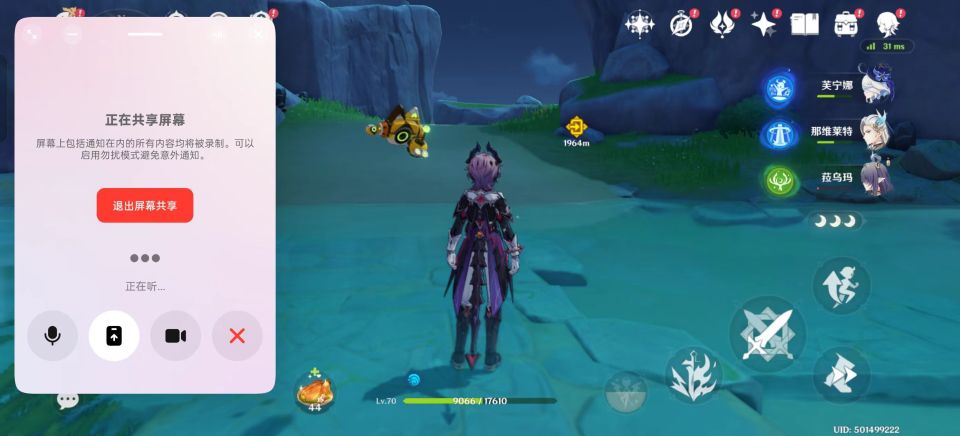
*Doubao accompanies you to play Genshin Impact. This is realized through the screen - sharing function in Doubao's video call, which doesn't interfere with the game operation.
Realism is another change in AI products in 2025.
This feeling