Securing the world's first AI large model IPO, Beijing's grand AI strategy is no longer a secret.
If you were to ask which city in China currently has the strongest AI capabilities, many might not think of Beijing. However, in reality, if Beijing is the second - best, then no other city would dare claim to be the first. This city not only dominates half of the country in terms of the scale of the core AI industry and the number of enterprises but also has unparalleled advantages in top - talent reserves, core technology breakthroughs, and industrial ecosystem aggregation. It has become the absolute core of China's artificial intelligence development.
Recently, there is further strong evidence for this advantage. Zhipu AI, which originated from Tsinghua University, successfully listed on the Hong Kong Stock Exchange on January 8, 2026, earning the title of "the world's first AI large - model stock." This not only marks the capital market's recognition of China's large - model technology route but also highlights Beijing's leading position in AI "brain" research and development. Represented by its GLM series of models, Zhipu AI has long proven its ability to build super - intelligence in the cloud. Its successful listing adds a brilliant stroke to Beijing's AI landscape and allows people to see the great potential of this "digital brain."
Around Zhipu AI's Beijing headquarters lies a vivid microcosm of Beijing's AI industrial ecosystem. Less than 2 kilometers away is the "Rongke Information Center," known as the world's most "expensive" office building, and the core reason for its "expensiveness" is AI. In this office park with a total construction area of only 250,000 square meters, tech giants such as NVIDIA, Apple, Microsoft, Google, Huawei, and Lenovo are gathered. It is estimated that the total market value of these enterprises exceeds 20 trillion US dollars. Even DeepSeek, headquartered in Hangzhou and shaking the world with its large model, has all its core R & D forces deployed in Beijing. Two - thirds of its R & D team is directly located on the 5th floor of Building C in the Rongke Information Center.
This dense AI industrial cluster stems from Beijing's unparalleled advantages in talent and scientific research. Centered around the Rongke Information Center, within a few kilometers, there are 41 universities such as Tsinghua University, Peking University, and Beihang University, 206 scientific research institutions such as the Chinese Academy of Sciences, and 67 national key laboratories, forming a unique scientific research and innovation ecosystem. Data can more intuitively confirm this advantage: Beijing has 148 top scholars ranked among the global AI TOP2000, the largest number in the country, accounting for 40% of the national total; the scale of the core AI industry is nearly 350 billion yuan, and there are 2,400 relevant enterprises, both accounting for half of the national total; a total of 162 large models have been registered and launched, accounting for nearly 30% of the national total, and the intelligent computing supply reaches 42,000 PFlops, providing solid support for AI R & D.
Beijing also holds a leading position in the key links of the AI core industrial chain. In the chip field, well - known enterprises such as Kunlunxin, Cambricon, Moore Threads, and Qingwei Intelligence are gathered; in the large - model field, benchmark products such as Baidu's ERNIE Bot and ByteDance's Doubao continue to lead. Among them, ByteDance's Doubao has the highest monthly active users in the country, demonstrating Beijing's strength in the commercialization and implementation of AI technology.
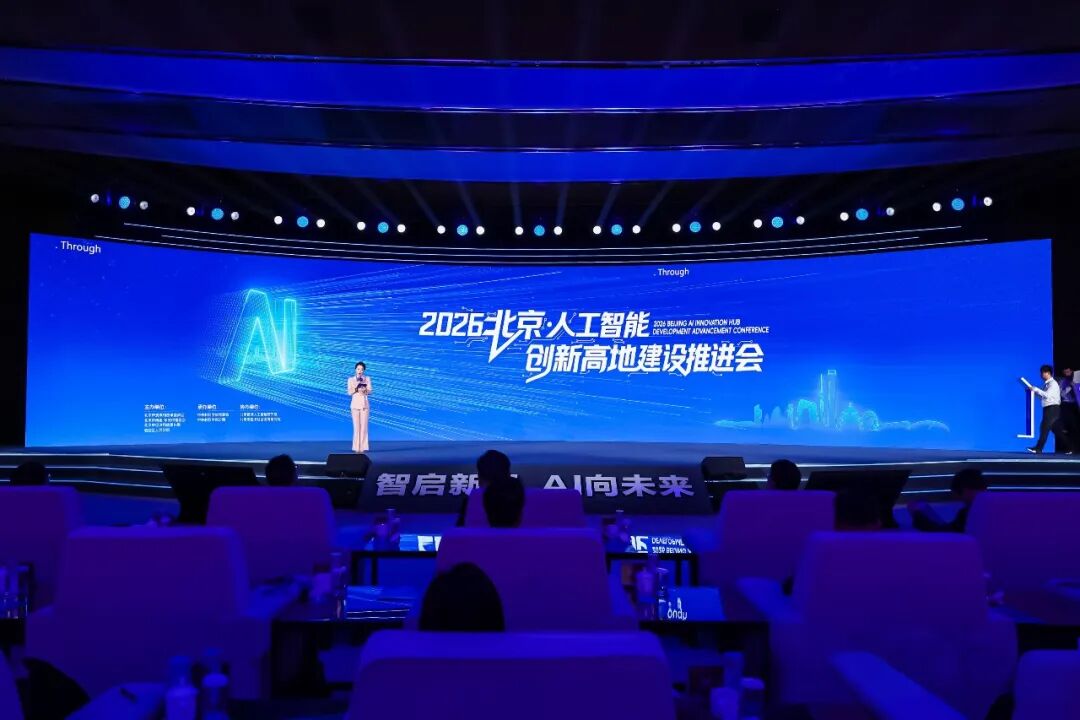
More notably, Beijing's layout for artificial intelligence has moved towards a deeper - level future. On January 5, 2026, Beijing held the "Promotion Conference on the Construction of an Artificial Intelligence Innovation High - ground." Among the "Nine Actions" announced at the meeting, "Full - chain Leap in Embodied Intelligence" was placed at an unprecedented strategic height. This marks that Beijing's understanding of artificial intelligence has gone beyond simple computing power competition and model iteration and entered a more profound and challenging realm - enabling AI to truly enter the real physical world from the virtual digital world.
This has taken the AI competition beyond the narrative of "smarter" AI and into the exploration of the "real world" - creating humans. If AI is a "digital brain" floating in the cloud, then Beijing's ambition is to equip this brain with a pair of "dexterous hands and feet" that match it.
True intelligence should not only win games in the virtual world but also solve problems in the physical world.
A number of Beijing's science and innovation companies are already ready!
For a long time, the problem has been that while the AI's brain runs at high speed in the cloud, its body is stuck in one place. The delay and uncertainty between the command sent from the cloud and reaching the robot's arm are like an incurable "neurosis." You can't let a slow - reacting robot operate in the operating room, nor can you let a mechanical arm that may "freeze" at any time tighten screws on the production line.
Mianbi Intelligence, which emerged from Tsinghua University, wants to directly install this "brain" into the "body."
They are trying to solve this problem with a "density revolution." Their proposed "density law" - the ability density of large models doubles approximately every 3.5 months. The core idea is not to infinitely stack computing power but to achieve capabilities comparable to cloud - based large models through extreme algorithm optimization on limited edge - side devices. Their upcoming open - source MiniCPM - o 4.5 edge - side full - modality model, with only 8B parameters, achieves capabilities comparable to cloud - based large models with hundreds of billions of parameters. More importantly, it realizes "full - duplex streaming interaction" and can interrupt and interject naturally like a human. This means that in the future, the robot's "brain" will no longer be slow but will be able to interact with the environment in real - time and without delay.
When the AI's brain starts to think at the terminal, intelligence truly obtains the "passport" to enter the physical world.
With the "passport," you also need "hands and feet."
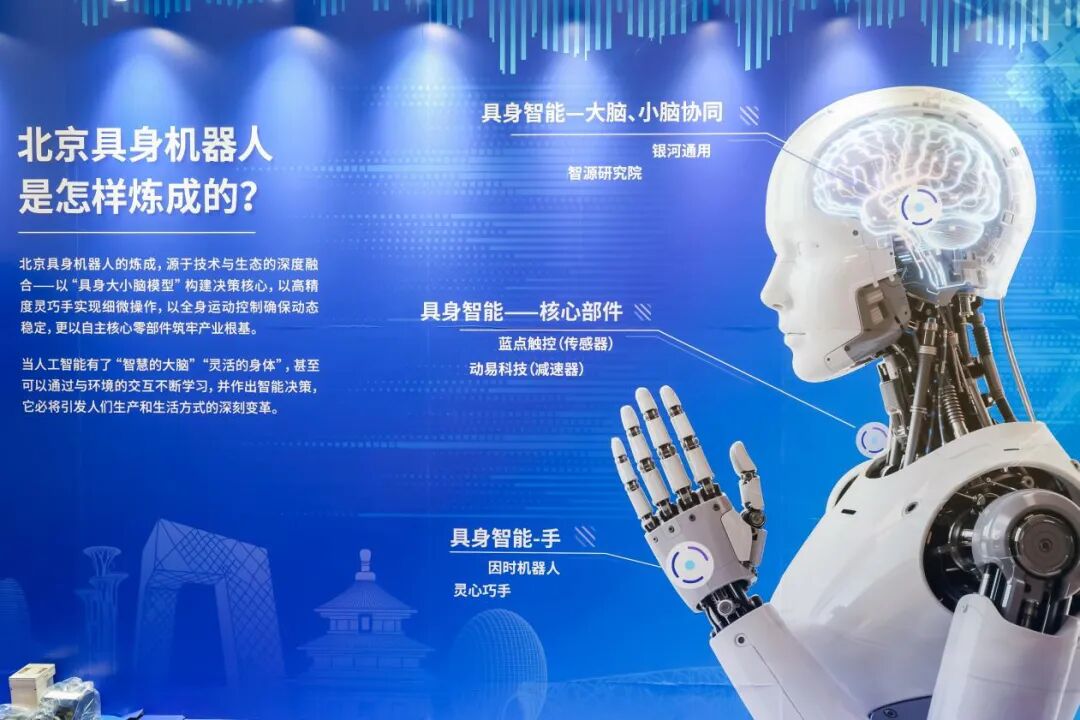
Lingxinqiaoshou holds about 80% of the global market share in the high - degree - of - freedom dexterous hand market, focusing on the most delicate "fingertip work" of robots. Its products can not only perform delicate operations such as threading a needle but also complete complex tasks such as musical instrument playing and precision assembly. At the same time, they significantly outperform international similar products in terms of performance, cost, and durability. Another company called BlueDot Touch gives these hands a "sense of touch." Their six - dimensional force sensors have a market share of over 70% in the humanoid robot field, and the joint force sensors reach over 95%. These sensors allow the robot to know exactly how much force it is using, whether it has crushed an egg or just picked it up. If the dexterous hand is the "hands" of embodied intelligence, then the force sensors are its "nerve endings." The combination of the two constitutes the complete "ability to act."
However, no matter how good the parts are, someone has to assemble them into a "person" that can do work.
The engineers at Galaxy Universal are doing this "person - assembling" job. Their Galbot G1 humanoid robot has been learning to organize shelves in supermarkets, carry material boxes, and sort parts in factories. These tasks may not sound high - end, but behind them is the empowerment of end - to - end embodied large models and the most cutting - edge scenario applications of global embodied intelligence.
Teaching a robot to do work is too costly. You can't let it fall and make mistakes repeatedly in the real world, as each trial and error may mean a real - money loss.
In the physical world, each trial and error comes at a high price; but in the digital world, each failure is valuable experience. Guanglun Intelligence is the helper for robot enterprises to reduce costs and increase efficiency.
Guanglun Intelligence's self - developed full - stack simulation platform provides a high - quality simulation environment for robots, enabling them to be trained at a speed millions of times faster than in the real world, greatly reducing costs and risks. Its RoboFinals Embodied Intelligence Simulation Evaluation Platform objectively measures the capabilities of robot models through industrial - level evaluation standards and large - scale parallel evaluations, supporting the long - term development of the embodied intelligence industry.
From Mianbi Intelligence's "edge - side brain," to Lingxinqiaoshou and BlueDot Touch's "dexterous limbs," then to Galaxy Universal's "system integration," and finally to Guanglun Intelligence's "evolution accelerator," a complete embodied intelligence innovation chain has taken shape under Beijing's strategic blueprint.
The establishment of the first batch of four "Artificial Intelligence Innovation Blocks," especially the implementation of the "Modular World" in the Economic Development Zone, means that these technologies will not remain on paper but will be tested in real scenarios.
In the past decade, the logic of China's Internet has been "application innovation" - creating better products and services on others' technology bases. This path has worked, but it has also left hidden dangers. The competition in embodied intelligence may be China's first opportunity to define the rules of the game from the bottom up. Because this time, there is no ready - made answer to follow and no established standards to abide by.
Beijing's layout is not about catching up with anyone but about seizing an undefined high - ground. When a city can get through every link from the edge - side brain to dexterous hands and feet, from force - sense sensing to simulation training, it is no longer just a link in the industrial chain but the definer of the entire industry.
This is Beijing's real ambition: not to become the next Silicon Valley but to compete to define the next era.
This article is from the WeChat official account "Huashang Taolue" (ID: hstl8888). Author: Huashang Taolue. Republished by 36Kr with permission.