Domestic financing of 2 billion yuan, 10,000 people queuing up globally: Can brain-computer interface allow the elderly to regain new life with "thoughts"?
Preface
If we look back from a more distant future, 2026 might be the beginning of science fiction accelerating into reality.
Aging – once regarded as an irreversible fate, accompanied by muscle atrophy, the human consciousness seems to only fade away in the deepening darkness.
However, with the continuous maturity of brain-computer interface technology, we are experiencing a reconstruction of the narrative about the "end of life." When digital signals start to take over damaged biological signals, technology is not only extending the length of life for the elderly but also mending their dignity.
Mass Production Announced: Brain-Computer Interface Reaches the "Singularity Moment"
On the first day of 2026, "Iron Man" Elon Musk dropped a bombshell.
On January 1st, Musk announced that his neurotechnology and brain-computer interface company, Neuralink, would conduct "mass production" in 2026 and shift to a "more streamlined and almost fully automated surgical process." This news quickly caught global attention, as it marks a crucial node for the brain-computer interface to enter the "commercial leap."
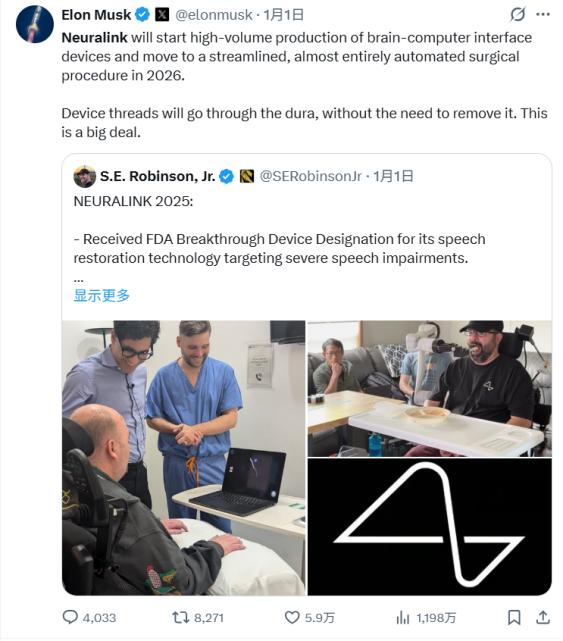
Image source: X
The brain-computer interface (BCI) is a technology that directly establishes a communication path between the brain and external devices and is widely used in scenarios such as motor/speech reconstruction, sensory recovery, neuromodulation, and human-computer interaction. In the science fiction movie The Matrix, the "plug in the back of the head" of the protagonist Neo might be the initial imagination of the brain-computer interface.

Image source: Still from the movie The Matrix
However, the development of the brain-computer interface technology in reality has long surpassed science fiction works. Nowadays, this technology is not limited to the stereotypical form of "craniotomy and intubation" in the public's impression but has developed multi-level and multi-path access solutions.
The most common classification is based on the implantation method: invasive, semi-invasive, non-invasive, and interventional brain-computer interfaces. Most invasive and semi-invasive brain-computer interfaces belong to Class III medical devices.
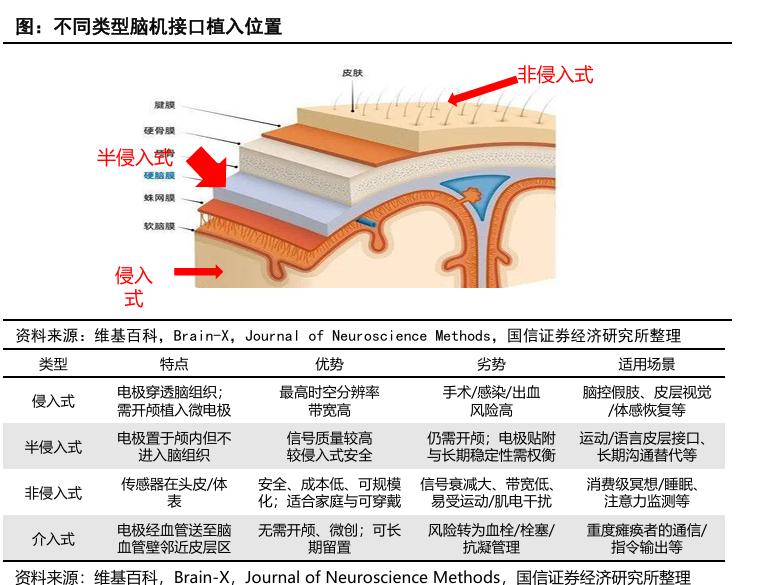
Image source: Guosheng Securities
Neuralink under Musk has achieved a key breakthrough in the field of invasive brain-computer interfaces. Its new-generation surgical robot has shortened the implantation time of a single electrode from 17 seconds to 1.5 seconds, with a depth exceeding 50 millimeters, enabling it to precisely reach deep neurons. Within 24 hours after the news was announced, there were more than 3,000 new appointments, and the global queuing number has exceeded 10,000.
Currently, Neuralink has completed the world's first invasive clinical trial, with a total of 12 clinical studies covering conditions such as spinal cord injury and amyotrophic lateral sclerosis, and has cooperated with international institutions such as the Barrow Neurological Institute and the Cleveland Clinic Abu Dhabi.
According to its plan, it will launch the "Blindsight" project for the blind in 2026, achieve simultaneous reading of motor, language, and visual signals in 2027, and further explore in-depth integration with AI and consciousness interaction in 2028.
In June 2025, Neuralink completed its Series E financing, raising $650 million. This round of financing was led by ARK Invest, Sequoia Capital, the Qatar Investment Authority, etc., and the company's valuation reached approximately $9 billion.
Neuralink is not alone. In the industry boom, other companies are also quickly catching up: Paradromics received $33 million in Series A financing in May of the same year and obtained FDA breakthrough device certification; Synchron completed a $200 million Series D financing in November to accelerate the commercialization of its non-invasive brain-computer interface platform; the startup Subsense received $10 million at the same time to promote the research and development of non-invasive technology.
Domestic companies have also attracted the attention of the capital market in this hot track. In January this year, Qiangnao Technology completed a financing of approximately 2 billion yuan, the second-largest financing in the brain-computer interface field after Neuralink under Musk.
The lineup of this financing is quite impressive, including IDG Capital, Walden International founded by Intel CEO Chen Liwu, Lens Technology, Lingyi Precision Industry, as well as strategic investors such as Will Semiconductor, Runze Technology, Huazhu Group, and TAL Education Group, and even top family offices in Hong Kong and the United States.
Reconstructing Abilities: The Elderly Break Through the Physiological "Cage"
For a long time, people's fear of aging is not so much a fear of the passage of time as an anxiety about the gradual breakdown of "connections." The brain-computer interface, like a precise digital key, is trying to unlock these doors locked by time one by one.
In the medical field, this technology is bringing the possibility of reconstruction to the elderly's lives from multiple dimensions such as movement, vision, and cognition.
1. Reconstruction of Motor Ability
The first thing the brain-computer interface brings is the reconstruction of motor ability. For millions of elderly people who are paralyzed due to stroke or bedridden due to spinal cord injury, traditional rehabilitation physiotherapy relies on external force traction, while the brain-computer interface realizes "mind-driven," which also announces the "return of the elderly's motor sovereignty."
The Dutch company ONWARD Medical completed the world's first joint implantation of a neural stimulation system and a brain-computer interface in 2023, helping spinal cord injury patients recover upper limb movement, and successfully raised 20 million euros in 2024 to restore the lower limb movement ability of spinal cord injury patients.
According to ONWARD Medical, 90% of the subjects improved their upper limb strength or function; 87% of the subjects improved their quality of life, and the efficacy was also confirmed in patients with an injury time of up to 34 years.
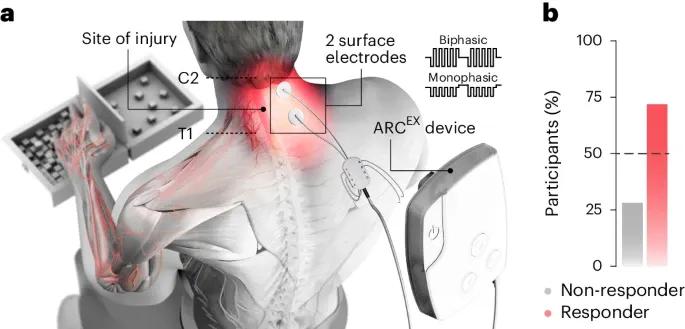
Image source: Nature Medicine
In October 2025, ONWARD Medical announced that it had completed a follow-on financing of over 50 million euros.
In China, the team from Huashan Hospital Affiliated to Fudan University has helped paralyzed patients recover the ability to stand and walk through the brain-computer interface. Companies such as Zhentai Intelligence are also exploring the integrated rehabilitation path of "brain-computer interface + VR + rehabilitation robot" to promote the "return of motor sovereignty."
2. Restoration of Visual Function
In addition to the reconstruction of motor function, the brain-computer interface also shows the possibility of reconstructing visual ability in 2026.
Take the Blindsight visual chip developed by Neuralink as an example. This technology was recognized as a "breakthrough medical device" by the US FDA in September 2024, opening up a new path in the field of visual reconstruction.
The technical path of Blindsight bypasses the damaged eye structure, collects external images through a camera, and then directly stimulates the visual cortex of the brain in the form of a wireless signal, thus "presenting images to the brain bypassing the eyes."

Image source: X
Musk said that as long as the function of the visual cortex of the brain remains intact, even congenital blind people are expected to obtain basic vision through this device. Although its imaging resolution is still lower than that of natural vision, it can help the elderly who have been blind for many years recognize the facial contours of their family members and avoid obstacles, significantly improving their ability to live independently.
In terms of the development path, the short-term goal of Blindsight is to restore basic visual functions for the visually impaired, enabling object recognition and spatial navigation; the long-term vision is even more imaginative – Musk hopes that in the future, it can achieve signal perception in the infrared, ultraviolet, and even radar bands, allowing users to have "supernatural visual ability."
3. Combating Cognitive Decline
Dementia, aphasia, and amnesia, diseases such as Alzheimer's are the most pressing issues in society today. When the elderly can no longer express themselves or remember, the bonds between society, family, and individuals are at risk of breaking. Currently, the brain-computer interface is also exploring the field of cognitive intervention.
The "Brain Power Xin" system launched by Qiangnao Technology, through portable EEG devices and personalized training, helps slow down the decline of cognitive functions such as memory and attention.
In September 2025, the "5G Brain-Heart Train" platform developed by institutions such as the Brain Hospital Affiliated to Guangzhou Medical University was launched, becoming the world's first brain-computer interface clinical treatment system for Alzheimer's disease. Early data shows that it can increase the cognitive scores of patients by about 37%; the Chinese Academy of Sciences team has also developed a flexible neural microelectrode, providing a new technical path for the precise intervention of Alzheimer's disease through the synergy of dopamine monitoring and electrical stimulation.

Image source: Yangcheng Evening News
From movement to perception, from communication to memory, the brain-computer interface is providing support for the elderly's lives at multiple levels. It is no longer just about extending the length of life but also about reconstructing the quality and dignity of life.
Industrial Fission: The Rise of Chinese Power
The popularity of the brain-computer interface is reshaping the entire industrial landscape of medical devices and assistive technologies. It is no longer an isolated component but a "parent industry" that drives multiple upstream and downstream chains.
Huafu Securities pointed out that the brain-computer interface industry has formed a complete industrial chain, covering multiple links such as the upstream (materials, chips, electrodes, etc.), the midstream (signal acquisition, perception, and processing), and the downstream (medical health, consumer goods, industrial production, etc.).
According to market research institutions' predictions, the global brain-computer interface market size was approximately $2.62 billion in 2024, is expected to reach $2.94 billion in 2025, and is expected to grow to $12.4 billion by 2034.
From the perspective of the global competition pattern, the brain-computer interface market in 2026 has shown a distinct bipolar pattern between China and the United States. If the advantage of the United States lies in pioneering technological breakthroughs and capital operation, then the advantage of China lies in its rich clinical resources, strong manufacturing system, and high-level policy drive.
Neuralink's mass production plan has greatly stimulated the competition among overseas brain-computer interface companies. Companies such as Paradromics and Synchron have started to accelerate their clinical trials, while companies such as Blackrock Neurotech and Emotiv hope to maintain their advantages in neural recording and non-invasive devices. Overall, Neuralink has further promoted the maturity of the industrial chain through its own financing and high valuation.
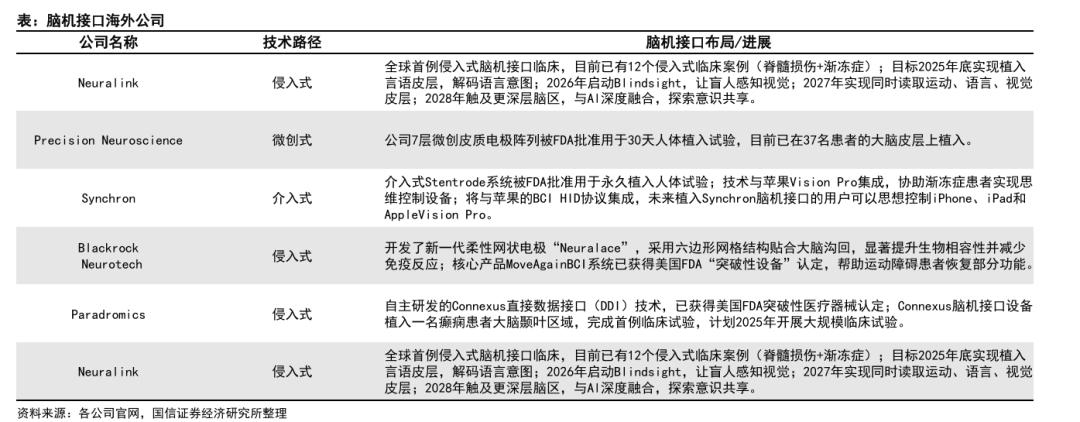
Image source: Guoxin Securities
In China, the brain-computer interface has also entered an explosive phase.
In terms of policy, in July 2025, seven departments including the Ministry of Industry and Information Technology issued the "Implementation Opinions on Promoting the Innovative Development of the Brain-Computer Interface Industry," officially including the brain-computer interface in the country's strategic emerging industries. This opinion clarifies the development goals of forming a technological system by 2027 and ranking among the world's top by 2030. Industrial agglomeration areas such as Shanghai, Beijing, and the Guangdong-Hong Kong-Macao Greater Bay Area are accelerating their implementation, and more than 10 billion yuan of future industry funds are continuously injecting vitality.
Meanwhile, the industry standards and payment system are also rapidly improving. In 2025, the National Healthcare Security Administration issued an independent charging standard for the brain-computer interface, and the Drug Administration issued industry standards for the brain-computer interface. Provinces and cities such as Hubei and Zhejiang have successively issued medical service prices for the brain-computer interface, and Zhejiang Province has directly included the "non-invasive brain-computer interface adaptation fee" in the medical insurance catalog.

Image source: Guoxin Securities
At the beginning of this year, the Healthcare Security Administration of Sichuan Province also issued a relevant notice, integrating 82 medical service price items for the nervous system and clarifying the medical insurance payment categories, including the brain-computer interface project.
In terms of clinical application, China is rapidly promoting the full-process verification from evaluation to treatment.
In March last year, the country's first brain-computer interface consultation and evaluation outpatient clinic was opened at Tiantan Hospital, and more than 1,000 patients received consultation and evaluation through the clinic. Four out of five clinical research patients were successfully discharged, verifying the feasibility of the complete process from surgery to postoperative management; in November