Unprecedented: The "Grand Game" Behind China's Application for 200,000 Satellites
Recently, the news that China has applied to the International Telecommunication Union (ITU) for more than 200,000 satellite frequency and orbital resources has shocked the industry and attracted strong attention from the capital market.
When interviewed by reporters from IT Times, many industry insiders pointed out that this is a record - breaking action. Both the number of applications and the total scale of satellites are the highest in history. What is particularly striking is that an institution newly registered, named the "Research Institute for Radio Spectrum Development, Utilization and Technological Innovation" (hereinafter referred to as the "Radio Innovation Institute"), has applied for more than 190,000 satellites. "This number not only far exceeds the sum of all previously applied constellation satellites in China, but is also several times that of the current largest in - orbit constellation (72,000 satellites applied by SpaceX's Starlink)." An industry expert introduced.
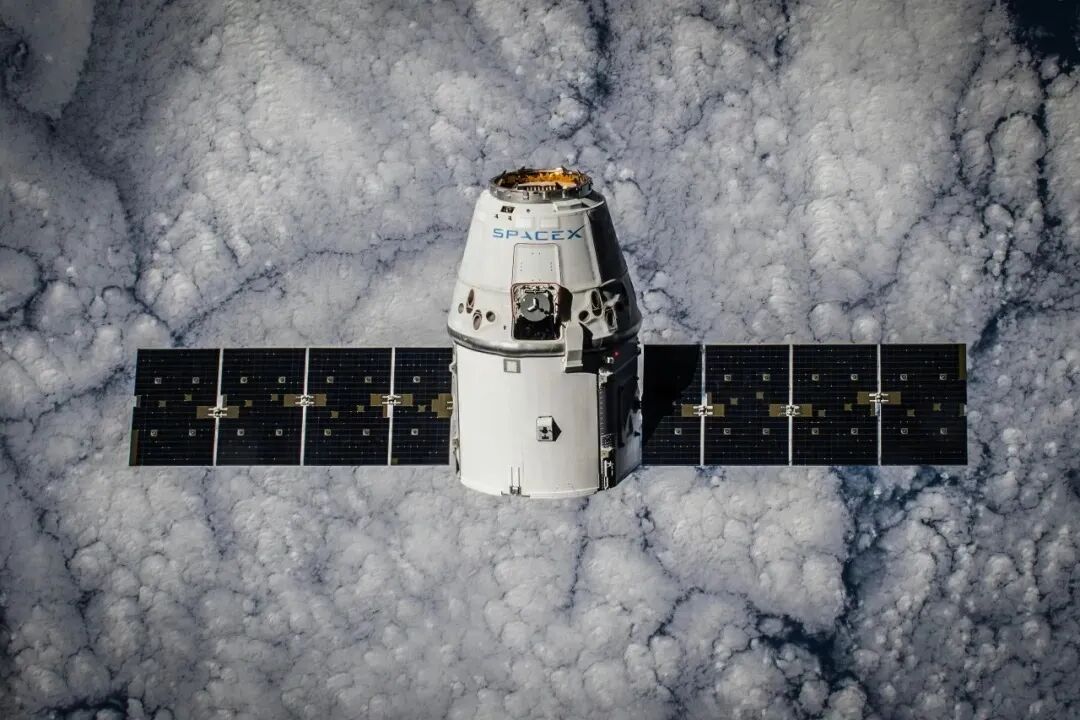
Image source: pexels
It is quite rare to apply for satellites to the ITU on such a large scale. The industry has relatively consistent views on the motivation behind this phenomenon.
The above - mentioned expert said: "This is a landmark and strategic 'resource occupancy' action. Currently, the ITU follows the rule of 'first application, first coordination'. The large - scale application is to ensure that China has a sufficient 'resource pool' of orbits and spectra in the next decade or even longer."
Xie Ying, a senior expert in the fields of mobile communication, satellite communication, and avionics, believes that "this reflects China's strategic determination to 'concentrate resources to accomplish major tasks'. The core purpose of the application is to 'protect frequencies and occupy orbits', that is, to obtain more orbital positions and frequencies, these international space strategic resources, to lay a solid foundation for future development."
Especially for commercial space, which is an important pillar industry during the 15th Five - Year Plan period, and 6G with the goal of "space - air - ground integration", high - level satellite infrastructure is indispensable for support.
Breaking historical records
"In 2025, China submitted 73 constellation frequency coordination applications to the ITU, with an activity level far exceeding any previous year. Especially in December 2025, the number of applications reached 34, almost half of the whole year." The above - mentioned industry expert said.
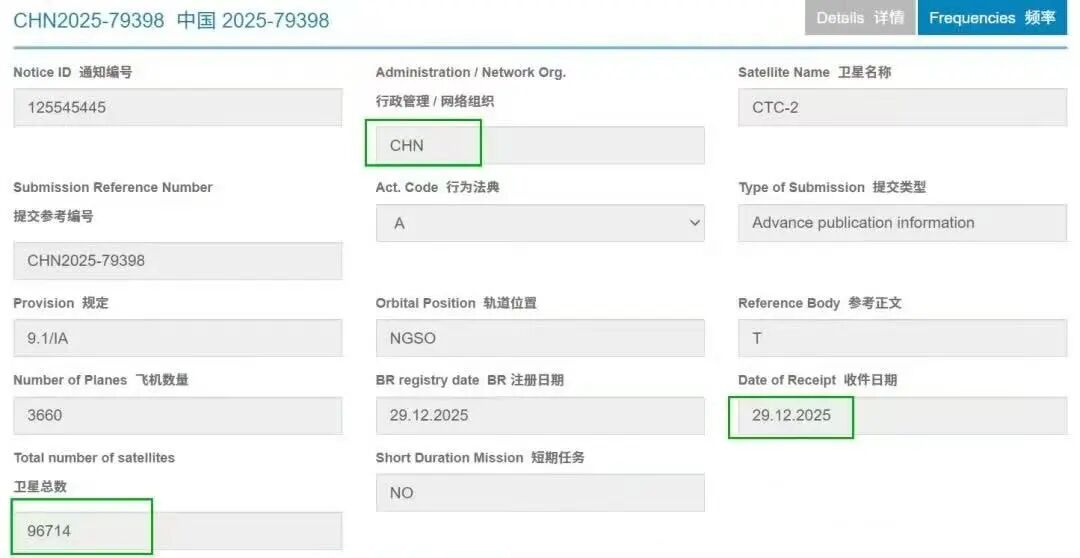
What is even more striking is the scale of satellites applied by China, with the total number exceeding 200,000. The applicants are widely distributed, including professional satellite operators such as China Satellite Network Group and Shanghai Yuanxin, commercial space enterprises such as GalaxySpace and Guodian Gaoke, and telecom operators such as China Telecom and China Mobile. Among them, the most - watched'star' is a 'new face' - the Radio Innovation Institute. This institution applied for two constellations, CTC - 1 and CTC - 2, each with a scale of 96,714 satellites, totaling 193,428 satellites.
Public information shows that the Radio Innovation Institute was jointly established by seven units, including the National Radio Monitoring Center, the Hebei Xiongan New Area Management Committee, the Hebei Provincial Department of Industry and Information Technology, China Satellite Network Group Co., Ltd., Nanjing University of Aeronautics and Astronautics, Beijing Jiaotong University, and China Electronics Technology Group Corporation. It was registered in the Xiongan New Area on December 30, 2025. One day before registration (December 29, 2025), the Radio Innovation Institute had submitted applications for the CTC - 1 and CTC - 2 constellations to the ITU.

"The Radio Innovation Institute is affiliated with the Ministry of Industry and Information Technology. It is the core scientific research and technical support institution in the fields of radio spectrum management and satellite communication standard setting in China. Its actions represent the national strategic will and it is a core member of the 'national team'." The above - mentioned expert emphasized.
He believes that the application for the CTC constellation clearly sends a signal that China's low - orbit satellite internet construction is evolving from a "single - core" to a "dual - core" and even a "multi - system" strategic pattern. This expert further analyzed that the positioning of the Radio Innovation Institute and another 'national team' - China Satellite Network Group - is both different and collaborative. "China Satellite Network Group mainly plays the role of a demand integration platform. Although it has R & D capabilities, it focuses more on proposing standards and requirements; the Radio Innovation Institute is more inclined to be a 'technology originator and resource reserve provider', responsible for verifying cutting - edge technologies, formulating standards, and reserving strategic resources for the country. In the future, the two may form a collaborative pattern of 'main operation + technology backup/supplement', thereby enhancing China's overall resilience and competitiveness in this field."
Making the first move
Not only is China applying for ultra - large - scale satellite constellation plans, but other countries are also taking active actions.
According to an official WeChat message from China Radio on January 11, several countries have applied for satellite network data with a single - application scale of more than 100,000 satellites according to their own situations. For example, companies such as MARVEL SPACE COMMUNICATIONS, E - SPACE, and KEPLER COMMUNICATIONS have applied for low - orbit satellite network data for 170,000, 110,000, and 110,000 satellites respectively.
This reflects that the competition in the current satellite field, especially in low - orbit satellite constellations, is becoming increasingly fierce.
As is well known, the high - quality orbits and communication frequency bands of low - orbit satellites are globally scarce strategic resources. "It is generally believed that the low - Earth orbit can accommodate about 60,000 satellites," the above - mentioned expert pointed out. However, the capacity of only 60,000 satellites is far from the actual demand. Taking the current largest low - orbit constellation, Starlink, as an example, its application volume alone has reached 72,000. In addition, China currently has 3 low - orbit constellations with the number of applied satellites exceeding 10,000.
Since the ITU currently follows the principle of 'first application, first coordination, first use', seizing the opportunity is crucial for all countries, and the first step is to submit applications to the ITU.

Image source: unsplash
China's large - scale application this time is to ensure that it has a sufficient 'resource pool' of orbits and spectra in the next decade or even longer. At the same time, the application also means obtaining the qualification to carry out frequency coordination and international negotiations, leaving sufficient room for subsequent technology route selection (such as laser inter - satellite links and communication payloads) and phased construction.
"The Radio Innovation Institute's application for nearly 200,000 satellites this time more represents the national will, highlighting China's grand plan for satellite development. This is a relatively long - term project," Xie Ying said.
"This is essentially a move to 'occupy a position' in advance. Such a grand plan is difficult to achieve only by the strength of enterprises. First, the application must be completed. After the ITU officially approves it, technology standard selection, network design, construction, and operation will be the subsequent focuses," said the technical director of a domestic satellite internet enterprise.
The above - mentioned industry expert believes that this will definitely be a long - term project and is likely to be promoted in batches. It will be gradually built over 10 to 15 years according to the rhythm of 'pilot constellation (hundreds to thousands of satellites) - extended constellation (tens of thousands of satellites) - full system'. During this period, the constellation design and launch plan will be continuously optimized based on technology maturity, market demand, cost control, and international coordination results.
Telecom operators enter the game
In addition to the Radio Innovation Institute, the two telecom operators, China Telecom and China Mobile, also appear among the applicants this time.
This is another important move by telecom operators in expanding the satellite internet field after the Ministry of Industry and Information Technology issued the "Guiding Opinions on Optimizing Business Access to Promote the Development of the Satellite Communication Industry" in August and September 2025 and issued satellite mobile communication business operation licenses to China Mobile and China Unicom. It marks that the satellite internet business of telecom operators has officially entered the "space - ground integration" actual combat stage. The industry expects that China Unicom will also join in later.
Relying on China's independently developed Tiantong satellite mobile communication system, China Telecom has built a complete "space - ground integrated" communication support system, achieving innovative services such as direct satellite connection of mobile phones and direct satellite connection of cars for the first time in the world, and promoting satellite communication from the professional field to the mass consumer market. In many major disaster relief operations in recent years, China Telecom has used the Tiantong satellite to first establish communication links between disaster - stricken areas and the outside world.
However, the Tiantong satellites are located in the geostationary orbit. High - orbit satellites are difficult to provide low - cost high - speed internet access services. Industry analysis believes that China Telecom's application for a low - orbit constellation this time is to make up for this shortcoming and form the ability of "full - domain high - speed data services", thus consolidating its leading advantage.
China Mobile's application for a medium - and low - orbit satellite constellation aims to become a "comprehensive full - domain intelligent connection service provider". Building its own constellation is a strategic necessity for it to ensure autonomy and master core capabilities in future communication competition, and it is also a key step in extending its ground "pipeline" advantage to space.
For both China Telecom and China Mobile, building their own constellations is crucial for the future development of 6G.
6G is one of the six future industries proposed in the "Suggestions" of the 15th Five - Year Plan. The 6G network not only needs to provide stronger connection capabilities to integrate computing, data perception, and AI functions but also achieve full - domain service coverage of space - ground integration. "And this requires a large number of low - orbit satellite resources as support. Therefore, whether it is the application for satellites by telecom operators or the large - scale application for satellites by the Radio Innovation Institute, they are all laying a solid foundation for China's future 6G development," summarized the technical director of the above - mentioned satellite internet enterprise.
Images/pixabay pexels unsplash
This article is from the WeChat public account "IT Times" (ID: vittimes), author: Qian Lifu, published by 36Kr with authorization.