StartseiteArtikel

Why has Shenzhen become the "Silicon Valley of China"?

芯潮IC2026-01-13 11:47
One of the cities with the greatest growth potential in the semiconductor industry in China.

This is Shenzhen, one of the cities in China with the greatest growth potential in the semiconductor industry.

In the 1980s, this was just a border town adjacent to Hong Kong. At that time, no one could have predicted that 40 years later, from the component stores in Huaqiangbei to the Kirin chips of HiSilicon, from the "processing with supplied materials, samples, and designs and compensation trade" factories to the 12 - inch wafer production line of SMIC, this land would grow into an important pole in the global semiconductor industry that cannot be ignored.

Today, when we talk about the "Chinese Silicon Valley", Shenzhen truly deserves the title. As of the end of 2024, there were 727 integrated circuit enterprises in Shenzhen. In 2024, the revenue of the city's integrated circuit industry reached 283.96 billion yuan, a year - on - year increase of 32.9%. In the current semiconductor field in Shenzhen, there are 50 listed companies, 14 unicorns, and over 200 specialized and sophisticated "little giants" enterprises, which are among the top in the country.

Looking back on the journey so far, it has not been all smooth sailing. There have been fierce competition, changing fortunes, and the clarion call for unity. Accompanying this city's journey through different stages is a breakthrough full of wisdom and courage.

Invest Another 5 Billion Yuan to Strengthen the Semiconductor Industry Chain

Recently, Tianyancha updated a piece of industrial and commercial information.

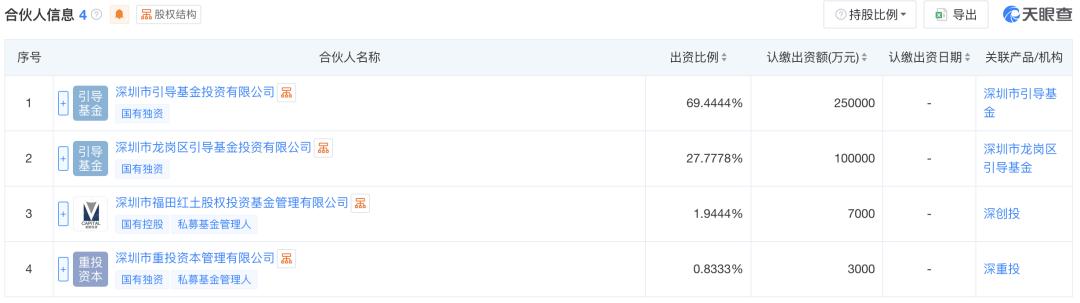
The "Semiconductor Industry Private Equity Fund" of the Shenzhen Semiconductor and Integrated Circuit Industry Investment Fund completed its industrial and commercial registration. It was jointly initiated by Shenzhen Leading Fund Investment Co., Ltd., Shenzhen Longgang District Leading Fund Investment Co., Ltd., Shenzhen Heavy Industry Investment Capital Management Co., Ltd. under Shenzhen Major Industry Investment Group Co., Ltd., and Shenzhen Futian Red Capital Equity Investment Fund Management Co., Ltd.

In short, this fund has a strong background, backed by two major state - owned assets in Shenzhen, Shenzhen Capital Group and Shenzhen Heavy Industry Investment Group. Its initial scale reaches 5 billion yuan.

These funds will be mainly invested in key semiconductor and integrated circuit projects in Shenzhen, as well as leading enterprises in niche markets and other projects that play a significant role in improving the semiconductor industry chain in Shenzhen. The focus is on building, supplementing, strengthening, and extending the industry chain around the major integrated circuit manufacturing project clusters in Shenzhen, effectively empowering the local industry chain and supply chain in Shenzhen.

When it comes to the semiconductor industry in Shenzhen, the two major groups that cannot be bypassed are Shenzhen Capital Group and Shenzhen Heavy Industry Investment Group.

By carefully tracing their investment patterns, it can be found that in 2025, Shenzhen Capital Group made intensive investments in nearly a hundred hard - tech projects in areas such as semiconductor equipment, joints of humanoid robots, and nuclear - grade graphite, with over 70% of the funds invested in "chokepoint" areas. In the semiconductor field, it has invested in dozens of projects, including the gallium nitride semiconductor laser diode manufacturer "JuXin Technology", the TSN switch chip developer "KunGaoXinXin", and the MicroLED chip enterprise "YanShan Technology".

By actively participating in the equity layout of enterprises at different stages and providing early intervention and long - term support to potential enterprises, Shenzhen Capital Group has blazed a new trail for state - owned capital to serve technological innovation, earning the city the title of "China's Venture Capital Origin".

Shenzhen Heavy Industry Investment Group is another important industrial investment platform in Shenzhen. Its subsidiary "Heavy Industry Investment Capital" has rich industrial investment experience. In the key links of the semiconductor industry chain, Heavy Industry Investment Capital has invested in several key enterprises, including the third - generation semiconductor enterprise "Founder Microelectronics", the silicon carbide material producer "Heavy Industry Investment Tianke", the wafer manufacturing factory "SMIC Shenzhen", the semiconductor equipment manufacturer "ChenZhuo Technology", and the silicon carbide chip R & D and design company "ZhiXin Microelectronics".

The absolute dark horse in 2025, "XinKaiLai", is wholly - owned by Shenzhen Heavy Industry Investment Group. At the 2025 Semicon China exhibition, XinKaiLai launched 31 semiconductor equipment items such as the epitaxial deposition equipment EPI (Emei Mountain), the atomic layer deposition equipment ALD (Ali Mountain), the physical vapor deposition equipment PVD (Putuo Mountain), the etching equipment ETCH (Wuyi Mountain), and the thin - film deposition equipment CVD (Changbai Mountain), covering areas such as etching, deposition, and measurement. Some of the equipment has broken international monopolies and entered the production line verification of SMIC, taking a solid step forward in the process of domestic substitution.

Through the construction of an investment matrix, Shenzhen Heavy Industry Investment Group has formed an industrial cluster effect. For example, in the Pinghu area, many enterprises and institutions such as PengXinWei, XinKaiLai, and the Pinghu Laboratory have gathered. This area has not only become the first street in the country with a full - fledged semiconductor industry ecosystem but also attracted over 200,000 chip engineers to settle in, forming a closed - loop collaborative innovation ecosystem for R & D, manufacturing, and application.

Today, Shenzhen has established a full - industry - chain system covering upstream supporting industries (EDA, IP, materials, equipment) - mid - stream production (wafer manufacturing, packaging and testing) - downstream application scenarios (consumer electronics, automotive electronics, AIoT). Moreover, different regions in Shenzhen cooperate with each other, forming a joint force - Nanshan focuses on chip design and EDA tools, Bao'an emphasizes semiconductor equipment, and Pingshan focuses on wafer manufacturing. From talent incentives to technological breakthroughs, from financial subsidies to space guarantees, they inject impetus into the supplementation and strengthening of the semiconductor industry chain.

From point - like investment to a closed - loop chain - type industrial investment, Shenzhen has continuously delved deeper and consolidated the underlying technological paths, and guided their integration and symbiosis with the industry, policies, and capital. Liu Suhua, the president of Shenzhen Capital Group, once summarized in an interview: Enterprises come to Shenzhen Capital Group because we not only understand the projects but also can connect the industry. The customers or suppliers they need may be among the enterprises we have invested in.

This is also the secret of Shenzhen's semiconductor venture capital ecosystem.

Policy and Capital Work Together to Nourish the Industrial Soil

The origin of Shenzhen's semiconductor industry can be traced back to the rise of the electronics manufacturing industry in the 1980s.

State - owned enterprises represented by China Merchants Group and Huaqiang Group accumulated their first pot of gold through the "processing with supplied materials, samples, and designs and compensation trade" model, bringing the initial foundation of the electronics industry to Shenzhen. At this stage, although Shenzhen mainly engaged in low - end manufacturing, it formed an agglomeration effect in the electronics industry, providing market demand and industrial chain support for the subsequent development of semiconductor design and manufacturing.

In 1991, Huawei established the ASIC Design Center (the predecessor of HiSilicon), becoming the first key turning point in the development of Shenzhen's semiconductor industry. This then - inconspicuous communication equipment manufacturer began to try to develop its own chips to reduce its dependence on imported components. This not only pioneered the self - developed chips of system manufacturers in Shenzhen but also laid the foundation for the rise of HiSilicon in the future.

Entering the 21st century, the Shenzhen municipal government carried out forward - looking industrial layout.

In 2000, the Shenzhen Integrated Circuit Design Industrialization Base was established, which was the first national - level IC design base in South China. By providing public services such as EDA tools, IP cores, and tape - out subsidies, the base not only lowered the startup threshold for small and medium - sized design enterprises but also nurtured a number of excellent enterprises such as Goodix Technology and Coretek Semiconductor.

In 2003, SMIC settled in Shenzhen and established an 8 - inch wafer factory, filling the gap in chip manufacturing capabilities in the Pearl River Delta region. Behind this project was the determination of the Shenzhen municipal government to attract major industrial projects through various supports such as land and policies. At the same time, local venture capital institutions in Shenzhen also began to pay attention to the semiconductor industry.

In 2004, Shenzhen Capital Group invested in ZTE Microelectronics, becoming one of the earliest venture capital institutions in China to layout in the semiconductor field. The industry generally believes that this marked the capital market's recognition of the value of the semiconductor industry.

The entry of SMIC enabled Shenzhen to form a preliminary industrial chain layout of design + manufacturing, while the investment of Shenzhen Capital Group pioneered the layout of state - owned capital in the semiconductor industry.

In 2010, Huawei HiSilicon released its first mobile phone chip, the K3V2, marking Shenzhen enterprises' official entry into the mobile processor field. Subsequently, the Kirin series of chips gradually matured, and the enterprise finally became an important player in the global high - end mobile phone chip market.

During this period, venture capital institutions in Shenzhen made frequent investments in the semiconductor field. In 2011, Shenzhen Capital Group led the Series B financing of Goodix Technology, which later became the global leader in fingerprint recognition chips. In 2016, Shenzhen Heavy Industry Investment Group participated in the expansion project of SMIC's Shenzhen factory, supporting its construction of a 12 - inch production line.

In 2017, the largest single - investment record in Shenzhen's semiconductor field was set - Shenzhen Capital Group jointly invested in ZTE Microelectronics with the National Integrated Circuit Industry Investment Fund, with a single investment exceeding 1 billion yuan. This investment helped ZTE Microelectronics make rapid breakthroughs in the field of 5G base - station chips and grow into a globally leading communication chip supplier.

In the following years, domestic semiconductor forces faced challenges, but their mission to move forward became even more determined. After 2020, Shenzhen's semiconductor industry entered a new stage of comprehensive development.

The most iconic event among them was the smooth progress of the expansion project of SMIC's Shenzhen factory, which is expected to achieve a monthly production of 40,000 12 - inch wafers. The 12 - inch wafer production line is the mainstream in current semiconductor manufacturing, with high technical difficulty and large investment scale. The investment in a single production line exceeds 10 billion yuan. The progress of the SMIC Shenzhen project will greatly enhance Shenzhen's say in the manufacturing link.

"Market traction + capital support + policy support", Shenzhen has explored a unique semiconductor development model of its own.

In the next decade, Shenzhen is expected to lead the semiconductor industry in the Pearl River Delta to achieve a new round of leap - forward development and play a leading role, forming industrial complementarity with Dongguan's packaging and testing, Guangzhou's chip design, and Zhuhai's power devices, jointly building a semiconductor industry cluster in the Guangdong - Hong Kong - Macao Greater Bay Area.

Conclusion

Forty years of chip - making in Shenzhen is a vivid footnote to China's semiconductor industry model.

It does not follow the traditional "technology - driven" path but has created a unique "market - capital - innovation" closed - loop model: driven by the huge demand of terminal applications, catalyzed by local "smart capital" such as Shenzhen Capital Group and Shenzhen Heavy Industry Investment Group, and supported by forward - looking industrial policies.

The value of this model has been verified in the past. From Shenzhen Capital Group's early heavy investment in Goodix Technology and ZTE Microelectronics to Shenzhen Heavy Industry Investment Group's large - scale bets on SMIC and CR Micro's manufacturing capacity, these benchmark cases are not only financial investments but also strategic supplements to key nodes in the industry chain, demonstrating Shenzhen's capital's profound insight into industrial trends and long - term endurance.

Looking forward to the next decade, Shenzhen's confidence in leading the semiconductor industry in the Pearl River Delta stems from the continuous evolution and expansion of this model. The next growth logic will shift from "filling the gaps" to "leading the frontier". Shenzhen's chip - making has grown from a follower to a shaper that cannot be ignored. Its next step is worth waiting for by everyone who pays attention to China's hard - tech investment.

This article is from the WeChat public account "XinChao IC", author: Chen Yi, published by 36Kr with authorization.