Elon Musk's "Factory of the Future": A Data Center "Supported" by Pension Funds
In Memphis, Tennessee, USA, there is a supercomputer cluster called Colossus owned by Elon Musk's xAI.
The initial power load of this supercomputer center with a planned capacity of "100,000 GPU cards" reaches as high as 150 megawatts, and the long - term planned total capacity exceeds 1.2 gigawatts, which is close to 40% of the peak power demand in Memphis.
For Silicon Valley, it is a "factory of the future," but for local residents, it is more like a "cyber monster" that gobbles up electricity, creates noise, and generates heat waves.
Data centers like Colossus are spread all over the world. OpenAI and Meta are both ramping up construction by taking on debt. In particular, OpenAI's planned total computing power is valued at $1.4 trillion.
But there is an ultimate question: Where does the money come from to feed these "money - guzzling beasts"?
01 Data Centers = Financial Products
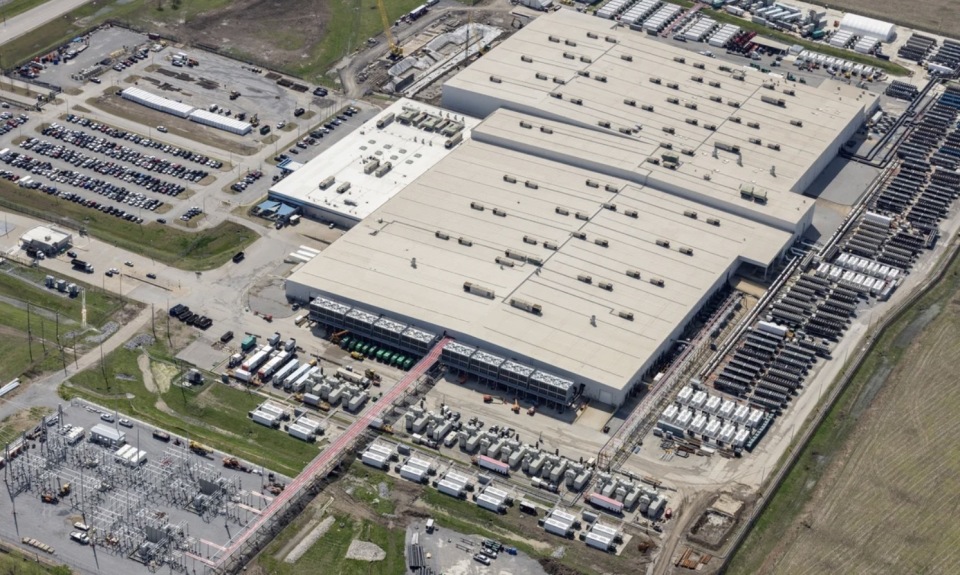
Exterior view of xAI's supercomputer cluster Colossus
As AI infrastructure, Colossus is unprecedented in scale, technology - intensive, and has huge energy demands.
During the construction phase, Memphis experienced a brief period of "prosperity": thousands of construction jobs were created, local government tax revenues increased, and the narrative of "tech investment landing" unfolded. However, after the concrete was poured and the servers were put online, this excitement was quickly replaced by more specific and long - lasting changes.
The first change: electricity prices began to rise.
According to data from the U.S. Energy Information Administration, in 2025, the average price of one kilowatt - hour of electricity for residents in Tennessee was 13.88 cents (about 0.96 RMB), a year - on - year increase of about 12%. In areas with a high density of data centers, wholesale electricity prices fluctuated several times.
Meanwhile, the cooling system continuously pumped groundwater. As a result, the tap water in some communities became cloudy and rusty, and water pressure decreased. The standby natural gas turbines ran day and night, and noise, heat pollution, and nitrogen oxide emissions also increased significantly.
These changes did not appear in the project's financial model, but they truly affected the lives of residents.
Looking beyond the racks, you'll find it is like a financial product - technology companies establish special purpose vehicles (SPVs), put data centers into them, and then external capital completes the financing. The data centers are then "sold back" to the parent company through long - term leases or computing power contracts for use.
This capital mainly comes from the private credit market, backed by pension funds, insurance companies, and annuity funds. They seek safe, long - term, and stable returns, and AI data centers happen to meet the conditions of "long - term contracts, predictable cash flows, and investment - grade ratings."
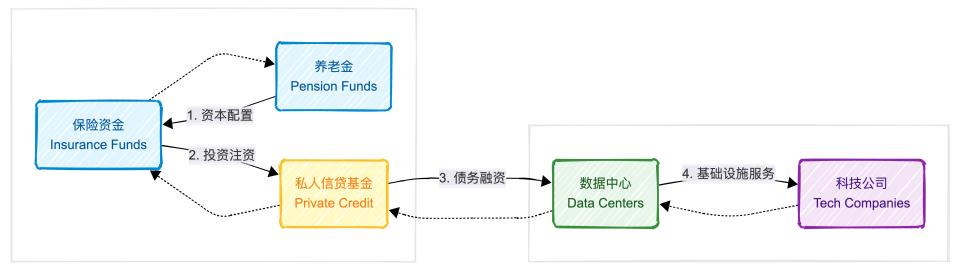
An invisible chain is thus formed: pension funds → insurance funds → private credit funds → data centers → technology companies. Risks are cut, packaged, and transferred on the books. Investors still seem safe, but it is actually ordinary people who originally hoped for the steady growth of their pension accounts that bear the pressure.
02 $120 billion Flows into Data Center SPVs
The "logic" of AI infrastructure construction in Silicon Valley is centered around off - balance - sheet financing and the private credit market.
Through SPVs, technology companies can obtain the required computing power and move huge expenditures off the balance sheet, which protects their credit ratings, beautifies financial indicators, allows them to access more capital than other industries, and transfers risks to off - balance - sheet entities.
As of now, Meta, xAI, Oracle, and the emerging cloud provider CoreWeave have raised more than $120 billion in data center funds through complex financing transactions.
A person in the industry said bluntly, "18 months ago, transactions of this scale were unimaginable. Now, it has become the norm."
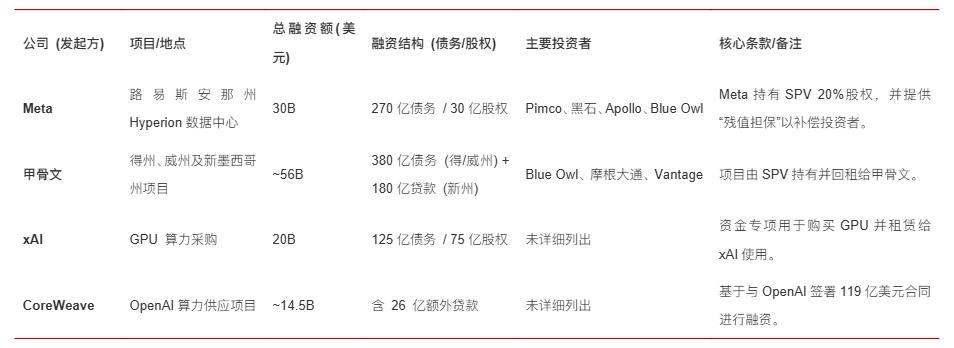
It should be noted that the mechanism of SPVs ensures that lenders can only recourse to the data center and its assets in case of default, not the parent company.
Financing has also given rise to more complex structures, such as asset - backed securities (ABS), which spread debt risks among a wide range of investors, including pension funds and asset management institutions. Although many investors believe that the balance sheets of large technology companies are strong, SPVs still increase outstanding debt, making the overall credit risk exceed traditional models.
Currently, traditional "hyper - scale cloud service providers" such as Google, Microsoft, and Amazon mainly use cash or public bonds for financing. Some companies are also starting to explore the SPV model to retain flexibility for future AI data center expansion.
Pension products that pursue stable returns have become the invisible capital supporting these supercomputer networks, and it is difficult for ordinary people to directly perceive the risks and connections.
As of the end of 2025, technology companies borrowed approximately $450 billion from private funds, a year - on - year increase of approximately $100 billion. Among them, approximately $125 billion flowed into long - term project financing transactions, such as Meta's Hyperion SPV with Blue Owl. Investment bank Morgan Stanley estimates that technology companies need approximately $15 trillion in external financing to achieve their current AI plans.
03 The Historical Echo of Off - Balance - Sheet Financing
Off - balance - sheet financing is not a new invention, and its purpose has never changed - not to make projects safer, but to make risks seem non - existent.
The Enron scandal in the 1990s provided an example of this risk structure. The energy business of this company did not completely collapse. The core operation was to "hide" the heaviest and most unstable assets off the balance sheet for a long time - by establishing special purpose entities, Enron successfully created an appearance of low debt and high credit, while the real risks were split, packaged, and transferred to various pools of funds. It was not until the risks broke out concentratedly that investors realized the huge gap between the company's book data and its actual operating conditions.
The dot - com bubble in 2000 demonstrated a similar logic.
The Nasdaq index soared from about 750 points in 1995 to about 5000 points in 2000, with its market value expanding nearly six times. Many Internet companies used stock option incentives, future revenue expectations, and various revenue - generating models to make the market believe that high - speed growth was sustainable. However, when the bubble burst, more than $5 trillion in market value evaporated.
The classic lesson left by the dot - com bubble is that capital flows to apparent growth, risks are packaged, and ultimately the losses are borne by the general public.
It can be said that the dot - com bubble and AI data center financing are almost parallel in mechanism. Both attract continuous capital inflows by packaging apparent growth, and it is always the general public, not the technology creators, who bear the real risks.
It should be noted that when technological expansion is based on "invisible debt" and "assumed long - term demand," the problem is not whether something will go wrong, but who will bear the consequences.
04 Small Towns Making Way for AI
AI data centers are rarely built in Silicon Valley and are more likely to be located in small towns with low electricity prices, abundant land, and a fiscal dependence on foreign investment. For technology companies, this is a rational choice, but for local communities, it is a long - term, complex, and unavoidable bill.
In Memphis, the power grid was upgraded in advance to ensure power supply. Large industrial users were given priority, resulting in an increase in residential electricity prices and more volatile wholesale electricity prices. The cooling system pumped groundwater, leading to a decline in water quality. The natural gas turbines ran day and night, increasing noise, heat pollution, and nitrogen oxide emissions, and the number of local asthma emergency cases rose accordingly.
Tax breaks and land supply have attracted project investment, but the community must bear the pressure on electricity, water resources, and the environment. From this perspective, AI is no longer an abstract concept but a force that redistributes resources and risks.
The end of the chain is not in the conference room or on the financial statements, but in towns like Memphis: rising electricity prices, water shortages, and increased environmental loads. Local residents, who are also pension holders and insurance policy - payers, are both the source of funds and the bearers of pressure.
There is no obvious single - point error in the chain, but when all the decisions are combined, pension funds with extremely low risk preferences end up in a pool of funds that may face significant fluctuations. When AI data centers are connected to these funds through off - balance - sheet structures, the changes are hardly noticeable immediately. There is no "computing power" on the bill, and no "data center" in the report. Everything seems normal.
Special correspondent Wuji also contributed to this article
This article is from "Tencent Technology." Author: Su Yang. Editor: Xu Qingyang. Republished by 36Kr with permission.