Chen Tianqiao returns to the battlefield
At the end of October 2025, in San Francisco, USA, the weather was at its most pleasant in autumn. Chen Tianqiao, the former richest man in China, an iconic figure of the Internet era, and the founder of Shanda Group, made a rare public appearance.
He stood in front of the podium, wearing a dark casual suit jacket on top and khaki trousers below. His hair was slightly gray but neatly combed, and his expression was composed and focused.
Below the stage, more than 20 top global scholars and industry leaders, including three Nobel laureates and the honorary president of Stanford University, gathered together. The theme they were discussing was: How can AI drive scientific discovery?
At the conference site, Chen Tianqiao, now emphasizing his role as the founder of the Tien Shan Brain Science Institute, announced that he would invest 1 billion US dollars in computing power to support innovative artificial intelligence research by global scientists.
This was the first time in many years since Chen Tianqiao faded out of the public eye that he clearly and directly stepped back into the spotlight. However, this appearance was different from his occasional previous glimpses.
Shortly after this speech, Chen Tianqiao not only published articles discussing organization and management in the AI era but also got personally involved in creating the AI-native company Tanka. On the first day of 2026, he even dropped a bombshell by co-founding the first domestic ultrasonic brain-computer interface company, "Gestalt."
The man who once stood at the peak of Chinese business has made a comeback.
01 Return
If one were to find a time point when "brain-computer interface" was truly pushed into the public eye, many would point to the beginning of 2024.
On January 29th of that year, Elon Musk confirmed on a social platform that Neuralink, the brain-computer interface company he founded, had completed its first human implantation experiment:
"Yesterday, the first human patient received an implantation surgery from Neuralink and is currently recovering well. Preliminary results show promising neuron spike detection."
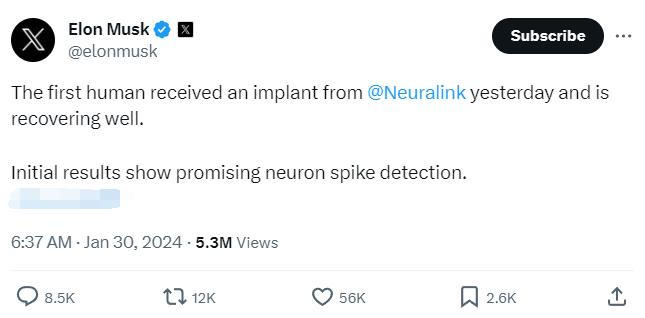
▲ Musk's post on social platform X
Musk also revealed that the company's first product is named "Telepathy." In the concept, the implanted person can control mobile phones, computers, and even other external devices just through their thoughts.
Thus, a brain-computer interface technology path was clearly presented to the public: invasive, hardware-oriented, by performing a craniotomy to directly implant electrodes into the cerebral cortex and establish a physical connection with the nervous system.
The advantages of this path are very obvious: high signal accuracy, immediate feedback, and it's easier to verify the effects in the short term. However, the costs cannot be ignored, including high risks, high thresholds, and long-term ethical, regulatory, and safety challenges that are hard to avoid. Due to the invasiveness of the craniotomy itself, this route has even been labeled "bloody" by the outside world.
As of September 2025, Neuralink had only completed human implantation experiments on 12 severely paralyzed patients and continued to face risks of postoperative infection and ethical disputes.
Musk's proposed "Full Brain-Computer Interface Plan" to be realized in 2028 - fully integrating the human brain with AI and achieving interconnection at the consciousness level - is also regarded by many as a radical and high-risk exploration.
And Chen Tianqiao chose an almost completely opposite route.
On January 1, 2026, "Gestalt," the first domestic ultrasonic brain-computer interface company jointly initiated by Peng Lei, the former co-founder and CEO of Brain Tiger Technology, and Chen Tianqiao, was officially established in Chengdu.
Different from the currently most concerned invasive brain-computer interface route, "Gestalt" chose a more restrained and challenging direction: non-invasive ultrasonic brain-computer interface.
There's no need for a craniotomy or electrode implantation. Instead, the brain is stimulated and regulated through external ultrasonic waves, aiming to achieve safer full-brain coverage.
But this is not a "conservative" technical route. On the contrary, it is more complex at both the engineering and scientific levels.
The invasive brain-computer interface solves the "point-to-point" signal problem; while the non-invasive, full-brain coverage route has to solve a highly complex system engineering problem, involving brain region positioning, signal attenuation, energy control, biological safety, and long-term modeling of the overall brain structure.
In other words, Musk chose a path of "proving feasibility first": by implanting electrodes through a craniotomy, he quickly crossed the threshold of clinical verification, but has been limited by invasiveness, ethical disputes, and large-scale implementation difficulties in the long term; while Chen Tianqiao chose a slower, more difficult, but more long-term medical and health application-oriented route.
While "Gestalt" was being established, Chen Tianqiao also dropped another bombshell by creating the AI-native company Tanka.
In a blog post titled "I Choose, I Bear, Therefore I Am" published on December 27, 2025, Chen Tianqiao disclosed that Tanka is supported by Shanda Group, and he defined it as a communication platform integrating the long-term memory function of artificial intelligence. In this article, Chen Tianqiao also made a startling judgment:
AI is responsible for execution, and humans are responsible for taking the blame.
Previously, Chen Tianqiao also published an article titled "The Dusk of Management and the Dawn of Intelligence: Rewriting the Biological Genes of Enterprises," discussing organization and management in the AI era. He emphasized in the article that future management will be based on intelligence, and it will be "the withdrawal of management and the rise of cognition." In the future, enterprises will no longer be led by humans with the help of intelligence, but by intelligence to expand humans.
In his latest article, Chen Tianqiao believes that in the AI era, computing has become cheap, and the only value of humans lies in "irrational" choices and "taking responsibility" for the results. The launch of Tanka is essentially his attempt to verify a new organizational paradigm: when all the underlying work of a company is completed by multi-agent AI (such as the OMNE framework he developed), how should human leaders define business value through "responsibility"?
He said bluntly that "the essence of AI is calculation, and the essence of humans is game theory." AI has no physical body and cannot take responsibility. Only when humans confirm rights and take responsibility can AI operations be transformed into business value.
Chen Tianqiao said, "I will make public our underlying logic, operation blueprint, and those crucial debates that determine life and death."
In short, his core logic can be summarized as: make everything public and take responsibility for failure.
02 Years in Retirement
Founding these two seemingly extremely hardcore companies, "Gestalt" and Tanka, was not a sudden idea of Chen Tianqiao. It was a natural result of his continuous in - depth exploration of brain science during more than a decade of retirement.
The starting point of all this can be traced back to the panic attack he had in 2004 during the peak of his career.
That year, 31 - year - old Chen Tianqiao was at the height of his life. Shanda Network successfully listed on the NASDAQ, and he became the youngest richest man in China, enjoying great popularity.
However, on a flight from Shanghai to Beijing, sudden and unexplained fear struck. He felt severe chest pain, difficulty breathing, and a strong sense of suffocation. He later recalled that at that moment, it was as if "death was sitting right beside him." He could only clearly feel the pain but couldn't stop it from happening.
After the plane landed, he was rushed to the hospital, but all the test results showed that his heart function was completely normal. Finally, the doctor diagnosed it as "panic attack disorder," caused by the long - term high - pressure business expansion rhythm and the subsequent huge public disputes.
This experience made Chen Tianqiao face the "out - of - control moment" of the brain for the first time. He began to repeatedly ask: What exactly happens inside the brain when fear strikes? Why does the body still be completely taken over by fear when one knows they are safe? And deeper questions emerged: Why are humans so afraid of death?
This sudden illness became the initial foreshadowing for his shift from the business world to exploring the "ultimate black box" of the human brain.
In 2009, after the setback of the Shanda Box project and the increasing public pressure, the panic disorder recurred and became significantly more severe, to the point that he couldn't even take a plane. This time, he no longer endured it. Instead, he gradually made up his mind to stay away from the hustle and bustle and systematically study the brain itself.
In 2012, Shanda completed its privatization and delisting, and Chen Tianqiao later moved to the United States. Different from the "hedonistic life after achieving financial freedom" imagined by the outside world, he embarked on a nearly stubborn "journey to find a cure." After extensive exposure to cutting - edge research, he realized a cruel fact: Human understanding of the universe far exceeds that of our own brains.
In 2016, Chen Tianqiao officially started his in - depth exploration of brain science. He announced a donation of 1 billion US dollars and co - founded the public - welfare Tien Shan Brain Science Institute (TCCI) with his wife, Luo Qianqian. TCCI is also one of the largest private brain science research institutions globally, clearly focusing on three core directions: "brain exploration, brain disease diagnosis and treatment, and brain enhancement."
In terms of path selection, he adopted a dual - wheel drive model of "basic research + clinical transformation." On the one hand, TCCI donated 115 million US dollars to the California Institute of Technology to establish a research institution; on the other hand, it carried out in - depth cooperation with Huashan Hospital Affiliated to Fudan University and the Shanghai Mental Health Center in China to build a transformation platform.
Over the past decade, the research results funded by TCCI have been continuously published in top - tier journals such as "Nature" and "Neuron," covering key fields such as serotonin mechanism, neural circuits, sleep, and memory.
If in the past decade, Chen Tianqiao completed a long and quiet "spiritual practice" in the laboratory, then his reappearance at the end of 2025 was due to his clear judgment of a technological qualitative change - AI is completely changing the speed and way of scientific research.
As mentioned at the beginning of this article, on October 27th and 28th, 2025, at the first TCCI AI - Driven Science Symposium held in San Francisco, Chen Tianqiao officially announced an additional investment of 1 billion US dollars in computing power to specifically support "AI - driven scientific research," with a focus on supporting structural experiments and the innovation of young scientists.
In Chen Tianqiao's view, relying solely on traditional scientific research funding can no longer keep up with the current pace of technological leap. In the past, the core of scientific research was "discovering laws," and now, AI is participating in "predicting laws."
It was also at this point that he was no longer satisfied with just being a scientific research funder. Instead, he decided to start a new business and transform the brain science achievements he had accumulated over more than a decade into an applicable and scalable product system.
This can be regarded as a business return, but it is also an upgrade of the problem - solving method of a brain science seeker.
03 Recreate a Legend?
When Chen Tianqiao re - entered the public eye with a dual - line layout of "brain science + AI," it's hard not to look back at the era of Internet pioneers.
In China, Internet pioneers of the first generation, such as Ding Lei, Zhang Chaoyang, and Zhou Hongyi, who rose almost at the same time as him, are still active in the center of the business stage but have taken significantly different transformation paths from him.
NetEase, under Ding Lei's leadership, has also highly focused on artificial intelligence in recent years.
NetEase released its self - developed large - scale model "Yuyan" in 2023. However, after a round of technological exploration, its overall strategy did not shift to the competition of general large - scale models. Instead, it returned to its core business of games, cloud services, and e - commerce, using AI mainly in specific scenarios such as content generation, intelligent customer service, game character, and gameplay design.
Zhang Chaoyang's Sohu has a relatively conservative layout in the AI field. "We haven't engaged in the development of large - scale models, and we haven't fully entered the AI infrastructure field yet," Zhang Chaoyang said frankly in an interview at the 2025 World Internet Conference last November. Sohu focuses more on integrating AI as an efficiency tool into its content ecosystem rather than blindly chasing the trend of large - scale models.
In contrast, 360 under Zhou Hongyi's leadership has a more positive attitude towards AI.
At the ISC.AI 2025 Conference held in August last year, Zhou Hongyi gave a speech and announced that 360 officially launched the "ALL IN Agent" strategy and released the "Agent Swarm" technology solution, attempting to reconstruct the enterprise - level digital security system with a security - oriented large - scale model as the core. Although this layout is still anchored in the main business of network security, in terms of technical structure, it has clearly moved closer to the AI - native system.
Overall, the paths of NetEase, Sohu, and 360 can be classified as a "main - business extension - type transformation": artificial intelligence is used to improve efficiency, reshape product forms, and strengthen existing moats, without completely jumping out of the original track and starting over.
Chen Tianqiao's difference lies in the fact that he chose a path that few people are willing to take.
His strategy is not "adding AI to the existing business," but "complete cross - border + long - termism."
After Shanda's delisting, he almost completely cut off his direct connection with the game business. He spent more than a decade continuously investing in the highly fundamental, cutting - edge, and long - return - cycle field of brain science, trying to build a complete chain from basic research, technology transformation to commercial implementation with his own hands.
This is not a patch - up and upgrade of the old system, but laying a new foundation at the intersection of artificial intelligence (AI) and human intelligence (HI).
Under such circumstances, his business return is doomed to be high - risk from the start: on the one hand, the clinical transformation of brain - computer interfaces often takes decades, accompanied by extremely strict medical ethics and regulatory reviews, and it's difficult to speed up any step; on the other hand, AI - native enterprises are still in a highly uncertain exploration stage.
Different from companies like OpenAI that are moving forward along the path of general artificial intelligence (AGI), Chen Tianqiao chose a route that starts from understanding the operating mechanism of the brain and shapes AI capabilities in reverse. This is a "hardcore path" with extremely high technical thresholds and almost no ready - made paradigms to refer to.
But on the other side of the risk, there are also equally rare opportunities.
The brain science research that "Gestalt" relies on provides an in - depth understanding of the underlying mechanisms of emotions, cognition, and consciousness. And the AI path represented by Tanka has the ability to quickly model, simulate, and scale up.
If the two can form an effective synergy, theoretically, it is expected to build a cross - ecological system of "brain science + AI," opening up new imagination space for understanding the human brain, intervening in emotional disorders, and even reshaping the way of human - machine interaction.
Therefore, Chen Tianqiao's return is by no means to relive the old dream of being the "richest man." It is a natural result of a long - termist concentrating and releasing the cognition, resources, and potential energy accumulated over more than a decade after seeing the future trend clearly.
Chen Tianqiao's role has also shifted from an investor pursuing capital returns to a practitioner exploring the next form of business organization at the intersection of carbon - based life and silicon - based intelligence.
Of course, this is also a heroic act of a hero standing in front of the AI wave, making a statement of his determination. As for whether he can recreate a legend, it's no longer a concern for him.
As he wrote in the blog post "I Choose, I Bear, Therefore I Am" published at the end of 2025:
"If I succeed, this will be a survival sample for the new era; if I fail, this will also be a valuable lesson for later generations. Regardless of the result, I choose to make it public. And I am willing to take all the responsibility for possible failure."
This article