A Comprehensive Look at CES 2026: Three Trends of AI Adoption Revealed by 21 AI Hardware Products
At the beginning of January this year, Las Vegas once again transformed into a huge "future showroom." CES 2026 brought together more than 4,000 exhibitors and once again became a window for the global technology industry to showcase its next steps.
Compared with previous years, an obvious change is that AI is no longer the protagonist in "capability demonstration" but is more systematically embedded in specific products.
Compared with model parameters or technical routes, people are clearly more obsessed with the "physical objects" that can immediately improve their living experience. AI has begun to be quietly stuffed into novelty toys, robots, wearable devices, and daily items, changing the interaction between people and devices in a way that hardly disturbs users.
If you take a comprehensive look at the entire exhibition, CES 2026 clearly presents at least three new trends in the evolution of AI hardware.
First, physical AI and embodied intelligence are starting to take center stage.
The core task of AI is no longer just "understanding and generating" but is clearly directed towards interacting with the physical world and solving problems in the real environment. Robots are gradually entering households, factories, and service scenarios from previous concept demonstrations, undertaking real and repeatable tasks.
For example, Boston Dynamics' Atlas robot announced that it will be stationed in Hyundai Motor's factory, and China's Vbot robotic dog can understand English instructions and carry out heavy-duty towing.
Second, the capabilities of edge-side AI are enhanced, and ecological collaboration has become the dividing line for the user experience.
The local computing power of personal terminals continues to increase, and the capabilities of devices such as AI PCs, mobile phones, and headphones in terms of privacy protection and instant response have been significantly improved. However, the more crucial change is that a single device no longer constitutes a moat, and the collaborative ability across devices and scenarios begins to determine the upper limit of the user experience.
AI is no longer just "installed in a single piece of hardware" but is distributed in a personal computing ecosystem that can be linked.
Third, super-personalized services are starting to be implemented concretely.
AI hardware is shifting from "recording preferences" to continuously understanding users' health, emotions, and living habits, and providing proactive intervention and precise services based on this. Whether it is around health management, emotional feedback, or daily life assistance, AI is no longer just passively responding to instructions but trying to intervene in advance and reduce decision-making costs.
For example, Lego's "smart bricks" can sense movements and interact in real-time, and L'Oréal's AI detection device can provide users with precise skin care solutions.
Based on these judgments, Silicon Base Jun selected 21 of the most representative AI hardware innovation cases from this year's CES, trying to restore the path through which AI hardware truly starts to "take root."
Consumer Fun: AI Sneaks into Every Corner of Daily Life
AI is becoming more complex and personalized than ever before. "Ultra-personalized AI" tailored for individual users has become the new norm. It has gone beyond being a simple provider of convenience and has begun to understand users' emotions and lifestyles and actively intervene based on these understandings.
A Physical AI Companion on Your Desk
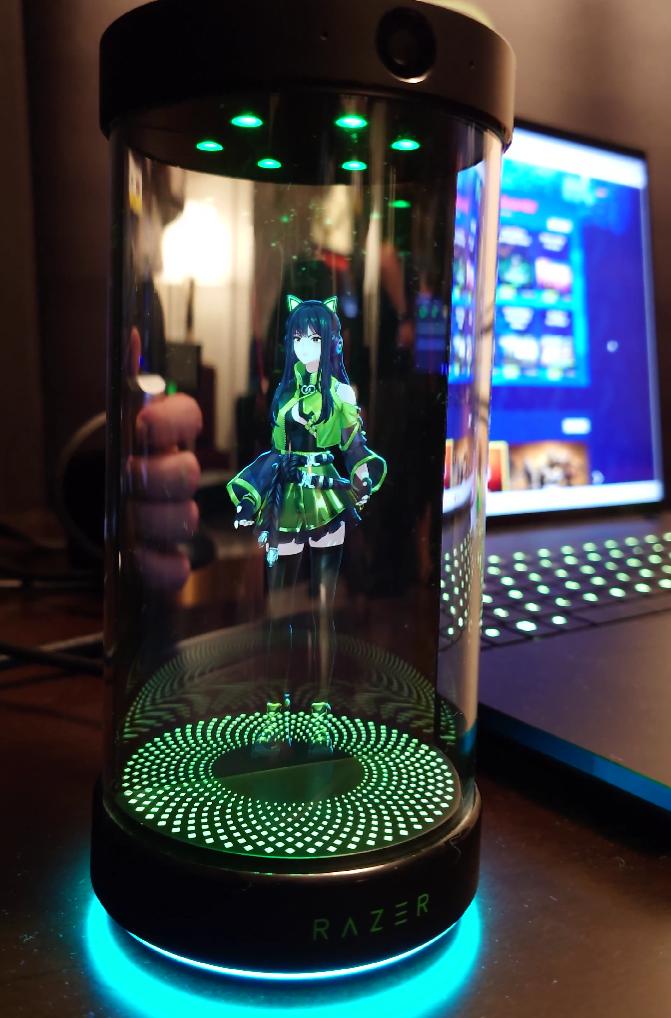
Razer's Project AVA has created a physical AI partner that can see you, understand you, and play games with you.
This "roommate" is housed in a 5.5-inch capsule-shaped holographic pod, equipped with a high-definition camera and sensors that can observe your screen and the surrounding environment. When you're stuck in a game, it can analyze the battle situation in real-time and point out the opponent's weaknesses; when you're hesitating about your outfit, it can even give you suggestions through the camera. Its core is driven by an AI engine similar to Grok.
You can choose your exclusive partner from multiple virtual avatars: whether it's the calm and reliable AVA, the anime-style Kira, the tough guy Zane, or even the image of e-sports legend Faker. These characters have delicate eye tracking and expressions, making every conversation feel like talking to a real person.
An AI Ultrasonic Chef's Knife That Keeps Sushi Intact
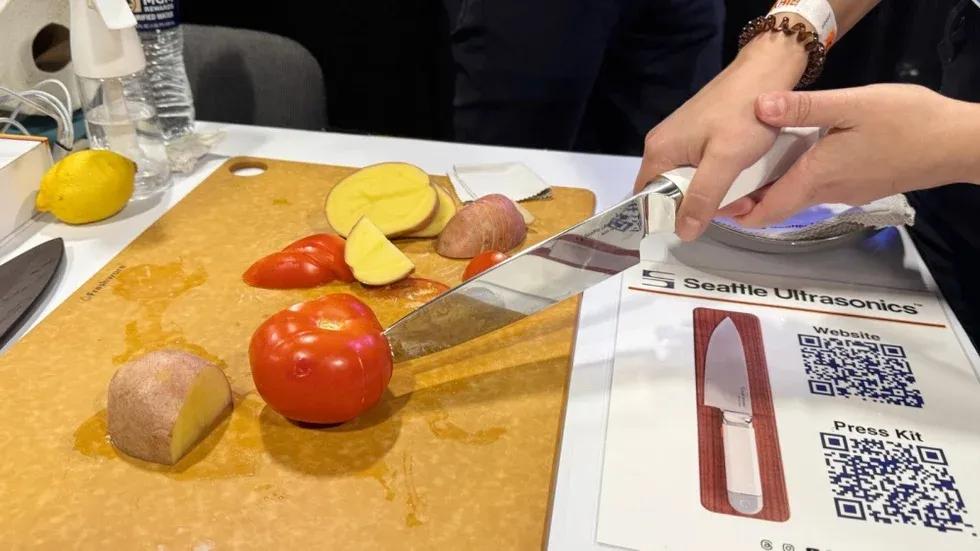
For $399, Seattle has packed a chef's knife skills into an ultrasonic "scalpel." It allows novices to experience a professional cutting process like a top chef - the toast doesn't crumble when sliced, the salmon slices don't collapse, and even frozen beef can be shaved into paper-thin slices directly.
The core of the C200 lies in its blade. With a 40kHz micro-vibration, invisible to the naked eye and imperceptible to the fingers, it reduces the friction between the blade and the food to almost zero. The device is integrated with intelligent sensors that can use AI to detect the hardness of the food and adjust the vibration frequency accordingly. The vibration stops when the user holds the knife incorrectly or moves away from the food, and it won't activate by accidental touch, thus preventing accidents.
A "Quiet and Reserved" AI Ice Maker
The smart home appliance brand GoveeLife has launched a smart noise-reducing ice maker priced at $499.99, and the product will be available on January 15. The device uses AI technology to detect the operating status of the machine and reduce the annoying noise emitted from the small ice maker.
The AI can detect when the machine is about to jam and make noise, so it will automatically defrost before the noise gets louder. The Smart Nugget Ice Maker Pro can produce fresh ice cubes in just six minutes, up to 60 pounds a day. The bucket can hold 3.5 pounds of ice at a time.
An AI Lollipop That Plays Cool Music in Your Head

Since musical toothbrushes already exist, why not have a lollipop that allows you to enjoy music through your taste buds? The "Lollipop Star" developed by Lollipop Star is one of the most peculiar and interesting products at CES 2026.
It uses bone conduction technology. When the user sucks or gently bites the lollipop, the sound is directly transmitted to the inner ear through the vibration of the teeth and jawbone. The device consists of a lollipop-shaped top and a handle with a button for activating the music. Interestingly, only the person eating the lollipop can hear the music in their head, while those around them can't hear a thing.
The "Lollipop Star" has collaborated with popular singers to launch three flavors of lollipops, corresponding to three artists - Ice Spice (peach), Akon (blueberry), and Armani White (lime). Each lollipop is priced at $8.99.
A "Thinking" AI Brick System

Lego's Smart Play is a "smart brick" system. Its biggest highlight is that it doesn't require an app or a screen. In the Star Wars set, when you place the Darth Vader character brick near the X-wing fighter, the device will automatically play the sound of the engine roaring or the lightsaber duel. This comes from the built-in sound synthesizer, not a monotonous recorded file.
The system consists of three main components: ① Smart Brick, a 2x4 brick that acts as the "brain"; ② Smart Tag, a 2x2 digital identification brick; ③ Smart Minifigures, intelligent characters.
It shrinks the AI chip to the size of a bump and embeds it in the Lego bricks to preserve the complete physical assembly experience, enabling it to sense movement, color, distance, and emit sound effects. The smart bricks are equipped with a custom ASIC processor, a micro-speaker, and various sensors such as an accelerometer, a light sensor, and a sound sensor. With these, the model can detect movement and tilt and interact directly with the player.
In addition, these bricks can "communicate with each other" via Bluetooth and near-field magnetic positioning, thus knowing their position and orientation in three-dimensional space.
An AI Office Ring for Recording and Shorthand
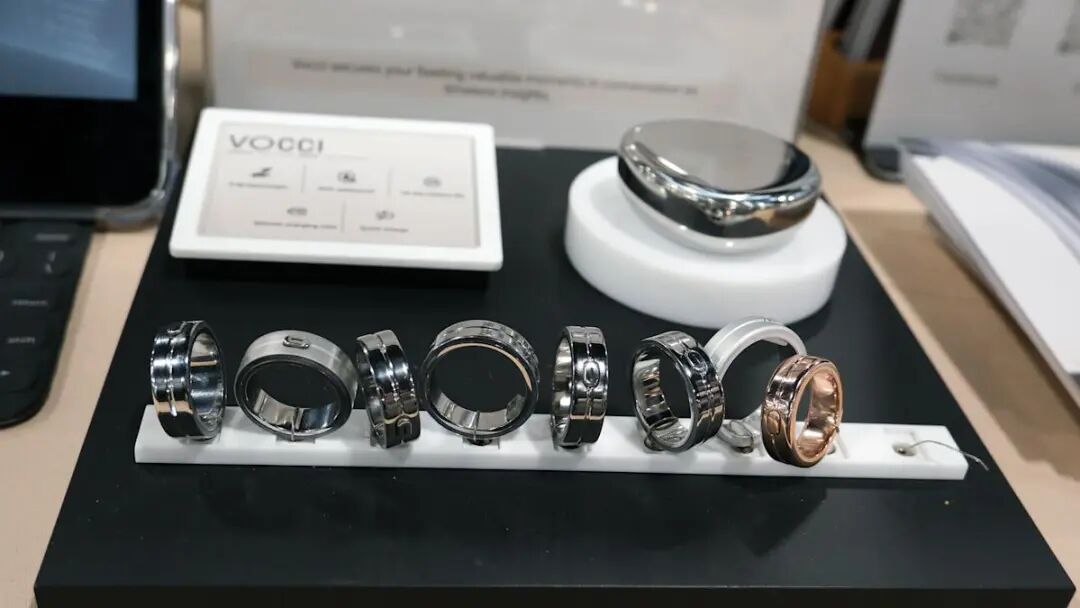
For office workers, content creators, and anyone "too lazy to replay recordings," the Vocci AI titanium alloy ring is like having a shorthand team condensed into your fingertips. Users just need to press the only physical button, and the Vocci AI ring will start recording continuously for 8 hours, locking in sudden inspirations, long meetings, or interviews in local storage.
Its accompanying app's offline AI model then takes over, converting speech to text, separating speakers, highlighting key sentences, and automatically generating to-do lists. A two-hour brainstorming session can generate a searchable summary in just 10 seconds. With a 0.9mm ultra-thin casing, IPX5 water resistance for daily use, and two color options of 18K gold and black titanium, it's priced at $299 and is now available for pre-order on the Vocci official website. The first batch is expected to be shipped in July.
An AI Travel Butler That Incorporates "Accessibility" into City Navigation
The AI travel system developed by South Korea's LBStech for wheelchair users and the elderly has just won the Best Innovation Award in the "Travel and Tourism" category at CES 2026 with its "MaaS - Bridge" solution. It aims to completely eliminate those wheelchair-unfriendly and dead-end navigation suggestions.
The core of this system is an AI that can "read the situation." It takes the real needs of wheelchair users, such as the flatness of boarding and alighting points, the slope of transfer routes, the width and condition of sidewalks along the way, and even the location of accessible entrances to buildings, as core variables and writes them into the algorithm to dynamically plan the truly feasible optimal route.
Its WheelAR app can also use augmented reality (AR) technology to overlay intuitive arrows and prompts on the mobile phone screen, making complex routes as easy to understand as following footprints on the ground.
An AI Memory Ring That Can Be Summoned with a Press
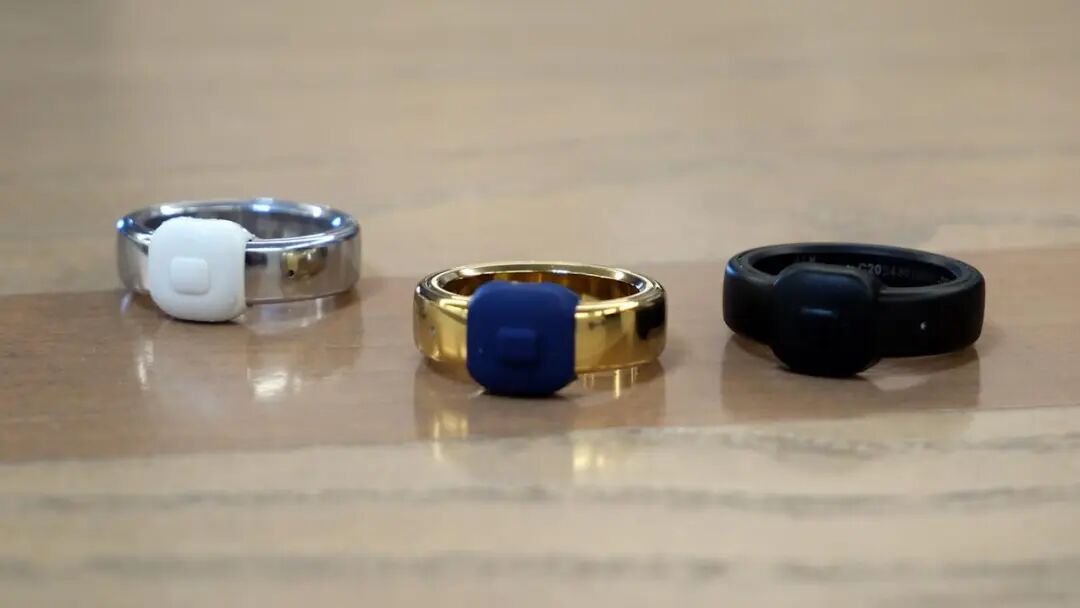
Pebble's Index 01 is a smart ring that allows you to talk to AI at any time. When you have a sudden inspiration, just hold down the button to make it remember, and release it to get an answer. The original intention of this ring is to reduce the burden of use. You don't need to take out your phone or say a wake-up word. Just touch it with your thumb, and it will listen quietly and respond intelligently.
The prototype tried on at CES was still a bit rough, and it was a bit loose when worn on the index finger. But when you press the small rubber button, the feeling is unexpectedly solid.
The founder, Michal Migurski, demonstrated on-site: He covered his mouth with his hand, pressed the button, and asked me "What's your favorite book recently?" Then he released it, and the mobile app immediately returned the conversation record and the reply: "Do you want me to note down the book you're currently reading?"
It's built with the Claude model and has a battery life of up to three years. Running out of power? Don't look for a charger. It will remind you a month in advance so you can directly replace it with a new one.
An AI Robotic Arm-Equipped Mobile Phone for Vlogging
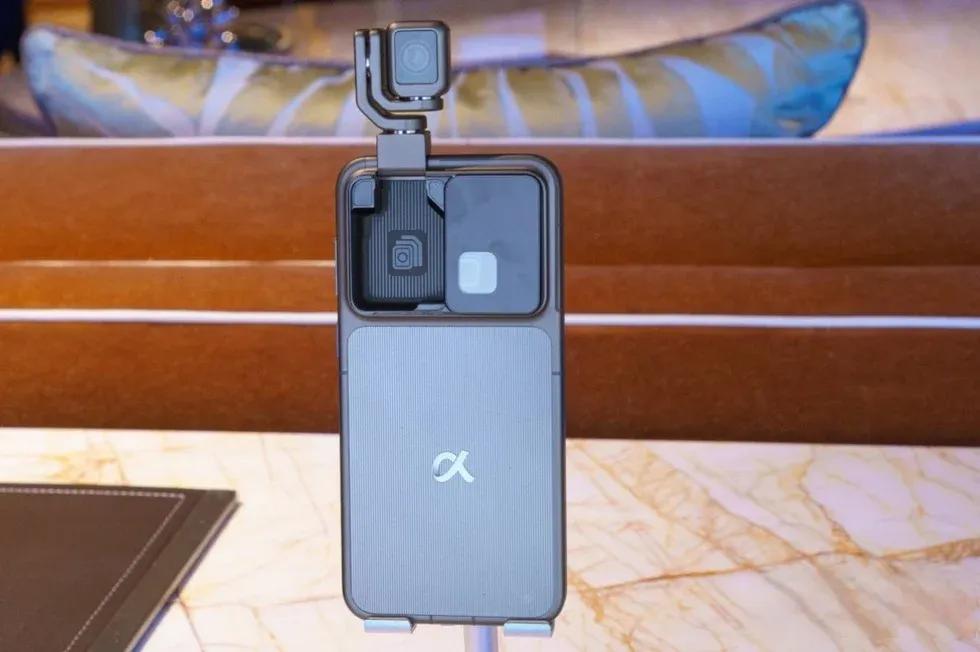
Vloggers no longer need an external stabilizer. Honor's robotic mobile phone directly equips the main camera with a 360° micro-mechanical universal arm, with only an extra 2.1mm in thickness. With a three-stage gearbox and a shape memory alloy drive, it can complete a 90° flip in 0.2 seconds. After the AI vision locks on the person, it will automatically follow and shoot, ensuring you're always in the center even when walking around the room.
When placed on the table and switched to the "anchor mode," the camera will nod, tilt its head, and respond to voice commands. It can do a 180° rotation and instantly switch to 4K selfies. It's like integrating DJI's Pocket into a mobile phone and pairing it with an AI photographer that can be cute. Currently, the engineering prototype supports 5-axis anti-shake and a control accuracy of ±0.1°. The mass-produced version is expected to be launched in Q4.
A Personal Computer Disguised as a Keyboard

Judging from its appearance, few people would guess that this is a complete AI personal computer. HP's EliteBoard G1a is a bit "mini" and a bit humorous.
It has the shape and weight of a keyboard, weighing 0.77kg and being 19mm thick. From the side, it looks like a 75% layout wireless keyboard. But when you open it, you'll find a complete motherboard with a Ryzen AI 300 series processor and a 50 TOPS NPU, meeting Microsoft's Copilot+PC standard.
You can take a keyboard peripheral out with you. When you get to the office, just plug it into a USB-C monitor, and it can output in 4K. AI summarization, real-time translation, and Recall all run locally, and even the power supply can be handled with a single cable. For those who like to disassemble devices, you don't even need a screwdriver. Just lift the magnetic bottom cover, and the memory, SSD, Wi-Fi, battery, and fan can all be hot