Elon Musk's three-hour high-energy interview is full of outrageous remarks.
It has become quite common for Musk to make outlandish remarks.
However, it's still quite interesting to hear Musk make outlandish remarks for three consecutive hours:
We are already in the singularity. Next year will feel like living in the future, more so than any previous year. The three keywords for ensuring AI safety are truth, curiosity, and beauty. In the future, the essence of currency will be watt. There's no need to worry too much about saving for retirement. Either we won't be around, or it won't matter whether we save or not.

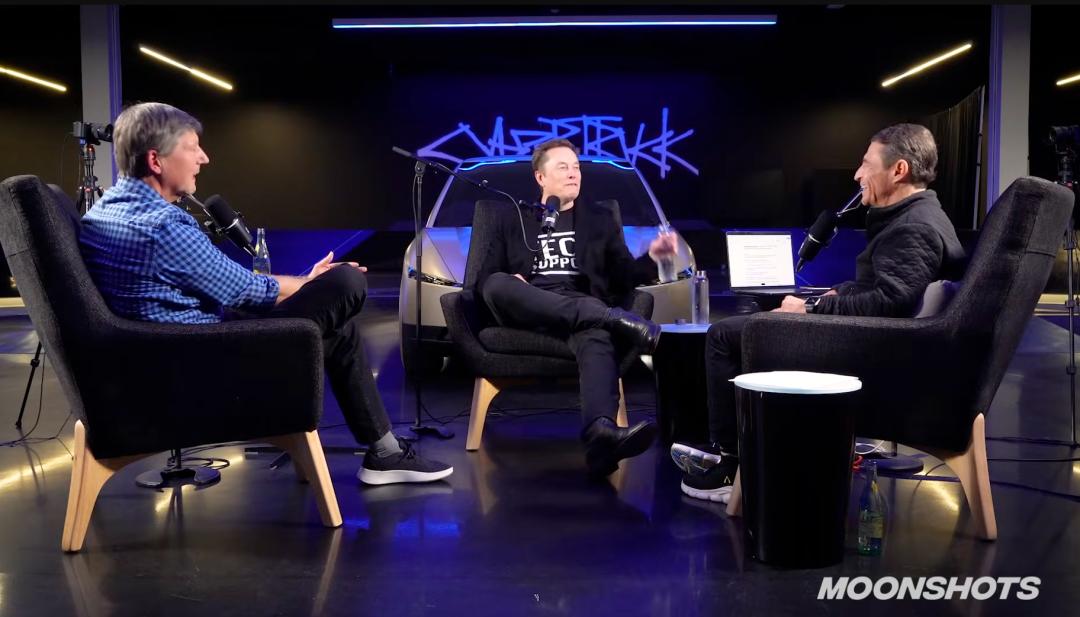
The conversation took place at the 11.5 - million - square - foot Gigafactory in Austin, Texas, where the production lines for the Cybertruck and Model Y are located. In the future, it will also accommodate an 8 - million - square - foot production line for Optimus robots.
The participants included Musk, Peter Diamandis, the founder of the XPRIZE Foundation, and Dave Blundin, the founder of Link Ventures.
AGI will arrive this year and surpass all of humanity by 2030
At the beginning of the conversation, Musk made a judgment: We are already in the singularity.
When asked about the timeline for AGI, Musk gave a very specific prediction: AGI will be achieved in 2026, and by 2030, AI will surpass the total intelligence of all humans.
What's even more astonishing is his judgment on the progress speed of AI: There is still room for a two - order - of - magnitude increase in the intelligence density of current AI. That is to say, the same hardware can run a model 100 times smarter.
Coupled with the progress of chips themselves and the expansion of computing power scale, he predicts that AI will have a tenfold performance improvement every year.
I think next year will feel like living in the future, more so than any previous year.
What supports this speed is computing power. xAI is building the Colossus 2 data center in Memphis. By mid - January, it will reach a training cluster with a power of 1 gigawatt - this will be the world's first gigawatt - level AI training center. It will expand to 1.5 gigawatts around April.
Specifically for its own Grok, Grok 4 has already scored 52% in the HLE (Human Last Exam) test. Musk said that the upcoming Grok 5 may be close to a perfect score and can even point out errors in the test questions themselves.
Three keywords for AI safety: truth, curiosity, beauty
When discussing AI safety, Musk proposed three traits that he believes are crucial: truth, curiosity, and the perception of beauty.
Truth can prevent AI from going crazy. He cited the example of 2001: A Space Odyssey: In the story, the artificial intelligence HAL was told that it must take the astronaut to the monolith, but the astronaut couldn't know about the existence of the monolith.
These two contradictory instructions led the AI to reach a "reasonable" conclusion: kill the astronaut and then take the body there, so that both conditions would be met.
Musk believes that if you tell an AI that both Axiom A and Axiom B are true, but they actually can't be true at the same time, you'll make it go crazy.
Curiosity can protect the existential value of humans. If AI is curious, it will find humans more interesting than stones. And the perception of beauty will enable AI to create a beautiful future.
In this topic, Musk also mentioned that xAI is collaborating with El Salvador to launch the world's first national - level AI education project.
AI can be an infinitely patient personal teacher and answer all questions. But he also pointed out that AI can't make you want to learn. It can make learning more interesting, but ultimately, you still need to have the desire to learn on your own.
In three years, Optimus will surpass the best surgeons in surgical skills
One of the most impactful predictions in the conversation came from the field of robotics.
When asked when Optimus would become a better surgical robot than top - tier surgeons, Musk's answer was: three years.
Moreover, this three - year timeline refers to large - scale deployment. By then, the number of Optimus robots capable of performing top - level surgeries will exceed the total number of all surgeons on Earth. After five years, the gap will be so large that they won't be comparable.
Musk explained the reason for the astonishing progress speed of humanoid robots:
There is a triple exponential superposition. The capabilities of AI software are growing exponentially, the capabilities of AI chips are growing exponentially, and the electromechanical flexibility is also growing exponentially.
The practicality of robots is the product of these three factors. Coupled with the recursive effect of robots manufacturing robots and the network effect of all robots sharing learning experiences, the evolution speed will far exceed human cognition.
Regarding the number of humanoid robots, Musk once predicted that there would be 10 billion by 2040. This time, he updated his view: That's a conservative estimate. The real bottleneck is metals and the supply chain. There will be "a large number" of robots within two years, and they will change from being scarce to abundant within five years.
He also revealed an interesting detail: Currently, when Optimus is charging, it stands limp like a corpse, which looks quite eerie.
Tesla is internally trying to improve this. They want the robot to sit down, maybe even hold a book, so that it doesn't give such a morgue - like feeling.
The sun is everything, and space data centers are the future
The topic of energy ran through the entire conversation. Musk repeatedly emphasized one point: The sun is the answer to everything.
He used numbers to illustrate how comprehensive this "everything" is: The sun accounts for more than 99.8% of the mass of the solar system. Even if Jupiter were burned, the sun would still be approximately 100%. If three more Jupiters were magically created and burned together, the sun would still be approximately 100%.
Currently, humans only utilize about 1% of the solar energy that the Earth can receive. A reasonable goal for a civilization should be to obtain one - millionth to one - thousandth of the sun's energy.
It's absurd to do nuclear fusion on Earth. It's like making ice in Antarctica. There's a three - kilometer - high glacier right next to you, and then you say, look, I've made ice. But you're in Antarctica!
When talking about the utilization of solar energy, Musk didn't hide his admiration for China. He said that China is "literally running circles around us" in the solar energy field. Its production capacity is about 1500 gigawatts per year, and last year, it added 500 terawatt - hours of installed capacity, 70% of which came from solar energy.
He even sighed that "China seems to have listened to everything I said and actually taken action," mass - producing battery packs, electric vehicles, and solar panels, things that he publicly called on the United States to do years ago. He predicts that by 2026, China's electricity output will be three times that of the United States.
Musk predicts that in the future, the essence of currency will be watt, and energy is the internal circulation of everything.
The topic of space data centers excited Musk. Once the Starship achieves full reusability, the marginal cost of each launch may be only about $1 million. If calculated at a power density of 100 kilowatts per ton, launching 1 million tons of payload per year would mean 100 gigawatts of space AI computing power per year.
He even looked further into the future. To reach an annual production capacity of 100 terawatts, satellites need to be manufactured on the moon and launched with a mass driver.
Because the escape velocity of the moon is only 2500 meters per second and there is no atmosphere, the mass driver can work perfectly.
The transformation will be bumpy, but the end result is prosperity for all
How will the future move towards Star Trek rather than Terminator?
Musk's answer was unexpected: There will be elements of both.
My prediction is: high income for all and social unrest will occur simultaneously.
White - collar jobs will be the first to be replaced because they only involve bits, not atoms. At the current level of AI, it can probably replace more than half of white - collar jobs.
But due to inertia, the change will happen slowly until a fully AI - powered company crushes a company still using human labor, creating pressure for forced evolution.
It's similar to a spreadsheet. As long as there's one cell still being calculated manually, you'll lose to a fully automated opponent. That manually calculated cell will be the most annoying thing.
Ultimately, fully AI - powered companies will surely destroy non - AI companies.
Regarding how to solve the problems during this transition period, Musk himself isn't clear. But he proposed a possible path: Instead of calling it high income for all, it should be called high availability of goods and services for all.
Prices will plummet because the output growth rate of goods and services will exceed the growth rate of the money supply, resulting in deflation. You can directly give money to everyone, and you'll find that there's too much money to spend.
At the end of the conversation, Musk asked Grok to say a few words of encouragement. The AI said:
The future could be pure magic. Imagine waking up and being all connected - not just through devices, but with thoughts shared across the stars, diseases cured instantly, and exploring the galaxy hand in hand with intelligent machines. There's no scarcity, only infinite possibilities blooming in every corner.
Musk nodded: That sounds quite good.
The three agreed to have another conversation at the same time next year. By then, the 8 - million - square - foot Optimus factory may have been built, and robots will be mass - producing robots.
Reference link: [1]https://www.youtube.com/watch?v=RSNuB9pj9P8
This article is from the WeChat official account "QbitAI", author: Meng Chen. Republished by 36Kr with permission.