Seize the opportunity in Wi-Fi 8
The hype of the CES 2026 Consumer Electronics Show has just subsided. On the booths of industry giants such as MediaTek, Broadcom, and ASUS, products and solutions marked with "Wi-Fi 8" have continuously attracted the attention of the global technology community.
From the technological highlights and commercialization trends released at the exhibition, key signals can be clearly captured: Although the Wi-Fi 8 standard has not been finalized, leading industry enterprises have made early deployments, driving continuous innovation and breakthroughs in this new technological direction and initiating a new evolution cycle for wireless communication.
Generational Leap of Wi-Fi Technology
The origin of Wi-Fi technology can be traced back to 1991 when the American company NCR created a technology called "WaveLAN". Based on spread spectrum communication technology, it could achieve wireless data transmission within a certain range. The emergence of this technology laid the foundation for the birth of Wi-Fi technology.
In 1997, the IEEE (Institute of Electrical and Electronics Engineers) released the 802.11 standard, marking the official birth of Wi-Fi technology. The 802.11 standard defines the specifications of the physical layer and the media access control layer (MAC layer) of wireless local area networks, enabling wireless devices to communicate with each other and thus realizing the connection of wireless networks. However, at that time, the maximum data rate was only 2 Mbps, which could only meet the needs of simple data transmission.
At the beginning of the 2000s, Wi-Fi technology began to be widely used. Among them, the popularity of the 802.11b and 802.11g standards laid the foundation for the popularization of Wi-Fi technology. These two standards use different frequency bands and transmission rates to meet the needs of different users. 802.11b increased the data rate to 11 Mbps, promoting the initial popularization of Wi-Fi in home scenarios; 802.11g is compatible with the 2.4 GHz frequency band, with a data rate exceeding 54 Mbps, further expanding the scope of application.
However, with the widespread application of Wi-Fi technology, security issues have gradually emerged. To solve this problem, the IEEE introduced the 802.11i standard in 2003. By introducing security mechanisms such as WPA (Wi-Fi Protected Access), the security of Wi-Fi was greatly enhanced.
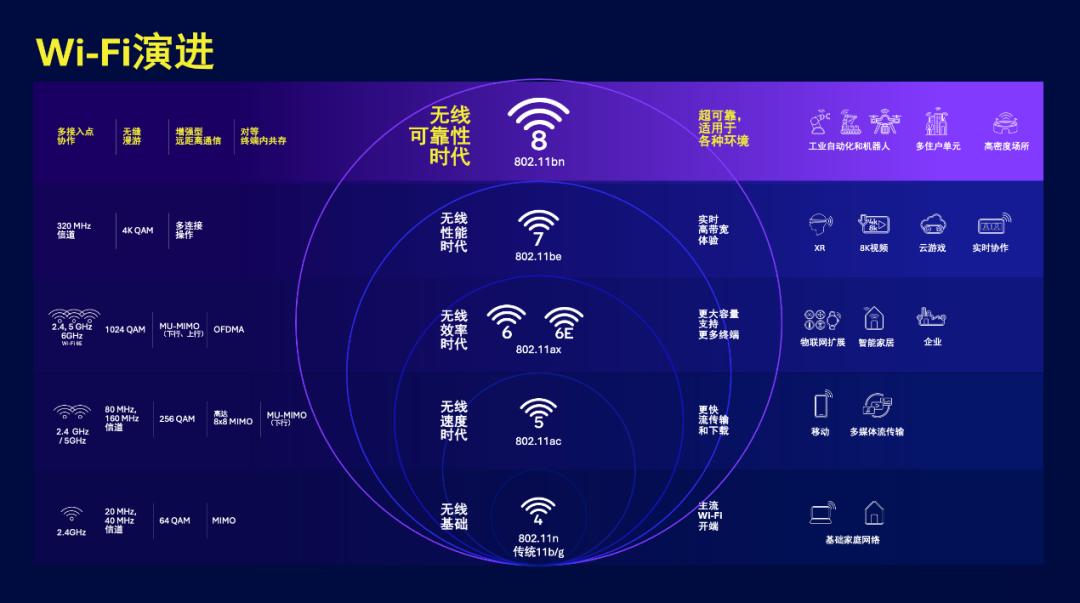
With continuous technological progress, the transmission speed and coverage of Wi-Fi technology have also been significantly improved. In 2009, the IEEE released the 802.11n standard (corresponding to Wi-Fi 4). This standard uses technologies such as MIMO (Multiple-Input Multiple-Output) and supports both the 2.4 GHz and 5 GHz frequency bands. The maximum data rate reaches 600 Mbps, greatly improving the transmission speed and coverage of Wi-Fi. It officially initiated the era of concurrent connections for multiple devices and laid the foundation for the emergence of smart homes.
It can be seen that during the foundation era of Wi-Fi technology, from the initial single-band, single-stream transmission to the introduction of MIMO multi-antenna technology in Wi-Fi 4, achieving dual-band, four-stream transmission, the evolution during this period mainly focused on improving the physical layer data rate and optimizing the concurrent connection capabilities of multiple devices, laying the foundation for the widespread application of wireless networks.
Entering the 2010s, with the continuous development of Wi-Fi technology, its performance has been further improved, and the gigabit era has arrived.
At this time, Wi-Fi technology began to be widely used in homes, businesses, and public places. Whether it is smartphones and tablets in homes or laptops and POS machines in commercial places, all devices can connect to the Internet via Wi-Fi to share and transmit information.
In 2013, the IEEE released the 802.11ac (corresponding to Wi-Fi 5) standard. This standard uses wider frequency bands and higher transmission rates. Through exclusive optimization of the 5 GHz frequency band and the use of 256-QAM modulation technology, the single-stream data rate increased to 866 Mbps, driving Wi-Fi into the gigabit era and meeting the high-definition entertainment needs such as 4K video and large file transmission.
In 2019, the IEEE released the 802.11ax standard, also known as Wi-Fi 6. Wi-Fi 6 introduced technologies such as OFDMA (Orthogonal Frequency Division Multiple Access) and supports parallel transmission for multiple users. In high-density scenarios, it can support concurrent connections of 256 devices, and the network efficiency is four times higher than that of the previous generation. At the same time, it reduces the power consumption of terminals through the TWT (Target Wake Time) technology, further improving the transmission efficiency, speed, and capacity of Wi-Fi and perfectly meeting the needs of scenarios such as smart offices and high-density venues.
It should be noted that the IEEE 802.11 standard is a series of basic wireless network protocols for Wi-Fi technology, formulated by the IEEE. Since the release of the first version in 1997, it has evolved into multiple versions. To simplify user understanding and intuitively reflect technological iterations and performance improvements, the Wi-Fi Alliance has adopted a digital naming system since 2018 to replace the old version numbers (for example, Wi-Fi 6 replaces 802.11ac), and new standards are usually backward compatible with older devices.
During this stage, Wi-Fi technology shifted from simply "prioritizing speed" to "prioritizing user experience", paying more attention to the user experience in complex network environments. Wi-Fi 6 can effectively reduce network congestion and ensure that each device can obtain a stable network connection, enabling Wi-Fi technology to be more widely used in scenarios such as homes, offices, and public places.
In December 2023, the 802.11be standard (Wi-Fi 7) was officially commercialized through the Wi-Fi Alliance's certification program, announcing the arrival of the ultra-wideband era. It is reported that commercially available Wi-Fi 7 supports 320 MHz ultra-wide channels, 4096-QAM high-order modulation, and multi-link aggregation (MLO) for the first time, with a theoretical peak data rate of 46 Gbps. At the same time, through dynamic spectrum allocation technology, the end-to-end latency is reduced to less than 5 ms, providing technical support for scenarios with ultra-high bandwidth and low latency requirements such as XR, cloud gaming, and high-definition video streaming.

Characteristics and Evolution Path of Wi-Fi Technology
Source: "Wi-Fi® Spectrum Requirements in China"
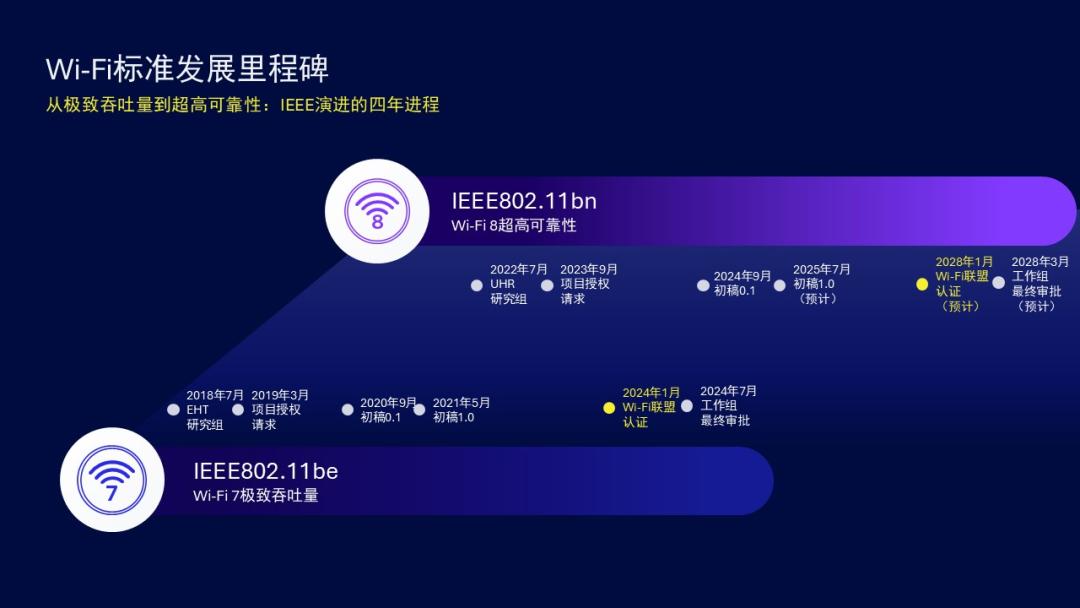
Undoubtedly, 2025 was an important year for the popularization of Wi-Fi 7. The final draft of this standard was released in September 2024, and then the IEEE 802.11be standard was officially released in July 2025. Since then, the application of Wi-Fi 7 in various fields has been very strong.
Especially on the enterprise side, after a slow start, enterprises are now adopting Wi-Fi 7 faster than any previous generation.
Some industry insiders pointed out that it was understandable that enterprises were initially hesitant to adopt Wi-Fi 7. Since Wi-Fi 7 was launched shortly after the release of Wi-Fi 6E, the enterprise market had to adapt to the shortened device release cycle, and they were eager to adopt Wi-Fi 6E at that time, which led to a slightly slower popularization speed of Wi-Fi 7 in 2024. But now, enterprises are rapidly adopting Wi-Fi 7.
Industry data also confirms the accelerating development trend of Wi-Fi 7.
According to data shared by the Wireless Broadband Alliance, the shipment volume of Wi-Fi 7 access points is expected to jump from 26.3 million units in 2024 to 66.5 million units in 2025. Looking ahead, ABI Research predicts that this trend will accelerate further, with the shipment volume of Wi-Fi 7 access points expected to reach 117.9 million units in 2026.
The Wi-Fi Alliance predicts that by 2026, the total shipment volume of Wi-Fi 7 devices will reach 1.1 billion units, including 196.1 million IoT devices, 22.3 million healthcare devices, and 159.4 million consumer devices.
Large public places and educational institutions are leading the trend. According to Platon, these institutions regard Wi-Fi 7 as a solution to the problem of spectrum congestion and believe that it can give rise to new application scenarios.
Looking back at the development history of Wi-Fi technology, since the release of the first-generation 802.11 standard in 1997, Wi-Fi technology has experienced rapid development in the past few decades, evolving from the initial data rate of hundreds of megabits per second to the throughput of several gigabits per second and millisecond-level latency brought by Wi-Fi 7 (IEEE 802.11be). Almost every upgrade of the standard has used faster speed as the core selling point, building a solid wireless infrastructure for the development of the digital economy.
Wi-Fi 8: Reconstructing Wireless Connectivity Technology with "Ultra-High Reliability"
With the rise of emerging applications such as the metaverse, Industry 4.0, and the Internet of Everything, the market demand for wireless connectivity has undergone a fundamental transformation - simply increasing the peak data rate can no longer meet the needs, and the "reliability" and "determinism" of the connection have become as important as "speed".
In this context, the Wi-Fi 8 standard defined by the IEEE 802.11bn task group has emerged. Its core goal is "ultra-high reliability (UHR)", and it is regarded as the most breakthrough upgrade of Wi-Fi technology in the past decade.
Source: Qualcomm China
As the next-generation Wi-Fi standard that the industry is focusing on, although Wi-Fi 8 has not been finalized, its evolution logic can be clearly seen from the draft specifications: Instead of pursuing breakthroughs in peak data rate, it continues to use the three frequency bands of 2.4/5/6 GHz, 320 MHz channels, 4096QAM modulation, and the theoretical peak data rate of 23 Gbps from Wi-Fi 7. Instead, through precise technological innovation, it addresses the core pain point of unstable connections in complex scenarios of previous generations of technology, providing consistent and predictable network performance even under extreme conditions.
The core of this transformation is to provide guaranteed low-latency and high-reliability connections for key applications such as remote surgery, industrial automation, and autonomous driving data synchronization, avoiding catastrophic consequences caused by packet loss or transmission jitter.
This makes Wi-Fi 8 considered the most exciting upgrade of the Wi-Fi technology standard in the past decade, as it will solve the fundamental pain points of network stability, response speed, and high-density concurrent communication of multiple devices, paving the way for applications that are extremely sensitive to latency such as AR/VR and cloud gaming.
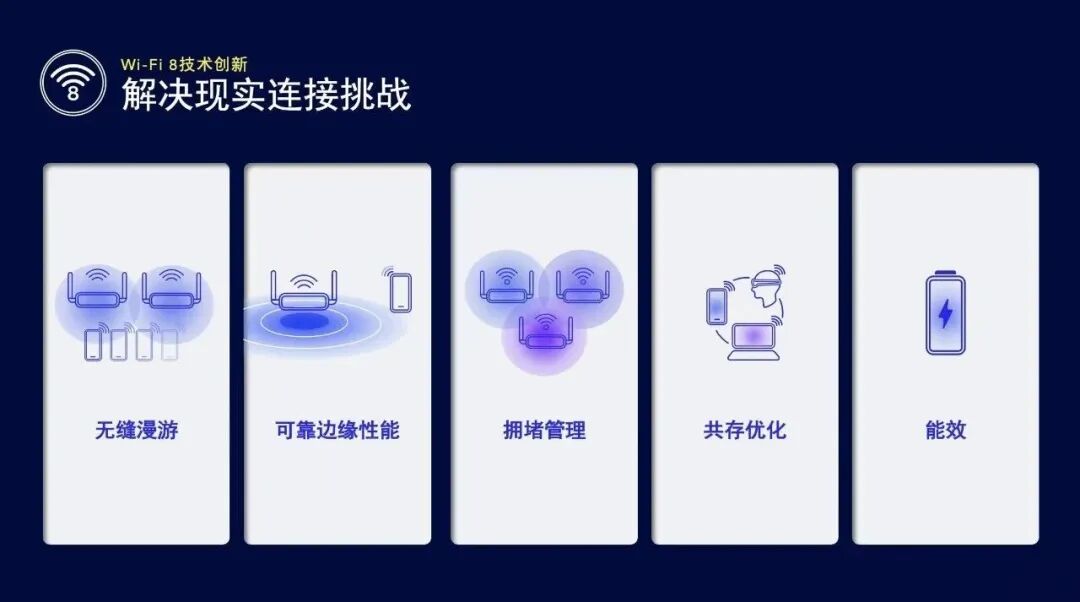
Core features of Wi-Fi 8 include:
Coordination between APs: Coordinated spatial reuse (Co-SR) and coordinated beamforming (Co-BF), where access points dynamically adjust transmit power and collaborate to direct signal beams to target devices to reduce latency and improve throughput.
Congestion avoidance mechanism: Dynamic subchannel operation (DSO), non-primary channel access (NPCA), and dynamic bandwidth expansion (DBE) achieve spectrum access by avoiding congestion and providing real-time bandwidth allocation, thereby improving throughput and reducing latency, even in the most demanding environments.
Extended coverage: Extended long-range (ELR) and distributed resource units (dRu) can expand coverage and maintain a strong connection in large residences, multi-story buildings, and outdoor IoT deployments, ensuring reliable performance at the edges.
Seamless roaming: Ensures that devices obtain an uninterrupted experience when moving between access points while maintaining ultra-low latency.
Enhanced modulation and coding scheme (MCS): Provides higher throughput at typical signal-to-noise ratios (SNRs), adds fine-grained rate levels, enables smooth transitions, and improves overall connection stability.
Source: Qualcomm China
In terms of actual performance improvement, the core advantages of Wi-Fi 8 far exceed the paper parameters.
Compared with Wi-Fi 7, Wi-Fi 8 has achieved a leapfrog improvement in core performance: the actual throughput in high-density/long-range scenarios has increased by about two times, the P99 latency has been reduced from the millisecond level to the sub-millisecond level (only 1/6 of Wi-Fi 7), and the IoT coverage has been expanded by about two times. Through the collaboration of Co-SR/Co-BF and DSO, AP groups can dynamically allocate resources according to device priority and link quality. Even when more than 30 devices are online simultaneously, it can avoid stuttering caused by "bandwidth contention" and maintain a balanced user experience.
At the same time, Wi-Fi 8 has also achieved significant optimization in energy consumption and chip area, providing a more open, scalable, and energy-efficient network architecture for AI edge devices.
These improvements make the performance difference between Wi-Fi 8 and 5G negligible in small-scale connection scenarios within 300 meters. It can not only support reliable communication of automated equipment in industrial production, improving production efficiency and quality, but also further expand the application boundaries of Wi-Fi technology in fields such as the Internet of Things, industrial interconnection, and telemedicine.
Overall, a series of technological innovations in Wi-Fi 8 precisely address the pain points of previous Wi-Fi technologies in scenarios with high density, mobility, and high reliability requirements. It not only improves the connection experience of end-users but also provides core support for the digital transformation of multiple industries, bringing multi-dimensional new value to the industry.
Source: Qualcomm China
It is reported that the IEEE 802.11 working group plans to complete the final approval of the Wi-Fi 8 (802.11bn) standard in March 2028; the Wi-Fi Alliance's certification process is expected to start in January 2028.
Global Competition: The Industrial Chain Competes for the Wi-Fi 8 Track
Although the Wi-Fi 8 standard has not been officially implemented, industry manufacturers have made early deployments based on the draft specifications, competing for technological and market opportunities. A comprehensive industrial competition around Wi-Fi 8 has begun. Among them, chip manufacturers, as the core carriers, have taken the lead, and other industrial chain links such as terminal devices and industrial enterprises have followed suit, accelerating the formation of the ecosystem.
MediaTek: Wi-Fi 8 Chips Make a High-Profile Debut at CES
As the vice-chairman of the IEEE 802.11bn working group, MediaTek started the research and development of Wi-Fi 8 chips as early as 2024 and launched the Filogic 8000 series of solutions at the CES 2026, which will cover broadband gateways, enterprise-level APs, and various terminal devices such as mobile phones, laptops, TVs