From connected devices to intelligent agent terminals, Alibaba Cloud ushers in the first year of inclusive AI hardware.
The Nevada Desert in Las Vegas is currently being swept by a technological hurricane named CES 2026. In this top - tier global technology showcase, Chinese enterprises, accounting for a quarter of the total exhibitors, are sending out a signal more important than the technology itself:
AI hardware has officially crossed the gap between gimmicks and toys and evolved into "edge - side intelligent agents" with independent thinking abilities.
But if you think the source of this wave of innovation lies only across the ocean, you're wrong.
On January 8th, some people shifted their attention from Las Vegas to Shenzhen. At the "Alibaba Cloud Tongyi Intelligent Hardware Exhibition" hosted by Alibaba Cloud, there were over 220 participating enterprises and more than 1,500 exhibits. Intriguingly, over 200 of these exhibits were the same "global premieres" as those on the CES stage at this moment.
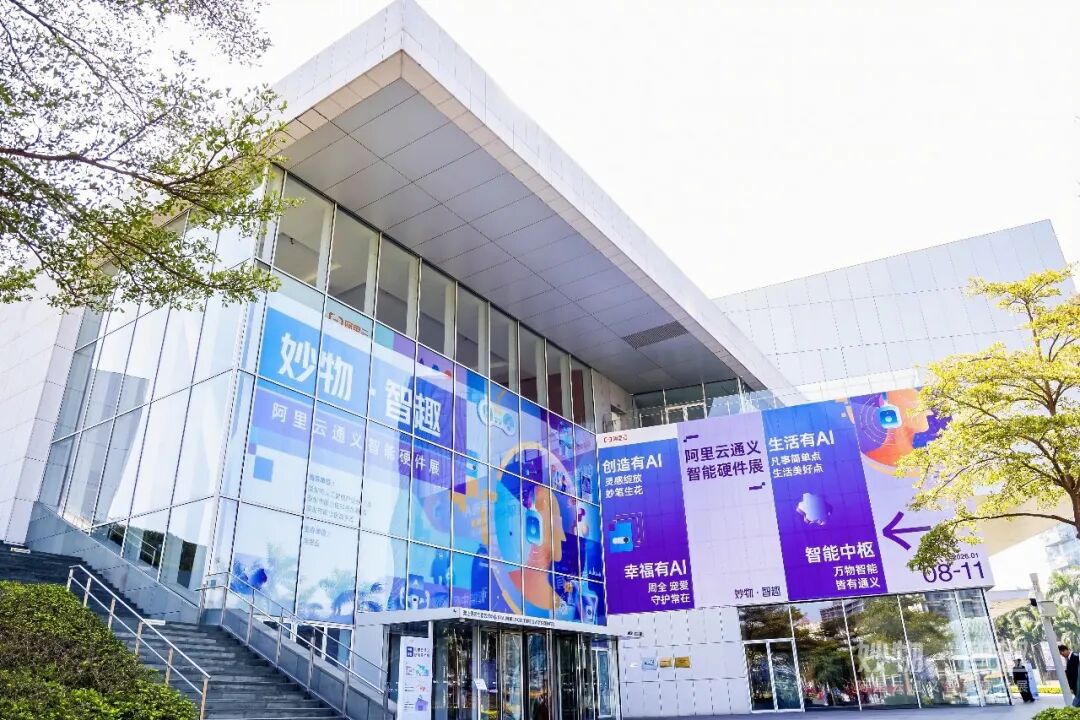
This large - scale presence further reflects that China's hardware industry has transcended the simple "OEM factory" stage and started to export continuous innovative solutions globally. The underlying logic of intelligent hardware is being reconstructed. Previously, those controlled devices relying on network connections are evolving into edge - side intelligent agents with independent thinking abilities. AI has shed its marginal and dispensable status in press - conference PPTs. It has taken root inside hardware and become the driving engine for the core capabilities and user experience of devices. CES is responsible for demonstrating trends, while the event in Shenzhen is responsible for implementing these trends on a large scale.
Behind this collective transformation, Alibaba Cloud plays a role that is both "restrained" and "ambitious". Empowered by the Tongyi large - scale model, hardware has bid farewell to its cold image of mechanically executing instructions. It has begun to understand the subtext of users and, as an intelligent partner, has penetrated into the details of daily life and the intricate industrial production lines, unleashing unprecedented vitality in human - machine collaboration.
However, in this process, what deters many hardware manufacturers is how they can obtain the most cutting - edge intellectual resources to transform technology into productivity across various industries. Alibaba Cloud's answer is to return to inclusiveness.
In Alibaba Cloud's view, the ultimate goal of technology is inclusiveness. In this collective transformation from "Made in China" to "Created in China", Alibaba Cloud has chosen the most open and friendly stance: as the foundation and soil of the industry, Alibaba Cloud does not pursue the independent construction of terminal hardware. Instead, with its globally leading model capabilities and the concept of integrating software and hardware, it provides solid technological and ecological support for the product innovation of numerous hardware enterprises. This role ensures that AI hardware will not become expensive collectibles for a few geeks but will become an inclusive force that promotes the natural coexistence of technology and scenarios and is within easy reach.
01 The Great Explosion of Species: The Result of the Joint Catalysis of Technology and Business
If 2025 is regarded as the "eve of the great navigation" for AI hardware, 2026 marks the official entry of the industry into an era of a great explosion of species. This prosperous scene is no longer a result of accidental flashes of inspiration. Instead, it is an inevitable outcome jointly constructed by the continuous release of underlying technological dividends and the migration of business logic to a new paradigm.
Previously, the intelligent hardware industry was always stuck in the quagmire of "pseudo - intelligence". Under the shells of those devices at that time, there was only a mechanical keyword searcher. Due to the lack of in - depth understanding ability of large - scale models, interactions often stopped at single, rigid instructions. Once users engaged in multi - round conversations or expressed themselves slightly vaguely, the devices would "crash collectively" because they couldn't understand the profound meaning of human language. This lack of intelligence not only made hardware a useless thing but also infinitely magnified problems such as privacy security and network latency in the poor user experience.
This deadlock was completely broken in 2026. AI hardware is undergoing an essential leap from "functional intelligence" to "system - level intelligence". The core lies in that hardware has finally grown a "brain" capable of understanding the complex world. This leap first benefits from the full implementation of infrastructure, achieving full - link connectivity from the underlying atomic instructions to the high - level multi - modal senses.
However, there is a cruel survival law in the hardware industry: products always strive to be as light and thin as possible and have as long a standby time as possible. Every additional gram of weight may ruin the hand - feel, and every redundant milliampere of power consumption means a collapse in battery life. There is a natural tension between this pursuit of extreme physical indicators and the huge computing power load and power consumption requirements of large - scale models. How to maintain the lightness and battery life without weakening the intelligence of large - scale models has become a life - and - death question for all hardware manufacturers.
The trade - off between "wanting both" has become an extreme game that hardware manufacturers face every moment. At the same time, the previously isolated cloud computing or edge - side self - research has become inadequate, and edge - cloud collaboration has become the default standard for industry evolution. Alibaba Cloud's solution is highly targeted: through the full - scale coverage of the Tongyi large - scale model from 0.5B to 480B, it provides customized "intelligence solutions" for hardware of different sizes, whether it's a smart ring with extremely low power consumption or a smart cockpit with abundant computing power. For wearable devices that are extremely sensitive to power consumption and require millisecond - level response, small - scale models can independently capture intentions on the edge side; for complex logic decomposition, it is handed over to the cloud - based ultra - large - scale model for processing.
The construction of this "intelligence ladder" enables hardware to achieve a delicate balance between performance and power consumption. Alibaba Cloud found in its research that AI hardware is in the L3 stage (edge - cloud collaboration) of evolving from "smart devices" to "intelligent agent terminals" and pointed out that the edge side is responsible for low - latency, privacy, and intention capture, while the cloud side is responsible for complex reasoning. This "cloud + edge" architecture is the only solution to the power - consumption contradiction.
Deeper - level evolution occurs at the underlying engineering level. The Tongyi Laboratory collaborates with the Xuantie architecture of DAMO Academy to conduct system - level optimization from the chip instruction set to the model inference path, enabling the Tongyi series of large - scale models to run efficiently on edge - side devices and becoming the fundamental driving force for the upgrade of intelligent hardware capabilities. Currently, the number of intelligent terminals equipped with Xuantie processors and running the capabilities of the Tongyi large - scale model has reached the level of hundreds of millions.
In terms of chip adaptation, this solution is already compatible with more than 30 mainstream terminal chip platforms based on the RISC - V and MIPS architectures, covering the needs of most hardware devices. In the future, the Tongyi large - scale model will continue to promote full - link collaborative optimization with the Xuantie RISC - V architecture to further improve deployment and inference efficiency.
As multi - modal models, edge - side computing power, and system integration capabilities gradually mature, the interaction logic is changing. For a long time, humans have been forced to adapt to the logic of machines, memorizing boring voice commands or referring to thick instruction manuals. A new - generation system represented by multi - modal models such as Qwen - VL enables hardware to recognize key elements in the environment and incorporate them into interaction decisions; more natural voice capabilities lower the threshold for users to express their intentions. When terminals gradually assume the role of a "unified entrance", in specific scenarios, users only need to give relatively abstract requirements, and the underlying AI Agent can complete task decomposition and process collaboration. The system starts to adjust more according to human usage habits instead of requiring users to adapt to complex operation logics. This may be the most human - oriented aspect of the evolution of intelligent hardware in 2026.
From a third - party perspective, this ability is not an accidental accumulation. According to the Generative AI Technology Innovation Guide Report released by an international research institution, Alibaba Cloud has been rated as an "emerging leader" in four key dimensions: cloud infrastructure, engineering system, model capabilities, and knowledge management applications. In the Asia - Pacific region, Alibaba Cloud is the only provider that has been recognized in all four of these capabilities, and its technological layout has entered the same evaluation framework as global leading AI enterprises.
All technological revelries must ultimately be concluded by business logic. Alibaba Cloud observed in its research that the market for AI consumer hardware is no longer an "enlightenment - type market" but a mature group that is extremely picky about experience, stability, and practical value.
At this stage, simple concept marketing and function stacking are quickly losing their magic. Early users might have paid for the simple AI label, but the current market rules have undergone a profound shift: users are more concerned about whether AI can operate stably in real - life scenarios and whether it can truly save time and reduce decision - making costs. This demand has set a new survival line for AI consumer hardware: it must not only be usable but also frequently used, easy to use, and trustworthy.
The reason why this explosion of species in 2026 can stand firm is that, subjectively, users have finally developed the mindset of paying for intelligence. According to in - depth research by the Alibaba Cloud Research Institute, the underlying value coordinates of the hardware market are undergoing two significant drifts.
First is the reshaping of value standards. Hard - core functional parameters are giving way to warm emotional connections. Data shows that the current core demands are highly concentrated on personalized "understanding me better" and automated "liberating hands". When hardware can accurately provide emotional value or truly achieve seamless service, users' resistance to AI will quickly disappear, and they will develop a dependence on intelligent experiences instead.
Following this is the substantial breakthrough in the payment model. The research reveals several details full of commercial potential: the average annual consumption of the mainstream population has been firmly anchored in the range of 3,000 - 5,000 yuan, leaving considerable commercial room for the continuous performance upgrade of AI hardware and the ecological subscription model; among them, the willingness to pay for health - related AI functions has climbed to twice that of other functions, reflecting users' high tolerance for essential intelligent hardware. What is even more exciting for the industry is that users are starting to accept paying a monthly subscription fee of 10 - 30 yuan for "perceivable value".
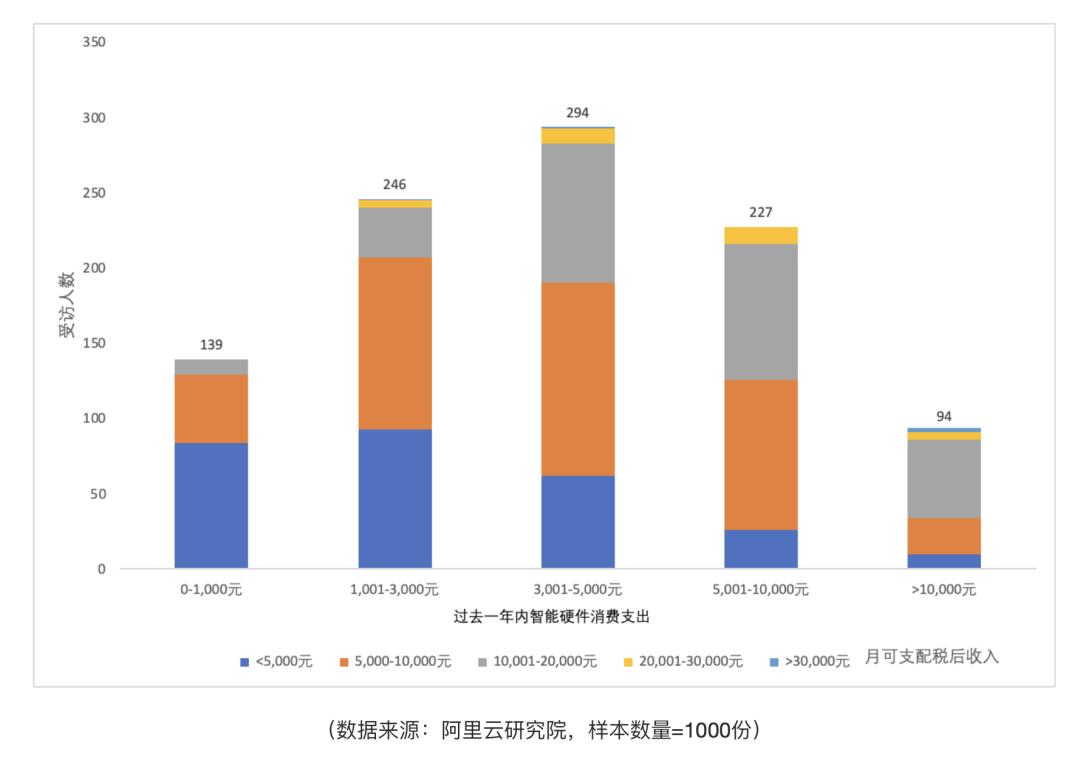
The transformation from one - time purchase to continuous service not only provides long - term commercial support for AI hardware but also proves that when AI can solve specific and minor troubles in real life, hardware enterprises can truly cross the "value gap".
Alibaba Cloud found in in - depth research that under the technological dividends of edge - cloud collaboration, the evolution of AI consumer hardware is not a dull linear stacking but a spiral - upward species evolution.
This evolution follows a trinity path of "automation, decision - support, and collaboration" and continues to climb upwards: from initially replacing humans to complete repetitive labor as an "extension of limbs", to advancing to providing rational advice as a "brain assistant", and finally evolving into an "edge - side intelligent agent" that can be deeply coupled with humans and enhance each other cyclically. These three modes do not exist in isolation. Instead, through the mutual superposition of algorithms and scenarios, they jointly complete the paradigm shift of hardware from an "inanimate object" to a "digital life".
02 The Encounter of the AI Soul and Made in China
In the race of species evolution in 2026, Alibaba Cloud plays a role that is both restrained and ambitious.
It chooses to stay out of the spotlight and serves as a silent innovation foundation, supporting the innovation experiments of 150,000 hardware manufacturers through the Tongyi multi - modal large - scale model. It publicly promises not to engage in terminal hardware production. This clear - boundary stance precisely dispels the collective suspicion of terminal manufacturers regarding the situation of "being both the referee and the player". After trust is established, manufacturers can put down their defenses and deeply connect the core product definition rights with large - scale model capabilities. When the energy originally used for preventing competition is transformed into the driving force for joint innovation, Made in China truly obtains the ticket to make a full - speed turn from simple physical material stacking to system - level intelligence competition.
When this open ability based on trust meets the ultimate supply - chain efficiency, the AI soul will reshape every piece of Chinese hardware entering the global market.
Along different hardware tracks, replicable "showrooms" are gradually taking shape. From the emergence of new species, to the system - level upgrade of leading mobile phone manufacturers, to the large - scale implementation of intelligent cockpits and exported hardware, a clear technology diffusion path is emerging. The collision between the AI soul and Made in China is generating specific innovation sparks in different scenarios.
In the most exploratory direction, the change is first reflected in the birth of a group of "new AI species".
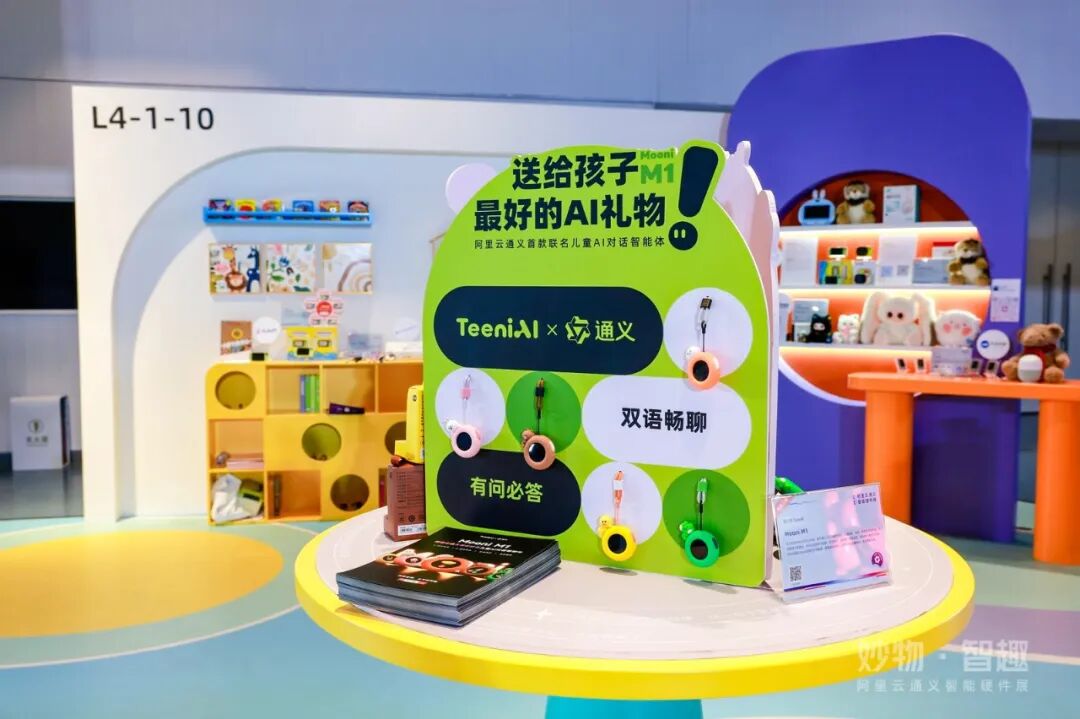
At the Alibaba Cloud Tongyi Intelligent Hardware Exhibition, many new products from Chinese manufacturers made their global debuts for the first time. Tinglixiong is a representative case. Tongyi collaborated with Tinglixiong to create the first domestic children's "AI Pin" for teenagers - Mooni M1. This portable AI dialogue intelligent agent is built on the Tongyi Qianwen large - scale model. Its core value lies not in "innovation in hardware form" but in the change of the interaction relationship: the device starts to have conversations around children's language, interests, and usage habits. Official data shows that after introducing the large - scale model capabilities, the average AI usage time of users has increased by 40 minutes.
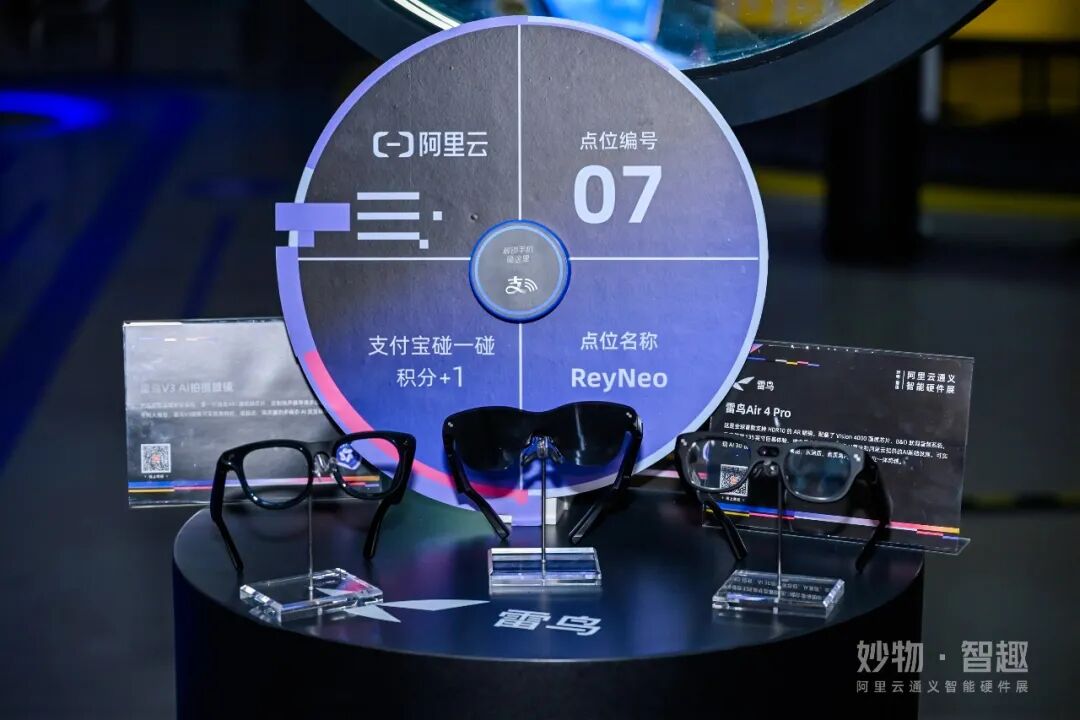
Similar changes are also taking place in wearable and creative hardware. Alibaba Cloud and Leion Innovation jointly launched an AI large - scale model for smart glasses, achieving significant improvements in key capabilities such as intention recognition. The shipment volume of Leion glasses equipped with relevant capabilities ranks among the top in the AR industry.
The TemPolor Melo - D smart guitar launched by Quwan Technology deeply integrates AI creation, performance assistance, and hardware form through the "Tianpu Music" music large - scale model, redefining the interaction mode between humans and music.
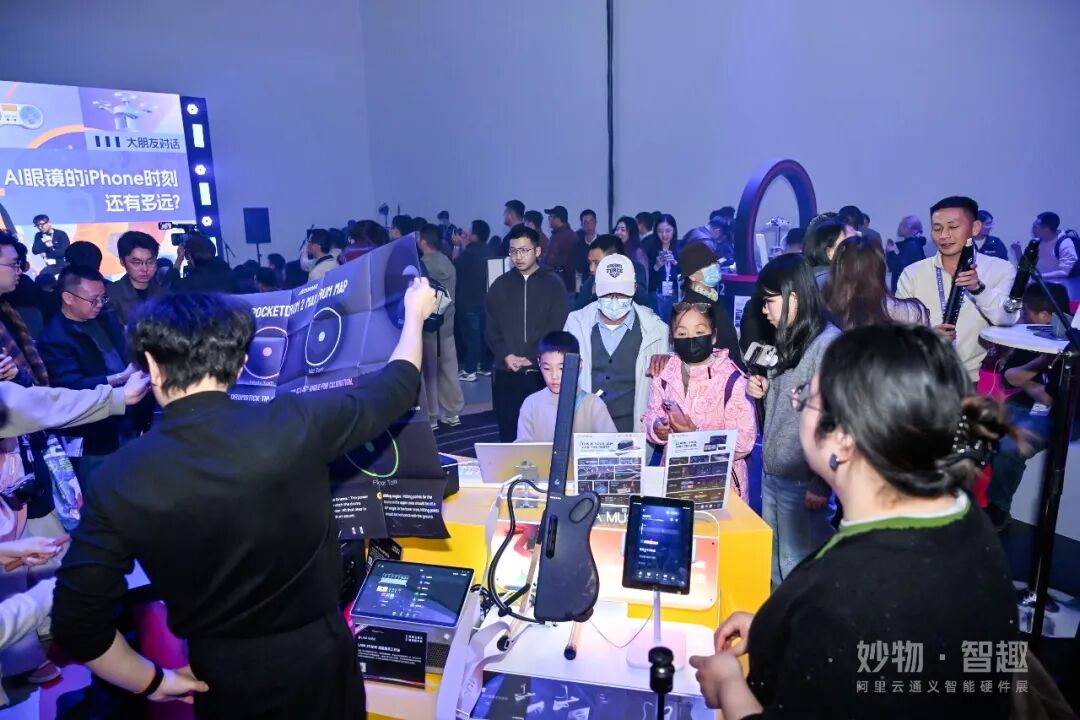
The common feature of these products is that AI is no longer an additional function but directly determines "what the hardware can do and how it is used".
Compared with the exploration of new species, the changes in the mobile phone track are more certain. In the process of serving the world's top 10 mobile phone manufacturers, Alibaba Cloud is not only a provider of computing power but also a partner deeply involved in interaction reconstruction.
Taking OPPO as an example, after introducing the multi - modal capabilities of the Tongyi Qianwen series into functions such as "Xiaobu Assistant" and "One - Key Screen Inquiry", its ability to understand screen content and respond to questions has been significantly enhanced, enabling the mobile phone to provide more coherent intelligent feedback around the current interface content. This kind of ability is not a revolutionary innovation, but it is gradually making "asking while looking at the screen and getting answers immediately" a part of daily interaction.
Honor's path emphasizes system - level integration. By collaborating with Alibaba Cloud's Bailian platform, Honor has implemented an end - to - end solution for visual question - answering (VQA) capabilities and further linked this ability with intelligent agents of vertical services such as travel and maps. In some foldable screen products, this system