Triggering a market boom in both the Hong Kong and A-share markets, why is the market "scrambling" for MiniMax?
On January 9th, MiniMax officially listed on the Hong Kong Stock Exchange. Trading data shows that after its opening, MiniMax's gains continued to rise, and it finally closed up 109%, with its market value exceeding HK$100 billion.
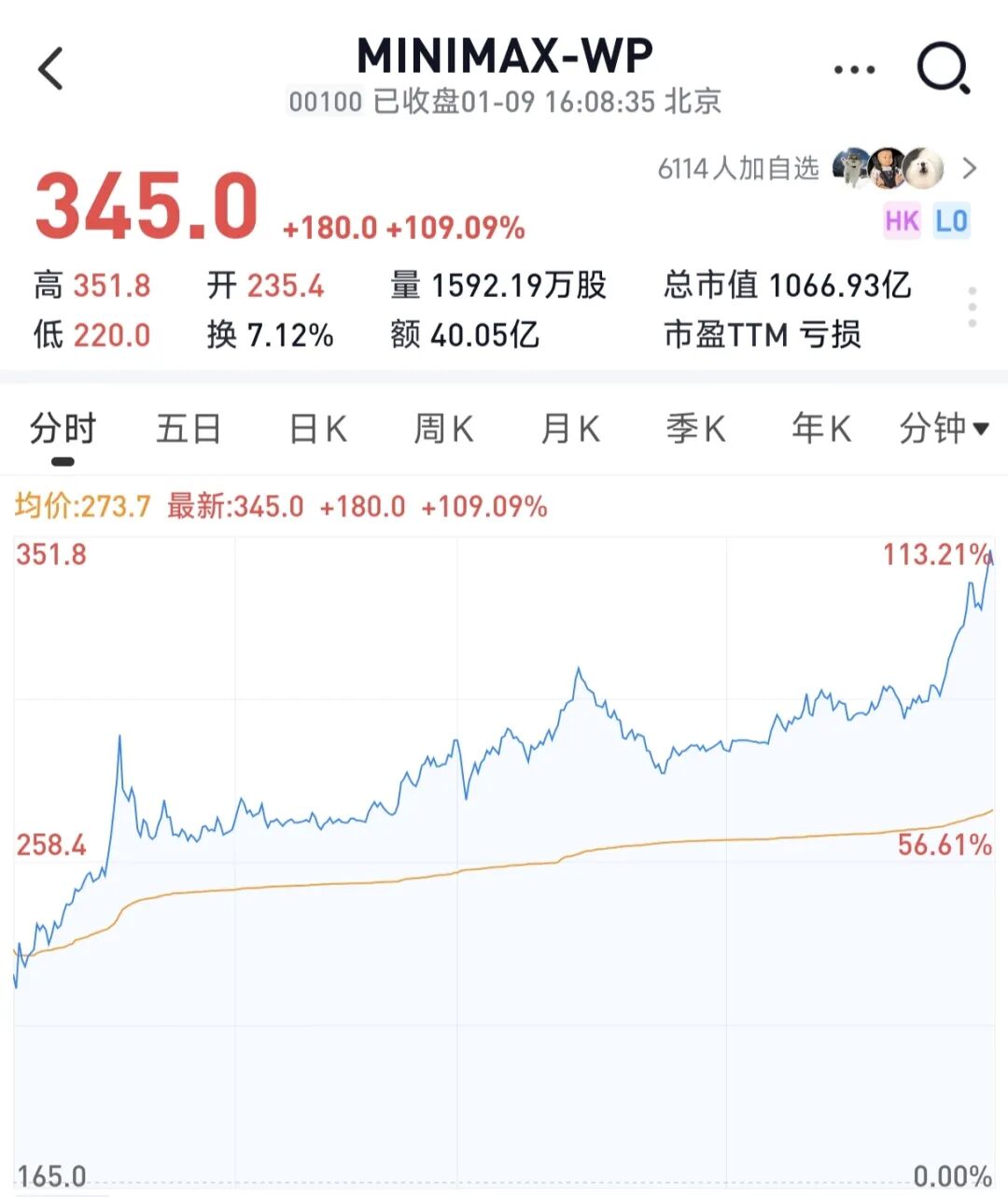
The AI sectors in the Hong Kong and A-share markets have also been fully ignited. From the closing data, in the Hong Kong stock market, Iflytek Medical Technology rose about 20%, and Fourth Paradigm rose about 7%. In the A-share artificial intelligence sector, there was a rare resonance. Among them, Kunlun Tech Co., Ltd. hit the 19.99% daily limit, and 360 Security Technology rose more than 6%, driving the Wind Multimodal Model Index to finally rise 5%, significantly outperforming the broader market index.
All of this is traceable. According to the allotment results previously announced by MiniMax, its public offering portion received 1,837 times oversubscription, and the international offering portion was finally allotted 37 times the subscription. In the enthusiastic market environment, the company's over-allotment option (green shoe mechanism) is also expected to be fully exercised, and the total funds raised could reach approximately HK$5.54 billion.
MiniMax is a special one among the six domestic AI startups. Four of the six follow a more conservative To B route. Compared with Luna, which also targets the To C market, MiniMax has more aggressively chosen to develop in multiple areas including text, voice, and video.
"We had a clear idea from the beginning. True AGI must have multi-modal input and output," said Yan Junjie, CEO of MiniMax.
In the context of difficult large model startups and limited resources, MiniMax wants it all. It seems crazy, but their stage achievements are already in front of us.
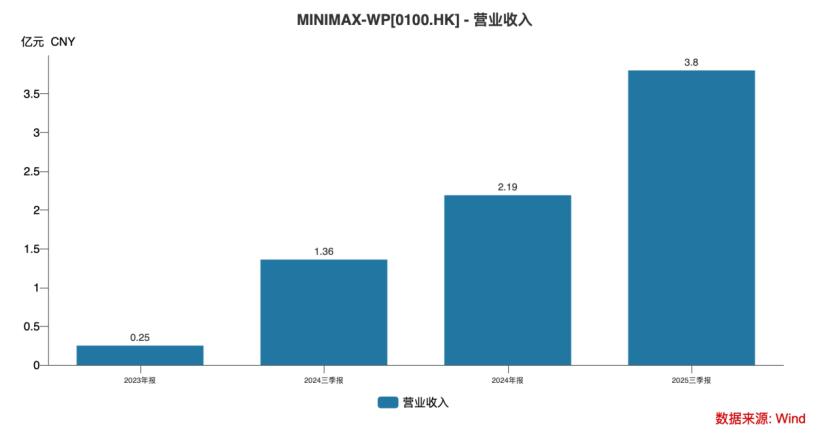
In the first nine months of 2025, the company's revenue reached US$53.44 million, a year-on-year increase of 174.7%. As of September 30, 2025, MiniMax had more than 212 million individual users in over 200 countries and regions, with the overseas market contributing more than 70% of the revenue.
Data from OpenRouter, which reflects the actual call volume of large models, shows that MiniMax M2 is the first Chinese model on OpenRouter with a daily token consumption exceeding 50 billion.
How did all this happen?

What is an "AI Native" application?
"Don't apply the logic of the mobile Internet to AI," Yan Junjie, CEO of MiniMax, has repeatedly emphasized this concept in interviews.
AI startups generally claim to build "AI native applications," but what is "AI native"? MiniMax has provided an answer through practice: the model is the product.
"In the era of large models, the real product is actually the model itself," Yan Junjie explained. "Because the essence of a large model product is to provide intelligence to people. Whether this intelligence is a piece of text, a video, or a voice, it is essentially providing intelligence. And the intelligence is calculated by the model, so the most core product is actually the model itself."
This concept subverts the thinking logic of traditional Internet companies. While other companies regard APIs and APPs as their core products, MiniMax positions them as "channels for the model."
This is also the main reason why Yan Junjie decided to focus on model capabilities rather than over-embellish the products.
"We have experienced strategic fluctuations, from emphasizing both 'model and product' to focusing on the model," Yan Junjie said. This decision was not blind but based on a deep understanding of the essence of the industry - after the model capabilities are improved, the products will naturally be good, rather than simply replicating the mobile Internet gameplay.
For example, in the field of video models, the latest generation Hailuo 2.3 model has made significant breakthroughs in dynamic expressiveness, stylized presentation, and the fineness of character performances, once again refreshing the global record for the cost - effectiveness of video models.
Based on the model's advantages, Hailuo AI has become a globally leading AI video generation platform and has helped global users create more than 590 million videos to date.
The prospectus data shows that as a newly launched product in 2024, as of the first nine months of 2025, Hailuo AI's MAU and the number of paying users were second only to Talkie/Starry, reaching 5.65 million and 310,000 respectively.
This directly shows that MiniMax's revenue model is undergoing a fundamental transformation - as the model capabilities improve, the user growth rate of front - end products from scratch is getting faster and faster.
In addition to focusing on technological iteration, MiniMax's understanding of AI native applications also stems from the judgment that the B - end and C - end will converge.
According to the "model is the product" end - game thinking, after achieving AGI, the B - end and C - end can be non - contradictory - the scalability in technology can be universal for both the B - end and C - end. That is to say, the concept of "B - end and C - end" under the Internet definition will no longer be as clearly defined as before.
"Scalability" is regarded by MiniMax as the company's core competitiveness. According to Yan Junjie's concept, after achieving scalability in technology, commercial scalability will come naturally.
The prospectus shows that as of September 30 last year, MiniMax's To C revenue increased 181% year - on - year, and its To B revenue increased 160% year - on - year. Among them, the gross profit margin of the B - end was as high as 69.4%. Driven by the gross profit of the API business, the company's gross profit quickly turned positive from - 24.7% in 2023, reaching 12.2% in 2024, and further increasing to 23.3% in the first nine months of 2025.
In the first nine months of last year, while the company's revenue achieved an explosive growth of 174.7%, the adjusted net loss only increased slightly by 8.6%. This means that the loss per unit of revenue decreased significantly by 60%, and the "loss rate" continued to narrow significantly.
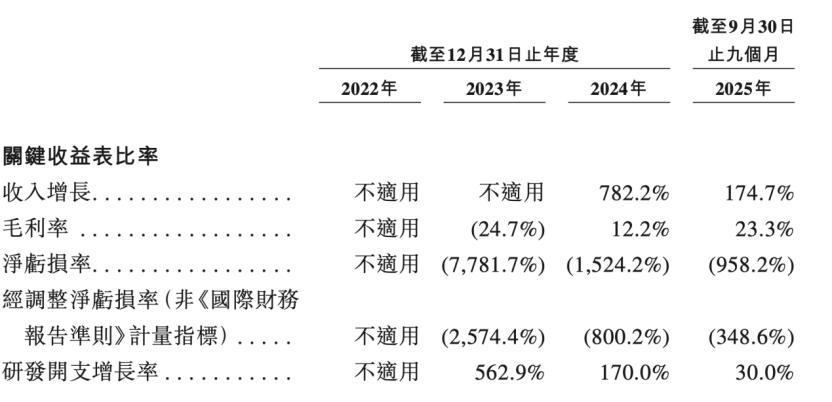
It can be seen that the company has successfully achieved cost control in just four years. From using computing power to gain market share in the early stage, through the reduction of inference costs and the decreasing marginal cost brought by scale, it has now entered a relatively healthy self - sustaining stage.
Behind the results of cost control is the scalability of the talent organization.
The prospectus shows that the company has 385 employees in total, with an average age of only 29 (post - 95s), and R & D personnel account for as high as 73.8%. More impressively, the company's output efficiency of "one person can do the work of ten" proves that its organizational scalability is based on "talent density" rather than "manpower stacking."
"AI has penetrated into the underlying way of daily work," Yan Junjie once said. "More than 80% of MiniMax's code is not written line by line by humans but is completed by AI."
The company has even created an "AI intern" internally. "It can access our various internal code libraries and online environments. When there is a problem online, after chatting a few words on Lark, it can modify the code, and we can directly launch it after review."
Regarding the AI Native organization, Yan Junjie believes that the talent structure should be able to organically combine people with different profiles to ultimately form diversity.
The end - game of AGI is still far away, and it is difficult to judge the heroes at present. In the three years since ChatGPT was launched, many startups have frequently adjusted their directions. Few are like MiniMax, whose business blueprint today is still the same as on the first day of its founding.
In this sense, Yan Junjie is a true idealist, truly practicing the "end - game thinking."
He firmly believes that only by starting from the ultimate goal and vision can one maintain strategic focus in the complex and volatile market environment and not be swayed by short - term temptations or difficulties. Every step of MiniMax's layout, whether it is investment in technology R & D or product iteration and upgrading, is closely centered around its long - term vision.
With its listing on the Hong Kong Stock Exchange, MiniMax's "model is the product" strategy will face more rigorous market tests, but its strategic focus and organizational innovation have already given it a unique and crucial position in the AI startup wave.