Breaking through the "bottleneck" of technology, a Peking University-affiliated company achieves mass production of atomic force microscope probes and secures tens of millions of yuan in financing | Exclusive report from Yingke
Author | Qiao Yujie
Editor | Yuan Silai
Yingke learned that recently, TZ Nano Technology (Quzhou) Co., Ltd., which specializes in the R & D of atomic force microscope (AFM) probes, completed a new round of equity financing and received more than ten million yuan in total investment from Quzhou Lvshi New Materials Equity Investment Partnership (Limited Partnership) and Hangzhou Defu Equity Investment Co., Ltd. We have summarized the information of this round of financing and several highlights of the company:

Financing Amount and Investment Institutions
Financing Round: Pre - A / A Round
Financing Scale: Tens of millions of yuan
Fund Usage: The funds will be mainly used to optimize the mass - production process of probes, improve product stability and yield. In addition, they will also be used for the R & D of all types of atomic force microscope (AFM) probes and the layout of new production lines.

Basic Information of the Company
Establishment Time: 2016
Registered Address: Quzhou City, Zhejiang Province
Technological Highlights: Relying on its years of technological and process accumulation in the field of micro - nano processing, TZ Nano Technology has achieved probe development starting from wafers through an innovative micro - nano processing process based on dry etching. It has reached the international leading level in some key indicators such as the radius of curvature, aspect ratio and service life of the probes. At the beginning of this year, the company's self - developed AFM probe products were launched on the market.
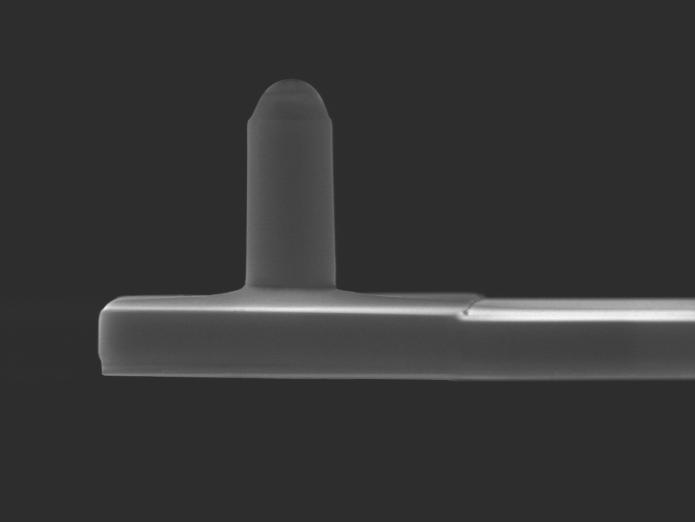
Ball Probe (Image Source/Enterprise)

Market Space
The atomic force microscope (AFM) is an indispensable high - precision detection instrument in many fields such as nanotechnology, materials science, semiconductor industry and life science. In semiconductor manufacturing, the AFM plays the role of "quality control". It conducts precise scanning of chips through nanoscale probes to determine whether the process meets the standards. As the core consumable component of the atomic force microscope, AFM probes are used frequently and have a strong repurchase attribute. However, they have long relied on imports, with high prices and limited supplies, gradually becoming a source of cost and supply - chain risks in scientific research and industrial applications.
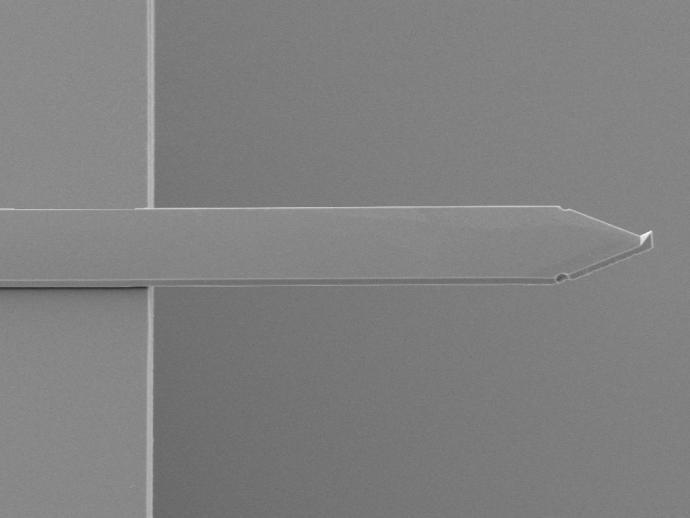
TZ Edge Series Edge Probe (Image Source/Enterprise)
Against the background of semiconductor localization and the independent and controllable development of scientific research instruments, the niche market of AFM probes, which features small - scale production, high added value and high repurchase rate, is showing clear room for domestic substitution. The localization process will also drive the development of related supporting industrial chains.

Team Background
Professor Cui Bo, the founder of the company, graduated from the Department of Physics of Peking University with a bachelor's degree and from the Department of Electrical Engineering of Princeton University with a doctor's degree. He has served as a professor at the University of Waterloo in Canada for many years and has been engaged in research in the field of micro - nano processing for nearly 30 years. In the past more than a decade, he has been continuously focusing on the R & D and industrialization of AFM probes. In 2024, Professor Cui Bo joined Ningbo Dongfang University of Technology. His research group maintains in - depth collaboration with the company in terms of technology. In addition to morphology detection probes, the company continues to conduct technological research on various AFM probes such as conductive probes, rapid positioning probes, diamond probes, spherical probes and magnetic probes.

Q&A with the Founder
Yingke: What stage is the domestic AFM probe industry currently in? What kind of industrial environment made you decide to return to China to start a business?
Cui Bo: Currently, 99% of the domestic market for atomic force microscope probes relies on imports. There are some domestic companies that make improved probes, such as adding functions to general - purpose probes, but we are the only ones making probes starting from wafers.
The decision to return to China to start a business is due to the fact that, on the one hand, the overall entrepreneurial atmosphere in China is more active, and on the other hand, the conditions in terms of financing, policy support and industrial matching are more mature. Take diamond probes as an example. In China, multiple mature diamond film suppliers can be found, and the upstream and downstream supporting industries are more complete.
Yingke: What are the core advantages of choosing the micro - nano processing process of dry etching?
Cui Bo: The core advantage of dry etching is better controllability. The shape of the probe in wet etching is determined by the crystal orientation of silicon and is difficult to adjust. Dry etching can adjust key parameters such as the sharpness of the probe according to different application scenarios. The cost of dry etching was originally higher, but in the past 20 years, dry etching technology has developed very rapidly, and the cost has also decreased. It has reached the level of being able to replace wet etching.
Yingke: What is the current customer group like? How is the customer feedback?
Cui Bo: Currently, our customers are mainly scientific research institutes, and we also cover some semiconductor manufacturers. Among them, large semiconductor manufacturers related to integrated circuit manufacturing are still in the testing and verification stage. In other semiconductor fields, a certain scale of actual sales has been achieved.

Whole Wafer (Image Source/Enterprise)
The main reason for customers to choose us lies in the cost - performance advantage. Compared with international leading brands, our prices are 30% - 40% lower, but in terms of indicators such as aspect ratio, tip radius of curvature and service life, our performance is not inferior, and some indicators are even better. What we currently lack is stability, but the test scanning images are already acceptable.
Yingke: What are the difficulties in achieving a considerable proportion of domestic substitution for AFM probes?
Cui Bo: Currently, the biggest challenge lies in brand building. Many users recognize the performance of domestic products during the testing stage, but still tend to choose international brands that they have been using for a long time, such as Olympus and NanoWorld, when making actual purchases, having formed a usage inertia.
From a technical perspective, I'm not too worried. We only started sales at the beginning of this year, and most of the current problems have been solved. There are still some minor problems, mainly concentrated on the yield and appearance consistency, which can be gradually improved in the next six months. However, building brand trust may take longer.