"Shortages will eventually lead to surpluses," a16z's 2026 outlook by Andreessen Horowitz: AI chips will see a surge in production capacity and a collapse in prices
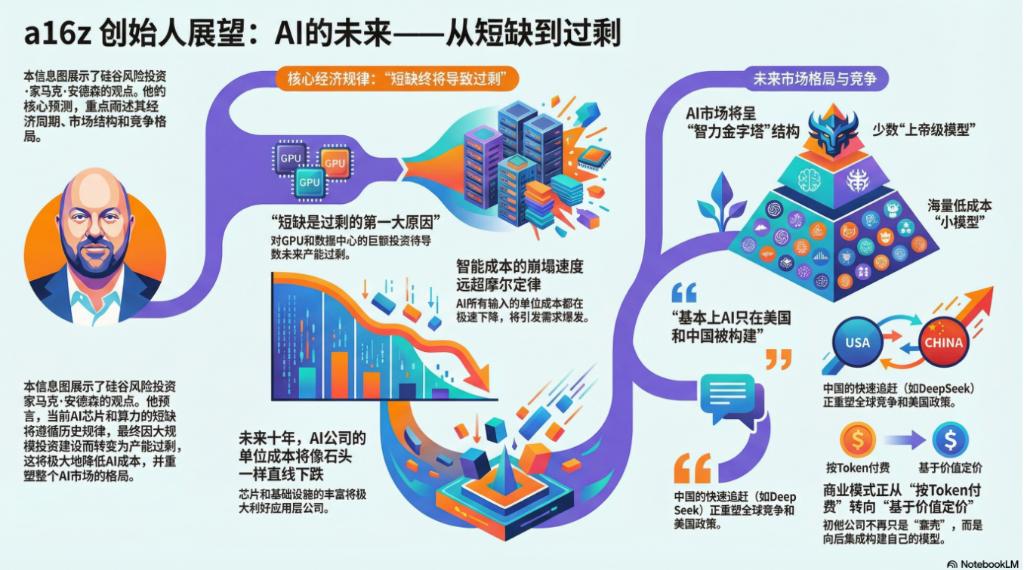
"If there's a shortage of something, human history shows that it will eventually be replicated on a large scale until it becomes an oversupply – AI chips and computing power are no exception."
In the latest special episode of The a16z Show, Marc Andreessen, the co - founder of a16z and the godfather of Silicon Valley venture capital, conducted an in - depth analysis of the future landscape of artificial intelligence, the Sino - US technology competition, and the return issues that the capital market is most concerned about. As a seasoned investor who has experienced the Internet cycle, Andreessen said bluntly: "(AI) This is the largest - scale technological revolution I've witnessed in my lifetime... It's not only bigger than the Internet; its magnitude is comparable to that of electricity and microprocessors."
Key points summary:
- Scale of AI technology:
AI is a more profound technological change than the Internet and can be compared with electricity, microprocessors, and steam engines. It is currently still in a "very early" stage.
- Cost "deflation":
The per - unit cost of intelligence is dropping much faster than Moore's Law, which will bring about an explosive growth in demand.
- "Shortage leads to oversupply":
Following the historical law of "shortage leads to oversupply", the large - scale construction of GPUs and data centers will ultimately result in an oversupply, further driving down the cost of AI.
- Market structure:
The future AI market will be similar to the computer industry structure: a few "god - level models" (similar to supercomputers) will be at the top, and a vast number of low - cost "small models" will be popularized at the edge.
- Sino - US competition:
This is a situation of two powerhouses competing. China (e.g., DeepSeek, Kimi) has shown amazing performance in catching - up speed, open - source strategies, and self - developed chips, which has prompted the regulatory stance at the US federal level to turn towards supporting innovation. He said, "Basically, AI is only being built in the United States and China. The rest of the world either can't build it or doesn't want to."
- Business model:
AI applications are shifting from "pay - per - token" to "value - based pricing"; startups are no longer just "wrappers" but are integrating backward to build their own models.
The democratization of AI: Whether it's text, video, or music, the world's most advanced AI technologies (e.g., ChatGPT, Sora, Suno) have broken down barriers, and anyone can directly use and verify these "originally expensive" top - notch technologies in real - time.
- The public is both panicked and embracing AI
: Polls show that the public is panicked about "AI replacement", but actual behavioral data shows that people are frantically adopting AI.
- The backward AI situation in Europe:
Since the EU cannot lead in innovation, it has turned to pursuing "regulatory leadership" (e.g., the EU AI Act). Andreessen believes that this approach has almost stifled the development of local AI, even causing Apple and Meta to refuse to launch their latest features in Europe.
"The primary cause of oversupply is shortage"
Although the market has different views on the revenue growth and money - burning speed of AI, Andreessen, from an investor's perspective, points out that many current concerns may be misinterpreted. He believes that the core lies in the "extreme deflation" of the cost of intelligence.
"The price of AI is dropping faster than Moore's Law," Andreessen emphasized in the interview. "The per - unit cost of all AI inputs is collapsing. The result is 'hyper - deflation' of the unit cost, which will drive demand growth beyond expectations."
Regarding the GPU and infrastructure bottlenecks that investors generally focus on, Andreessen made a judgment based on historical cycles: "In any market with commodity attributes, the primary cause of oversupply is shortage... Due to the shortage, you'll see hundreds of billions or even trillions of dollars invested. In the next decade, the unit cost of AI companies will drop like a stone."
The Sino - US competition: The shock brought by DeepSeek
During the interview, Andreessen rarely gave a detailed evaluation of the competitive pressure from China, especially mentioning the rise of models such as DeepSeek and Kimi. He admitted that China's progress in open - source models has surprised both Washington and Silicon Valley.
"The release of DeepSeek was a'supernova moment'," Andreessen said. "It not only has excellent performance but also comes from a hedge fund rather than a large - scale technology giant, which is completely unexpected." He pointed out that the strategies of Chinese companies in the open - source field have actually created global price competition, which may make US policymakers rethink their regulatory direction.
"In Washington, whether it's the Democrats or the Republicans, there is now little interest in doing anything that might prevent us from beating China," Andreessen revealed. The risk of strict federal - level regulation that the industry was worried about before has significantly decreased, and the current game is mainly concentrated at the state level (e.g., California's SB 1047 bill).
The shift of AI pricing power: From "pay - per - use" to "value - based pricing"
In terms of business models, Andreessen observed a key shift. Although cloud giants are happy to sell computing power through "pay - per - token", startups are exploring more moat - building models.
"If you can significantly improve the productivity of doctors, lawyers, or programmers, can you share a piece of the value from this improvement?" Andreessen believes that high pricing is often beneficial to customers because it supports better R & D. "AI startups are more creative in pricing than SaaS companies."
Moreover, Andreessen strongly refuted the question of "whether startups are just wrappers of large models". He pointed out that leading application companies like Cursor are integrating backward and "actually building their own AI models" because they have the deepest domain knowledge.
Closed - source large models VS open - source small models
Regarding whether closed - source large models or open - source small models will win in the future, Andreessen believes that it is not a zero - sum game but a well - defined "intellectual pyramid". He used recruitment as an analogy: "Some tasks require a string theory doctor with an IQ of 160 (large models), but the vast majority of economic activities in the world only need competent people with an IQ of 120 (small models)."
He predicted that the industry structure will be similar to the computer industry:
"You'll have a very small number of 'god models' equivalent to supercomputers running in huge data centers; then there will be a series of small models that gradually extend to embedded systems." Andreessen summarized. "The smartest models will always be at the top, but the largest number will be those small models at the edge."
This article does not constitute personal investment advice and does not represent the views of the platform. The market is risky, and investment requires caution. Please make independent judgments and decisions.
This article is from the WeChat official account "Wall Street Insights", author: Long Yue. It is published by 36Kr with authorization.