The secret of Hangzhou's AI lies in the town.
The atmosphere in the small towns of Hangzhou allows for maximum innovation with minimal social resources.
Why Hangzhou?
It all starts with DJI.
Around 2009, a postgraduate student at Zhejiang University received a message from Wang Tao, the founder of DJI, inviting him to join the newly - founded company. The student declined. At that time, Wang Tao was recruiting talents to focus on drone research and development, while the student's goal was to work on underwater robots, also known as remotely operated vehicles (ROVs). They were on different paths and thus missed the chance to work together.
Many years later, another postgraduate student at Shanghai University was pre - admitted by DJI but only worked there for two months. The test video of the XDog quadruped robot he developed went viral after being reposted by foreign media, attracting customer orders and investment intentions. He quit his job without hesitation and chose to return to Hangzhou, which is close to his hometown in Ningbo, to start a business.
The first student mentioned above is Liang Wenfeng, and the second is Wang Xingxing. If they had stayed at DJI, DJI's R & D team would undoubtedly have been even stronger, but Hangzhou's Six Rising Stars would have lacked Unitree Robotics and DeepSeek.
The birth of new things often depends on rebels. Their insatiability with the present is their deepest driving force. On the other hand, these people tend to gather together, creating a cluster effect. Just as more than a decade ago, the mobile Internet first thrived in Beijing, and hardware enterprises gradually scaled up in Shenzhen. This wave of artificial intelligence has finally landed in Hangzhou.
This is an important signal. It marks that Hangzhou, which has mainly been associated with e - commerce narratives, officially entered a new AI narrative in 2025 with the rise of the Six Rising Stars and even Alibaba's AI.
The Six Rising Stars in Hangzhou refer to six high - growth enterprises focusing on cutting - edge technologies such as robotics, AI, game development, and brain - computer interfaces. Not all of them were founded in Hangzhou. Game Science, one of the Six Rising Stars, was founded in Shenzhen in 2014. It wasn't until 2019 that Feng Ji, the founder of Game Science, decided to move the company to Hangzhou.
At the beginning of 2025, after the popularity of DeepSeek, Unitree Robotics, and "Black Myth: Wukong", there was a hot topic on Zhihu: "Why couldn't Shenzhen retain Liang Wenfeng, Wang Xingxing, Feng Ji, etc.? What caused them to leave?"
It is more meaningful to explore why Hangzhou attracts them than to discuss why Shenzhen couldn't keep them. Since "Black Myth: Wukong" made a splash, Feng Ji has explained several times why he moved from Shenzhen to Hangzhou. He recalled that the decision was made in the winter of 2019. "We just like the atmosphere of this city. The pace is relatively slower, and the housing prices are not too high. People can be patient."
Implied in his words is that one can better maintain the purity of entrepreneurship here. Entrepreneurship is a high - investment, long - cycle endeavor with high uncertainty in future returns. It's difficult for a city that distracts young people with housing and cars to be suitable for entrepreneurship.
More importantly, it comes down to Hangzhou's "generosity" and "patience". Technology - innovation enterprises usually have long R & D cycles, and there is often a mismatch between products and the market. Few are willing to help enterprises get through the "valley of death" in the early stage.
In 2015, Han Bicheng, who had been engaged in neuroscience research, formed a startup team with some Chinese students studying in the United States to research brain - computer interfaces at the Harvard Innovation Lab. At that time, there was little knowledge of brain - computer interfaces in China, and few enterprises invested in R & D in this field.
Hangzhou keenly saw the prospects of this industry. In 2018, an inspection team from the Future Science and Technology City in Yuhang District, Hangzhou, flew more than 10,000 kilometers and found BrainCo in a basement in Boston, USA. They had a three - or four - hour conversation.
Soon, Han Bicheng's team moved from Boston to Hangzhou and settled in the Artificial Intelligence Town. They received policy, space, and industrialization support and gradually achieved mass production and commercialization of their technology. In 2024, the Hangzhou Innovation Fund made a direct investment of 200 million yuan in BrainCo.
Huang Xiaohuang, the CEO of Coohom, also has a deep feeling. In November 2011, Huang Xiaohuang, who left NVIDIA, returned to Hangzhou to register and establish Coohom, which is now located in Shangcheng District, Hangzhou. Until the end of 2012, Huang Xiaohuang's technology was generally not favored by the capital market. Fortunately, Huang Xiaohuang was selected for the "Hundred Talents Program" in Jianggan District at that time. The 1.5 million - yuan reward solved the company's urgent need during the financing gap.
Most of the Six Rising Stars in Hangzhou have directly or indirectly received policy support. For example, when Unitree Robotics had difficulty in financing, it received investment from Hangzhou's state - owned assets. Hangzhou also provided human resources support, housing subsidies for high - end talents, and supporting facilities for their children's education.
Hangzhou's AI cluster effect is continuously attracting more enterprises and talents. In May this year, Huang Hui left a large - model company in Beijing and joined a manufacturing platform company in Hangzhou. They planned to set up a consumer electronics experience hall called "Youmei Discovery Home". After hearing about it, the Gongshu District government directly provided various supports. Huang Hui said that the government's sincerity made it hard to choose other places.
The "Youmei Discovery Home" consumer electronics experience hall is expected to open to the public in March this year. Its significance is not just a technology exhibition hall. With the help of AI technology, it enables the rapid implementation of more creative designs and a closed - loop transaction. It also lowers the threshold for young people with creativity and ideas to produce hardware.
Shanghai's AI unicorn, Unquestionable Core Dome, also established a company in Hangzhou in November last year. Unquestionable Core Dome is a company that builds infrastructure systems for Agentic AI. People within the company said that they came to Hangzhou because they valued Hangzhou's endowment in the intelligent agent industry and its rich real - world scenarios in e - commerce, logistics, and manufacturing.
The essence of Hangzhou's industrial support is not just accurately catching up with this wave of AI technology. It provides a long - term and patient soil for innovative enterprises, allowing young people's idealism to take root quickly.
At a dinner, the chief scientist of Coohom sighed to us that it's rare for a company to spend 90 cents on R & D for every dollar earned in the early stage. It's precisely this persistence in idealism that enables the enterprise to quickly seize opportunities when the market matures, build the world's largest indoor 3D scene data, and become the most promising domestic company to tackle the spatial large - model field.
From Alibaba and the Six Rising Stars in the past to the emerging new enterprises and new forms, it's easy to conclude that Hangzhou is a place where idealism and realism can coexist. Ma Yun is the most typical example. In 2011, Duan Yongping said on Xueqiu: "Pure idealists can't go far, and pure realists can't achieve great things. Fortunately, Ma Yun is both."
If Ma Yun is like this, aren't the founders of the Six Rising Stars also?
What does Hangzhou really have?
Policy support alone cannot fully explain the emergence of the Six Rising Stars in Hangzhou. Ultimately, it reflects the advantages of Hangzhou's private economy in technological innovation.
Zhejiang is one of the most active provinces in terms of private economy. During the Southern Song Dynasty, the population of Hangzhou exceeded 1.2 million, making it the largest and most prosperous city in the world at that time. Marco Polo described it as "the most beautiful and magnificent city in the world" in his travelogue.
Ten years ago, Li Qiang, then the governor of Zhejiang Province, said that Zhejiang's private economy "will thrive with a little sunshine and sprout with a little rain". There is no more accurate and vivid description. Starting a business is as common as having a meal for Zhejiang people. When we came to Hangzhou in early May this year, we often heard people around us say, "Rather sleep on the floor than not be the boss." Wang Jian, the founder of Alibaba Cloud, also said in an interview this year, "One in five people in Hangzhou is a CEO."
The business talent of Zhejiang people seems to be innate. From family workshops in the 1980s, to light - industry clusters in the 1990s, and then to the Internet economy later, Zhejiang people have been exploring new fields. The rise of technology enterprises such as the Six Rising Stars proves that in Zhejiang, not only is there a path for doing business, but technological innovation is also a good choice.
Wang Jian said in an interview this year that today's "Hangzhou phenomenon" is because the vitality of the private economy is combined with technological innovation, especially in small and medium - sized enterprises. In the past, Zhejiang preferred to develop leading enterprises, but now small and medium - sized enterprises are becoming the main force in technological innovation.
A good environment depends on policies, but it should not overly rely on them. "The mechanism, in essence, is that you do your thing, and I do mine, but we share a common value system. This is really a rare environment in Hangzhou," Wang Jian said. Hangzhou's policies for these enterprises often follow the strategy of "only serve, not interfere", minimizing intervention as much as possible, which is more conducive to stimulating market vitality.
The active private economy is like a booster for Hangzhou's technological explosion. From a more systematic perspective, Hangzhou's unique "town mechanism" is also the reason why innovative enterprises keep emerging in this city.
There are technology towns almost in every district of Hangzhou. Yuhang District has Dream Town and Artificial Intelligence Town; Xihu District has Yunqi Town; Xiaoshan District has Turing Town; Gongshu District has Wisdom Valley Town; and Binjiang District has Embodied Intelligent Robot Town, etc.
These towns are scattered in different districts of Hangzhou. Usually, a town is planned to cover an area of about 3 square kilometers, with about 1 square kilometer of construction land. Production, living, and the ecological environment can be organically integrated, forming a closely - interacting small ecosystem. As a result, the town has a small - scale space, close relationships, and extremely fast information flow.
In contrast, Beijing, Shanghai, Guangzhou, and Shenzhen rely on the scale of super - large and large cities. Resources are distributed in a gradient from the center to the periphery, with a larger spatial scale. Moreover, they rely more on the central radiation and professional clusters of large cities (such as Financial Street and Science Parks), with more formal interactions and longer flow paths.
In addition, Hangzhou usually develops an ecosystem first and then builds an industry. It cultivates small and refined industrial clusters around vertically - segmented fields. For example, in the Yuhang Future Science and Technology City, the Alibaba ecosystem was first established, and then it focused on the vertical field of AI, incubating technology unicorns such as Rokid (AI glasses), iFlytek (RPA + AI), and BrainCo.
Since 2025, Hangzhou's AI ecosystem has shown obvious levels. Alibaba is the giant, the Six Rising Stars are the middle - sized enterprises, and the startups in Liangzhu form a cluster, finally creating a situation of "one super - large, multiple strong, and clusters". Interestingly, except for Alibaba, almost all the other enterprises and teams were nurtured in the towns.
Game Science is in the Art and Innovation Town, BrainCo is in the Artificial Intelligence Town, Coohom is in the Yunqi Town, DeepRobotics is in the Dream Town, and Unitree Robotics is in the Binjiang Internet of Things Town. It can be said that the town mechanism has been deeply integrated into Hangzhou's technology system, nourishing innovation like the water system in the Jiangnan region.
Liangzhu Cultural Village is essentially a town. Half of the entrepreneurs here are talents overflowing from large enterprises in Hangzhou such as Alibaba, NetEase, and ByteDance, and the other half come from all over the country. What attracts them to start businesses here is the relaxed living rhythm in a beautiful natural environment and a good entrepreneurial atmosphere. For example, Xi Yuan, the founder of "FateTell" whom we know, has worked in large enterprises. He originally started an AI business in Hong Kong and then came specifically to Liangzhu to start a business with like - minded people.
This kind of town has another advantage. It acts as a buffer layer, preventing large companies from monopolizing innovation and allowing small companies not to start from scratch. Relying on its close - knit community ecosystem and low - cost entrepreneurial environment, Hangzhou attracts a large number of young entrepreneurs and "digital nomads", creating a high - density innovation field.
The entrepreneurial model in Liangzhu is completely different from the "big - company" model. They advocate small - team entrepreneurship, or even one - person entrepreneurship. The advantage of this model is that there's no need to worry about failure. Even if it fails, the cost is not too high, and they can quickly join another team. The failure experience can also become a shared asset within the town. Only when a city allows a certain degree of tolerance for failure can it cultivate an innovative soil.
Master Qi is well - known in Liangzhu. Every month, he holds offline AI activities in the backyard of a villa in Liangzhu, attracting hundreds of AI enthusiasts and entrepreneurs. They present their AI products and share their experiences in using various AI technologies, almost turning the social capital required for entrepreneurship into a daily resource.
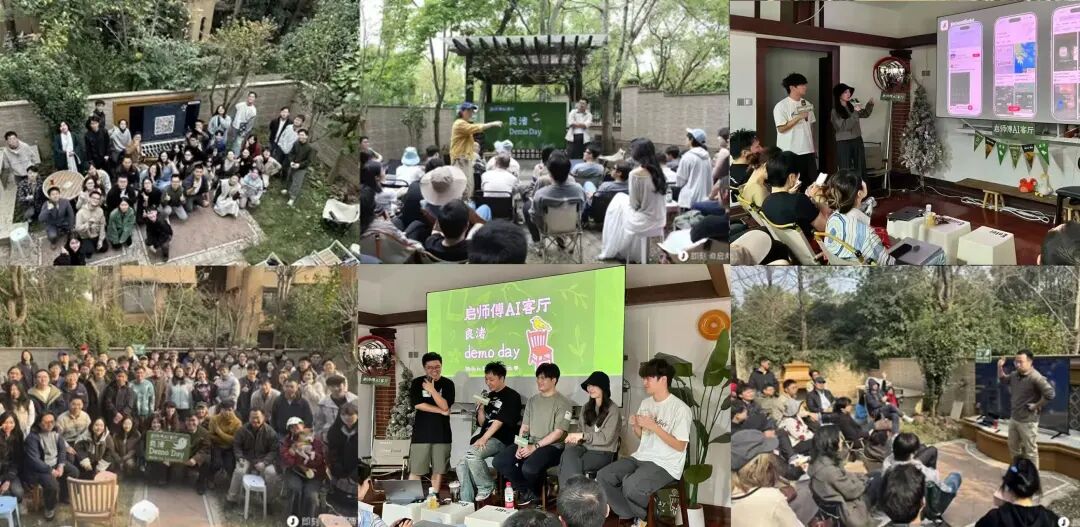
Image source/ Master Qi's AI Living Room (WeChat official account)
Like other towns in Hangzhou, people in Liangzhu don't need to enter a circle; they are already in it. This kind of communication atmosphere in a small circle is very precious. Some AI products have emerged from this small circle and obtained financing. No one can say for sure whether the next DeepSeek will be born in this backyard.
In the early days of Zhongguancun, there were people assembling computers everywhere. In another era, in Huaqiangbei, there were people assembling mobile phones everywhere. In our experience, in Hangzhou today, as long as you are close to some technology towns, you won't be short of people talking about AI.
So, what exactly is the "town mechanism"? First of all, the town mechanism is in line with the logic of the water system in the Jiangnan region, which means it is open and fluid, able to break free from the constraints of physical forms. Secondly, the town should solve the problem of "creating something out of nothing". It is not about replacing others but about innovation. Finally, it forms a positive industrial cycle of openness, fluidity, and mutual exchange.
Furthermore, Hangzhou's town mechanism does not just "set up a stage" for innovative enterprises. It compresses life, social interaction, industry, and the cost of failure into the same space. This can save resources as much as possible and allow information to flow quickly.
Wang Jian, the founder of Alibaba Cloud, once said that the atmosphere in Hangzhou's towns allows for maximum innovation with minimal social resources. "The town should be small and have its own characteristics. Alibaba Cloud grew from scratch into a mature enterprise in Yunqi Town."
Beyond the towns, there are the 'Valleys'
Hangzhou's town mechanism is inseparable from Alibaba Cloud. Alibaba Cloud almost pioneered the technology - town mechanism. In October 2014, when visiting Yunqi Town, the governor of Zhejiang Province proposed: "Let Hangzhou have one more beautiful characteristic town and let more innovative clouds float in the sky." This was the first time the concept of "characteristic town" was mentioned, and other technology towns started to be built later.
These towns alone are not enough to provide the technological ammunition needed by technology - innovation enterprises. Alibaba can just make up for this. To some extent, the birth of Hangzhou's "Six Rising Stars" is inseparable from Alibaba's early - stage preparation and talent supply. Alibaba has built the foundation of the digital economy, the talent - capital ecosystem, and even the innovation - culture environment in Hangzhou.
Luo Fuli, a former core R & D member of DeepSeek, used to work at Alibaba's DAMO Academy. In 2025, she was poached by Lei Jun with an annual salary of tens of millions. In addition, several members of DeepSeek have a technical background from Alibaba Cloud and Ant Group. The currently popular AI glasses, Rokid, which is also known as the "Seventh Rising Star" in Hangzhou, has a founding team that came from Alibaba.
It can be said that as the core engine of Hangzhou's digital - economy ecosystem, Alibaba, through talent overflow, technology empowerment, capital linkage, and support in business scenarios,