The "wealth gap" in the venture capital market: The top 3% of companies take half of the market's funds.
Will the "80/20 divide" phenomenon in the market intensify in 2025?
Has most of the money flowed into a small number of star projects and institutions? "
In 2025, while the trading volume in China's primary market recovered, a concerning phenomenon emerged:
Extreme unevenness in capital distribution.
Data shows that throughout the year, 7,627 companies received investments, with a cumulative amount of 821.368 billion yuan.
However, the distribution of this over 800 billion yuan in funds showed an extreme Matthew effect -
Less than 5% of top - tier companies absorbed more than half of the market funds, while more than three - quarters of the companies had to compete for less than one - sixth of the funds.
This divide has gone beyond the traditional "80/20 rule" and evolved into a more extreme "90/10 divide". It is not only changing the flow of funds in the venture capital market but also reshaping the entire startup ecosystem.
Extreme Divide: 75.9% of companies received only 15.67% of the funds
Judging from the distribution of financing amounts, the degree of divide is "shocking".
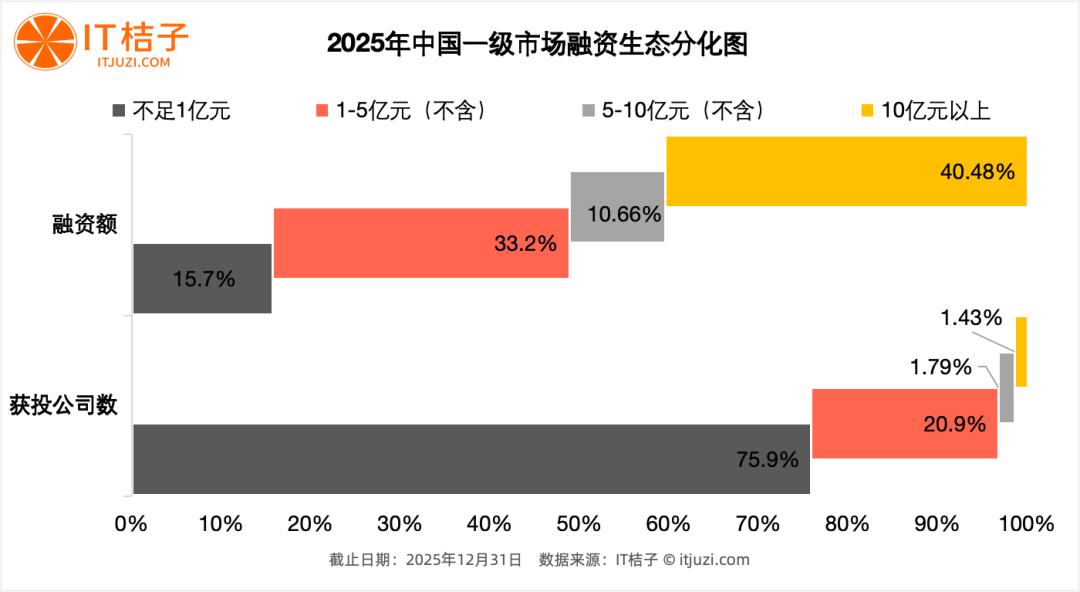
75.9% of the companies in the market received less than 100 million yuan in investment. However, these companies, which have an absolute numerical advantage, only received a total of 15.67% of the market funds.
In other words, more than 5,700 companies could only share about 130 billion yuan in investments.
In sharp contrast is the concentration of funds among top - tier companies.
Companies with a total financing amount in the ranges of 5 - 10 billion yuan and over 10 billion yuan accounted for only 3.22% in total. That is, about 245 companies took away 51.14% of the total funds, more than 420 billion yuan.
The most extreme are those companies with annual financing of over 10 billion yuan.
They accounted for only 1.43% of the total number of invested companies, about 109 companies, but grabbed 40.48% of the market funds, about 330 billion yuan.
This means that on average, each super - top - tier company received more than 140 times the investment of those companies with financing of less than 100 million yuan.
Subsidiaries of central and local state - owned enterprises dominate large - scale financing, and strategic industries become capital gathering places
Taking a closer look at those extremely large - scale financing cases, a prominent feature emerges: Companies with central and local state - owned enterprise backgrounds dominate.
The five companies with a total financing of over 10 billion yuan in 2025 were all related to central and local state - owned enterprises.
State Grid Xinyuan, a subsidiary of the State Grid, received 36.5 billion yuan in investment, becoming the company with the highest financing amount for the year; Ping An Life Insurance, a subsidiary of Ping An of China, received 20 billion yuan in strategic investment; Inner Mongolia China General Nuclear Power, 100% owned by China General Nuclear Power, received 11.8 billion yuan; Shenzhen China Star Optoelectronics Technology, in which the Shenzhen State - owned Assets Supervision and Administration Commission holds shares, raised 11.562 billion yuan; and Fusion Energy, a subsidiary of China National Nuclear Corporation, received 11.492 billion yuan.
These five companies raised nearly 91.4 billion yuan in total, accounting for 11% of the total annual financing amount.
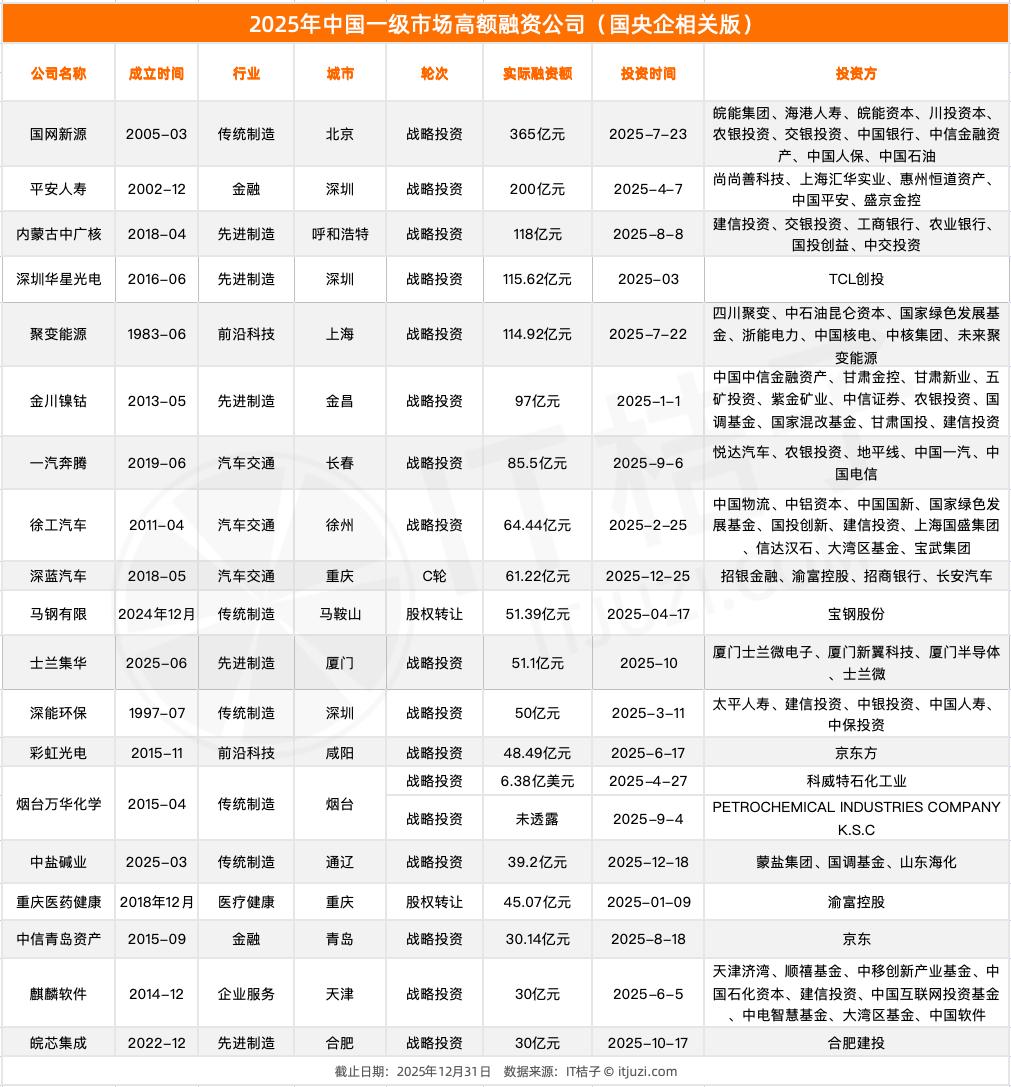
Among the top 20 central and local state - owned enterprise - related companies with the highest total financing amounts, manufacturing enterprises accounted for half, including State Grid Xinyuan, Maanshan Iron & Steel Co., Ltd., Shenzhen Energy Environmental Protection Co., Ltd., Inner Mongolia China General Nuclear Power, Jinchuan Group Co., Ltd., and Anhui Core Semiconductor Co., Ltd. Most of these enterprises align with the national strategic direction and focus on key areas such as hard technology and energy.
It is worth noting that many of these companies with large - scale financing are spin - offs from state - owned enterprises or central enterprises and have received equity investments in the market. With their state - owned background and industrial resources, they have shown strong capital - attracting ability in the capital market, significantly affecting the total market amount and the capital distribution pattern.
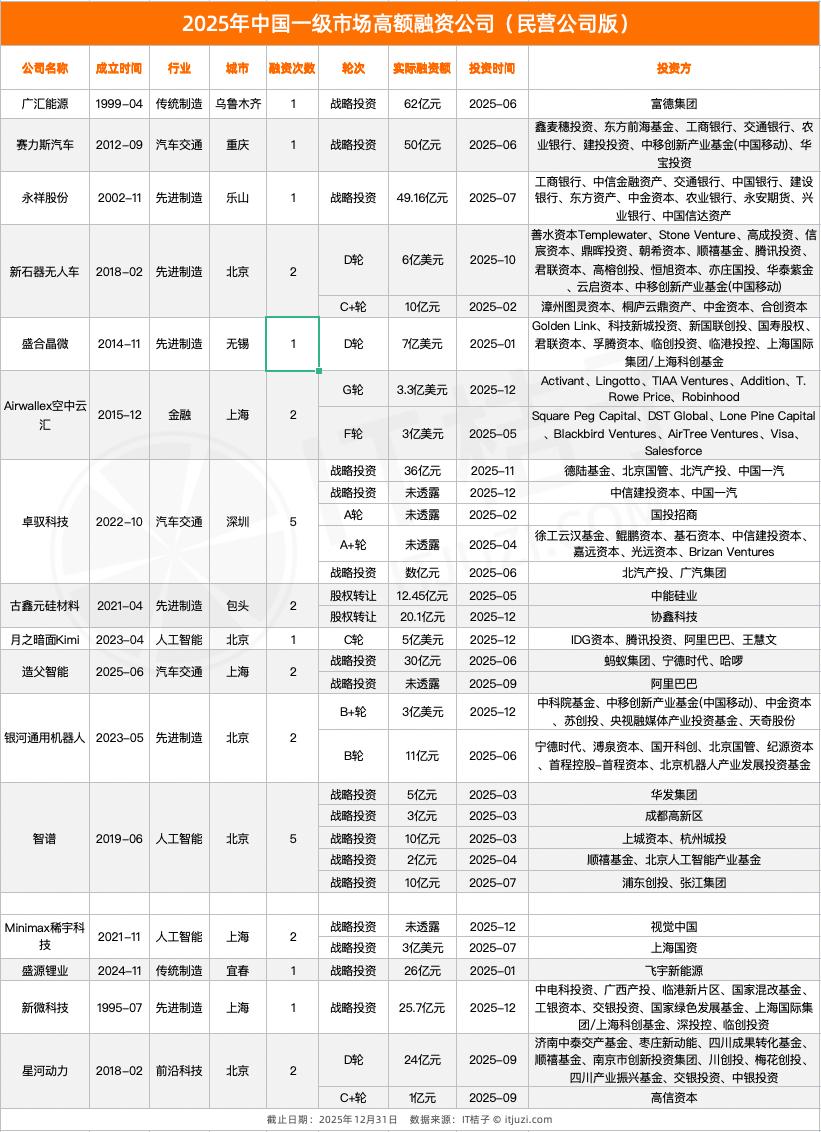
Among startups, in the top financing cases, 9 companies completed two or more rounds of financing. Among them, Zhuoyue Technology, a provider of high - level intelligent driving solutions, and Zhipu, a Chinese cognitive large - model platform, each raised funds 5 times, demonstrating their ability to continuously attract capital.
Structural problems masked by market recovery
It is worth noting that the primary market generally recovered in 2025. The average monthly trading volume reached 755 cases, a year - on - year increase of 27.7%. The year - on - year increase exceeded 30% for 7 months. In terms of quantity, the market was indeed recovering.
However, the "90/10 divide" phenomenon reminds us that the increase in the number of transactions does not mean an even distribution of funds.
The increase in quantity and the rise in capital concentration occurred simultaneously - more companies got investment opportunities (even if the amount was small), but large - scale funds were more concentratedly flowing into a small number of top - tier companies, especially those with central and local state - owned enterprise backgrounds and in line with the national strategic direction.
This phenomenon reflects the structural problems in the market. The prosperity of the market is more manifested in the financing feast of top - tier companies and strategic industries, rather than the balanced development of the entire ecosystem. A large number of small and medium - sized enterprises and early - stage projects are facing unprecedented financing difficulties.
Future: Divide or integration?
Looking ahead, the trend of the "90/10 divide" may continue for some time.
In the short term, the cautious strategies of investment institutions will not change, the dominant position of state - owned capital in the market will continue to strengthen, and the siphon effect of top - tier projects will also continue. In technology - intensive industries, the characteristics of large - scale investment and long - term returns determine that funds will inevitably concentrate on the top.
However, in the long run, the market needs to be vigilant against the risks brought by excessive division. The healthy development of the innovation ecosystem requires the participation of a large number of early - stage projects and small and medium - sized enterprises. If long - tail companies do not receive effective support for a long time, it may lead to problems such as insufficient innovation drive, a decline in industrial diversity, and the solidification of the market competition pattern.
A more ideal pattern should be to establish a hierarchical and differentiated investment ecosystem:
Let large - scale funds and state - owned capital platforms continue to support strategic top - tier projects, while providing necessary living space and growth opportunities for long - tail companies through diversified capital channels such as angel investments, early - stage funds, and government - guided funds.
This article is from the WeChat official account "IT Juzi" (ID: itjuzi521), author: IT Juzi. Republished by 36Kr with permission.