Jensen Huang Sets the Tone, "Physical AI" Sounds the Trumpet
How will AI develop next? How will humans and machines re - divide their labor in the next decade? Jensen Huang, the CEO of NVIDIA, has given the latest answer.
At the 2026 CES in Las Vegas, Jensen Huang pointed out a new direction for the global technology community with a 90 - minute speech.
In the view of this "Yellow - robed Guru", artificial intelligence has officially entered a new stage - evolving from understanding language to understanding the physical world. He calls this transformation the "ChatGPT moment" of "Physical AI".
Jensen Huang confidently predicted that in 2026, we are expected to see robots with "human - level" capabilities.
Many industry analyses believe that this means that artificial intelligence will move from the virtual realm of processing text and images to a new era where it can understand gravity, friction, and materials and interact with the physical world in real - time and rationally.
In the view of Brother Ma, an AI industry insider, the concept of "Physical AI" is not difficult to interpret. In fact, judging from the actions of many relevant domestic enterprises, "Physical AI" has already shown signs. "Of course, the challenges it faces are still quite significant."
"It is foreseeable that 2026 will surely be a year of the explosion of 'Physical AI'." Brother Ma firmly pointed out that every player in this field should try their best to seize the high - ground as soon as possible. "Although it is not easy, if you are slow, you will be left behind. There is no doubt about this."
01 "Physical AI" Ushered in the "ChatGPT Moment"
In July 2025, when Jensen Huang had a dialogue with Wang Jian, the director of Zhejiang Lab and the founder of Alibaba Cloud, he first clearly proposed that "the next wave of artificial intelligence is 'Physical AI'."
Half a year later, at the CES 2026, this concept had evolved into a specific product roadmap. Jensen Huang announced that artificial intelligence had officially entered a new stage with a 90 - minute speech.
"The 'ChatGPT moment' of 'Physical AI' is coming soon." In his latest speech, Jensen Huang clearly put forward this core view. At the meeting, he announced that artificial intelligence is evolving from understanding language to understanding the physical world.
Jensen Huang interpreted "Physical AI" as "AI that can understand the laws of nature." He pointed out that Physical AI involves the interaction between AI and the world. In the context of Physical AI, the public has AI that interacts with the physical world and Physical AI that understands the laws of physics.
Jensen Huang believes that the problem with "Physical AI" is how to transform the intelligent agents that interact with you through the screen and speakers in the computer into intelligent agents that can interact with the world. This means that it can understand the common sense of how the world works: object permanence (the object is still there when I look away and then look back), and causality (if I push it, it will fall).
In the concept of "Physical AI", a single model is no longer sufficient. A complete set of working intelligent agents that can call multiple models, disassemble problems, and use tools needs to be established.
Therefore, Jensen Huang's core is not to show the computing power breakthrough of a single chip, but to depict a complete blueprint called "AI Industrialization".
Jensen Huang emphasized that "every layer of the computing industry needs to be rewritten." This points to a fundamental change: the real leap of AI no longer depends on the breakthrough of a single - point model, but on the complete industrial capabilities that are replicable, deployable, acceptable, and scalable.
Jensen Huang's logic is very clear. To enable robots to understand the physical world, more than just algorithms and computing power are needed. It is not simply a "movable robot", but an intelligent system that can understand gravity, friction, inertia, materials, and causality and make reasonable decisions and actions accordingly.
Therefore, what NVIDIA released this time is no longer a simple chip upgrade, but a complete set of open models, frameworks, and infrastructures for "Physical AI", and it also demonstrated multiple robots developed by global partners for various industries.
These models can help robots generate synthetic data based on physical principles and evaluate strategies, enabling machines to see, understand the physical world, and take actions like humans.
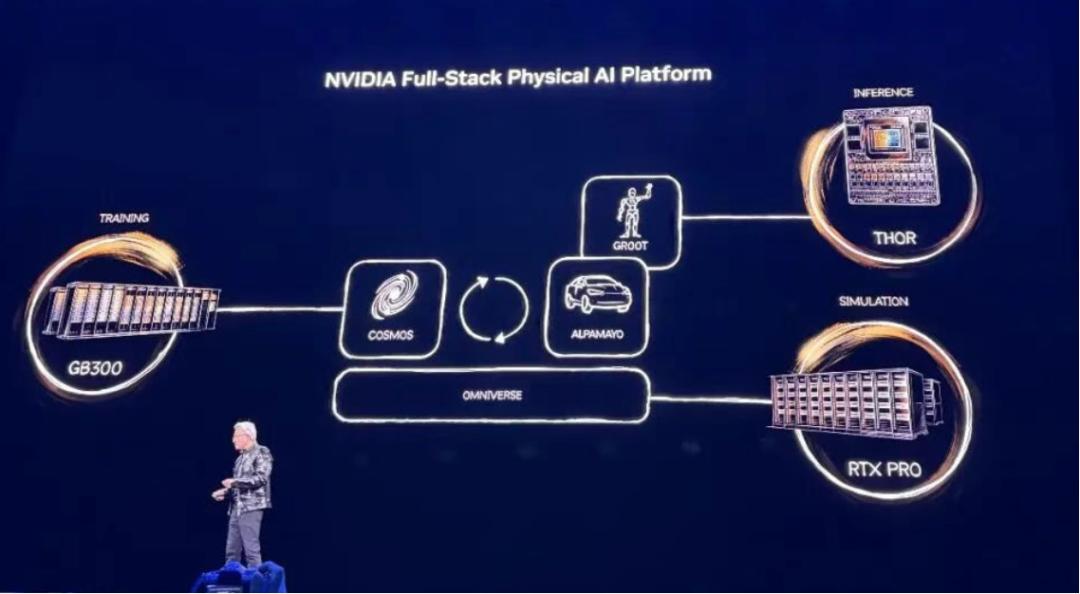
"It's not just that the robot can move, but it's an intelligent system that can understand gravity, friction, inertia, and causality and can conduct billions of training sessions in the virtual world first." Jensen Huang believes that this is a crucial step for artificial intelligence to move from the virtual digital world to the physical world.
Jensen Huang pointed out that through digital twin and simulation training, the learning of robots can be completed in the virtual world and then quickly deployed to real - world scenarios.
In Jensen Huang's view, humanoid robots are no longer just laboratory exhibits, but products with real commercial potential.
"The ChatGPT moment of robot development has arrived. There has been a breakthrough in the field of 'Physical AI'. These models have the ability to understand the real world, reason, and plan actions, continuously giving rise to new application scenarios."
Jensen Huang once sighed, "In the past 12 years or so, AI has developed extremely rapidly, and there has been a major breakthrough basically every 3 - 5 years."
Perhaps, the major breakthroughs that Jensen Huang believes will occur every 3 - 5 years are coming faster.
02 How Will It Affect the Industry?
"You can understand that the sci - fi movies you've watched in the past will be getting closer and closer to you." Regarding Jensen Huang's latest speech, Brother Ma tried to interpret it in a more vivid way.
"If in the past, robots were just exhibits and far from the lives of ordinary people, then in Jensen Huang's speech this time, the thinking is very clear." Brother Ma said with a smile, "Many of the scenes you see in sci - fi movies may soon become a reality."
"Of course, Jensen Huang also made it clear that industrialization is the first step for 'Physical AI' to move from the laboratory and demonstration videos to large - scale commercialization." Brother Ma pointed out that Jensen Huang's meaning is obvious: robots will become the first batch of mass - produced products of AI industrialization.
Actually, at this CES, Boston Dynamics also released a mass - produced version of the bipedal humanoid robot Atlas, whose specification parameters have reached a new height and can achieve high - precision operations.
Industry analyses pointed out that the Atlas demonstrated this time proves to the outside world that humanoid robots have begun to be designed for the real world.
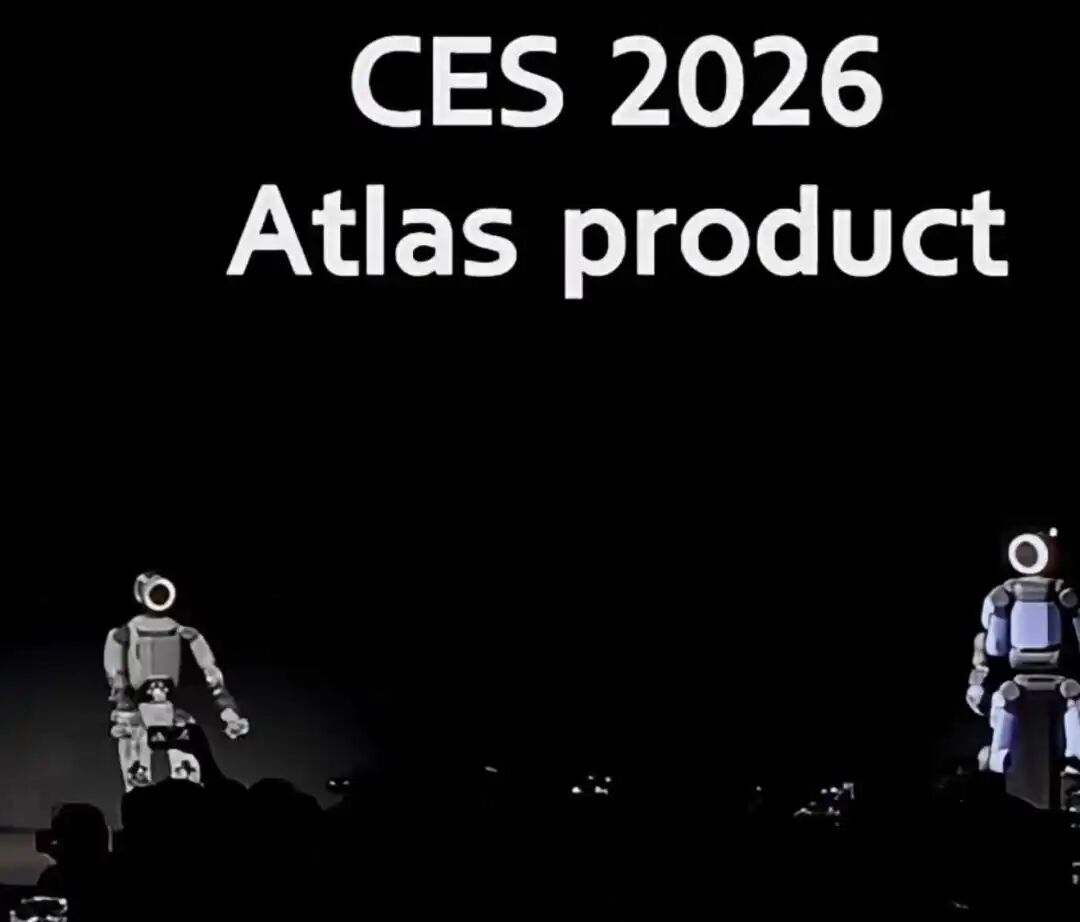
Brother Ma clearly pointed out that judging from the performance of the demonstrated Atlas, "What you see is no longer a robot that walks or performs like a human, but a robot that may achieve 'efficiency, practicality, and scenario - specific functionality'."
In Brother Ma's view, this will be the key development direction for robots in the future and the "high - ground" that enterprises in this field need to conquer.
However, Brother Ma also believes that although the future development path of AI is clear, the full implementation of "Physical AI" is still fraught with difficulties. "Especially for those enterprises that aim to participate in this revolution, they must clearly recognize the core challenges ahead."
Brother Ma pointed out that the core of "Physical AI" is data. Obviously, the traditional "big data" paradigm adopted by many enterprises at present cannot meet the needs. "As many experts and scholars have said, 'Physical AI' requires 'good data' that meets the three criteria of 'physical authenticity, semantic comprehensibility, and scenario generalization'."
For example, to teach a robot to "open a door", the data should not only include the image of the door but also accurately describe the rotation trajectory of the hinge, the mechanical characteristics of the handle, and enable the AI to understand the semantics of the instruction "open".
Brother Ma said bluntly that, as far as the current situation is concerned, there is still a large gap in this regard both at home and abroad. "Building such a high - quality data set is a huge project with high costs."
In Brother Ma's view, another challenge lies in the gap between simulation and reality. "Currently, many robots are more about'simulation' and are far from 'actual operation'."
"In real - world business applications, the perfect actions trained in the simulation environment may completely fail due to various factors in the real world." Brother Ma pointed out that especially in some special scenarios, the current technology is obviously unable to solve the problems. "It must be understood that it's not about using a remote control to make the robot open the door, but the robot learning to open the door on its own."
The third challenge lies in technology integration and ecological barriers.
"You can see that currently many enterprises are working independently, which actually restricts the development of technology to a large extent and may also affect the progress of the entire industry." Brother Ma said bluntly. Perhaps, in the current environment, "collaborative development is the best and fastest way, although it's not very realistic."
"In this situation, if an enterprise wants to be proactive in the competition, it must form irreplaceable differentiated capabilities in some key links." Brother Ma pointed out.
Some industry insiders believe that in terms of the development path, domestic enterprises are usually better at starting from specific application scenarios such as local life, logistics, and manufacturing, solving practical problems, and iterating technology and refining models in the process.
"For enterprises, no matter which path is taken, once it is successful, the moat will be equally deep. It depends on how enterprises weigh and choose." Brother Ma said frankly. "There is no unified end - point for the AI revolution in the physical world, but obviously, the race has begun."
This article is from the WeChat official account "Tingtong Tech". Author: Tingtong Tech Studio. Republished by 36Kr with permission.