What stage has the partner marketing, which both Anker and PatPat are engaged in, evolved to?
When consumers delegate their decision - making power to third - parties, how can the logic of overseas growth be reconstructed?
Once upon a time, almost all overseas teams firmly believed that they had grasped the underlying logic of growth.
In this logic, advertising investment was the only super - lever. Resources were extremely tilted towards user acquisition and optimization: the models were dissected in great detail, the investment rhythm was gamed minute by minute, and ROI was regarded as the sole measure of survival. For a long time, additional budgets and minor strategy adjustments always brought back excellent data feedback, which further solidified the industry's path dependence: Growth seemed to be equivalent to precise traffic arbitrage.
However, in recent years, this consensus has begun to crumble.
Enterprises have found that the same budget can no longer yield equivalent results, and the marginal contribution of optimization actions to the growth curve is becoming increasingly limited. Squeezed by the crowded traffic platforms, rising costs, and homogeneous competition, even if the short - term ROI is still above the survival line, enterprises cannot avoid two core questions: Why is it becoming more and more difficult to retain new users? Why can't the brand image break through the existing circle?
The truth is that there has been a structural shift in the behavior pattern of consumers' decision - making. Nowadays, users no longer place orders just because of a single advertising exposure. They are more accustomed to searching for real - life experiences in communities, seeking systematic evaluations in videos, blogs, and podcasts, and even directly asking AI search tools for purchase decisions.
This means that the original direct "brand - user" path has been replaced by a complex and dynamic marketing network. In the era of multi - touchpoint, content - rich, and intermediated consumption, the brand's own expression is gradually giving way to the deconstruction and evaluation of third - party creators and professionals. When the effectiveness of advertising reaches its ceiling, the focus of growth will inevitably shift from "precise traffic investment" to "winning trust" — those partner and alliance systems that were once on the periphery of the budget are moving from the background to the strategic center.
This is exactly why the practices of impact.com are of great value for industry observation.
As a global infrastructure provider for partner marketing, impact.com stands at the crossroads of brands, creators, media, and agencies. Its perspective can penetrate different regions and business models to see the qualitative changes in growth trends. In its newly released Global Partner Marketing Insights Report (Download link: https://app.jingsocial.com/mF/commonLandingPage/CTA/0846cb7d913642d19c97645af5631686?pushId=SMnrR82uygJeKmofuJpg6j1), impact.com attempts to dissect a proposition crucial for overseas enterprises in the next three years:
● After the advertising dividend fades, how can the third - party traffic in the hands of creators, communities, and AI searches reshape the foundation of growth?
● Are these unofficial and decentralized forces becoming the real deciding factors in the next stage of global competition?
● When the growth logic is completely reconstructed, how can enterprises complete the paradigm shift of partner marketing from a supplementary to a core strategy?
01
Affiliate Marketing: From the Periphery to the Core
For a long time, "affiliate marketing" has occupied an awkward position in the overseas market ecosystem. When people mention it, they often think of cash - back websites, coupon sites, or price - comparison sites. It is regarded as a tool for clearing inventory and boosting conversions in a hurry, which can make users place orders instantly but is difficult to make users truly trust a new brand.
However, this old subsidy - driven logic is being completely rewritten by the drastically changing user behavior at its core.
In the previous linear growth model, the consumer journey was simply "see an ad - get interested - place an order". But in today's global market, this process has been infinitely lengthened and highly fragmented: after being exposed to an ad, users' first reaction is no longer to make a direct purchase. Instead, they turn to video platforms like YouTube to find real unboxing videos, browse relevant content posts in various communities, or observe the lifestyle product placements of KOLs on social platforms like Instagram. Even with the rise of AI search, AI Q&A assistants like ChatGPT and Gemini are becoming new decision - making entrances — users are starting to ask AI for purchase suggestions.
Behind this transformation is a harsh reality that brand owners have to face: at the critical moment of purchase decision - making, the weight of official advertising is being diluted, while the evaluations and opinions from third - parties hold the final say.
Therefore, leading overseas brands are beginning to assign a deeper strategic function to "affiliate marketing": to penetrate those trust nodes that truly influence decisions but are not in the hands of the brand. Against this background, the connotation of "affiliate marketing" is undergoing a qualitative change and evolving into a "Partnership Marketing" with a broader scope and a more complex structure. This shift from the periphery to the core comes from the evolution of three core dimensions:
First, from single - point to all - domain. Traditional affiliate marketing highly depends on cash - back and coupon referrals; while partnership marketing integrates creators, content media, strategic B2B partners, and even brand - loyal users into the growth path.
Second, from traffic trading to asset operation. When the affiliate relationship doesn't end with commissions, brands can continuously recruit, cultivate, and amplify partner assets through the system.
Third, from result attribution to value exploration. Through full - funnel attribution, partners responsible for user education and early brand awareness can get reasonable incentives, driving a positive cycle in the brand ecosystem.
impact.com clearly captured this paradigm shift in the report. The report points out that consumers are massively fleeing traditional advertising and embracing credible communities and creator content instead. This structural change forces brands to reconstruct their partner marketing strategies.
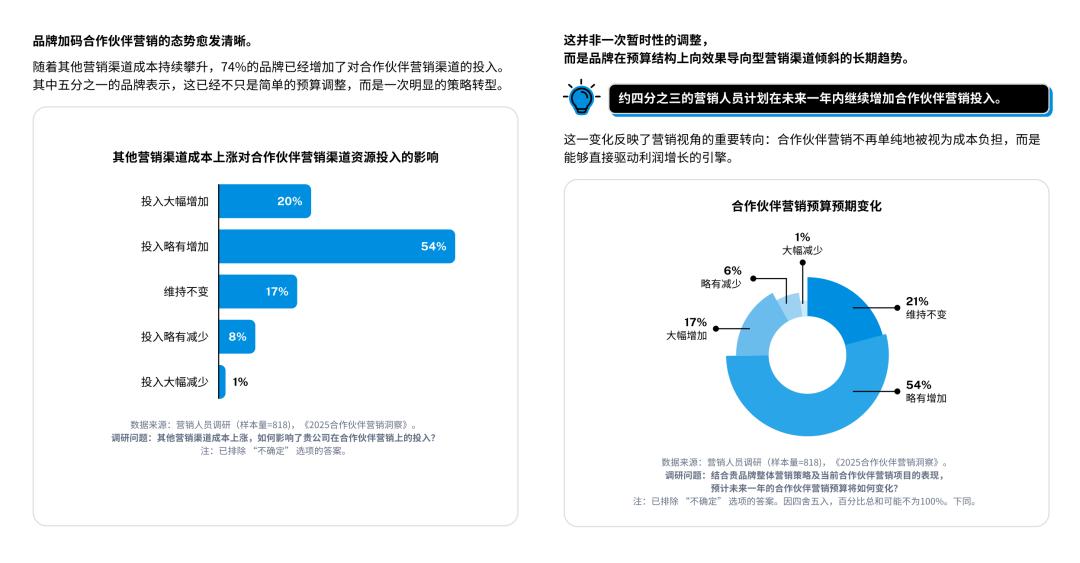
The era of simple traffic trading is over, and the importance of managing influence is becoming more and more prominent. Data confirms this collective shift in strategic focus. The report shows that 74% of brands significantly increased their investment in partner marketing in the past year, mainly because the cost of traditional marketing channels has approached or even exceeded the return. Currently, the "sovereignty" of budget allocation is shifting: about 38% of brands have allocated 21% - 30% of their marketing budget to partner channels, and even 6% of radical pioneers have invested more than half of their budget in this area.
When this strategic consensus moves from theory to practice, brands at different stages of development are deriving completely different growth formulas by reconstructing their partner systems.
02
From One - time to a Long - term, Scalable, and Predictable Network
The practical feedback from enterprises at different stages outlines two vertical lines in the evolution of global partner marketing: one is leveraging trust from scratch, and the other is improving management efficiency from existing success.
Since 2023, TrainPal has shifted its growth focus from simple user acquisition to the partner ecosystem. Through the systematic tools of impact.com, it has retrospectively identified local media that provide trust endorsements, achieving an explosive growth of over 350% in its core new markets. The American outdoor brand Stio, on the other hand, demonstrated cost - reduction and efficiency - improvement during its expansion stage: through unified management and reconstructed attribution, Stio identified the real contributions of its partners, increasing sales by 25% year - on - year while reducing expenses by 7.5%.
Although they started from different points, they are heading towards the same end — Affiliate marketing has officially bid farewell to the marginal "inventory - clearing" ecosystem, and partnership marketing has become the core driving force for brand growth.
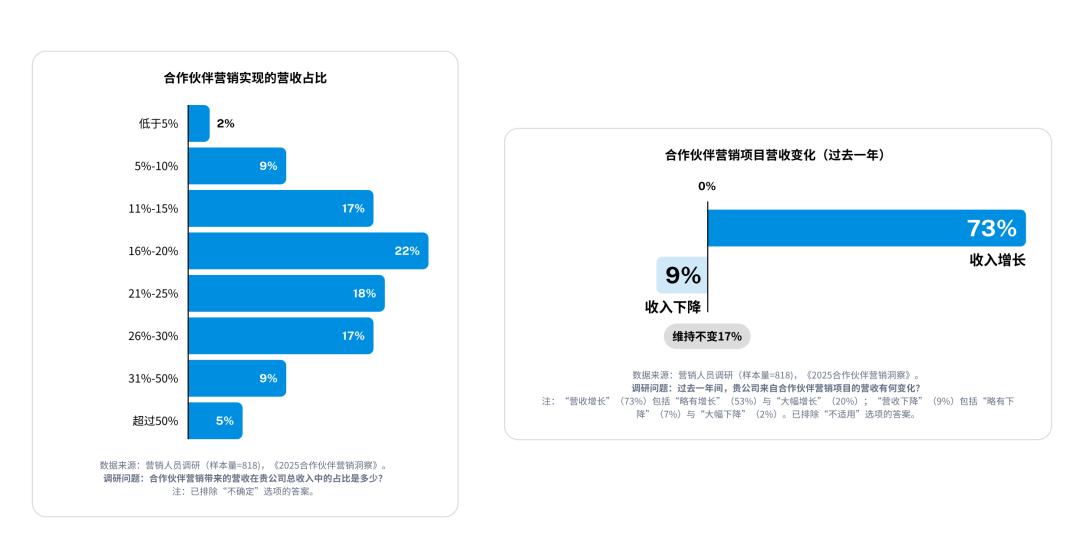
The essence of this transformation is the fundamental reconstruction of the enterprise's growth logic. As revealed in the impact.com report, partnership marketing is no longer an optional "extra". About 73% of brands witnessed continuous growth in the revenue of their affiliate programs in the past year, and 66% of brands clearly observed a significant increase in ROAS (Return on Advertising Spend). This means that brands are no longer simply buying traffic in the increasingly crowded advertising traffic pool, but are building their own trust - asset networks through a manageable system.
When the steering wheel of growth shifts to third - party creators and communities, a harsh question emerges: How can enterprises manage this "unofficial" scattered power and transform it into a definite competitive moat?
In reality, most teams are still stuck in the "agricultural era" management model, relying on Excel spreadsheets, manual communication, and scattered coupon settlements. This approach will quickly lead to systematic risks such as out - of - control management costs and attribution black boxes when facing thousands of partners across multiple markets and languages. Overseas brands moving into deeper waters, like Stio mentioned above, are completing a crucial paradigm shift through an operating system like impact.com.
On the one hand, through unified attribution sovereignty, the value evaluation system is completely reconstructed. When brands can view every node from a global perspective and see which creators were responsible for the initial "brand awareness" and which media made the final "push", brands will truly have the power to accurately price traffic.
Another industry - changing force is the automation brought by AI. The report shows that 97% of brands have started using AI in their workflows. Through a complete reconstruction of the underlying technology stack, in - depth data mining, and full - funnel integration of AI, impact.com transforms scattered cooperation relationships into scalable digital assets.
Ultimately, when the partner network is further connected with retail media and AI search, brand management can finally form a cognitive network that can be reused and scaled up in the long term.
From this perspective, for most Chinese brands going global, they should at least complete a key leap before 2026: Upgrade partner marketing from decentralized operation to platform - based management and gradually introduce AI - assisted decision - making. This is the watershed for long - term and sustainable growth capabilities. Continuing with the old methods means that organizations will have to bear increasingly high management costs but still struggle to get clear attribution; truly high - quality partners will choose more mature collaborators due to complex processes and unbalanced incentives.
This invisible structural gap often becomes apparent after a few years. After all, in the global competition that is constantly evolving around refined and systematic capabilities, not upgrading means being quietly left behind.
03
Efficiency, Intelligence, and Ecosystem Capability Bring Scarce Certainty
A few years ago, TikTok for Business discovered an anti - common - sense truth in a survey: More than 75% of small and medium - sized enterprise advertisers did not learn about advertising investment through official channels. Instead, they preferred to seek experience from third - party ecosystems such as blogs, KOLs, and YouTube. This means that the key variables driving decisions are the creators and partners scattered around the world. If these external roles cannot be systematically managed, growth will inevitably encounter structural bottlenecks.
Based on this, TikTok for Business introduced impact.com as the underlying platform to build a global partner system from scratch. By integrating creators, agencies, and B2B partners into an online management framework, the cumbersome signing and settlement processes are replaced by automated operations; more importantly, its attribution logic has evolved from "last - click" to a deep dissection of users' journey contributions.
The efficiency improvement brought by this system is immediate: while the scale of partners has expanded more than three times, the manual operation workload of the team has decreased by 75%. Since then, the affiliate channel has undergone a fundamental qualitative change from a "supplementary advertising channel" to a "long - term growth engine driven by trust and content".
When enterprises regard the partner network as infrastructure to operate rather than a temporary customer - acquisition channel, the growth mode will undergo a qualitative change. This is also the direction that impact.com continuously emphasizes in the report — partner marketing is starting to shift from a "tactical move" to a "strategic structure".
In the process of long - term cooperation with a large number of brands, impact.com has summarized a gradually clear evolution path: enterprises no longer rely on a single type of partner but build a more diverse matrix; the investment method has changed from burning budgets first to paying for real results; AI is no longer just in the experimental stage but is used to support scalable management; content cooperation has shifted from short - term exposure to long - term asset building; and the measurement system has evolved from single - attribution to a multi - model combination.
If the focus in the first stage was "whether to do affiliate marketing", then today, a more important question is how to integrate affiliate marketing into the enterprise's growth center and link it with systematic operation capabilities. In this regard, impact.com's role is actually more like an "operating system" — it reconstructs the way enterprises manage their partner networks around three things.
Firstly, efficiency.
When the number of partners increases from dozens to hundreds or even thousands, pure manual coordination is almost unsustainable. impact.com breaks down and automates these processes: from recruitment, approval, signing, settlement, to report verification, all are driven by fixed processes. To further improve this productivity, it recently launched a complete reconstruction of the front - end technology stack. It not only redesigned all 650 pages to revolutionize the operation experience but also optimized the mobile version and a new Chrome extension to ensure that brands and partners can collaborate efficiently anytime and anywhere.
Secondly, intelligence.
As the data dimensions continue to increase, it is difficult to make accurate judgments based on manual intuition alone. impact.com has introduced intelligent assistants like "Ask Impact" into the platform to convert massive amounts of data into suggestions. The core of this intelligence is driven by the "Data Lab" function. Through newly designed dashboards and widgets, brands can view the overall situation with greater flexibility and data richness. In a more advanced stage, intelligent agents start to take over entire processes — automatically expand the recruitment scope, generate invitation emails, follow up on progress, and trigger approvals when necessary.
Finally, it is the spill - over effect at the ecosystem level.
When the affiliate platform expands from a single role to include creators, loyal users, media, and the retail end, the partner economy itself begins to show a networked structure. According to impact.com's product roadmap, its next - generation flagship product will further deeply integrate AI and the partner ecosystem, aiming to help brands optimize affiliate, creator, and referral marketing in one - stop. In the Creator module of impact, brands can more accurately match creators; in the Advocate module, loyal users are included in the referral system. When these capabilities are combined, partner marketing becomes a network asset that can be continuously optimized and reused.
For global brands, the real deciding factor is not getting caught up in the efficiency game of single - time advertising investment but rather precipitating sustainable influence at the structural level. In this sense, what impact.com provides is not just a simple tool upgrade but also a fundamental methodology for networked operation. It reconstructs the discrete, accidental, and highly individual - experience - dependent collaboration model into a system that can be observed, measured, and evolved.
And this systematic ability is precisely the scarcest certainty for long - term growth in global competition.
04
From Individual Combat to the Game of Global Operation Systems
Looking at global competition, a harsh truth has emerged: in the second half of the overseas expansion journey, the competition between companies is evolving from individual combat to a game of system complexity.
Traditional overseas marketing was carried out in a small - scale way, relying on manual work in Excel spreadsheets to connect with a few cash - back websites or KOLs. In essence, it was using the management precision of the agricultural era to confront the algorithmic torrent of the information age. Leading players represented by Anker, Banggood, PatPat, and Jackery are building a fully automated ecological matrix.
The data in the impact.com report shows a highly explosive signal: 97% of brands have deeply embedded AI in partner management. This is an inevitable choice for survival — When your partners grow exponentially, spanning different languages, regional laws, and multiple attribution logics, enterprises without an "operating system" will instantly fall into the quagmire of increasing management entropy.
