DJI counterattacks Insta360, and LIU Jingkang stops pretending.
After Insta360 took off, Liu Jingkang became anxious instead.
Within 48 hours after the release of the Insta360 Antigravity A1, a product defined as "the world's first panoramic drone", it sold about 30 million yuan.
However, before the hype subsided, the cold water from the industry was poured on.
According to Sina Finance, quoting industry insiders, based on the customer unit price of about 7,000 - 8,000 yuan, the sales volume of over 30 million yuan actually translates to roughly 3,000 - 4,000 units, which is "not outstanding".
Liu Jingkang didn't accept this view. He responded in an internal letter, saying that "the content of many articles doesn't conform to the facts." However, on social media, where the perception is more real and noisy, the reviews of the Insta360 A1 are mixed.
Facing the doubts, Liu Jingkang seemingly made a thought - provoking choice: to point the finger at DJI.
From "unfair competition", to "supply - chain exclusivity", and then to "negative public relations", he publicly named DJI multiple times, with his wording becoming tougher each time.
Objectively speaking, with the core innovation of "panoramic shooting" entering the drone territory, Insta360 indeed has reasons to make DJI vigilant. Liu Jingkang once admitted, "When we made this decision five years ago, we anticipated that it would stimulate DJI to 'copy' our panoramic camera business. Even at this cost, we chose to set sail."
In his narrative, this is more like a bold gamble where one knows they will face a strong enemy but still has to set off.
Once upon a time, Liu Jingkang still maintained a considerable degree of restraint and respect towards DJI. "In the past decade, thanks to GoPro and DJI. They are like gravity, the pioneers of the industry and the fundamental conditions for the existence of the industry."
But now, this decent restraint seems to be torn off by his own hands. Liu Jingkang began to frequently emphasize that the competition with DJI is "not normal" and publicly stated that he will -
"Fight to the end, until death."
When emotions come to the forefront, it often means that the balance sheet is no longer that easy.
Insta360, which successfully went public in 2025, has been in a state of "increasing revenue but not profit" for multiple consecutive quarters. And the Insta360 A1, a product full of high hopes, is both a hope and a cost black hole.
As a result, this competition, originally about product innovation, quickly escalated to the level of "all - out confrontation".
Actually, the seeds of this war were sown at the beginning of Insta360's entrepreneurship.
Insta360 "Takes Off"
Speaking of which, Insta360's first moment in the spotlight was also when it "sent the panoramic camera into the sky".
In 2017, before the official release of Insta360's first panoramic camera, the Nano, Liu Jingkang came up with an idea - to tie the panoramic camera to an eagle and record the world it saw while flying. Within two weeks, this video got over 50 million views across the internet, and the Nano became popular even before its launch. In the following years, Insta360 almost released a "eagle's - eye view" video every year.
If we look further back, Liu Jingkang's initial inspiration for entrepreneurship actually came from his first experience of watching a 360° panoramic aerial video. To some extent, making the panoramic camera fly seems to have become an obsession later on.
Liu Jingkang even wrote in a later internal letter: It (the panoramic drone) is the consumer - grade drone that best suits human intuition. Through the panoramic lens and the somatosensory control of the handle, fingers are the direction, and the gaze is the focus. There's no need for complex camera movements. When paired with VR glasses, it's like flying in the sky like a bird.
The real action took place in 2020. According to Liu Jingkang, in this year, Insta360 officially entered the drone field, and this decision later stimulated DJI to "copy" their business. However, looking at the timeline, in 2019, DJI released its first action camera, the Osmo Action: Actually, DJI made the first move.
At this time, Liu Jingkang was still polite to his competitors. Before his own company's drone came out, he even "thoughtfully" made a panoramic camera compatible with DJI's drones:
In 2022, Insta360 released the "Tong Sphere" drone panoramic camera. It's an external - type product, specifically designed to be compatible with DJI's Mavic Air 2 and Air 2S models. Its biggest selling point is the ability to achieve a "stealth" shooting effect of the drone in a 360° picture. Completing the seamless stitching of the panoramic picture through algorithms is Insta360's most proficient core technology, and this time, it was fully transplanted to DJI's flight platform.
However, it's hard to say that this "thoughtfulness" is just a simple accessory idea. It's more like an implicit reminder to the market and users: Traditional drones can't do panoramic shooting, which means that for most ordinary users, there are two professional technical thresholds in drone aerial photography: flight control and photography composition.
In other words, for the vast majority of ordinary users, being able to fly doesn't mean being able to shoot. Therefore, Liu Jingkang even used an ambitious metaphor in last year's internal letter: "Panoramic drones are to traditional drones what cars are to horse - drawn carriages."
Therefore, in this seemingly accessory product serving competitors, Insta360 quietly accomplished two things: one was technical verification, and the other was user education.
By the time Insta360 finished this step, DJI also woke up. That year, DJI, which was busy with the Osmo Action 3, officially launched its panoramic camera project. The "copying" that Liu Jingkang had predicted before finally came.
Even so, Liu Jingkang always maintained a considerable degree of restraint and respect towards his competitors. In July 2024, he wrote "Respect DJI" on his WeChat Moments, actively breaking the common narrative in the action - camera industry where "challengers always belittle the leader". "The top runners in a marathon are top - level athletes, and you'll also run faster." At the company's annual meeting that year, he publicly said again "Thank you, DJI. Thank you, GoPro".
The direct confrontation soon arrived.
One year later, DJI's first panoramic camera, the Osmo 360, was officially released, posing a substantial direct threat to Insta360. The standard set of the Osmo 360 is priced at 2,999 yuan, 800 yuan lower than the initial launch price of Insta360's flagship model, the Insta360 X5. The price war quickly started.
DJI has successfully entered Insta360's territory.
A Do - or - Die Battle
For Insta360, drones are no longer just Liu Jingkang's personal "obsession". After its shipment volume exceeded that of GoPro, this is a real - world choice that the company has to face.
Looking at the market space, the answer is not complicated. According to the Frost & Sullivan report, in 2024, the global panoramic - camera market size was about 590 million yuan, with an expected compound annual growth rate of 11.8% from 2023 - 2027. In the same period, the global drone market size had reached about 260 billion yuan, with a compound annual growth rate as high as 19.17%. The two curves point to different growth prospects.
Although both are leading players in their respective fields, in terms of both scale and flexibility, they are no longer on the same level. More importantly, after DJI entered the panoramic - camera field, the structure of the panoramic - camera industry is changing - from a nearly single - dominant pattern in the past to a confrontation between "Insta360 and DJI". In the drone field, DJI still holds an absolute dominant position.
The data shows the most intuitive change trajectory. In 2024, Insta360 still had a market share of about 81.7% in the panoramic - camera market. But by the third quarter of last year, this figure had quickly dropped to 49%. Meanwhile, with the launch of the Osmo 360, DJI's market share rose to about 43%. This is not just the result of a product competition but a signal: The panoramic - camera field is no longer safe.
In this context, Liu Jingkang's decision to launch the long - awaited panoramic drone into the market seems like an inevitable choice. By creating a new niche scenario, Insta360 is trying to open a new growth entry point for itself and the drone field. What was once an active layout has gradually evolved into a defensive counter - attack at this moment.
However, reality soon gave another reminder. The market performance of the Osmo 360 in a short period of time just shows one thing: For DJI, entering the imaging field is more like a "side - by - side" horizontal expansion. However, drones are not Insta360's comfort zone. In fact, it's a completely different engineering world - flight control systems, wireless communication, stability, safety redundancy, and regulatory compliance. Each aspect is much more complex than a camera.
That's why DJI's counter - attack didn't stop at the product level but started from this complex system engineering.
Four days after the release of the Insta360 A1, Liu Jingkang revealed in an internal letter that half a year before the plane was launched, several core suppliers of Insta360's Antigravity series suddenly faced "exclusivity" pressure: 7 suppliers of optical lens modules, 8 of structural parts, 3 of screens, 2 of batteries, 8 of chips and electronic components, and 5 other suppliers.
Insta360's supply - chain director later told the outside world that this kind of pressure was not the first time. In the past five years, the exclusivity requirements for some suppliers were only at the oral level. But in the third quarter of 2024, this attitude was further clarified as: "You can cooperate with other customers, but Insta360 must be excluded."
In response, a mid - level DJI employee said, "Some supply chains were cultivated from scratch by DJI over several years... If suppliers turn around and sell to others, it's like directly telling competitors our established technological and product foundation. This is unfair to DJI."
The game at the channel end is also fierce. Sohu Technology reported that DJI once terminated cooperation with some dealers on the grounds of "suspected operation of competing products" and asked them to remove DJI's logos from their stores. In Insta360's authorized system, there are also restrictions on competing products. Last year, an Insta360 store in Hunan even had to remove its signboard because of an exclusive agreement between the mall and DJI.
In the internal letter, Liu Jingkang emphasized that Insta360 was not unprepared. Facing the risk of supply - chain exclusivity, the company formulated multiple contingency plans in advance, enabling it to complete the supplier switch in a short time and rebuild a relatively self - controllable supply system. The R & D and supply - chain teams "protected the product's lifeline".
However, from the final product result, this tug - of - war around the supply chain still left clear marks on the Insta360 A1.
Liu Jingkang Drops the Act
As the world's first panoramic drone, the innovation of the Insta360 A1 really surprised many consumers.
The logic of "fly first, then compose" is almost tailor - made for non - professional users. When shooting, users only need to focus on flying, and they can freely select the view from the panoramic footage later without having to reshoot repeatedly. "If you want to capture those fleeting natural sceneries, this shooting method is very practical."
What Liu Jingkang emphasizes, "Fingers are the direction, and the gaze is the focus", is not just empty talk in terms of experience. The somatosensory control significantly reduces the learning cost. For users who don't want to spend a lot of time practicing flight control and just want to experience the feeling of flying and panoramic imaging, the Insta360 A1 provides an alternative to the DJI system.
However, problems also emerged.
As Insta360's first - generation panoramic drone product, many consumers felt that "the idea is good, but the product seems to be rushed to the market before it was perfected."
Image transmission became the most - complained - about shortcoming. Some users reported that there was a probability of signal loss even at an altitude of 375 meters in an open environment, and the limit distance was limited. In common scenarios such as parks and riversides, the signal started to turn yellow and the image transmission became laggy at about 900 meters. In the VR scenario, the unstable image transmission often brought a sense of dizziness to users.
In addition, problems such as the inability to fly backward, the lack of all - around obstacle avoidance, an overly large automatic obstacle - avoidance range, and limited wind - resistance ability were superimposed to some extent, further reducing the overall experience.
It's worth noting that this is not just "emotional complaints" from domestic users. In the reviews of many overseas reviewers, the above problems were also repeatedly mentioned.
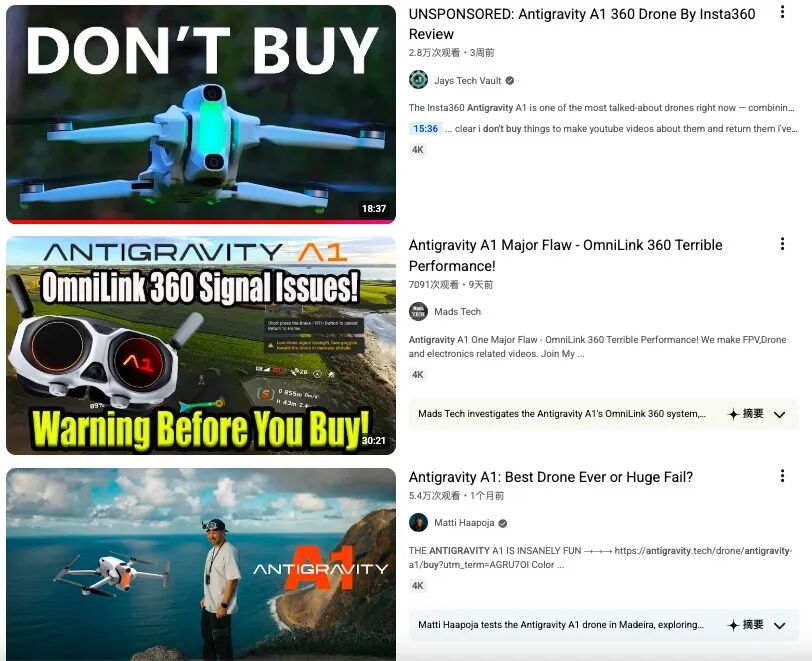
Even so, the market didn't completely deny Insta360's innovation. Both domestic users and overseas reviewers generally recognized the breakthrough of the Insta360 A1 and expected it to make up for its shortcomings in subsequent versions.
But what really alerted Liu Jingkang was not just the controversy at the product level.
Insta360 found on social platforms that a large number of negative reviews used the same "customer - service communication screenshots" to prove "refusal to return goods". Accounts originally focused on beauty, mother - and - baby products, and fashion started to intensively post negative reviews of drones. Even some newly - registered accounts almost only posted negative content about the Insta360 A1.
On December 8th, Liu Jingkang said bluntly in an internal letter, "These unconventional and intensive attacks just show that we have really touched some existing patterns."
On December 22nd, Insta360's legal department further disclosed that within two weeks after the launch of the Antigravity A1, more than 2,500 false and malicious pieces of content appeared on the internet. The relevant evidence has been fixed and reported to the police.
Subsequently, Liu Jingkang forwarded a statement soliciting clues about negative public relations on his WeChat Moments: "I counted. In the past three years, we only sent six or seven people to prison. I estimate that the number will increase sharply in 2026."
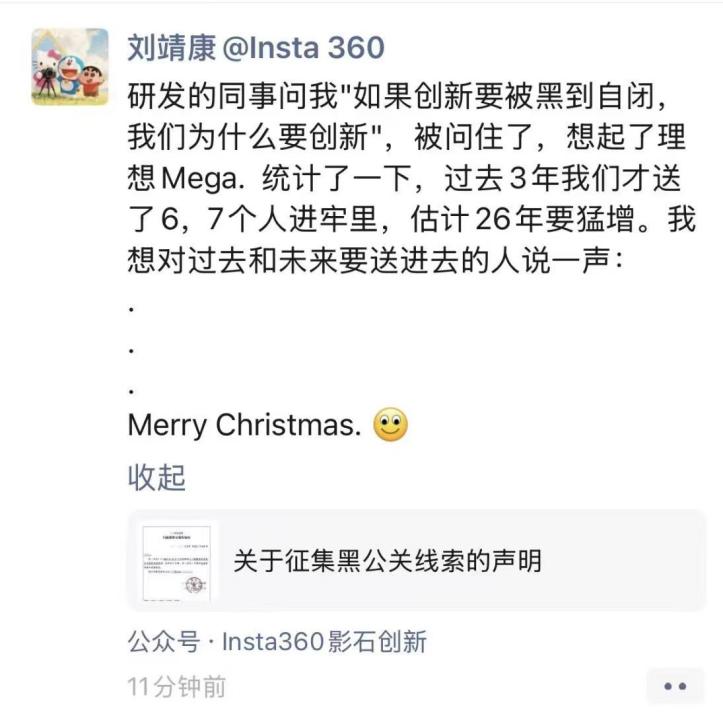
Rather than an emotional outburst, it's better to say that Insta360 has already defaulted that this conflict is no longer just a simple product competition.
In fact, Liu Jingkang's attitude towards DJI has long changed from "respect" in public to "respect" with a sarcastic meaning. In October last year, he wrote on his WeChat Moments, "The only king capable of achieving a monopoly in consumer electronics and consumer products is unprecedented and will be unparalleled. It's impossible to achieve a monopoly just by product technology and marketing."
This is not just a war