Jensen Huang personally transfers money. Elon Musk raises a staggering 140 billion overnight and bets on the ultimate outcome of AGI with one million GPUs.
Elon Musk has aggressively raised $20 billion to take on OpenAI head - on. Holding a million GPUs, he's betting big on the arrival of AGI next year. This computing power arms race for humanity's future has completely entered a "crazy" mode.
A few days ago, Musk declared, "We've entered the singularity, and 2026 is the year of the singularity!"
Today, xAI has officially received a new round of financing (Series E): a whopping $20 billion (about 140 billion RMB), far exceeding the previously set target of $15 billion.
Even Huang (Jensen Huang) has invested. NVIDIA and Cisco are both "strategic investors."

Meanwhile, other participants in this round of financing include a host of star venture capital firms such as Valor Equity Partners, Stepstone Group, and Fidelity Management & Research Company.
Next, this huge sum of money will be used to scale up computing power and build the world's largest GPU cluster.
Even more exciting is that Grok 5 is in training and will debut this year.
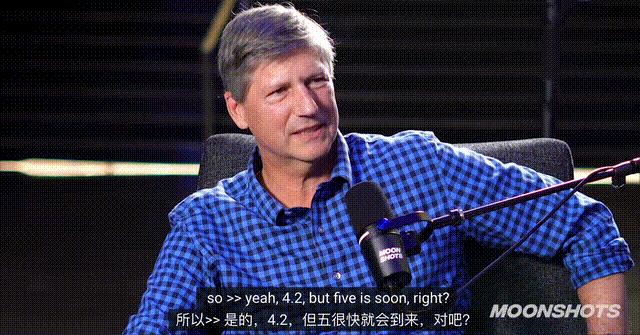
An excited researcher from the xAI team said, "This is xAI's year, and it's also a year of whole - heartedly pursuing the truth!"



A record - breaking $20 billion in financing, valuation closely trailing OpenAI
Founded in 2023, xAI has created an impossible miracle in just three years.
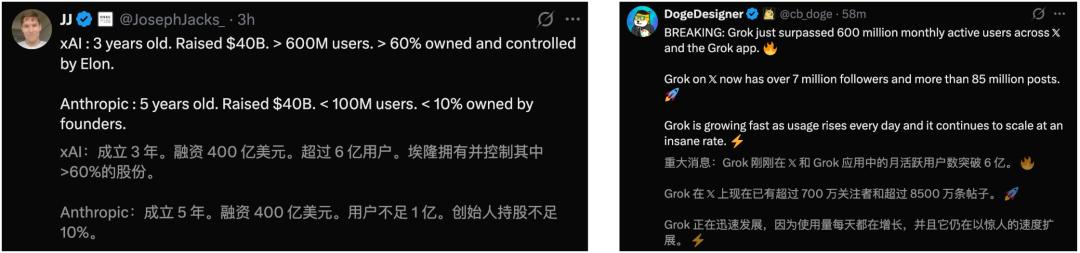
Currently, the monthly active user count of its Grok application has exceeded 600 million and is still expanding at an astonishing rate.
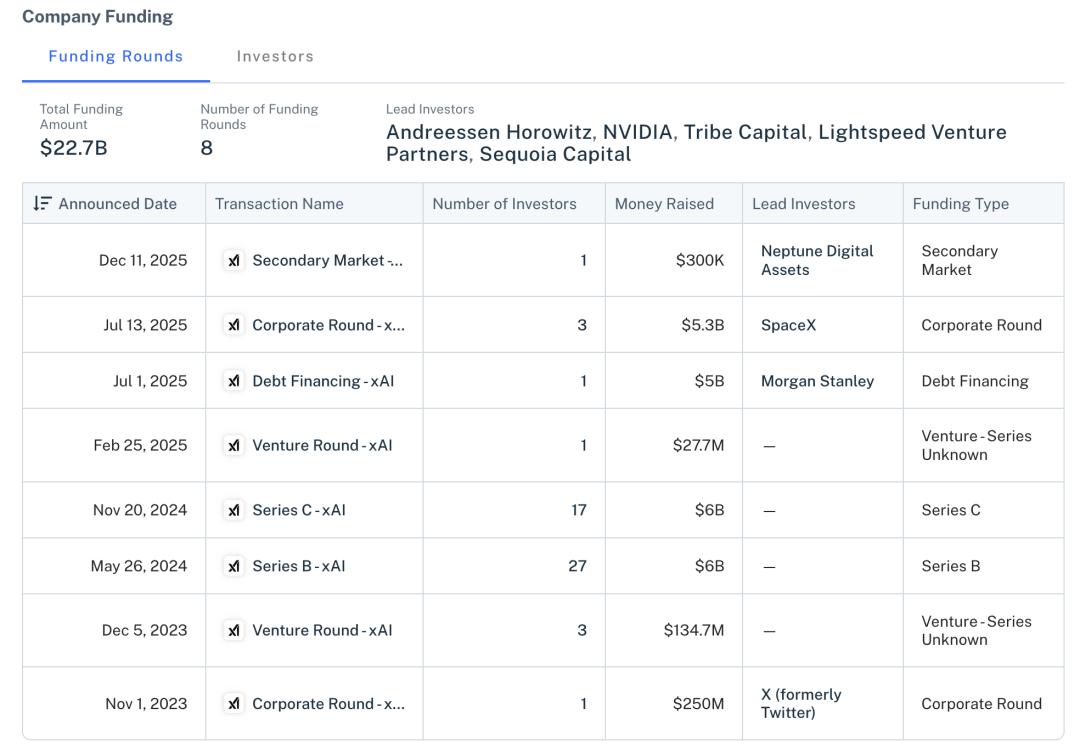
According to Crunchbase statistics, xAI has completed 8 rounds of financing so far, with a total amount of up to $22.7 billion.
The two largest financing rounds were the Series C and Series B rounds completed in 2024, each worth $6 billion.
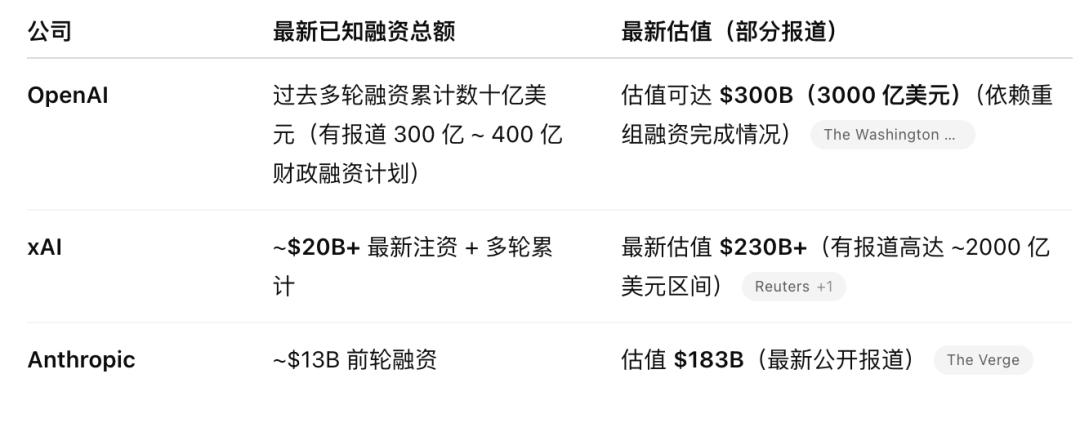
With this latest financing of up to $20 billion, the total financing amount has exceeded $40 billion.
Now, xAI's valuation has been pushed to approximately $230 billion, closely trailing OpenAI and far exceeding Anthropic.
xAI stated that strategic investors will also provide support in terms of computing power. NVIDIA supplies chips to xAI for the training and operation of its AI models.
Holding a million GPUs, Grok 5 is in training
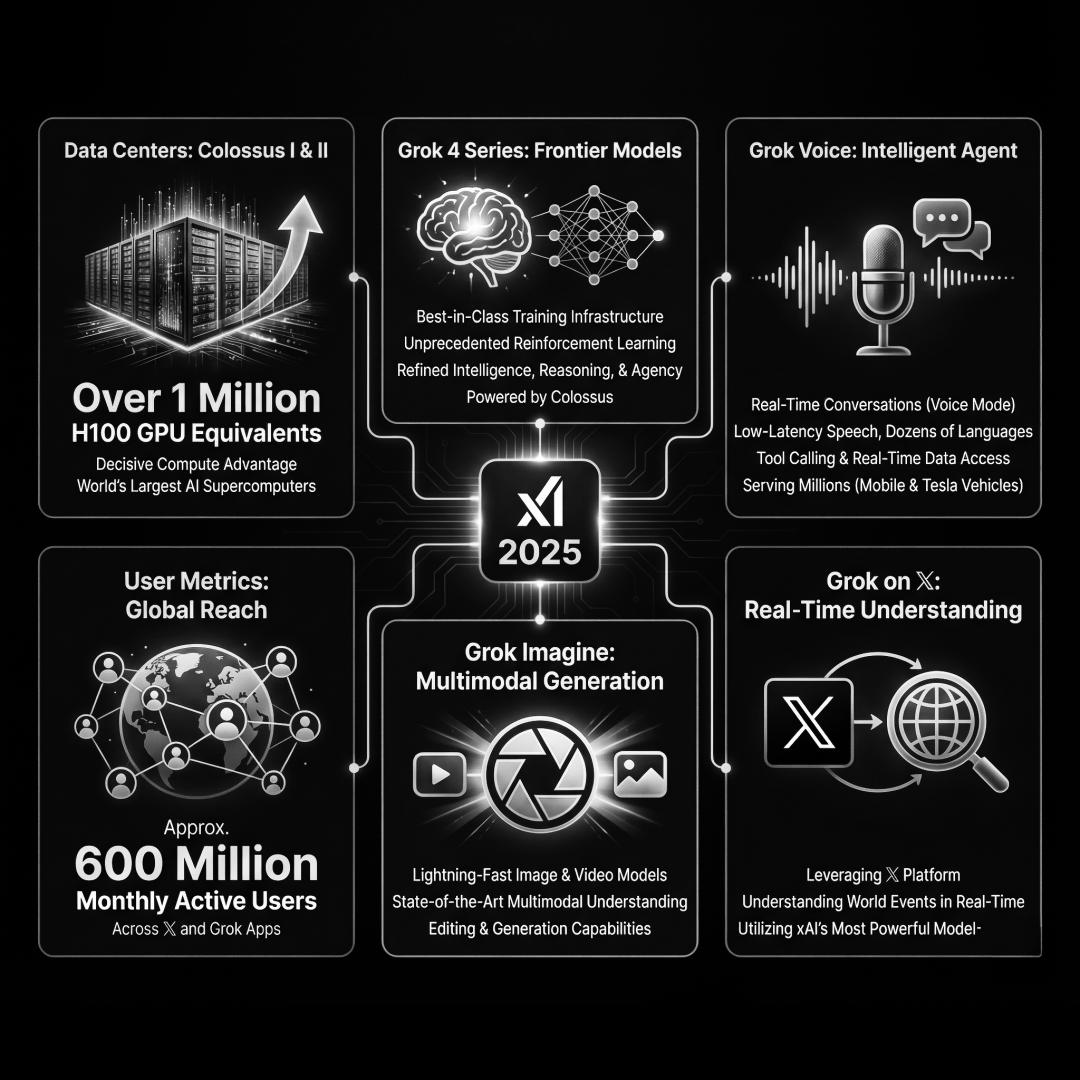
On its official blog, xAI said, "2025 was a year of breakthroughs," and publicly shared the achievements it has made over the past year:
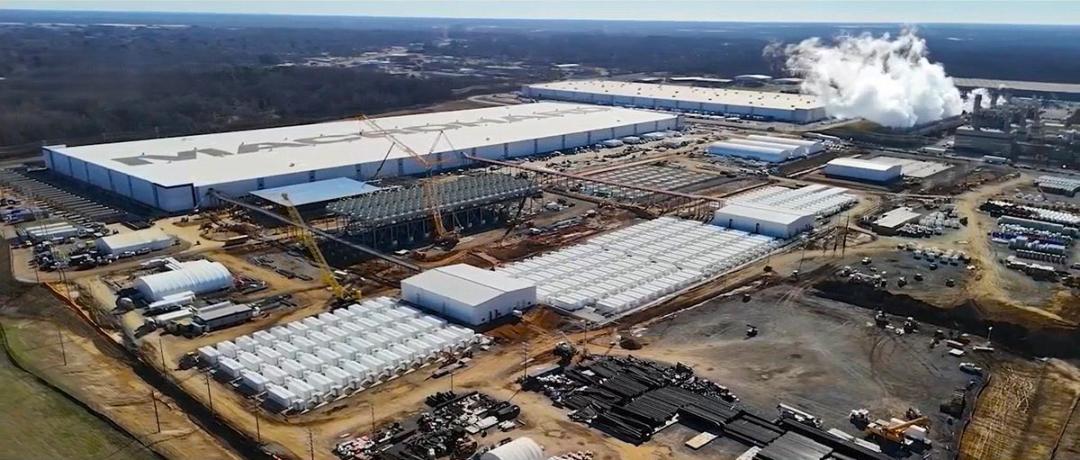
Data Centers
xAI has continuously expanded its decisive computing power advantage by deploying the world's largest AI supercomputer system at Colossus I and Colossus II.
By the end of the year, the equivalent number of H100 GPUs had exceeded one million.
The Grok 4 Series
The most powerful Grok 4 series was trained on the world's computing power behemoth powered by Colossus.
Moreover, xAI has taken RL training to an unprecedented level, using pre - training - scale computing power to systematically optimize Grok's intelligence level, reasoning ability, and autonomy.
Grok Voice
The current most intelligent voice AI agent supports real - time conversations in voice mode and provides services through the agent API.
It supports low - latency voice interaction, tool invocation, and real - time data access in dozens of languages and has provided support to millions of users in the Grok mobile application and Tesla vehicles.
Grok Imagine: An image and video generation model with extreme speed, offering industry - leading multimodal understanding, editing, and generation capabilities.
User metrics: The monthly active user base on 𝕏 and the Grok application is approximately 600 million.
Grok on 𝕏: Relying on the 𝕏 platform to gain real - time insights into global trends, it runs the most powerful model xAI has developed to date.
Most importantly, the next - generation flagship model, Grok 5, is in training. Musk has predicted that it will be launched in the first quarter of 2026.
Musk: AGI in 2026, half of white - collar jobs will disappear
In an interview that just went live today, Musk once again boldly stated, "AGI will arrive in 2026!"
By 2030, AI will surpass the combined intelligence of all humans and grow exponentially at a rate of ten times per year.
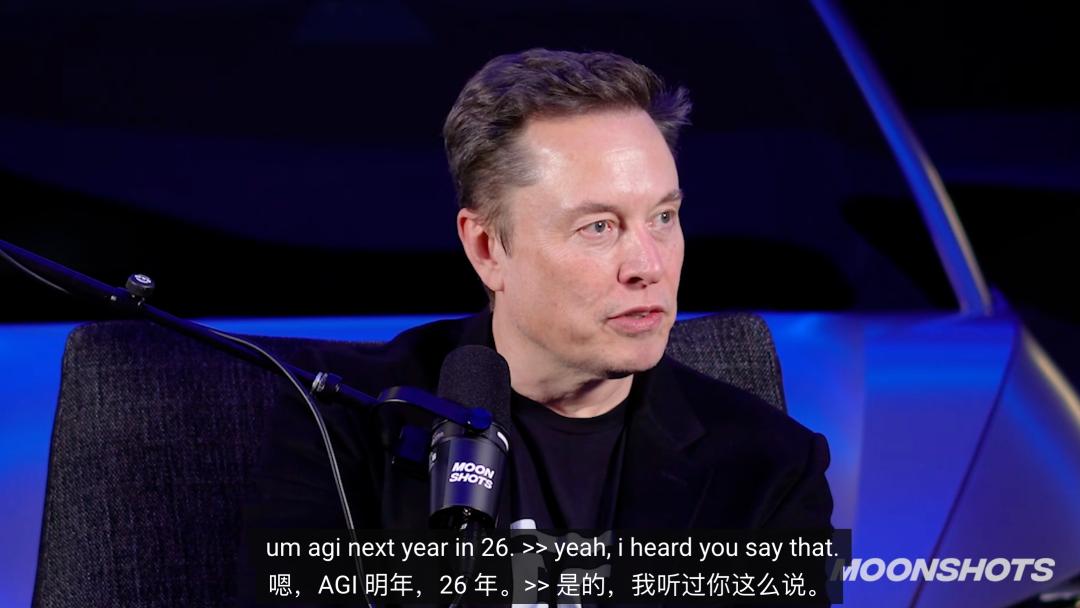
In a nearly three - hour podcast, Musk also shared his views on topics such as robots, space exploration, the chip crisis, and extraterrestrial life.
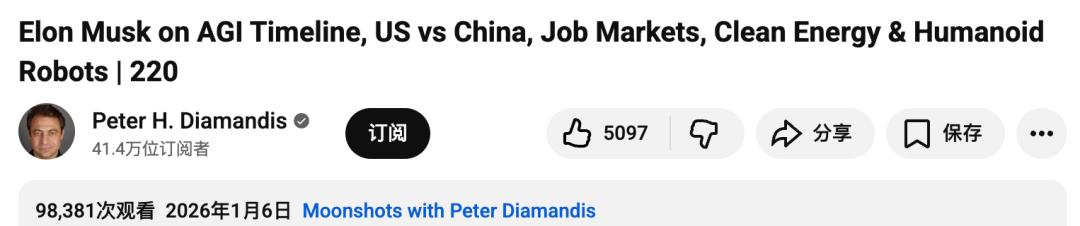
The host, Peter Diamandis, said bluntly that after this conversation with Musk, he had a profound feeling:
We are in the midst of the singularity.
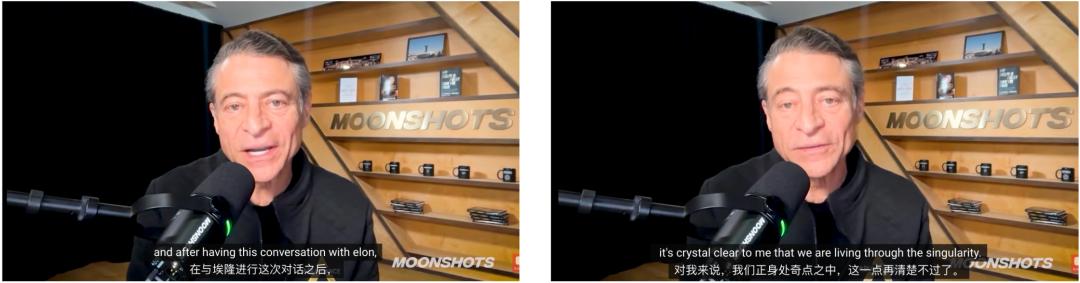
What exactly did Musk say to make the host have such deep feelings?
He said that the combination of AI and robots will create an irreversible exponential impact - a "supersonic tsunami."
Even today's AI "can almost replace half of full - time jobs," especially white - collar jobs are the first to be affected.
Moreover, he proposed an acceleration mechanism for replacement: AI companies will outperform non - AI companies. In the future, only companies that fully utilize AI will reach their full potential.
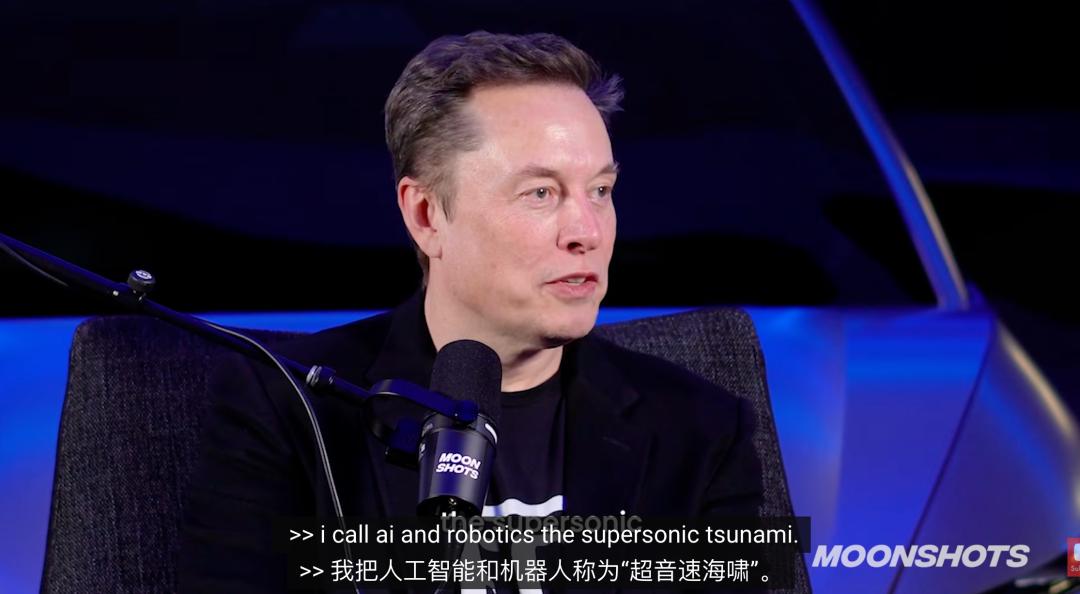
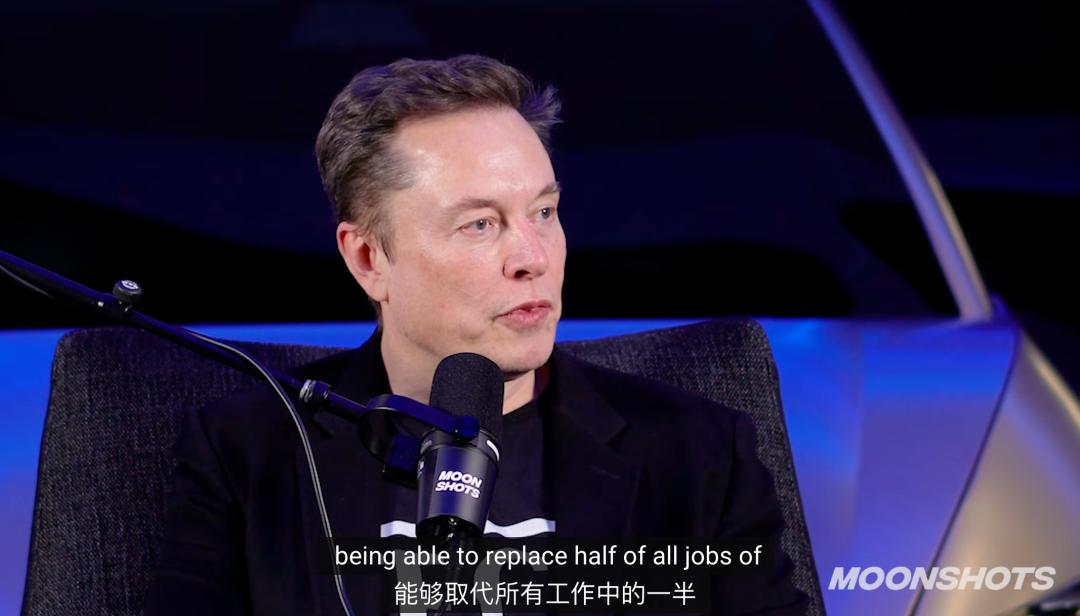
In Musk's ultimate AI narrative, the goal is not to become like "The Terminator" but "Star Trek." AI should first satisfy all human desires, and then lead to a deeper - level civilization leap.
For AI not to "go crazy," it needs three things: truth, curiosity, and aesthetic sense. This is "Musk's philosophy."
In his view, energy and computing power scale are the bottlenecks for AI. When the transportation cost is low enough, AI computing will naturally "migrate to space."
An AI data center in orbit has three major advantages: continuous solar energy, unlimited heat dissipation, and no competition for electricity with the Earth.
Moreover, 100GW is just the starting point. The long - term goal is to build a TW - level, or even 100TW - level AI energy system.
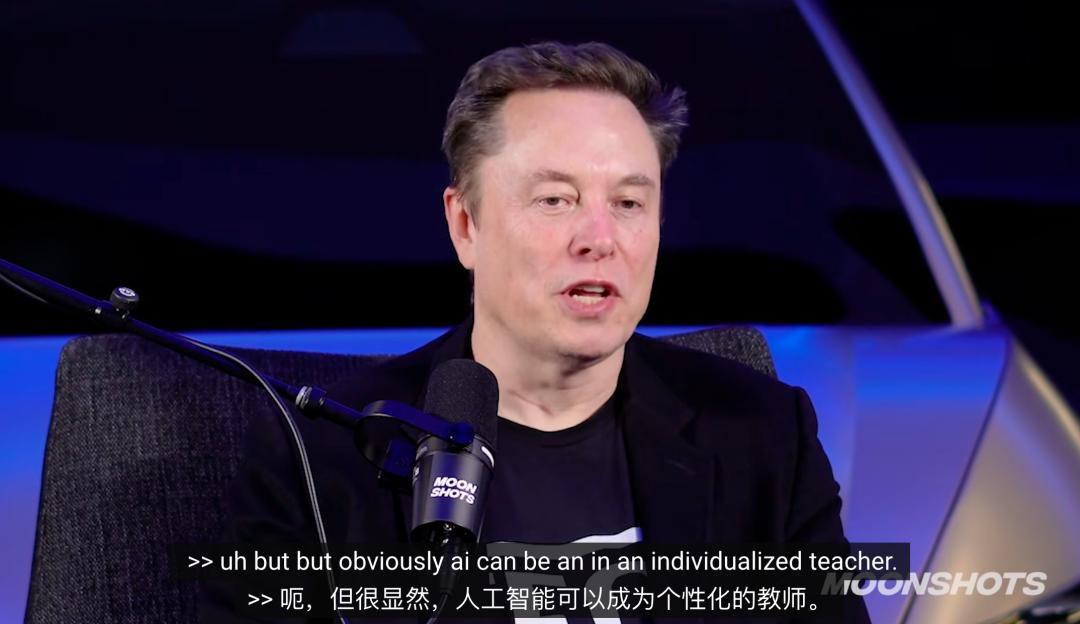
When talking about education in the AI era, Musk said that AI will have infinite patience and become a "one - on - one teacher" that answers questions at any time.
AI can make learning more interesting and even "motivate" learning, provided that students have curiosity.
Musk said that within the next 3 - 5 years, the humanoid robot "Optimus" will be able to perform surgeries far better than any surgeon on Earth.
Most importantly, robots can share everyone's experiences.
To understand the development speed of humanoid robots, the key lies in grasping the superimposed effect of three exponential growths:
First, the exponential improvement of AI software capabilities; second, the exponential leap in AI chip computing power; third, the exponential progress in the dexterity of electromechanical systems.
The practical value of humanoid robots is the result of multiplying these three factors.
More importantly, there is a "recursive effect" - Optimus can manufacture the next - generation Optimus. In essence, it is just a self - replicating device.
He even optimistically estimates that over 10 billion humanoid robots will be produced by 2040.
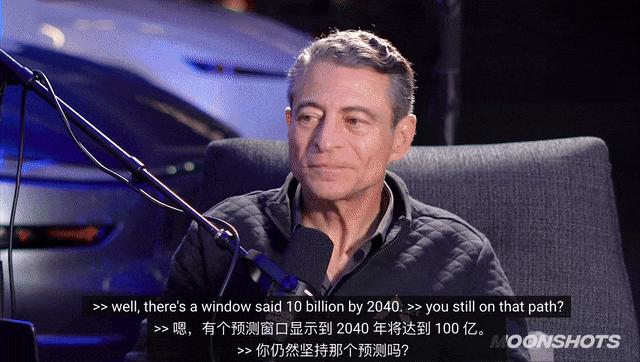
When talking about supercomputer construction, Musk shared an interesting story about xAI's "power self - rescue." At that time, they were building the first 1GW training cluster, Colossus, but it would take a year to connect to the power grid, so they had to "temporarily piece together power."
In the future, the biggest black hole for AI computing power will be video because of its high pixel bandwidth.
Musk also said that AI will turn mathematics, physics, chemistry, and materials science into "almost easy tasks." Math will soon be conquered by AI, and then the conquest will extend to the field of physics.