Explosive! What signal does it send when China is making every effort to develop nuclear fusion?
Many people wonder why, across the world, only China is vigorously pursuing nuclear fusion.
Controlled nuclear fusion has always been a controversial topic. Some say it is "the ultimate solution to humanity's energy shortage," while others claim it is a hoax.
Recently, Elon Musk publicly downplayed it, even saying that nuclear fusion is "utterly stupid." Since there is already a natural sun in the sky, why spend money to create another one?
However, China doesn't care about these opinions. Instead, it is increasing its efforts at an unprecedented pace to achieve a breakthrough in nuclear fusion.
Just three years ago, the United States was the absolute leader in global nuclear fusion financing, accounting for over 90% of the total.
But by last October, Bill Gates exclaimed that China's investment in thermonuclear fusion was already twice the sum of that in the rest of the world!
Take a look at the following chart. The red bars represent China, which is rising rapidly:
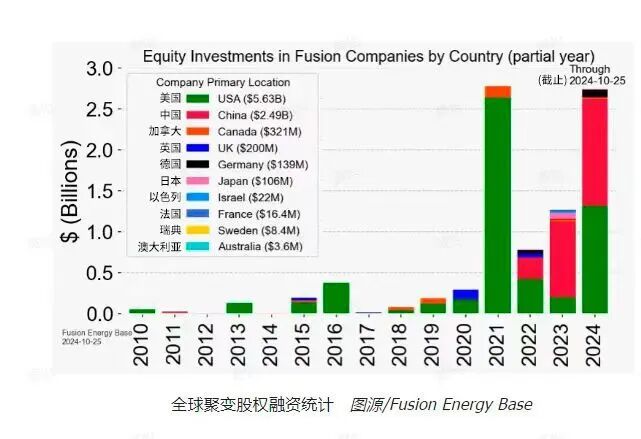
As a result, some industry insiders in the United States are worried. In the past few years, China has invested between $6 billion and $12 billion in the nuclear fusion field, while the United States has made slow progress and "still seems to be at the level of the 1990s."
What signal does China's vigorous pursuit of nuclear fusion send?
01
Many people haven't noticed that, imperceptibly, China has elevated nuclear fusion to a national strategic level.
In 2025, the State-owned Assets Supervision and Administration Commission of the State Council officially included nuclear fusion in the "Top Ten Projects of Future Industries." It plans to invest over 300 billion yuan before 2030, with an average annual investment of over 60 billion yuan.
In contrast, the annual nuclear fusion budget of the U.S. Department of Energy has been stable at around $700 million to $800 million in recent years, less than one-tenth of China's investment. Due to a lack of funds for maintenance and reconstruction, the tokamak devices in the United States have generally aged severely, and it has to rely on equipment from Japan, Europe, and the United Kingdom to maintain its research progress.
In July 2025, China Fusion Energy Co., Ltd. (referred to as "Fusion Company") was officially established in Shanghai. Its first-round financing reached as high as 11.492 billion yuan, setting the largest single financing record in Shanghai that year and directly giving birth to a super unicorn.
Its shareholder lineup is like a "national team all-star": China National Nuclear Corporation, China National Nuclear Power, and Kunlun Capital of China National Petroleum Corporation have all joined.
Meanwhile, private forces are also rising rapidly. In June 2024, the "Honghuang 70" of Energy Singularity successfully discharged electricity, becoming the world's first all-high-temperature superconducting tokamak device, significantly reducing cooling costs and shrinking the device's volume. Star Ring Fusion Energy focuses on spherical tokamak and magnetic reconnection technology, challenging traditional technical paths with a more compact structure and a simpler heating system.
The rapid progress of these diverse technical routes demonstrates the vibrant innovation ecosystem of China's nuclear fusion field.
Now, China's nuclear fusion has entered the "engineering feasibility verification" stage. From January 16th to 17th, the first national nuclear fusion conference integrating industry, academia, research, government, and finance will be held in Hefei, Anhui, aiming to promote collaborative innovation and achievement transformation in the upstream and downstream of the nuclear fusion industry chain.
Capital is also following up. Huachuang Securities pointed out that controlled nuclear fusion has entered a capital expenditure expansion cycle. It is expected that the peak of bidding will come from 2025 to 2028, and the total investment in major domestic projects will reach 146.5 billion yuan. Among them, the investment related to high-temperature superconducting magnets will exceed 100 billion yuan, driving the magnet market size to nearly 30 billion yuan and the strip market to over 10 billion yuan.
When will real commercialization arrive?
According to international standards, the commercialization of fusion energy needs to go through six stages: principle exploration, scale experiment, combustion experiment, experimental reactor, demonstration reactor, and commercial reactor.
As the "chain leader" unit for China's nuclear fusion commercialization, China Fusion Energy Co., Ltd. has released a clear "China timetable": start the combustion experiment in 2027, have the design ability for an engineering experimental reactor in 2030, build the first engineering experimental reactor in 2035, and build the first commercial demonstration reactor around 2045.
In June last year, Ren Zhengfei said in an interview with People's Daily:
"Artificial intelligence may be the last technological revolution in human society. Of course, there may also be nuclear fusion in the energy field."
This statement is probably not just a casual remark but has profound implications. Grandpa Ren may have seen a more distant evolution.
02
Facing China's increasing efforts in the nuclear fusion field, the anxiety of Americans can no longer be hidden.
On December 30, 2025, Fox News Network in the United States reported that as China increases its investment in nuclear fusion research, the United States may be facing another "Sputnik moment" in this field.
In the 1950s, the Soviet Union launched the artificial satellite "Sputnik" first, shocking the world and starting the space race. Now, "Sputnik" is used to describe the moment when one feels pressure and challenges in high-tech competition.
The old media New York Times recently wrote in an almost trembling tone that China is winning this energy race at an astonishing speed.
However, the United States' years of accumulation cannot be underestimated. The competition between the two sides is still in a stalemate.
In the United States, the well-funded nuclear fusion company "Commonwealth Fusion Systems" (CFS) announced that its experimental device in Massachusetts will achieve "energy gain" - that is, the output energy will exceed the input energy - in 2027. This will be a signal that nuclear fusion is expected to power facilities such as data centers and steel mills in the future.
Almost at the same time, in October 2025, the first compact fusion energy experimental device BEST using the all-superconducting tokamak technology route in Hefei, Anhui, officially entered the final assembly stage. It will be completed in 2027 and achieve that the output energy is greater than the consumed energy, demonstrating fusion energy power generation.
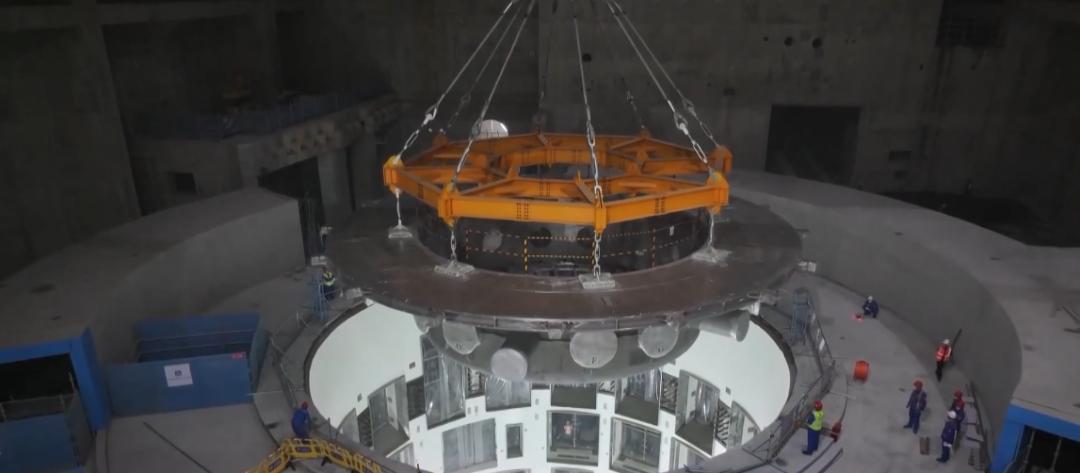
The source of the Dua base, a key component of the BEST device's mainframe: CCTV Military
This means that China and the United States are almost simultaneously targeting the critical node of 2027, and a head-on confrontation in nuclear fusion is about to take place.
However, the United States' anxiety lies in the fact that as a latecomer, China is approaching the engineering and large-scale implementation at an extraordinary speed.
It should be noted that the core of the United States' development of nuclear fusion is "capital-driven," relying on private enterprises, venture capital, and market mechanisms. Behind leading nuclear fusion companies like Commonwealth Fusion and Helion stand Bill Gates, Jeff Bezos, Sam Altman of OpenAI, and the hot money from Wall Street. This model is flexible, efficient, and encourages disruptive innovation, but it has a fatal shortcoming:
A lack of "strategic patience."
Because capital pursues profit, it needs to see returns.
However, controlled nuclear fusion is precisely a field that requires decades of perseverance, regardless of cost, and the willingness to endure hardship.
Even Elon Musk, who is the most daring to invest and innovate, looks down on nuclear fusion. He thinks it burns money too fast and makes money too slowly, so he chooses the solar energy field that can better guarantee cash flow.
After Trump took office, he cut the scientific research budget, which affected nuclear fusion research. Liu Chang, a Chinese-American scientist at the Princeton Plasma Physics Laboratory, once tried to recruit young researchers but gave up due to insufficient budget. Finally, he chose to return to China and join Peking University.
So, China's opportunity has come.
Once China takes the lead in realizing the commercial application of fusion energy, it will not only reshape the global energy pattern but also likely dominate the standard-setting power of future high-energy-consuming industries. From chip manufacturing to artificial intelligence, from seawater desalination to interstellar travel, all can be based on "nearly zero-cost electricity." This strategic advantage is far beyond short-term technological leadership.
03
It should be noted that the explosion of AI is triggering a power crisis.
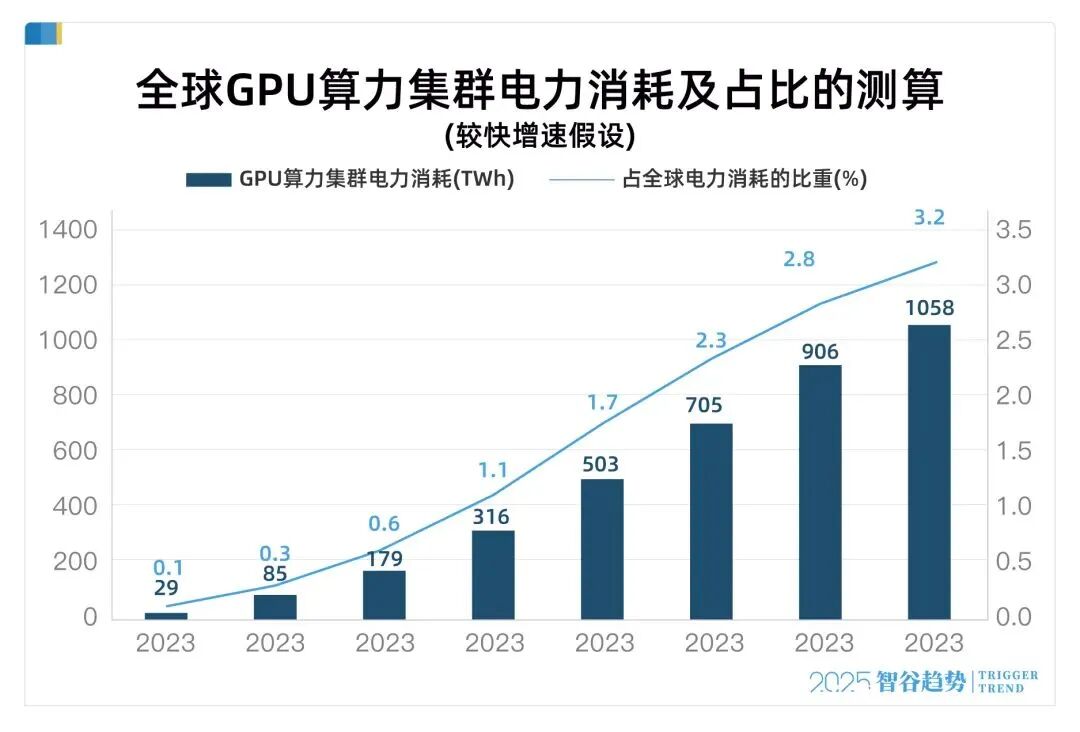
According to a report by the International Energy Agency, the total power consumption of global data centers in 2022 was about 460 terawatt-hours, accounting for about 2% of the world's electricity consumption. By 2026, this figure will exceed 1000 terawatt-hours, approximately the total electricity consumption of Japan in 2022.
By 2030, the power consumption of AI data centers may account for 20% of the world's total electricity consumption, and the United States will face a power shortage of up to 73.2 gigawatts during the same period, with more than one-third of it due to the surge in computing power.
The chief of staff of the U.S. Department of Energy even said directly that the current power shortage has put the United States in a "national emergency."
Controlled nuclear fusion is precisely an excellent way to solve this problem. It almost has all the advantages:
Its raw materials are hydrogen isotopes from seawater, which are inexhaustible;
The energy released by 1 kilogram of deuterium-tritium fuel is equivalent to that of 10,000 tons of coal, with huge production capacity;
It emits no greenhouse gases, has no risk of nuclear leakage or explosion, and produces very little radioactive waste;
More importantly, it can provide stable power supply 24 hours a day, regardless of weather or geographical conditions...
It can be said that whoever takes the lead in mastering nuclear fusion technology will occupy the energy high ground in the AI era. This is truly a battle for national fortune.
Imagine what China will be like if the power cost approaches zero in 20 years?
In Liu Cixin's "The Three-Body Problem," a future world of "wireless power transmission" was depicted: all devices, whether flying in the sky, held in the hand, or swimming in the water, are powered by an invisible electric field in the air. If controlled nuclear fusion is achieved, this once "luxurious" scenario may become a reality.
In addition, large-scale seawater desalination will completely solve the problem of water shortage; super pumps can transport fresh water from the Indian Ocean over thousands of kilometers and inject it into the Taklimakan Desert, which may become China's largest granary; factories can carry out vertical agriculture by simulating sunlight 24 hours a day, ensuring food security for 1.4 billion people; particle colliders can even synthesize rare elements such as gold, making precious metals no longer scarce.
Even interstellar migration by spaceships driven by fusion reactions...
Some scientists have proposed the idea that a spacecraft equipped with an inertial confinement fusion engine can reach 1% - 10% of the speed of light, allowing us to reach Proxima Centauri within 40 - 100 years and truly move towards the stars and the sea.
Energy will no longer be a scarce resource but a public good that can be produced infinitely. This is simply the ultimate track tailored for the "world's largest industrial country."
Winning this battle for national fortune is of crucial importance.
Reference materials:
1. Cailian Press: The first nuclear fusion conference of this year is coming
2. Cailian Press: The "national team" of nuclear fusion makes its first public appearance
3. DeepTech: China's "artificial sun" evolves again! The CAS team breaks the density bottleneck and refreshes the new height of nuclear fusion operation
4. Guancha.cn: The founder of a U.S. nuclear fusion company: China's research and development are progressing rapidly, while the United States still seems to be stuck in the last century
5. Investment.cn: The birth of Fusion Company: A one-time financing of 11.5 billion yuan
6. Meiri Angel: Ecosystem | China and the United States are competing for the "artificial sun." Who will break through in controlled nuclear fusion?
7. Xinhua News Agency: Outlook | Controlled nuclear fusion is on the verge of industrialization
8. Bad Potato Doesn't Cry: Major breakthrough! China has just rewritten the course of human civilization!
9. IT Home: The United States releases a nuclear fusion energy roadmap: Aiming for commercialization in the 2030s, but lacking financial support
10. Gelong: The power shortage is driving the United States crazy!
11. Guancha.cn: China is making every effort to tackle the "ultimate solution" to human energy. What about the United States?
This article is from the WeChat official account "Trend of Zhigu", author: Xiyun. It is published by 36Kr with permission.