Glass substrates: One of the biggest expected differences in AI storage in the next few years.
Decades ago, when people talked about chips, they discussed the number of transistors; today, the soaring memory prices have made headlines, and behind it is a material innovation revolution that will determine the future.
Behind the memory shortage in 2026, in essence, the explosive growth of computing demand is testing the physical limits of traditional semiconductor technology. The wafer area consumed by high-bandwidth memory per bit is three times that of standard DDR5.
As the power density of AI chips approaches the kilowatt level, a more decisive transformation is taking place in the field of semiconductor packaging: a smooth glass is about to quietly delineate a new boundary for the global semiconductor industry, and the violent turmoil in the memory market is just a surface ripple.
The organic substrate has reached the end
For decades, packaging substrates made of organic resins have been the industry standard, but the exponential demand for AI and high-performance computing chips is breaking through the physical limits of these materials. Organic substrates expand and warp under thermal stress and cannot adapt to the large size and harsh working conditions of AI processors.
Traditional organic substrates are facing severe problems such as large signal transmission loss, poor matching of the thermal expansion coefficient with silicon chips, and easy warping of large-size packages. These problems not only limit chip performance but also increase packaging complexity and cost.
When an AI training cluster requires thousands of GPUs to work together, these microscopic physical mismatches will accumulate into a fatal performance bottleneck at the system level.
In contrast, glass substrates, with their unique advantages such as low dielectric loss, excellent thermal stability, and a thermal expansion coefficient similar to that of silicon, have quickly become the key material to break through the existing bottlenecks. This seemingly simple material conversion actually represents a fundamental change in the semiconductor packaging paradigm.
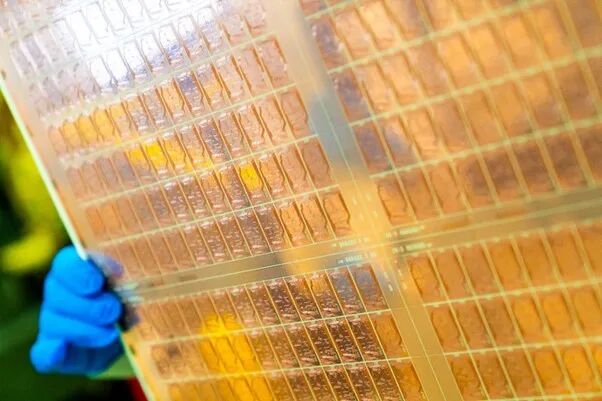
Glass plays an indispensable role in every key link of manufacturing these processors: it can not only be used in extreme ultraviolet lithography technology to help manufacturers produce more advanced chips in GPUs but can even “be used as the actual substrate of GPUs.”
The revolutionary improvement brought by glass
The core value of glass substrates comes from the fundamental characteristics of the material. Compared with traditional substrates, semiconductor glass substrates are smoother and thinner, can achieve finer circuits, and have less thermal warping, making them suitable for high-performance and high-integration semiconductor applications.
In terms of electrical performance, the signal transmission loss of glass substrates in the 10GHz frequency band is only 0.3dB/mm, and the dielectric loss is reduced by more than 50% compared with traditional organic substrates. Behind this figure is a significant reduction in the delay, attenuation, and crosstalk of high-speed signal transmission in AI chips.
From the perspective of thermal management, by adjusting the material formula, the coefficient of thermal expansion (CTE) of glass substrates can be precisely adjusted to 3 - 5ppm/℃, which is highly matched with silicon chips. This reduces the warpage by 70% during the heating and cooling cycles of chip operation.
The improvement in structural stability makes large-size packaging possible. The surface roughness of glass substrates can be controlled below 1nm without additional polishing, providing an ideal substrate for micron-scale or even sub-micron-scale wiring. Currently, ultra-fine wiring with a line width and spacing of 2μm/2μm can be achieved, and the via density reaches 10^5 per cm², more than 10 times that of traditional organic substrates.
In terms of packaging density, the advantages of glass substrates are also significant. Data shows that glass substrates can accommodate up to 50% more chips in the same area of packaging. This means that more transistors can be integrated in the same space, greatly improving the overall performance and functions of the chip.
The strategic game of giants
The transformative potential of glass substrates has attracted giants in all aspects of the global semiconductor industry chain to enter the market.
Intel was the first to layout in the field of glass substrates, and its research and development can be traced back to about a decade ago. In September 2023, Intel officially released the industry's first glass substrate technology for next-generation advanced packaging. According to Intel's plan, products equipped with this technology are expected to be launched between 2026 and 2030.
Samsung has adopted a unique “dual-track internal strategy.” Samsung Electro-Mechanics focuses on the rapid commercialization of glass core substrates and plans to achieve mass production between 2026 and 2027. Samsung Electronics focuses on the long-term research and development of glass interposers, aiming to introduce them into the advanced packaging process in 2028 to replace the current silicon interposers connecting GPUs and HBMs.
Absolics, a subsidiary of South Korea's SK Group, is actively deploying and plans to complete the preparation for mass production by the end of 2025. The company has started prototype production at its factory in Georgia, USA, with an annual production capacity of about 12,000 square meters.
Corning, a global leader in the field of glass material science, also plays a key role in the field of glass substrates. The company is extending its glass expertise to the semiconductor packaging field through its Glass Core program.
BOE released a glass substrate technology roadmap from 2024 to 2032, planning to achieve mass production capacity with an aspect ratio of 20:1, a fine pitch of 8/8μm, and a packaging size of 110x110mm by 2027. This goal is basically in sync with international leading enterprises.
From AI chips to co-packaged optics
The value of glass substrates is becoming more prominent in multiple cutting-edge application scenarios. In AI chip packaging, glass substrates can support the high-density heterogeneous integration of HBM (high-bandwidth memory) and logic chips, which is one of the key solutions to the current AI computing bottleneck.
What's more revolutionary is its application in the field of CPO (co-packaged optics). CPO technology is a key breakthrough in dealing with the “power wall” and “bandwidth wall” of data centers. Servers in traditional data centers still use copper connections to transmit electrical signals. These connections will also lose signal quality over short distances, waste energy, require expensive signal boosters, and generate additional heat.
The transparent characteristic of glass substrates enables them to directly carry optical waveguide structures, realizing the heterogeneous integration of electronic and photonic chips. This integration not only simplifies the alignment process of optoelectronic devices but also can replace expensive silicon photonic interposers, significantly reducing the cost of CPO solutions.
Industry research data shows that in the priority application fields of TGV glass substrates, optical module packaging ranks second with a proportion of 23%, second only to the display industry. This fully reflects the industry's recognition of its value in the field of optoelectronic packaging.
Obstacles and prospects in the commercialization process
Although the prospects of glass substrates are broad, their commercialization still faces multiple challenges. The fragile nature of glass increases the processing difficulty, and there are technical challenges in processes such as drilling, cutting, and electroplating. Currently, laser processing is mainly used to maintain the integrity of the glass, but this process still needs further optimization.
Glass substrates are an emerging technology in the field of semiconductor packaging. The long-term reliability data is not yet complete, especially in applications in fields with high reliability requirements such as the automotive and aerospace industries, which may be limited. The accumulation of this data requires time and practical application verification.
The diversity of materials also brings problems in matching the thermal expansion coefficient. Although the thermal expansion coefficient of glass substrates is low, there are still differences with other materials on the substrate, which may lead to stress problems and require precise temperature management.
In terms of manufacturing, key equipment such as laser-induced deep etching tools for producing TGV (through-glass vias) remains a bottleneck in the supply chain. The learning curve in 2026 will result in unstable yields, and the initial supply may be limited to the most profitable AI server applications.
Conclusion: Material innovation will be the only way to break through the computing bottleneck
Artificial intelligence has begun to replace human engineers in writing code, but what determines how fast these codes can run will still be smooth glass substrates. Chip manufacturers understand better that before the new wafer fab capacity comes online in 2027 - 2028, material innovation will be the only way to break through the computing bottleneck.
This revolution is reshaping the geopolitical landscape, corporate strategies, and material foundation of the semiconductor industry. Its impact will far exceed the fluctuations in memory prices and become a key factor in defining the next computing era.
This article is written based on public information and is only for information exchange purposes and does not constitute any investment advice
This article is from the WeChat official account “Jinduan” (ID: jinduan006), author: Zhang Chuan, published by 36Kr with authorization.