From 3D printing to desktop CNC, Chinese maker hardware breaks through the circle collectively | Hard Krypton's on-site report from CES
Author | Zhang Ziyi
Editor | Yuan Silai
Las Vegas is once again hosting the largest number of Chinese enterprises in a year.
In the dry, cold air of the Nevada desert, a subtle sense of competition pervades. In the 12 exhibition halls, companies are showing their most ambitious cards. You can see humanoid robots for household chores, flying vacuum - cleaning robots, and mobile phones that can be folded into a Z - shape. Even if these products won't appear in your home in the next decade, they are enough to elicit a moment of wonder.
The hardware industry is approaching a boiling point. All market segments are tightly packed. Some niche sub - sectors that were obscure in the past are now full of competitors. Latecomers to the hardware industry may feel a bit desperate.
As a media outlet deeply involved in the hardware industry, "Hard Krypton" has been continuously following CES. In the next few days, you will follow our perspective to capture the flow of attention and emotions and jointly witness the eve of the upheaval in the hardware industry in 2026.
At the last CES, no one could have imagined that the maker track would become such a hot topic. But in just one year, more than one company's single product has achieved crowdfunding results of tens of millions of dollars. The valuation of leading enterprise Tuozhu has exceeded tens of billions of dollars, and xTool has submitted its prospectus to the Hong Kong Stock Exchange.
At this year's CES, at the booths of creative tool products for the Maker field, each enterprise has demonstrated strong product capabilities. Creality has its latest intelligent 3D printing brand - SPARKX i7; xTool has brought its newly launched desktop UV printer, which claims to be able to "print on everything" and can perform high - precision color printing on materials such as plastic, acrylic, and metal, and support more types of mugs, tumblers, and other cylindrical objects.
Both Kexiao Technology and Zaowu Times have brought their latest products with crowdfunding results of over tens of millions of dollars on Kickstarter. The former set the highest crowdfunding record for 3D printers, and the latter also refreshed the crowdfunding record for consumer - grade CNC products.
There was a time when Maker tools were just expensive toys in gearheads' garages. They were niche, difficult to use, and had a high threshold, and were jokingly said to be used "by hand - rubbing".
But this track has changed so rapidly. Five years ago, people were still amazed that established 3D printing companies like Creality and Anycubic could achieve revenues of over one billion yuan. Tuozhu took less than four years to achieve a revenue of over six billion yuan. Laser engravers, considered a very niche product category, have enabled xTool to achieve annual revenues of over two billion yuan.
And the even more niche CNC products, which were mostly used in the industrial field in the past, are now being brought to the desktop. Term sheets from investors are flying like snowflakes towards Zaowu Times, the representative company.
Industrial - grade manufacturing capabilities are being condensed into the limited space of a desk. From additive manufacturing to subtractive manufacturing, from gearhead toys to industrial products, Chinese maker hardware products are redefining current productivity. After years of effort to lower the product usage threshold, they have finally broken into a broader audience.
01 Interlaced Duels between Products
Wandering around the booths of maker companies, you can definitely smell a whiff of gunpowder.
This is no longer a hidden track. The competition has long been out in the open.
xTool has crossed boundaries and presented a desktop UV printer. From a technical perspective, the xTool UV printer uses UV - LED curing technology, which uses ultraviolet light to trigger the photoinitiator in the ink to polymerize into a solid film within milliseconds. Although its footprint is slightly larger than that of a typical consumer - grade UV printer, it can still be comfortably placed on a desktop.
The last product to detonate the desktop UV printer market was the eufy Make E1 launched by Anker last year, with a crowdfunding amount of over 42 million US dollars, setting a record at that time.
Actually, xTool launched a DTF clothing printer last year, and its crowdfunding result was not bad, but its limelight was overshadowed by the subsequent eufy Make E1. This year, xTool also plans to broaden its thinking.
Meanwhile, Hard Krypton learned that the product manager of the eufy Make E1 has left Anker Innovations. The first - generation eufy Make E1 amazed the market, opening up market possibilities and leaving a certain market gap. xTool's launch of the UV printer at this time is well - timed.
It is worth noting that xTool is exhibiting its UV printer during CES 2026, and the development process is planned to be a co - creation with the community. They opened the development process of their first desktop UV printer to the community in the early stage and invited global creators to participate in defining the product's hardware functions, software workflows, etc.
In fact, the co - creation plan is a marketing and product R & D method adopted by many Chinese enterprises going global. Among photography accessory enterprises, Smatree and Yubasket have both launched many products through co - creation plans.
Obviously, this is a relatively safe approach, but it also indicates the saturation of market competition. It is difficult for each company's products to have prominent differentiations, and they must seek inspiration from the user end.
The 3D printing track shows this cruelty even more.
At this CES, Kexiao Technology brought its latest 3D printer product - Snapmaker U1. This product was refined for a full two years, and its crowdfunding amount on Kickstarter reached 20.61 million US dollars, ranking first in the global consumer - grade 3D printer crowdfunding amount. During this period, Kexiao Technology also completed a Series B financing of hundreds of millions of yuan.
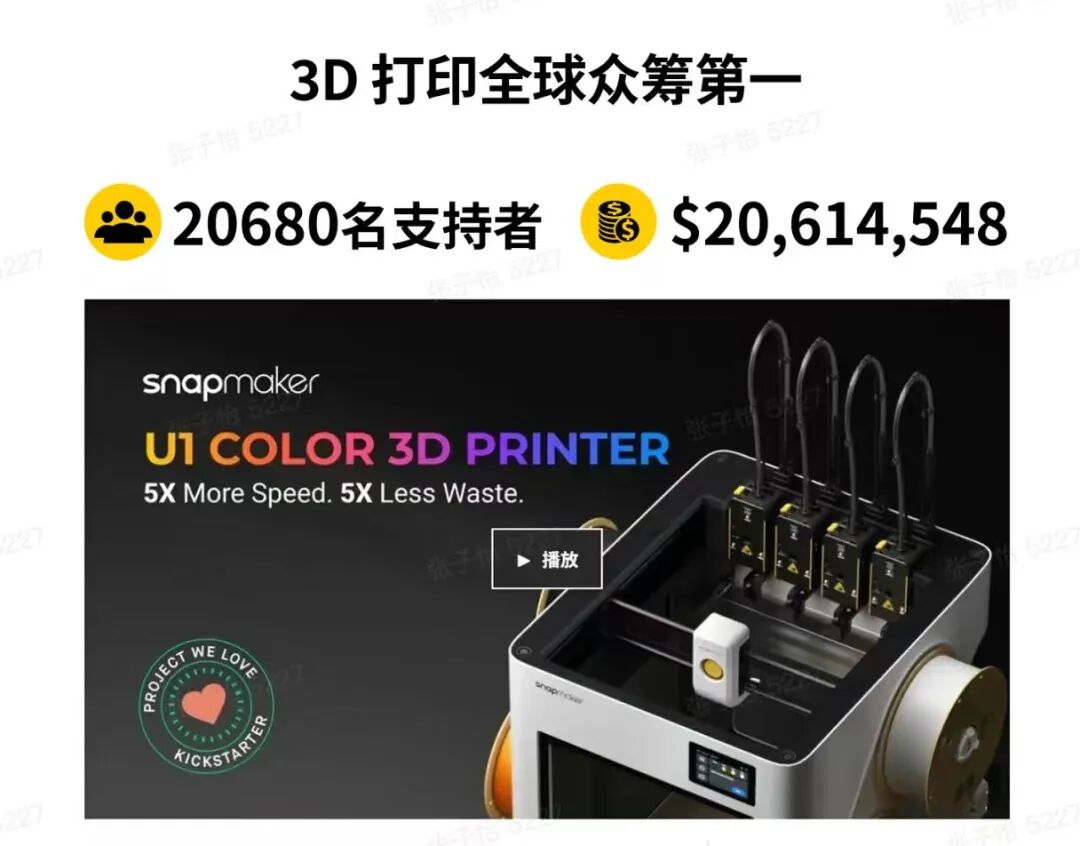
Snapmaker U1 (Image source/Enterprise)
For many years in the past, Kexiao Technology, which made "all - in - one" products, also had stagnant revenues, hovering at the scale of hundreds of millions of yuan. Hard Krypton learned that after studying multi - color printing solutions, the Kexiao Technology team believes that multi - color printing is the future trend of 3D printing, and the problem of time and material waste in multi - color printing has become the key to their technological breakthrough.
The biggest highlight of the U1 is that it supports pre - loading and pre - heating of materials with 4 print heads. Through the rapid head - changing function, it can shorten the waiting time to 5 seconds and eliminate the extrusion of remaining materials when changing materials, achieving a 5 - fold increase in printing speed and a 5 - fold reduction in material waste.
Wanmosi Evaluation believes that as of today, the U1 is the fastest consumer - grade FDM 3D printer for four - color printing, and it is also the only product that supports both four - color TPU printing and mixed printing of hard and soft consumables.
But competitors are all eyeing the pain point of material waste.
Tuozhu and Prusa have also released or announced 3D printers equipped with the Indx system. The Indx system - or what Tuozhu calls Vortek - uses multiple nozzles instead of multiple tool heads to switch colors and materials on the machine. It is not only faster but also, like the U1, significantly reduces waste. The problem it has not solved is that the Indx system is too expensive.
Creality has also discovered this pain point. Its new product SPARKX i7 exhibited at CES claims to be able to reduce multi - color printing waste by 50%. It uses a design that retracts the material first and then cuts it to reduce flushing waste. The consumables do not need to be returned to the CFS lite, and the material - changing efficiency is also increased by 15%.
It can be seen that whether it is UV printers or 3D printers, as everyone is racing forward, the time advantage that early - movers can gain through innovative performance is getting shorter and shorter.
02 Creation and Breaking into the Mainstream
When the track heats up, an interesting question is how exactly do maker tools break into the mainstream? We have to admit that some key companies have shown foresight in leading the market.
Consumer - grade CNC (Computer Numerical Control) machines have long been used only by the most hardcore players. They are difficult to set up, require many different tools, and have a very high threshold. Both the products and the ecological chain are not fully developed.
Different from the long - standing open - source history of 3D printing, where models, slicing software, and even products have been continuously developed and made more accessible by generations of gearheads, CNC products have been used in the industrial field for many years. Traditional industrial - grade CNC machines start at hundreds of thousands of yuan, and the software that comes with them also has a relatively high learning threshold.
But after 3D printing and laser engravers entered the mass market, CNC has become the last piece of the puzzle in the Maker track. As the audience expands, the potential of subtractive manufacturing in the creative field is full of charm.
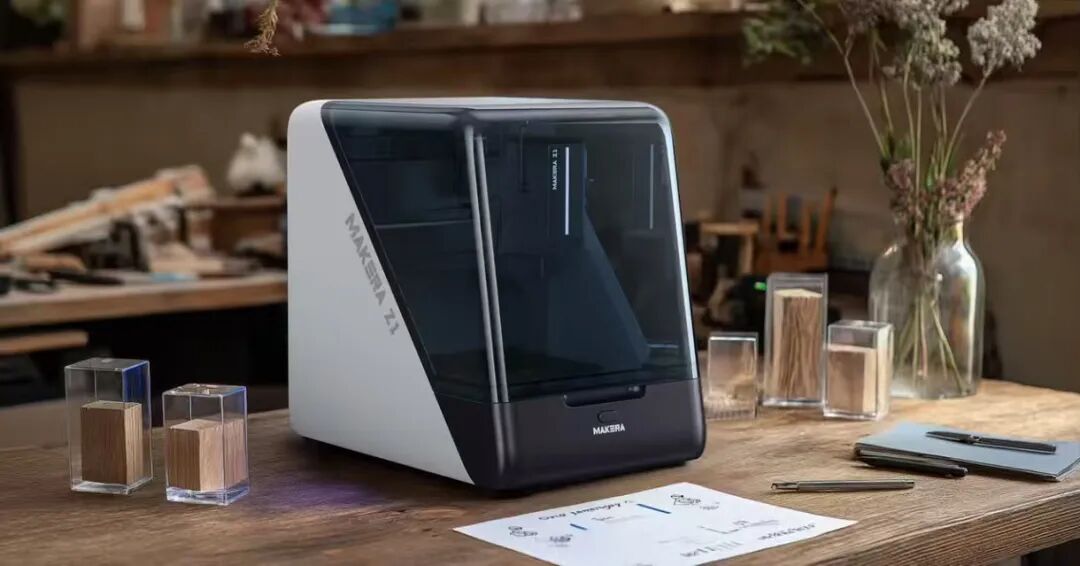
CNC (Image source/Enterprise)
At this CES, Zaowu Times showcased its latest product, the Makera Z1 desktop CNC device. The Makera Z1 crowdfunded nearly 10.25 million US dollars on the Kickstarter platform in 45 days, equivalent to over 72 million yuan in RMB.
This result not only refreshed the historical crowdfunding record for the CNC category but also means that the desktop CNC category, which has long been regarded as a professional and niche tool, is experiencing a new explosion.
Like the popularization of all tool - type products, lowering the threshold is the way to go. In terms of usability, this generation of CNC tools from Zaowu Times has added functions such as quick tool - changing, intelligent automatic leveling, and one - key tool calibration. The preparation process is highly automated, reducing the usage threshold. The built - in high - definition camera supports remote monitoring and time - lapse photography, making the creative process recordable and shareable. This is obviously a function targeted at the consumer market.
"We hope that in the future, a large number of users will record their creative processes and share them on our ecological platform or social media, so that more people can understand CNC," Zhang Qiuxi told Hard Krypton.
This is a rather interesting transformation in product thinking. Consumer - grade creative tool products are no longer just tools. Their social attributes are increasing, and more importantly, their productivity value is also being recognized by more people.
Taking 3D printers as an example, Tuozhu's first - generation X1 series pioneered the functions of complete camera recording, AI monitoring, and one - key sharing. Users can view the live printing process at any time through the Bambu Handy mobile app and automatically get a generated time - lapse video after printing is completed, which can be shared on social platforms with one click.
After that, being equipped with a camera, time - lapse photography recording, and AI monitoring gradually became the standard for mainstream 3D printers.
For the Maker community, these three functions not only enhance the user experience during the printing process, allowing for more worry - free printing but also the video recording function itself can be used as a marketing material on social media. It not only allows more people to understand the 3D printing process but also arouses people's interest in 3D printed parts.
The same is true for multi - color printing solutions.
Before 2022, due to complex debugging and high failure rates, the penetration rate of multi - color 3D printers in the consumer market was less than 1% - 3%, and it was only a novelty function for gearheads. After 2022, Tuozhu became the promoter of multi - color printing. In the mid - to - high - end consumer market, multi - color printing has changed from an "optional feature" to a de facto "standard feature".
On leading model platforms such as MakerWorld, more than 60% of the most popular downloaded models are multi - color designs. The leap from "single - color gray models" to "full - color finished products" in 3D printing has given 3D printed parts higher commercial added value and become a powerful tool for small and micro entrepreneurs to make money, indirectly attracting more and more people to use 3D printers.
More than a decade ago, when Zhang Qiuxi was making accessories for model airplanes, drones, and robots, he once DIYed a CNC product. "Back then, it was not so automated, the software was not perfect, and the threshold was very high. Its user base was mainly small B - type enterprises."
The same is true for senior user Lin Yu. She studied industrial design. She recalled that in 2017, when she was looking for a seller on Taobao to print engineering parts she needed with a 3D printer, a single order cost over ten thousand yuan. Now, after buying several Tuozhu 3D printers, she can download the most popular mobile phone stand models on Tuozhu's Makerworld, modify the models, and then sell them on e - commerce platforms.
Hard Krypton found that among the top 20 models on the MakerWorld platform, more than 80% are articulated toys or stress - relief props. The single - time download volume of such models far exceeds that of functional engineering parts.
This trend is also confirmed to some extent in the user profiles of major manufacturers. According to the user data disclosed by xTool and Snapmaker, the proportion of users who buy equipment for "small business" or "side hustle" has risen from a niche group of gearheads a few years ago to the core user group. In some popular models, the proportion of commercial users is even close to half.
3D printers, laser engravers, and CNC devices are no longer just niche gearhead toys. They have begun to evolve into "money - making tools" for the maker community.
On December 15th last year, Tuozhu launched the "Let's Make It" creation fund, which will provide long - term financial, technical, and resource support for global makers. A single project can receive up to one million yuan. Both independent individuals and small studios can apply. This is also the largest - known maker - support program in China in terms of funding.
In the past, the bottleneck of creativity was craftsmanship. Two or three decades ago, makers had to start from basic tools like saws to create. A decade ago, the threshold of such products was machine debugging and software learning. Now, Chinese manufacturers have used technology to lower the "craftsmanship" threshold, bringing the competition back to creativity itself, allowing more people to participate. This is a form of technological equalization in another sense.