Entrepreneurial spirit is a kind of exuberant "vital energy".
Economic growth is a fascinating and huge puzzle. The great economist Robert E. Lucas once said a famous quote: "Once we start thinking about economic growth, it's hard to think about anything else." Take China as an example. After the reform and opening - up, China's economy has maintained an average annual growth rate of nearly 8% for a long time. Economists have spent a great deal of effort trying to unlock the mystery of this "8%". About 4% - 5% of it can be explained by China's high investment, but the remaining 3% - 4% can only be attributed to a black box called "total factor productivity". Even the seemingly explainable "high investment" itself is probably the result of this black box.
If we look at the situations of different regions within China, the puzzle becomes even more complicated. Zhejiang, located in the southeast coastal area, is mostly mountainous, and its geographical conditions are not particularly favorable. For most of history, these "remote and inhospitable" areas were far from the reach of the central government. However, after the reform and opening - up, this place has achieved remarkable economic growth. Another example is Yiwu in central Zhejiang. Surrounded by mountains on three sides and without a seaport, it doesn't seem geographically suitable for international trade, but now it has become the global distribution center for small commodities.
Zhang Weiying's Re - understanding Entrepreneurship is an important attempt to solve this mystery. This book condenses his forty - year thinking, and its core idea can be summed up in one sentence: The real engine of economic growth is not capital, not "algorithms", nor government planning, but the "unscientific" judgment, alertness, and imagination of entrepreneurs.
This is not a tepid popular science book on economics but a sharp - edged theoretical manifesto. It "destroys and then constructs". It not only sharply criticizes the mainstream neoclassical growth theory but also builds a self - consistent theoretical framework, bringing entrepreneurs and entrepreneurship back to the "throne" of economic growth. With this perspective, when we look at the real - world problems in China, Japan, and Europe, everything becomes clear.
Entrepreneurship is a surging "vital energy"
Zhang Weiying places entrepreneurship within Friedrich Hayek's theory of knowledge, saying that it is humanity's real ability to deal with uncertainty. Entrepreneurs make decisions based on intuition, judgment, and imagination, relying on that kind of "tacit" soft knowledge. Precisely because of this "unscientific" nature, they can find opportunities and create value in the chaos.
To clarify what entrepreneurship is, this book first draws three lines to explain what it "is not".
First, entrepreneurs' decision - making is not based on the "scientific" calculations of big data and statistical models. This distinguishes entrepreneurs from managers and engineers. Managers and engineers make decisions based on describable and quantifiable "hard knowledge", while entrepreneurs' decisions rely heavily on personalized and ineffable "soft knowledge". Laozi's saying "The Tao that can be told is not the eternal Tao" expresses this very meaning.
This is not being deliberately mysterious but is determined by the nature of innovation. True innovation is inevitably accompanied by uncertainty and unpredictability because it means the birth of new knowledge. Here is a key paradox: If new knowledge can be predicted and calculated before it is produced, can it still be called truly "new" knowledge? Entrepreneurs are like people searching for land in the vast ocean. No one knows in advance whether what lies ahead is a coast or a reef. This is not a "risk" with a calculable probability but a complete "unknown". As the saying goes, "Small wealth comes from hard work, while great wealth comes from fate." For things that can be calculated clearly by scientific methods, the profit margins have already been squeezed almost dry. The things that can lead to great success are often those that others can't calculate and that you dare to bet on.
It is worth mentioning that when this book was written, there was no such a surging AI wave as there is now, so it doesn't specifically mention it. However, the book's distinction between "soft" and "hard" knowledge and its emphasis on intuition and imagination are even more relevant today when AI has swept across all calculable and quantifiable fields. After machines handle most of the "hard knowledge", human beings' comparative advantage may return to the fields that rely on intuition, judgment, and imagination. After all, these are the results of millions of years of human evolution. This applies not only to entrepreneurs but to everyone. After the emergence of large - language models, the US labor market has changed significantly, but the ones most affected are new college graduates, while experienced workers have been affected much less. Perhaps it is because these "rookies" have only learned a lot of standardized "hard knowledge", which makes them easily replaceable by AI.
Second, entrepreneurs do not solve problems within given constraints but directly rewrite the constraints and turn the impossible into the possible. These constraints can be technology, the market, institutions, or even the mental barriers in people's minds. In other words, entrepreneurs are not "problem - solvers" but "problem - setters". They not only meet existing needs but are also good at "creating something out of nothing" and creating new needs. The book gives an example: In the 18th century, John Wilkinson in the UK proposed building ships with iron, and everyone laughed at him, thinking he was "iron - crazy" because how could iron float? But in 1787, his all - iron barge, the Experiment, actually floated on the River Severn.
Third, entrepreneurs don't just pursue profits; they have "dreams" in their hearts. This doesn't mean they don't love money, but compared with investors who simply focus on returns, entrepreneurs often value values beyond money more and may even do things that seem "crazy" in the eyes of capital. This often makes the relationship between entrepreneurs and investors very tense. Entrepreneurs like Steve Jobs and Elon Musk have had many conflicts with their investors. Back then, Mike Markkula, Jobs' benefactor and mentor, chose John Sculley over Jobs, forcing Jobs out of Apple.
On the contrary, if a society can stimulate the entrepreneurship of entrepreneurs in the population, it is the best thing in the world. These people don't come just for money (some even "bring their own resources"). They are driven by the fire in their hearts and fully devote themselves to new methods and new fields, creating a vibrant scene of "all things competing freely in the autumn sky". This is very similar to what the Germans call the "Zeitgeist" or what the ancient Greeks referred to as the "animal spirits" - in short, it is a surging "vital energy". It's hard to explain in proper "scientific" language, but people in the midst of it can feel that energy. Conversely, if we restrict and suppress this "vital energy" with various rules and regulations, it is the greatest waste in the world. Once this "vital energy" dissipates, it can't be brought back by subsidies or stimuli, and the economy will fall into a long - term slump like some developed countries.
"Destroy": Criticism of Neoclassical Economics
Since the early 20th century, neoclassical economics has been the "orthodox school" in economics. It's not difficult to start learning, and anyone can study it, but it's easy to learn but hard to master. When one really delves deep, they will have a strong insight into the world, and can use any small thing to make a point. Precisely because of its solid framework and sharp logic, in the second half of the 20th century, it invaded social science fields such as sociology, history, and political science in the guise of "economic imperialism".
However, neoclassical economics has an embarrassing "weak point": It always seems to lack explanatory power in the area of economic growth, which it should be best at. The reason is that its theoretical model is too "stable" and certain, lacking an evolutionary perspective. It often has to simply insert technological progress as an external variable, so it can't help us understand the real engine of economic growth - the inherent "uncertainty" of innovation activities. For this reason, entrepreneurs have no place in this framework: If the future is certain, the price mechanism can automatically solve the problem of resource allocation, so what's the use of entrepreneurs? It's like the play Hamlet, where the stage is set and the supporting actors are in place, but the Prince of Denmark himself is missing.
In this book, Zhang Weiying launches a full - scale attack on neoclassical economics (especially the growth theory). He has spent decades studying neoclassical economics and has a deep understanding, so he can clearly see its "weaknesses". He doesn't hold back and compares it to the "geocentric theory". He also points out that even the "endogenous growth theory" of Nobel laureate Paul Romer only sees innovation and technological growth as the inevitable result of R & D investment, rather than a real "exploration of the unknown". This overly certain picture is very misleading, making people think that as long as more money is invested and more subsidies are given to R & D, the growth problem can be easily solved - this precisely ignores the unplannable "vital energy" of entrepreneurship.
The idea of stimulating innovation through government industrial subsidies is based on a key assumption: The government can gather a group of experts to accurately predict the general direction of technological evolution. However, as the book quotes Harvard professor Clayton M. Christensen's pungent comment: "When we see experts predicting emerging markets, the only thing we can be sure of is that their predictions will be wrong." There are numerous such examples. At the beginning of the 20th century, when the aviation industry was just starting, most top scientists and engineers bet on airships, thinking that airplanes were just "dangerous toys".
The development history of artificial intelligence is the same. There are two research approaches in AI: symbolicism and connectionism. Simply put, symbolicism is a "top - down" design approach. It tries to turn everything in the world - cats, dogs, tables - into clear "symbols" and then process these symbols according to a set of proper logical rules. Therefore, it has a natural appeal to scientists and has been regarded as the "hope of the village" by most researchers.
Connectionism, on the other hand, is a "bottom - up" evolutionary approach, allowing machines to find patterns directly from a large amount of data by themselves. The process is like a "black box", so it has been relatively marginalized for a long time. It was only in the past decade or so that it achieved a "come - from - behind victory" with deep learning and large - language models. Interestingly, NVIDIA, which later became the core of AI computing power, didn't recognize the power of this wave at first. At an academic conference in 2009, deep - learning pioneer Geoffrey Hinton introduced his work to thousands of researchers and advised them to buy NVIDIA's GPUs to speed up their research. After the conference, he sent an email to NVIDIA, saying something like: "I just told 1000 researchers to buy your graphics cards. Can you send me one as a sign of support?" NVIDIA was very touched and then politely declined. If even NVIDIA was like this, it goes without saying for others.
In an open academic and market environment, different technological routes compete with each other, rising and falling. Some people bet right and some bet wrong, but even if some routes are eliminated, the trial - and - error cost for the whole society is relatively limited, and new outlets can always be found. Once the government steps in to "pick the winner", the risk of resource misallocation increases. During the Cold War, the United States and the Soviet Union were competing in the semiconductor field. The Soviet Union was not inferior in the electron - tube technology route. However, when the United States achieved a "come - from - behind victory" with transistors, Soviet leader Nikita Khrushchev still personally decided to concentrate efforts on the "miniaturization of electron tubes". Despite having a large number of the world's top scientists and engineers, the Soviet Union gradually lost in the semiconductor industry competition because it chose the wrong technological path. This example may give us a clearer understanding of the limitations of "planning innovation".
"Construct": The Smith - Schumpeter Theory
More than two hundred years ago, the father of economics, Adam Smith, pointed out the mystery of economic growth: Division of labor and specialization promote technological progress. He used a simple example of pin - making to explain this clearly - a single worker might not be able to make even one pin a day, but when the process is divided into more than a dozen specialized processes, the average daily output per person can reach thousands of pins. The power of division of labor is truly amazing.
Then the question arises: Since division of labor is so useful, why can't it be infinitely subdivided? Why is the division of labor in some countries very detailed while in others it is very rough? Smith's second insight hits the nail on the head: The depth of division of labor is essentially limited by the market scale. If the market is not large enough, even the most specialized products can't find enough buyers. Thus, the cycle of "market expansion - deepening of division of labor - technological progress - economic growth" starts, and this is the famous "Smithian growth". The economic history of more than two hundred years since the Industrial Revolution has almost been a footnote to this theory.
However, Smith's theory left a key "loose end": Where does the market itself come from? Zhang Weiying uses Joseph Schumpeter's theory of entrepreneurship to fill this gap. The market doesn't appear out of thin air but is created by entrepreneurs with new products and new ideas. In many cases, demand is not the "mother of innovation". Before entrepreneurs' discoveries and creations, consumers may not even know (or imagine) what they need. The book reviews previous industrial revolutions and clearly shows a main line: Behind each economic leap, it is entrepreneurs who are exploring new frontiers and discovering new continents. Going back to the previous example - if John Wilkinson hadn't been obsessed with the crazy idea that "iron can float on water", where would the later iron ships and the modern ship - building industry come from? Only then was the "first driving force" of economic growth found.
Implications for the Present
This theory with a complete and coherent logic is very helpful for us to understand the economies of different countries. There is a phenomenon that many readers haven't noticed: Since the mid - 1990s, there has been a great divide within developed countries. The United States has left developed economies such as Europe and Japan far behind (Figure 1). Why? Following the ideas in this book, we can understand - from the IT revolution to the AI wave, the "vital energy" in the United States has never dissipated, and new entrepreneurs and new giants have emerged one after another. In contrast, Europe and Japan have either been restricted by cumbersome government regulations or trapped by rigid organizational structures, gradually dissipating that vital energy. With such a large economic volume and so many highly educated and skilled people in both regions combined, it's really a pity that no globally influential IT or AI giants have emerged.
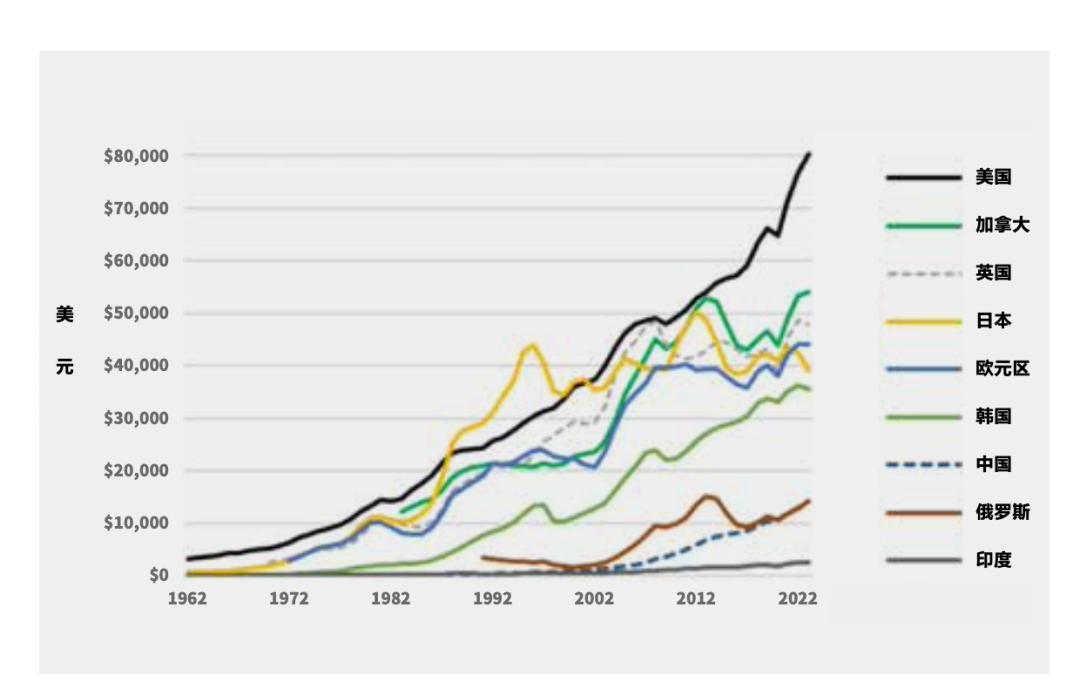
Figure 1 The changing trend of per - capita GDP of major economies from 1962 to 2022 (in US dollars)
Looking at the world, currently only China can compete with the United States in emerging industries - and this achievement has been made when China's per - capita income is only about one - sixth of that of the United States. We mentioned Zhejiang earlier. At the beginning of 2025, the scientific and technological innovation forces represented by the "Six Dragons of Hangzhou" really shocked the world. By sorting out the underlying context, we can clearly see the inheritance of the "Zhejiang merchant" spirit. However, we also need to be vigilant: Although China's scientific and technological level has been making great strides in recent years, the number of new "unicorn" enterprises has actually decreased, and the enthusiasm of young people for taking the civil - service examinations has only increased. In the critical period of the Sino - US scientific and technological competition, how to preserve the "vital energy" in society has become an unavoidable major issue.
The theory in this book also provides insights for our understanding of the current phenomenon of "involution". To break out of involution, in the final analysis, we still need the vitality of entrepreneurship. There's no need to talk about grand theories; just look at history: In the late 18th century in the UK, with the popularization of coke - iron - making technology, there was a serious over - supply of steel. How was it solved? Not by government intervention or forced capacity reduction, but by the "crazy spirit" of entrepreneurs. People like Wilkinson, with a vision beyond their contemporaries, had already seen the future where "everything can be made of iron". He built the first iron bridge over the River Severn and tested the first iron - clad ship... Later, the British really started using iron to build houses and make furniture. New demands and new markets emerged, and the over - capacity was naturally digested.
Conclusion
After reading the whole book, I remembered a sentence that Zhang Weiying has repeatedly said on different occasions: "China's success in the past forty years is not because we are better at planning than others, but because we let entrepreneurs make trial - and - errors earlier and more thoroughly than others." In today's world where algorithms, big data, and industrial policies seem to dominate everything, this sentence is like a calm mirror. Looking back at the economic development since the Industrial Revolution, the major progress of the human economy has not been