Global hardware blockbusters are clustered on Liuxian Avenue in Shenzhen.
Global hardware innovation looks to Shenzhen. In Shenzhen, hardware innovation is being concentrated on a major urban thoroughfare called "Liuxian Avenue".
The "tech gala" just held by Luo Yonghao took place in Shanghai, but the focus of the products couldn't stray far from Liuxian Avenue. Among the six Shenzhen - based hardware products mentioned, DJI, Jike, and Qingxian Intelligence are all located in the Liuxiandong Base along the avenue. The Second Curve was incubated at Professor Li Zexiang's XbotPark Robotics Base in Dongguan, and the same - system Science and Innovation College is also located in the Liuxiandong Base.
In 2025, it's hard to discuss hardware brands without mentioning this avenue.
Zooming in on the map along Liuxian Avenue, you can see a string of well - known names in the global market: DJI, EcoFlow, AfterShokz, Wonder Workshop, Zhiyan Technology, Kaadas, Timekettle, Hesheng Innovation, xTool, Kuma Dynamics, Aqara...
More and more brands going global are gathering here.
Since October this year, Anker Innovations has moved to the intersection of Liuxian Avenue and Chuangye Second Road, less than 200 meters from Xingdong Station of Metro Line 5, which is very convenient for commuting. As early as the end of 2022, Anker spent 1.542 billion yuan to purchase this building, planning to use it as its southern headquarters and the R & D center.
Liuxian Avenue is located in the northern part of Nanshan District, Shenzhen. It is a long and narrow valley between the southern foothills of Yangtai Mountain and Tanglang Mountain, about 12 kilometers long from west to east. Anker's new building is at the western starting point, while the eastern end connects to Shenzhen North Station, one of the busiest transportation hubs in Shenzhen.
More than a decade ago, Liuxian Avenue was just a dirt road of only a few kilometers and was considered a misnomer. However, with the upgrade and transformation promoted by policies, it has now become a "golden corridor" for high - tech enterprises and a gathering area for a new generation of cross - border enterprises.
Along Liuxian Avenue, in any industrial park or office building, you can find several cross - border enterprises on the company nameplates. Just a simple visit to the brand factories revealed dozens of cross - border related enterprises, including even e - commerce giants like Shein.
Today, to the outside world, Liuxian Avenue may still just be a road on the Shenzhen map. But for global hardware entrepreneurs, it has become an answer: when you want to know where the new generation of hardware is being born, Liuxian Avenue is an unavoidable coordinate.
01 Retaining the "Immortals" of Cross - border Business
Two kilometers east of the Anker building along Liuxian Avenue is the Liuxiandong Base. After moving eight times in 16 years since its establishment, DJI finally settled its headquarters here.
In October 2022, DJI officially moved into the "Sky City" in Liuxiandong, and its nearly 5,000 employees in Shenzhen were extremely excited. Zhang Xiaonan, the spokesperson of DJI, sighed, "Finally, we can have our own flight field in our office building. We don't have to go out in the sun and rain, take the shuttle bus, or go to another office location anymore."
DJI's settlement is like a magnet, attracting more cross - border enterprises to Liuxiandong. Among them are also a group of entrepreneurs who left DJI but didn't want to go far, such as EcoFlow, the leading brand in mobile energy storage, and LiberLive, a stringless guitar brand.
EcoFlow is located in the Chuangzhi Cloud City, just across the road from the west side of DJI. This industrial base, built by the Special Zone Construction and Development Group with a total investment of 24 billion yuan, has quickly become a "favorable location" in the eyes of cross - border enterprises. Well - known brands going global like Kaadas, Zhiyan Technology, and Hesheng Innovation have successively settled here.
Zhiyan Technology was founded in 2017 by Wu Wenlong, the co - founder of Anker. Its smart lighting brand, Govee, has been on the Amazon best - seller list all year round. Its revenue reached 4 billion yuan in 2024, and it launched the listing process in June this year. Hesheng Innovation was founded in 2020 by Wei Lihu, a former partner of Zepp. Its smart kitchen appliance brand, DREO, achieved sales of over 1 billion yuan in just three years.
The Chuangzhi Cloud City not only gathers enterprises but also innovation resources. In 2022, Professor Li Zexiang, known as the "Godfather of DJI", founded the Science and Innovation College and immediately chose this place when selecting the location. In addition, the Lingyi College initiated by Academician Zheng Quanshui is also located here. The two colleges continuously provide methodologies and talents for hardware entrepreneurship.
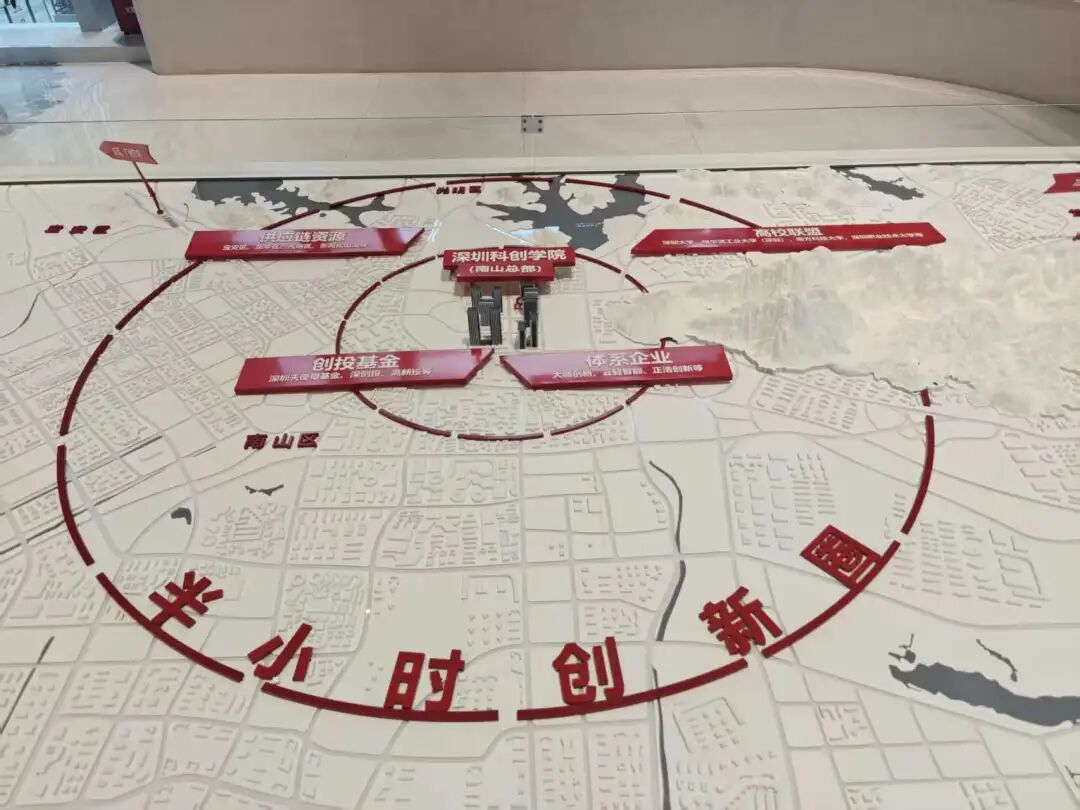
During a visit to the Science and Innovation College, the brand factory saw a cross - border industrial ecosystem map centered around the Chuangzhi Cloud City, forming a "half - hour innovation circle" that gathers key elements such as universities, technology companies, supply - chain resources, and venture capital funds, providing strong support for entrepreneurs.
If Liuxiandong is the core of enterprise agglomeration in the western section of Liuxian Avenue, then the focus of the eastern section lies in Nanshan Zhiyuan.
Nanshan Zhiyuan is located between Liuxian Avenue and Xueyuan Avenue. The total area of its three - phase project is 172,000 square meters, and it is positioned as a new - generation high - tech innovation park. Brands going global like xTool, Kuma Dynamics, and Qibo Technology have taken root here.
xTool is one of the early enterprises to settle in Nanshan Zhiyuan. This laser engraving company has been growing rapidly in recent years, with an average annual growth rate of over 100%. Its revenue is expected to exceed 5 billion yuan in 2025, and it officially submitted a listing application on the first day of 2026. Kuma Dynamics' intelligent lawn mowing robot ranks first in China and second in the world. Qibo Technology's commercial cleaning robots have been deeply involved in the Japanese market, with cumulative shipments of over 100,000 units and total sales of over 5 billion yuan.
In the third - phase Chongwen Park of Nanshan Zhiyuan, there is also a group of Xiaomi ecosystem enterprises, such as Aqara. Its whole - house smart products are very popular overseas, covering more than 30 categories and over 1,000 SKUs, ranking first in the number of self - developed product categories in the industry.
Liuxiandong and Nanshan Zhiyuan are located at both ends of Liuxian Avenue, and there is also an important node in the middle: Nanshan Yungu. Well - known companies like Qingxian Intelligence, a brand of ergonomic chairs, Kenqing Technology, an exoskeleton robot enterprise, Qulai Technology, a smart lighting company, and Weipai IoT, a security camera enterprise, all started here.
Qingxian Intelligence was founded in November 2023. Its founder, Yan Le, used to work at DJI and Yunjing. Its first ergonomic chair, Omni, quickly became popular this year. It raised 6.75 million yuan on the first day of its launch on the crowdfunding platform Kickstarter and has raised over 70 million yuan in total, attracting tens of thousands of supporters.
"Currently, there are more than 200 enterprises settled in the first - phase of Nanshan Yungu, covering multiple industries, and there are also quite a few engaged in cross - border e - commerce," a staff member of the Nanshan Yungu Service Center introduced to the brand factory. It is understood that the rent in the park is about 65 yuan per square meter per month, which is quite friendly to start - up enterprises.
From DJI and Anker to EcoFlow and Zhiyan Technology, and then to Hesheng Innovation, Kuma Dynamics, and Qingxian Intelligence, Liuxian Avenue not only gathers a group of cross - border enterprises but also a group of global companies that directly control product definition and brand awareness through R & D and innovation. This is not just a "cross - border e - commerce gathering corridor" but has become the innovation source of global hardware brands.
02 From Wasteland to a Science and Innovation Center
Today, Liuxian Avenue is one of the busiest roads in Shenzhen, with traffic during peak hours comparable to that on Yuehai Street. However, more than a decade ago, it was a desolate scene here.
"The only lively place along the road was ZTE's factory. The rest were mostly empty lots overgrown with weeds taller than people. There were only a few street lights at night," a friend who studied at Shenzhen Polytechnic in 2011 recalled.
The turning point also started that year. In 2011, Liuxiandong was included in Shenzhen's "12th Five - Year Plan" and positioned as a "strategic emerging industry headquarters base". The following year, the "Dashahe Innovation Corridor" plan was officially released, clearly proposing to build the "Liuxian Avenue - Shahe West Road" golden cross - axis, with the goal of achieving an output value of 200 billion yuan by 2015, surpassing Qianhai.
The Liuxiandong Base has since turned things around. In 2013, after the land preparation was completed, the first - batch projects such as Chuangzhi Cloud City and Vanke Cloud City started construction intensively. More than 20 leading enterprises, including DJI, Tianlong, and Transsion, immediately signed intentions to settle in. Today, more than 1,500 enterprises have gathered on this 1.35 - square - kilometer land, forming a 100 - billion - level industrial cluster.
Almost at the same time, the old industrial areas along Liuxian Avenue also began to "replace the old with the new". The dirty, chaotic, and low - end manufacturing industries were phased out and replaced by new - type technology parks such as Nanshan Zhiyuan and Nanshan Yungu.
"In the past, this area was full of low - end industries. There were small garment factories, iron - casting processing, injection - molding and other labor - intensive factories everywhere. The ground was in a complete mess, with sewage and garbage that made people sigh. It was no longer in line with the development trend of this location," a government planner at that time described. After 2012, these old industrial areas successively launched renovation and upgrading projects.
Behind this is a principle that the Nanshan District Government has adhered to for a long time: to reserve the best land for science and innovation.
In 2021, Nanshan District further launched a 10 - kilometer industrial belt strategy of "headquarters R & D + high - end manufacturing", promising to provide "1 million square meters of headquarters R & D space + 2 million square meters of high - end manufacturing workshops".
This industrial belt consists of multiple key nodes, including R & D clusters such as Nanshan Zhiyuan, Nanshan Zhigu, and Liuxiandong Headquarters Base, as well as high - end manufacturing bases such as Baiwangxin Industrial Park, Honghualing Industrial South Area (Nanshan Zhizao), and Yijing Industrial Park. Obviously, Liuxian Avenue is the core axis of this industrial belt.
The ingenious part of this plan is to keep R & D and manufacturing closely adjacent. A new technology can complete the closed - loop from the laboratory blueprint to the downstairs prototype and then to mass production in a nearby factory within a very small geographical radius and in a very short time.
"The Nanshan Zhizao next to us will be completed in the first quarter of next year. As a pilot project for industrial buildings, the invited enterprises to settle in are all large manufacturing factories," a staff member of the Nanshan Yungu Industrial Park revealed to the brand factory.
In addition to the industrial agglomeration advantage, these parks also offer very competitive rents for the settled enterprises. Botany Intelligent, which moved into Nanshan Zhiyuan in April this year, said that the rent here is even lower than that of factories in the suburbs. Botany Intelligent was founded in 2014, focusing on "the first drone for young people", and its products have been sold to more than 100 countries and regions around the world.
The prosperity of industrial parks has also made the office buildings along Liuxian Avenue a popular choice for cross - border enterprises. The Zhongguan Times Square Building, adjacent to Nanshan Yungu, has gathered more than a dozen cross - border related enterprises such as Xinghe Infinite, Wogu Technology, Ivy Marketing, Wanxun Technology, and Compliance Cloud. Shein has also settled here and often holds closed - door meetings to exchange cross - border business opportunities.
03 The Carrier for the Next - Stage Going Global
If we only regard Liuxian Avenue as a "cross - border industrial belt", we will undoubtedly underestimate its value. Its emergence is not just another cross - border e - commerce gathering area in Shenzhen but a microcosm of the continuous upward movement of China's going - global forces in the global value chain.
In the past two decades, China's going - global hardware products have been continuously upgraded, from mice and data cables to power banks and bracelets, then to sweeping robots and drones, and even to lawn mowing robots, 3D printers, AI glasses, etc. The complexity of products has been continuously increasing, and the requirements for R & D, engineering, and mass - production capabilities have also been raised accordingly.
Meanwhile, the logic of cross - border e - commerce agglomeration has also evolved: in the early days, it was centered around "finding goods", and enterprises gathered in Huaqiangbei; as the industry developed, operation, logistics, and cost became crucial, and Bantian began to rise; now, brand going - global has become the mainstream, and the focus of competition has shifted to products and technology. Liuxian Avenue has thus become the gathering high - ground for a new generation of cross - border enterprises.
What this reflects is the deep - seated changes in the global consumer electronics and smart hardware industries: R & D is no longer exclusive to Silicon Valley, and manufacturing is no longer just the role of contract manufacturers. More and more key links, from product definition and engineering implementation to global sales, are being completed by Chinese enterprises.
Liuxian Avenue is the "spatial answer" that Chinese brands going global have given in the process of global industrial chain restructuring.
Today, Liuxian Avenue is still continuously strengthening its capabilities: on the one hand, it is accelerating the connection between manufacturing through the transportation system; on the other hand, it is strengthening the R & D foundation relying on dense scientific and educational resources.
In terms of transportation, the Xili High - speed Railway Hub under construction will be a key variable. According to the plan, this super - hub, located on the north side of Liuxian Avenue and adjacent to the Liuxiandong Base, will introduce 4 high - speed railways, including the Ganzhou - Shenzhen Passenger Dedicated Line and the Shenzhen - Maoming Railway, 2 inter - city railways, including the Shenzhen - Huizhou and Shenzhen - Dongguan - Zengcheng railways, as well as Metro Lines 13, 15, 27, and 29, with a scale of 13 platforms and 25 tracks. After completion, it is expected to have a daily passenger flow of 1.3 million, exceeding that of Shenzhen North Station.
More importantly, different from Shenzhen North Station, which focuses on inter - city passenger transportation, the Xili High - speed Railway Hub pays more attention to the in - depth integration with urban rail transit and will become the core connector within the Guangdong - Hong Kong - Macao Greater Bay Area. This means that the enterprises on Liuxian Avenue will have a super - interface directly connected to Guangzhou, Shenzhen, Dongguan, and Foshan, seamlessly connecting to the world - class factories and ports in the Greater Bay Area, further shortening the cycle from R & D to manufacturing.
On the other hand, there are rich scientific and educational resources. Liuxian Avenue is located in the Xili area. The Xili University Town and the Xili Lake International Science and Education City are both located along the avenue, making Liuxian Avenue one of the areas with the most concentrated scientific and educational resources in Shenzhen. It gathers nearly half of the universities in Shenzhen, more than 70% of full - time academicians, and over 1,100 national high - tech enterprises. For hardware companies going global that highly depend on engineers and R & D talents, this is an irreplaceable fertile ground.
Anker's decision to move its R & D center