Buffett steps down, but still wields power
Author | Wang Hanyu
Editor | Zhang Fan
On December 31st local time, Warren Buffett officially retired, ending his 60 - year tenure at the helm of the Berkshire Hathaway investment empire.
Despite stepping down as the company's CEO, Buffett himself still retains approximately 29.8% of the voting rights in Berkshire. This means he still has the final say in the appointment and removal of important positions such as the company's CEO.
Currently, Buffett holds around 14% of Berkshire's Class A shares, but has nearly 30% decision - making power over major company matters. This difference stems from Berkshire Hathaway's special dual - class share structure. In 1996, Berkshire began issuing "affordable" Class B shares. Meanwhile, to ensure that the company's control is not diluted, this structure sets the voting rights of each Class B share at only 1/10000.
The dual - class share structure was initially set up to provide direct and low - cost investment channels for small and medium - sized investors. At the time of the handover between the old and new management teams, this design is also regarded as a guarantee that the successor team can continue to implement Buffett's investment philosophy after his retirement.
In other words, even if Buffett steps down as CEO, he can still indirectly "escort" the successor team through his high voting rights to ensure that the investment philosophy does not deviate.
The new successor, Greg Abel, is not only taking over a huge investment empire but also the "expensive task" of managing the more than $380 billion in reserve funds on Berkshire's books. Berkshire has been a net seller of stocks for 11 consecutive quarters, and its cash and short - term Treasury bill reserves have reached $381.7 billion. In the new market environment, he needs to prove to Buffett and his followers that the Berkshire model is still effective.
"The Stock God" Missed the Internet Wave
During his 60 - year tenure at Berkshire Hathaway, Buffett was well - known for his firm practice of "value investing" and "long - termism".
The core logic is that he only invests in companies he understands and pursues long - term, stable and certain returns. This strategy has enabled Berkshire to significantly outperform the market for a long time. According to 36Kr statistics, Berkshire's cumulative investment return rate in the past two decades is significantly higher than that of the S&P 500 index.
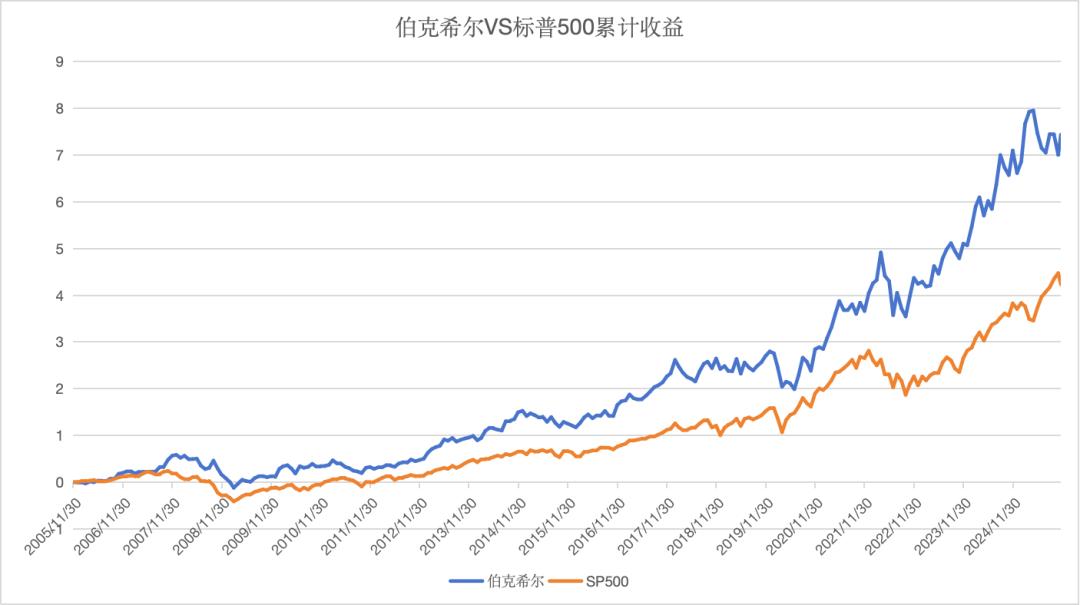
Data source: Wind Charting: 36Kr
However, on the other side of the coin, because of strictly adhering to the principle of "not investing in businesses he doesn't understand", Berkshire selectively kept its distance during the crucial early stage of the development of the technology industry, thus missing out on an explosive growth represented by the Internet.
The most well - known case is that although Buffett has a close personal relationship with Microsoft founder Bill Gates, he did not buy Microsoft stocks for a long time. Regarding Amazon, which has reshaped the retail industry, he only started investing in it in recent years from the perspective that "it has become a company that does everything", rather than getting involved in the early stage when Amazon was purely a technology company.
This adherence to the "circle of competence" has made his investment portfolio almost insulated from traditional technology giants for a long time.
The change occurred in 2016 when Berkshire began to buy Apple stocks for the first time and completed the main position - building in 2018.
This investment is widely regarded as a breakthrough by Buffett in the tradition of "not investing in technology stocks". However, it is worth noting that Buffett has explained many times that he regards Apple as an outstanding consumer goods company with strong brand loyalty and an ecosystem, rather than a pure technology enterprise.
As of the end of the second quarter of 2023, Apple's weight in his stock investment portfolio once reached as high as 51%. This is both an evolution of his investment philosophy and still based on the traditional framework of looking at companies from a consumer perspective.
$380 Billion: The Task for the Successor
Since the fourth quarter of 2023, there has been a significant change in Buffett's investment portfolio: he began to gradually reduce his holdings of Apple stocks.
According to Dataroma's data statistics, as of the end of the third quarter of 2025, Berkshire's holdings of Apple as a proportion of its stock investment portfolio have dropped from the peak of 51% to about 22.69%. This reduction in holdings has significantly reduced the concentration risk of a single stock in the investment portfolio.

Data source: Dataroma Charting: 36Kr
Meanwhile, as the world steps into the wave of artificial intelligence technology, the layout structure of Berkshire in the technology field is also being adjusted.
Although the proportion of technology stocks in its investment portfolio seemed high from 2020 - 2024 due to the heavy investment in Apple, in essence, it was a bet on the same company. After 2024, the situation has changed, and Berkshire's technology investments have begun to cover more diverse fields.
For example, in the third quarter of this year, technology giants such as Apple, Google A, and Amazon have appeared among its top ten heavily - held stocks. This trend of diversified technology investment may, to some extent, reflect that in the process of Buffett gradually handing over decision - making power, the influence of the management and investment team led by Greg Abel is increasing, and the investment perspective and scope are also expanding.
And a more symbolic change lies in the current asset allocation of Berkshire.
On the eve of the official handover, the company has been a net seller of stocks for several consecutive quarters, which has caused its reserves of cash and short - term Treasury bills to soar to a record $381.7 billion.
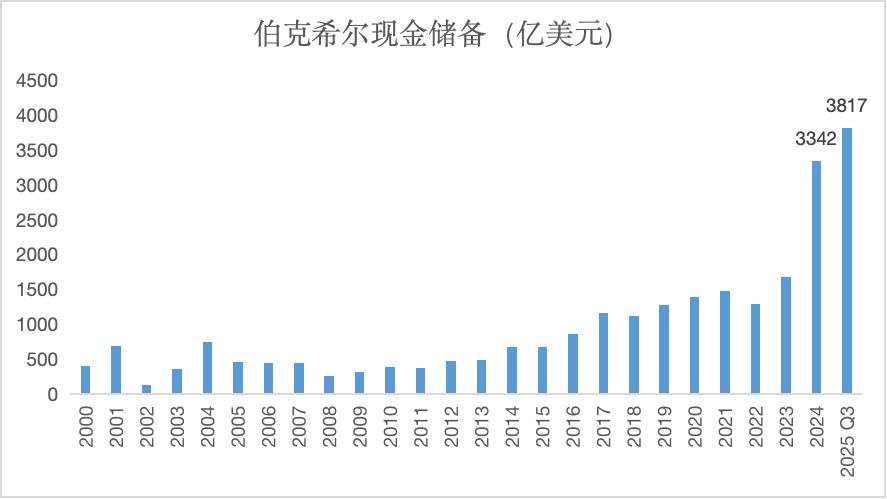
Data source: Company financial reports, Wind Charting: 36Kr
Analyzing the reasons for its cash hoarding in recent years, first of all, Buffett himself has repeatedly stated in shareholder letters that there are fewer and fewer large - scale acquisition targets in the market that meet his criteria of "reasonable price and excellent business"; secondly, the overall valuation of the U.S. stock market has been at a historical high in recent years, which has reduced his interest in large - scale stock purchases.
Moreover, reserving sufficient "ammunition" to seize opportunities in case of a possible economic recession or a significant market correction in the future is Buffett's consistent crisis - response strategy.
In addition, leaving a starting point with extremely abundant liquidity for the new management team is both a safety cushion and a test.
Currently, more than $380 billion in cash has become the core "assignment" left by Buffett to his successor. The successor, Greg Abel, not only needs to prove that he can independently operate this huge investment group after Buffett's retirement, but also needs to make correct capital allocation decisions in the new round of technological revolution led by artificial intelligence and the complex economic cycle.
The nearly 30% voting rights that Buffett retains are like a silent "insurance". This means that if the new team's strategic decisions deviate significantly from Berkshire's traditional value track or fail to achieve satisfactory long - term performance, Buffett still retains the ultimate influence.
This is both a guarantee and an invisible assessment pressure. Greg Abel and his team need to find a balance between inheritance and innovation, and win the continuous trust of this "shadow examiner" while handling the huge amount of cash.
The new helmsman needs to answer: When, in what way, and in which fields should this huge amount of cash be invested to continue creating value for shareholders in the future.
*Disclaimer:
The content of this article only represents the author's views.
The market is risky, and investment should be made with caution. In any case, the information in this article or the opinions expressed do not constitute investment advice to anyone. Before making an investment decision, if necessary, investors must consult professionals and make decisions carefully. We have no intention of providing underwriting services or any services that require specific qualifications or licenses for the parties involved in the transactions.

Follow for more information