As the resolution of mobile phones and TVs gets higher and higher, is it really necessary for human eyes?
You may have heard of "optical illusion" experiments: two balls of the same size can appear to be different sizes; an image that is actually stationary can appear to be moving. These phenomena prove that it's quite easy to deceive the eyes and the brain.
However, when it comes to "resolution", it's probably not that easy to fool the human eye.
As one of the most sensitive visual parameters of the human eye, resolution has always been the focus of technology companies. In 2010, Steve Jobs introduced the iPhone 4 with a "Retina Display" at an Apple press conference, claiming that its pixel density was so high that it exceeded the human eye's recognition limit. But this press conference didn't end the "resolution race". Even today, more than a decade later, the resolution of digital devices, from smartphones to tablets, from computers to TVs, is still being continuously refreshed.
Recently, a study found that on the resolution track, smartphone manufacturers can continue to "compete fiercely", but TV manufacturers may be able to take it easy.
Take a closer look at the 326ppi Retina Display?
The iPhone 4 back then was equipped with a 326ppi screen, meaning it had 326 pixels per inch. Apple had the confidence to call it a "Retina Display" because the human eye's limit for pixel density recognition is 300ppi, and 326ppi clearly exceeds this value.
But there's a premise, which Jobs also mentioned at the press conference: you need to hold the screen about 10 to 12 inches (about 25 - 30 centimeters) away from your eyes.
This is because this limit number changes as the distance changes. Your perception of clarity is completely different when you hold your phone close to your eyes compared to when you hold it farther away. As the distance gets closer, the human eye's limit resolution increases. For example, when you look at your phone screen up close like in the "old man on the subway looking at phone" meme, the screen that originally seemed perfectly clear may no longer seem so "flawless".

The core indicator that truly determines whether the human eye "can see clearly" is ppd - the number of pixels the human eye can distinguish within a 1 - degree field of view. In simple terms, it takes distance into account.
The previously widely - used visual standard states that the human eye's limit resolution is 60ppd, which is also the theoretical basis for the 300ppi "Retina Display".

The iPhone 4 reached 69.4ppd at a 12 - inch distance, exceeding 60ppd | phrogz.net
However, according to this new study published in Nature Communications by a team from the University of Cambridge and Meta, the human eye's discriminatory ability is far greater than this.
The human eye's limit is far more than 60ppd
The researchers invited 18 subjects with normal vision and measured their visual resolution in three color modes: black - and - white, red - green, and yellow - purple. The experiment used a self - designed 4K display device that could slide back and forth. Some subtle patterns would appear on the screen, and by adjusting the distance between the screen and the observer, the ppd value could be changed.
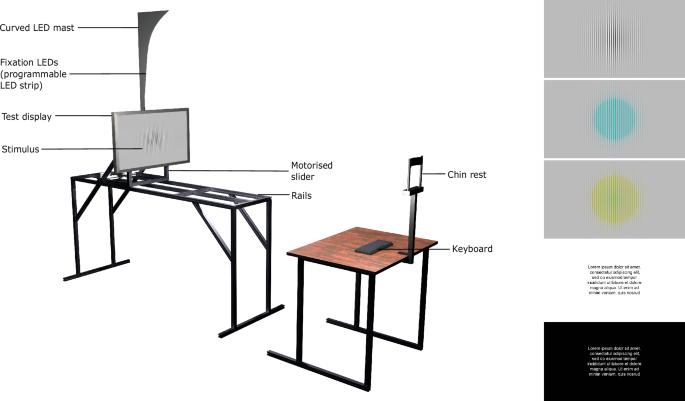
Experimental device | Reference 1
You might wonder: if you want to change the resolution, why not just adjust the image on the monitor? This is because simply adjusting the image on the monitor can't perfectly achieve a continuous change in resolution. Directly adjusting the resolution of an image on a monitor is similar to "scaling": for example, to change a 1000x1000 - pixel image to a 500x500 - pixel image, you just need to remove half of the pixels. But if you want to adjust it to a 700x700 - pixel image, you need to recalculate and process the image, and this process will cause the image to be distorted. Using a physical track allows you to continuously and seamlessly adjust the number of pixels within the field of view without changing the image itself, which is the advantage of this device.
The experimental results showed that the resolution limit of the human eye's fovea (the center of fixation) for black - and - white patterns is as high as 94ppd, 89ppd for red - green patterns, and 53ppd for yellow - purple patterns. Except for the resolution of the yellow - purple patterns, the values of the other two experiments exceeded the previously recognized limit of visual resolution.
But this result doesn't mean that "all displays have to keep competing on resolution". Further research through calculations points out that different devices have different requirements for resolution, which is related to the actual viewing distance.
For example, 8K might really be unnecessary for TVs. When watching an 8K TV, there's only a certain visual advantage when the distance from the screen is less than or equal to 1.3 times the screen height. Take a 55 - inch 8K TV as an example. Only when the viewing distance is less than or equal to 0.8 meters can you perceive the clarity advantage brought by 8K. But if you really watch TV like this, your parents might scold you soon.
But for smartphones and tablets, since they are used closer to the eyes, there's still a long way to go to reach the visual limit. For example, the researchers pointed out that for the 13 - inch iPad Pro released in 2024, when used at a distance of 35 centimeters (the shortest comfortable viewing distance), its effective resolution is 65ppd, which is still far from the human eye's limit.
Of course, this might be a bit too "strict". After all, the closer you get to the human eye's resolution limit, the more limited the improvement in visual perception. However, with the continuous development of VR and AR devices, the screens are getting closer and closer to the human eye, and there's still a lot of room for improvement in the resolution of such screens.
For example, the amazing Vision Pro has a pixel density of 3386ppi, but at the actual usage distance, its effective resolution is only 34ppd, far from the human eye's limit.
Actually, besides continuously increasing the pixel count, the paper also suggests another direction.
Sometimes it's okay to "cheat a little"
Sometimes when you buy a box of strawberries, you might be disappointed: the top layer has big, red strawberries, but when you look underneath, they're all small ones. The same logic can be applied to improving resolution: you can cheat a little in the areas where the human eye can't see clearly.
The human eye's resolution isn't uniform. The fovea (the area of fixation) has the sharpest resolution, and once you deviate from the center, the resolution drops sharply. Between the foveal vision and a 10 - degree eccentricity, the resolution limit for black - and - white patterns drops by a factor of 2.3, 4.9 times for red - green patterns, and 4.8 times for yellow - purple patterns.
This means that you can keep a high resolution in the center of the screen and appropriately "reduce the quality" in the peripheral areas, and the human eye will hardly notice. Therefore, electronic devices can refer to the data changes of different colors and use the "eccentric rendering" technology: maintain a high resolution in the center of the screen and moderately reduce the resolution in the surrounding areas, thus reducing the processor load and bandwidth consumption.
From the Retina Display of the iPhone 4 in 2010 to today's 8K TVs, the pixel competition among digital products shows no sign of ending. However, while manufacturers keep competing, as consumers, we don't have to blindly believe that "the higher the resolution, the better" when choosing devices. Just choose a suitable resolution according to your own usage scenarios.
After all, after buying a monitor, you also have to consider whether you need to subscribe to the SVIP, Platinum Membership, or Super Membership of video websites... (Otherwise, you might as well build your own NAS to watch Dolby - quality content.)
References
[1] Ashraf, M., Chapiro, A. & Mantiuk, R.K. Resolution limit of the eye — how many pixels can we see?. Nat Commun 16, 9086 (2025). https://doi.org/10.1038/s41467 - 025 - 64679 - 2
This article is from the WeChat official account "Guokr" (ID: Guokr42), written by Pras G, and is published by 36Kr with permission.